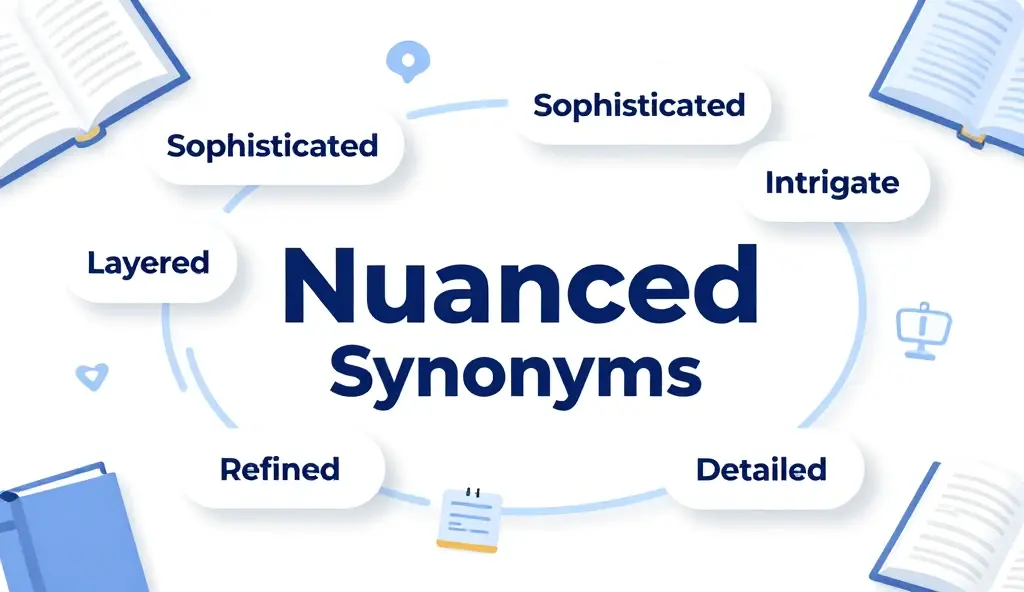
Nuanced means showing, recognizing, or containing small but important differences.
Something nuanced is not simple, flat, or divided into only two sides. It includes fine details, slight changes, mixed feelings, or several connected meanings.
Merriam-Webster defines “nuanced” as having subtle and often complex qualities, aspects, or distinctions. Cambridge explains it as being slightly different in appearance, meaning, sound, or another quality. Collins adds that something nuanced shows small but important differences. (Merriam-Webster)
Consider this sentence:
She gave a nuanced answer to the question.
This means her answer was not a simple yes or no. She may have considered different facts, exceptions, risks, and points of view.
A nuanced answer might explain:
- Why an idea works in one situation
- Why it fails in another situation
- Which facts support it
- Which facts weaken it
- How different people may see it
- Why the final answer is not simple
The word often carries a positive meaning. It suggests care, intelligence, depth, or sensitivity.
Nuanced Meaning in Simple English
In simple English, nuanced means:
Full of small but meaningful differences.
It can also mean:
- Not black and white
- Not too simple
- Rich in detail
- Carefully expressed
- Sensitive to small differences
- Showing more than one side
- Hard to explain with one basic answer
For example, imagine two people discussing whether working from home is good.
A basic answer might be:
“Working from home is good.”
A more nuanced answer might be:
“Working from home can save travel time and offer more freedom, but it may also reduce social contact and make teamwork harder for some people.”
The second answer is nuanced because it considers several sides.
Why People Search for Nuanced Synonyms
People often search for nuanced synonyms because they want a more exact word.
“Nuanced” is useful, but it can become repetitive in essays, reviews, reports, and professional writing.
A writer may need to describe:
- A detailed argument
- A sensitive performance
- A balanced opinion
- A complex character
- A refined flavor
- A thoughtful response
- A layered story
- A subtle difference
- A deep understanding
- A carefully planned approach
Each situation calls for a different alternative.
For example:
A nuanced flavor may be delicate or complex.
A nuanced political view may be balanced or carefully considered.
A nuanced character may be layered or multidimensional.
A nuanced explanation may be detailed or thoughtful.
The strongest synonym is the one that matches the noun and the intended meaning.
Pronunciation of Nuanced
The word nuanced is commonly pronounced:
American English: /ˈnuː.ɑːnst/
British English: /ˈnjuː.ɒnst/
A simple pronunciation guide is:
NOO-ahnst
or
NYOO-ahnst
Cambridge lists a slight difference between common American and British pronunciation, while Merriam-Webster records several accepted pronunciation patterns. (Merriam-Webster)
To pronounce it naturally:
- Begin with noo or nyoo.
- Move quickly into an ah sound.
- End with nst.
Say it smoothly:
NOO-ahnst
The final sound should not become a full extra syllable. Avoid saying:
“noo-AN-see-ed”
The word normally has one main stressed syllable.
Example:
“She gave a nuanced response.”
Part of Speech of Nuanced
Nuanced is mainly an adjective.
An adjective describes a noun or gives more information about it.
Examples:
- A nuanced argument
- A nuanced opinion
- A nuanced performance
- A nuanced approach
- A nuanced understanding
- A nuanced character
In each phrase, “nuanced” describes the noun that follows it.
The word comes from nuance, which is usually a noun.
A nuance is a slight but meaningful difference in meaning, tone, color, feeling, appearance, or expression. (Cambridge Dictionary)
Examples:
- She noticed a nuance in his voice.
- The translation lost several cultural nuances.
- The actor understood every nuance of the character.
“Nuance” can also be used as a verb in less common formal usage, meaning to add or express fine distinctions.
Example:
“The later evidence nuanced their understanding of the event.”
This means the evidence made their understanding more detailed and less simple.
Quick List of Nuanced Synonyms
| Synonym | Main Meaning | Best Use | Formality | Example | Difficulty |
| Subtle | Not obvious but important | Meaning, emotion, change | Neutral | The film has a subtle message. | Easy |
| Refined | Improved and carefully developed | Taste, style, method | Formal/neutral | She has a refined writing style. | Medium |
| Layered | Having several levels of meaning | Stories, characters, arguments | Neutral | The novel has a layered plot. | Easy |
| Complex | Made of connected parts | Issues, systems, emotions | Neutral | The problem is complex. | Easy |
| Balanced | Considering different sides fairly | Opinions, reports, arguments | Neutral | The article gives a balanced view. | Easy |
| Sophisticated | Advanced or highly developed | Ideas, methods, analysis | Formal | The model uses a sophisticated method. | Medium |
| Delicate | Fine, slight, or sensitive | Flavor, color, issues | Neutral | The tea has a delicate flavor. | Easy |
| Textured | Rich in varied details | Writing, music, performances | Formal/creative | The album has a textured sound. | Medium |
| Detailed | Containing many facts or parts | Reports, descriptions, plans | Neutral | She gave a detailed explanation. | Easy |
| Thoughtful | Showing careful consideration | Answers, gifts, opinions | Neutral | His response was thoughtful. | Easy |
| Discerning | Able to notice fine differences | Judgment, taste, audiences | Formal | The book appeals to discerning readers. | Medium |
| Multifaceted | Having several different sides | People, issues, problems | Formal | Poverty is a multifaceted issue. | Medium |
| Multilayered | Containing many connected levels | Stories, meanings, debates | Formal/neutral | It is a multilayered drama. | Medium |
| Intricate | Having many small connected details | Designs, systems, plots | Formal/neutral | The carpet has an intricate pattern. | Medium |
| Fine-grained | Showing very small differences | Analysis, data, research | Technical | The study offers fine-grained data. | Hard |
| Qualified | Limited by conditions or exceptions | Support, approval, claims | Formal | She gave qualified support. | Medium |
| Measured | Calm, controlled, and careful | Responses, statements | Formal | He issued a measured reply. | Medium |
| Sensitive | Aware of feelings or fine differences | Topics, portrayals, treatment | Neutral | The film offers a sensitive portrayal. | Easy |
| Perceptive | Showing deep understanding | Comments, analysis, observations | Formal/neutral | She made a perceptive comment. | Medium |
| Discriminating | Able to judge fine differences | Taste, choice, judgment | Formal | It was made for discriminating buyers. | Hard |
| Shaded | Showing slight differences or degrees | Meaning, color, opinions | Formal/creative | The issue has many shaded meanings. | Medium |
| Precise | Exact and carefully expressed | Language, measurement, analysis | Neutral | Use precise language. | Easy |
| Careful | Giving close attention | Analysis, wording, judgment | Neutral | The report makes a careful distinction. | Easy |
| Subdivided | Separated into smaller parts | Categories, analysis | Formal | The data was subdivided by age. | Medium |
| Graduated | Changing in small stages | Color, scale, response | Formal | The chart uses graduated tones. | Medium |
| Varied | Containing different types | Experiences, tones, opinions | Neutral | The class expressed varied views. | Easy |
| Rich | Full of detail or meaning | Writing, flavor, culture | Neutral | The story is rich in detail. | Easy |
| Deep | Showing serious understanding | Thought, analysis, emotion | Neutral | She has a deep understanding. | Easy |
| Insightful | Showing clear understanding | Comments, writing, analysis | Neutral | The essay is insightful. | Medium |
| Contextual | Based on surrounding conditions | Meaning, analysis, explanation | Formal | The study uses contextual evidence. | Medium |
Best Synonyms for Nuanced
The following words are among the closest synonyms for nuanced. However, they do not all carry the same meaning.
Subtle
Meaning: Present but not easy to notice.
“Subtle” is one of the closest synonyms for nuanced. It works well when a difference, message, feeling, or change is small and not immediately clear.
Example:
“The actor showed a subtle change in emotion.”
This suggests that the emotional change was quiet and controlled. The viewer had to pay attention to notice it.
Difference Between Nuanced and Subtle
“Subtle” focuses on something being difficult to notice.
“Nuanced” focuses on the presence of fine distinctions or several slight differences.
A message may be subtle because it is hidden.
An argument may be nuanced because it includes several carefully separated ideas.
Best Situations
Use “subtle” for:
- Changes
- Colors
- Flavors
- Hints
- Emotions
- Humor
- Messages
- Differences
- Expressions
Common Mistake
Do not use “subtle” when something is obvious or extreme.
Incorrect:
“The building made a subtle impact because everyone stopped to stare at it.”
Better:
“The building made a dramatic impact.”
Layered
Meaning: Having several connected levels, meanings, or qualities.
“Layered” is a strong synonym for nuanced when describing stories, characters, arguments, performances, or emotions.
Example:
“She gave a layered performance as the troubled leader.”
This means the character showed several feelings or qualities at once.
The character may appear confident but also afraid, proud but also insecure, or calm but quietly angry.
Difference Between Nuanced and Layered
“Nuanced” highlights small distinctions.
“Layered” highlights several levels that build on one another.
A discussion can be both nuanced and layered.
Best Situations
Use “layered” for:
- Fictional characters
- Novels
- Films
- Performances
- Arguments
- Emotions
- Music
- Historical accounts
Common Mistake
Do not use “layered” for every detailed object. It sounds most natural when there are clear levels of meaning, feeling, sound, or structure.
Refined
Meaning: Carefully developed, improved, polished, or made more exact.
“Refined” works well when nuanced means elegant, controlled, or carefully adjusted.
Example:
“The chef created a refined balance of sweet and sour flavors.”
Difference Between Nuanced and Refined
“Nuanced” means rich in fine distinctions.
“Refined” suggests that something has been improved through care, skill, or experience.
A refined argument is polished and carefully expressed. It may also be nuanced, but the words are not exact matches.
Best Situations
Use “refined” for:
- Style
- Taste
- Methods
- Language
- Design
- Skills
- Manners
- Analysis
- Techniques
Common Mistake
“Refined” can also suggest social elegance or high-class taste. Make sure that meaning fits the sentence.
Complex
Meaning: Containing many connected parts and not easy to understand.
“Complex” is a broad synonym for nuanced. It works when a topic has many causes, effects, viewpoints, or details.
Example:
“The causes of migration are complex.”
Difference Between Nuanced and Complex
Something complex has many parts.
Something nuanced has small but important distinctions.
A problem can be complex without being presented in a nuanced way. For example, a difficult issue may receive an overly simple explanation.
Best Situations
Use “complex” for:
- Social problems
- Systems
- Relationships
- Emotions
- Scientific questions
- Legal cases
- Historical events
- Decisions
Common Mistake
“Complex” can sometimes sound negative, suggesting difficulty or confusion. “Nuanced” often sounds more positive because it suggests careful understanding.
Balanced
Meaning: Giving fair attention to more than one side.
“Balanced” is a strong replacement for nuanced when discussing opinions, reporting, arguments, or analysis.
Example:
“The report offers a balanced view of the policy.”
Difference Between Nuanced and Balanced
A balanced discussion includes different viewpoints fairly.
A nuanced discussion notices fine details within those viewpoints.
A report can be balanced but still lack depth. It can mention both sides without examining the details.
Best Situations
Use “balanced” for:
- News reports
- Arguments
- Essays
- Reviews
- Opinions
- Debates
- Judgments
- Evaluations
Common Mistake
Balanced does not mean that every side must receive equal support. It means the writer considers relevant evidence fairly.
Sophisticated
Meaning: Advanced, highly developed, or showing deep understanding.
“Sophisticated” works when nuanced describes an advanced idea, analysis, method, or interpretation.
Example:
“The researchers used a sophisticated model to study climate patterns.”
Difference Between Nuanced and Sophisticated
“Nuanced” focuses on fine differences.
“Sophisticated” focuses on development, complexity, or advanced skill.
A sophisticated explanation may use advanced ideas but still fail to recognize an important nuance.
Best Situations
Use “sophisticated” for:
- Analysis
- Technology
- Models
- Arguments
- Methods
- Art
- Design
- Audiences
Common Mistake
Do not use “sophisticated” merely to make writing sound impressive. The subject should actually be advanced, polished, or highly developed.
Delicate
Meaning: Fine, slight, gentle, or requiring careful handling.
“Delicate” can replace nuanced when discussing fine flavors, colors, emotions, or sensitive matters.
Example:
“The perfume has a delicate floral scent.”
Difference Between Nuanced and Delicate
“Delicate” emphasizes softness, lightness, or sensitivity.
“Nuanced” emphasizes small distinctions.
A delicate flavor is gentle. A nuanced flavor may contain several slight notes that become clear over time.
Best Situations
Use “delicate” for:
- Flavors
- Scents
- Colors
- Emotions
- Negotiations
- Relationships
- Health issues
- Artistic details
Common Mistake
“Delicate” can also mean physically weak or easy to damage. Context must make the intended meaning clear.
Textured
Meaning: Rich in varied details, tones, sounds, or qualities.
“Textured” is often used in literary, musical, artistic, and critical writing.
Example:
“The novel presents a textured picture of city life.”
Difference Between Nuanced and Textured
“Nuanced” focuses on fine distinctions.
“Textured” suggests richness created by many varied details.
A textured description may include sights, sounds, memories, and social differences.
Best Situations
Use “textured” for:
- Writing
- Music
- Art
- Performances
- Cultural descriptions
- Historical accounts
- Film criticism
Common Mistake
Outside creative or critical writing, “textured” may first suggest a physical surface. Make sure the figurative meaning is clear.
Multifaceted
Meaning: Having many different sides, features, or parts.
“Multifaceted” is useful when nuanced describes an issue, person, or problem with several dimensions.
Example:
“Unemployment is a multifaceted problem.”
It may involve education, location, health, technology, economic policy, and personal circumstances.
Difference Between Nuanced and Multifaceted
“Multifaceted” emphasizes the number of different sides.
“Nuanced” emphasizes the slight distinctions within or between those sides.
Best Situations
Use “multifaceted” for:
- Social issues
- Personalities
- Problems
- Careers
- Historical events
- Identities
- Research topics
Common Mistake
Avoid using “multifaceted” for a basic issue with only one or two clear parts.
Thoughtful
Meaning: Showing careful consideration.
“Thoughtful” works when a nuanced response, answer, or opinion is careful and considerate.
Example:
“She offered a thoughtful response to the criticism.”
Difference Between Nuanced and Thoughtful
A thoughtful response shows care.
A nuanced response shows fine distinctions.
A response can be thoughtful but simple. It can also be nuanced without being kind.
Best Situations
Use “thoughtful” for:
- Answers
- Comments
- Advice
- Reviews
- Decisions
- Gestures
- Gifts
- Opinions
Common Mistake
“Thoughtful” also means caring toward another person.
- A thoughtful analysis is carefully considered.
- A thoughtful gift shows care.
Perceptive
Meaning: Showing an ability to notice and understand things quickly or deeply.
“Perceptive” is a useful nuanced synonym for observations, comments, critics, readers, and analyses.
Example:
“Her perceptive review identified the novel’s hidden conflict.”
Difference Between Nuanced and Perceptive
“Perceptive” describes strong understanding or observation.
“Nuanced” describes the fine distinctions in the result.
A person may be perceptive enough to notice nuance.
Best Situations
Use “perceptive” for:
- People
- Observations
- Comments
- Reviews
- Analysis
- Questions
- Criticism
Common Mistake
“Perceptive” usually describes intelligence or insight, not the physical amount of detail in an object.
Discerning
Meaning: Able to recognize small differences in quality, value, or meaning.
“Discerning” often describes people, judgment, taste, or audiences.
Example:
“The restaurant attracts discerning diners.”
Difference Between Nuanced and Discerning
A nuanced work contains fine distinctions.
A discerning person can notice and judge those distinctions.
Best Situations
Use “discerning” for:
- Readers
- Buyers
- Audiences
- Critics
- Taste
- Judgment
- Consumers
Common Mistake
Do not use “discerning” as a direct replacement for every use of nuanced.
Incorrect:
“The report provides a discerning explanation.”
Better:
“The report provides a nuanced explanation.”
Or:
“The writer shows discerning judgment.”
Detailed
Meaning: Containing many facts, features, or pieces of information.
“Detailed” is a simple alternative when nuanced means carefully explained.
Example:
“The witness gave a detailed account of the event.”
Difference Between Nuanced and Detailed
A detailed explanation contains a lot of information.
A nuanced explanation identifies fine or meaningful differences.
A long explanation can be detailed but not nuanced if it treats every issue too simply.
Best Situations
Use “detailed” for:
- Reports
- Plans
- Instructions
- Accounts
- Descriptions
- Maps
- Records
- Explanations
Common Mistake
Do not assume that more detail always creates better understanding. Details should be relevant and organized.
Fine-Grained
Meaning: Showing very small divisions or highly specific differences.
“Fine-grained” is common in technical, scientific, business, and data-related writing.
Example:
“The survey provides a fine-grained analysis of voting behavior.”
Difference Between Nuanced and Fine-Grained
“Fine-grained” focuses on the level of detail.
“Nuanced” focuses on interpretation and meaningful distinctions.
Best Situations
Use “fine-grained” for:
- Data
- Research
- Categories
- Analysis
- Measurements
- Models
- Statistics
- Comparisons
Common Mistake
It may sound too technical for casual conversation.
Casual:
“She understands the issue in great detail.”
Technical:
“She provides a fine-grained analysis of the issue.”
Measured
Meaning: Calm, controlled, and carefully judged.
“Measured” is a useful synonym for nuanced when discussing a reply, statement, tone, reaction, or decision.
Example:
“The minister gave a measured response.”
Difference Between Nuanced and Measured
A measured response avoids extreme language or emotion.
A nuanced response recognizes fine distinctions.
A reply can be measured but not especially detailed.
Best Situations
Use “measured” for:
- Statements
- Responses
- Reactions
- Criticism
- Tone
- Leadership
- Decisions
Common Mistake
Do not confuse “measured” with physically calculated size, although the word can also have that meaning.
Qualified
Meaning: Limited by conditions, exceptions, or concerns.
“Qualified” can replace nuanced when support, approval, praise, or agreement is not complete.
Example:
“The committee gave qualified support to the plan.”
This means the committee supported the plan but had conditions or concerns.
Difference Between Nuanced and Qualified
“Qualified” signals limits or exceptions.
“Nuanced” may include limits, but it can also involve several shades of meaning without direct disagreement.
Best Situations
Use “qualified” for:
- Support
- Approval
- Agreement
- Praise
- Claims
- Conclusions
- Recommendations
Common Mistake
“Qualified” also means having the training or legal ability to do a job.
- A qualified nurse
- Qualified support
These meanings are different.
Synonyms for Nuanced by Context
Different nouns call for different alternatives.
Synonyms for a Nuanced Argument
A nuanced argument explores fine distinctions and avoids an overly simple position.
Useful alternatives include:
- Balanced argument
- Carefully reasoned argument
- Sophisticated argument
- Layered argument
- Qualified argument
- Detailed argument
- Complex argument
- Thoughtful argument
- Well-developed argument
- Fine-grained argument
Example:
Original:
“The author makes a nuanced argument about education.”
Alternative:
“The author makes a carefully reasoned argument that considers both access and teaching quality.”
Synonyms for a Nuanced Understanding
A nuanced understanding recognizes details, exceptions, causes, and different viewpoints.
Useful alternatives include:
- Deep understanding
- Sophisticated understanding
- Detailed understanding
- Refined understanding
- Contextual understanding
- Perceptive understanding
- Mature understanding
- Well-developed understanding
- Fine-grained understanding
- Multidimensional understanding
Example:
“She has a nuanced understanding of workplace conflict.”
This may become:
“She has a deep and context-sensitive understanding of workplace conflict.”
Synonyms for a Nuanced Approach
A nuanced approach changes according to context instead of using one rule for every case.
Useful alternatives include:
- Flexible approach
- Balanced approach
- Tailored approach
- Sensitive approach
- Thoughtful approach
- Refined approach
- Context-based approach
- Carefully judged approach
- Sophisticated approach
- Case-by-case approach
Example:
“The teacher used a nuanced approach with struggling students.”
Alternative:
“The teacher used a flexible approach based on each student’s needs.”
Synonyms for a Nuanced Opinion
A nuanced opinion recognizes that an issue may have strengths, weaknesses, limits, and exceptions.
Useful alternatives include:
- Balanced opinion
- Considered opinion
- Thoughtful opinion
- Qualified opinion
- Informed opinion
- Measured opinion
- Carefully formed opinion
- Sophisticated view
- Context-sensitive view
- Even-handed view
Example:
“His opinion on social media is nuanced.”
Alternative:
“His view of social media is balanced and considers both its benefits and risks.”
Synonyms for a Nuanced Analysis
Useful alternatives include:
- Detailed analysis
- Fine-grained analysis
- Sophisticated analysis
- Multilayered analysis
- Contextual analysis
- Careful analysis
- Perceptive analysis
- In-depth analysis
- Discriminating analysis
- Thorough interpretation
Example:
“The paper provides a nuanced analysis of income inequality.”
Alternative:
“The paper provides a fine-grained analysis of how income inequality differs by age, location, and education.”
Synonyms for a Nuanced Character
A nuanced character feels human because they have mixed traits, changing emotions, and believable motives.
Useful alternatives include:
- Layered character
- Complex character
- Multidimensional character
- Fully developed character
- Richly drawn character
- Well-rounded character
- Complicated character
- Textured character
- Deep character
- Psychologically complex character
Example:
“The series presents a nuanced villain.”
Alternative:
“The series presents a layered villain whose fear and pride shape his actions.”
Synonyms for a Nuanced Performance
A nuanced performance shows small changes in emotion, voice, movement, or expression.
Useful alternatives include:
- Subtle performance
- Layered performance
- Sensitive performance
- Controlled performance
- Refined performance
- Expressive performance
- Textured performance
- Understated performance
- Emotionally detailed performance
- Carefully judged performance
Example:
“She delivered a nuanced performance.”
Alternative:
“She delivered a subtle performance built on small changes in tone and expression.”
Synonyms for Nuanced Writing
Nuanced writing avoids broad claims and gives readers enough context to understand exceptions and different meanings.
Useful alternatives include:
- Subtle writing
- Layered writing
- Sophisticated writing
- Thoughtful writing
- Refined writing
- Rich writing
- Textured prose
- Carefully qualified writing
- Detailed writing
- Perceptive writing
Example:
“The book is known for its nuanced writing.”
Alternative:
“The book is known for its layered prose and careful treatment of moral conflict.”
Synonyms for a Nuanced View
Useful alternatives include:
- Balanced view
- Informed view
- Sophisticated view
- Thoughtful perspective
- Measured perspective
- Contextual view
- Multidimensional view
- Qualified position
- Even-handed perspective
- Carefully considered position
Antonyms of Nuanced
| Antonym | Meaning | Best Use | Example |
| Simplistic | Too simple for a complex issue | Arguments, explanations | The article gives a simplistic answer. |
| Crude | Lacking care or fine detail | Methods, humor, portrayals | The model offers a crude estimate. |
| Blunt | Direct and lacking subtlety | Speech, criticism | His reply was blunt. |
| Obvious | Easy to notice or understand | Meanings, changes | The message was obvious. |
| Superficial | Concerned only with the surface | Analysis, knowledge | The report is superficial. |
| One-sided | Supporting only one position | Arguments, reports | The documentary felt one-sided. |
| Black-and-white | Treating an issue as only two choices | Thinking, judgments | The debate is not black-and-white. |
| Unsubtle | Lacking fine expression | Performances, messages | The joke was unsubtle. |
| Unrefined | Not polished or improved | Style, methods | The early design was unrefined. |
| Flat | Lacking depth or variety | Characters, performances | The main character felt flat. |
| Basic | Simple or not advanced | Explanations, methods | The guide offers only a basic summary. |
| Generalized | Broad rather than specific | Claims, analysis | The conclusion is too generalized. |
| Heavy-handed | Too forceful or obvious | Messages, storytelling | The film’s message felt heavy-handed. |
| Oversimplified | Made simpler than the facts allow | Accounts, arguments | The history was oversimplified. |
| Unqualified | Expressed without limits or exceptions | Support, claims | He gave unqualified support. |
| Absolute | Allowing no limits or middle position | Claims, judgments | The writer makes an absolute claim. |
| Coarse | Lacking fine detail or sensitivity | Language, distinctions | The categories are too coarse. |
| Insensitive | Failing to consider feelings or context | Treatment, comments | The remark was insensitive. |
Simplistic
“Simplistic” is one of the clearest opposites of nuanced.
It means treating a difficult issue as if it were much simpler than it really is.
Example:
“Saying that poverty results only from bad choices is simplistic.”
The statement ignores education, health, employment, family conditions, location, and economic policy.
“Simplistic” is usually negative. It does not mean clear or easy to understand. It means too simple.
Superficial
“Superficial” means dealing only with the most obvious parts of a topic.
Example:
“The article gives a superficial account of the conflict.”
A superficial account may name the major events but fail to explain causes, motives, or consequences.
The opposite would be:
- In-depth
- Perceptive
- Detailed
- Nuanced
- Thorough
One-Sided
“One-sided” means presenting only one position or favoring one group without fairly considering other evidence.
Example:
“The report offers a one-sided view of the dispute.”
A nuanced report may still reach a clear conclusion, but it will usually address relevant objections and opposing evidence.
Heavy-Handed
“Heavy-handed” means too forceful, obvious, or lacking subtlety.
It is often used for:
- Political messages
- Moral lessons
- Film direction
- Advertising
- Criticism
- Management
Example:
“The film’s message about greed was too heavy-handed.”
The message may have been repeated so clearly that the audience had no room to interpret it.
Flat
“Flat” is an antonym of nuanced when describing characters, stories, performances, or writing.
Example:
“The supporting characters felt flat.”
A flat character has little depth, growth, conflict, or individuality.
A nuanced character has several believable qualities and may act differently under different pressures.
30 Real-World Examples of Nuanced and Its Synonyms
- The professor gave a nuanced explanation of the causes of the war.
- Her review offered a balanced assessment of the new phone.
- The actor delivered a subtle performance that relied on facial expression.
- The novel has a layered story about love, loyalty, and ambition.
- The report provides a fine-grained analysis of regional voting patterns.
- His answer was thoughtful rather than rushed.
- The chef created a delicate balance of spice and sweetness.
- The documentary presents a multifaceted view of city life.
- She has a sophisticated understanding of international trade.
- The manager gave a measured response to the complaint.
- The historian offered a careful interpretation of the letters.
- Her character is complex but still believable.
- The research gives a detailed account of changes in rainfall.
- The perfume has a subtle citrus note.
- The article takes a context-sensitive approach to school discipline.
- He gave qualified support to the proposal.
- The artist used graduated shades of blue and gray.
- Her speech included a perceptive observation about loneliness.
- The policy requires a tailored approach in rural areas.
- The discussion was balanced and well informed.
- The book offers a richly textured picture of family life.
- His criticism was precise without being cruel.
- The customer’s needs require a case-by-case response.
- The study presents a multilayered explanation of migration.
- She made a careful distinction between equality and fairness.
- The musician gave the song an understated emotional quality.
- The judge issued a carefully reasoned decision.
- The wine has a complex flavor with light fruit and wood notes.
- The writer avoids black-and-white claims about success.
- The therapist showed a sensitive understanding of the family’s concerns.
25 Sentences Using Nuanced Synonyms
- Her subtle humor is easy to miss at first.
- The report offers a balanced view of the proposed law.
- He gave a carefully qualified answer.
- The novel contains a layered discussion of grief.
- This is a complex problem with no quick solution.
- The museum created a detailed record of the collection.
- Her comments were both perceptive and practical.
- The company adopted a flexible approach to remote work.
- The actor’s understated performance felt honest.
- The tea has a delicate floral taste.
- The study provides a fine-grained view of local housing costs.
- His judgment was calm and measured.
- The essay presents a sophisticated moral argument.
- The policy requires a contextual reading of each case.
- She has a deep understanding of childhood development.
- The film gives us a multifaceted lead character.
- The speaker made a careful distinction between intent and effect.
- The music has a rich and textured sound.
- The article takes an even-handed position.
- His support was qualified by concerns about cost.
- The new evidence produced a more refined explanation.
- Her response showed thoughtful consideration of both sides.
- The painting contains subtle variations in light.
- The researchers used a precise set of categories.
- The critic offered an insightful interpretation of the final scene.
Formal vs. Informal Synonyms for Nuanced
| Informal Expression | Formal Alternative | Example |
| Not so simple | Complex | The issue is more complex than it appears. |
| Has many sides | Multifaceted | The problem is multifaceted. |
| Looks at both sides | Balanced | The report provides a balanced account. |
| Full of detail | Fine-grained | The paper offers a fine-grained analysis. |
| Carefully thought out | Well considered | The proposal is well considered. |
| Has deeper meaning | Layered | The novel has a layered meaning. |
| Picks up small details | Perceptive | Her analysis is highly perceptive. |
| Changes with the situation | Context-sensitive | The policy should be context-sensitive. |
| Not black and white | Qualified | The conclusion is carefully qualified. |
| Calm and careful | Measured | The director gave a measured response. |
Informal Usage
In daily conversation, you can explain nuanced ideas with simple phrases:
- It is not that simple.
- There is more to it.
- It depends on the situation.
- There are several sides.
- The answer is not black and white.
- Small details matter.
- It is a mixed picture.
- Both things can be true.
Example:
“The issue is nuanced.”
More conversational:
“The issue is not as simple as it first looks.”
Formal Usage
In formal writing, useful choices include:
- Multifaceted
- Fine-grained
- Context-sensitive
- Qualified
- Sophisticated
- Carefully differentiated
- Multidimensional
- Refined
- Perceptive
- Even-handed
Example:
Informal:
“The problem has a lot of different sides.”
Formal:
“The problem is multifaceted and requires a context-sensitive response.”
Academic Usage of Nuanced Synonyms
“Nuanced” is common in academic writing because research often deals with conditions, limits, variation, and uncertainty.
However, repeating the word in every paragraph can weaken the writing.
Instead of:
“The study gives a nuanced analysis. It also gives a nuanced explanation of the results and a nuanced view of policy.”
Write:
“The study provides a fine-grained analysis of the data. It offers a context-sensitive explanation of the results and a balanced assessment of the policy options.”
Useful Academic Alternatives
| Basic Phrase | Academic Alternative |
| Nuanced analysis | Fine-grained analysis |
| Nuanced understanding | Sophisticated understanding |
| Nuanced approach | Context-sensitive approach |
| Nuanced argument | Carefully qualified argument |
| Nuanced view | Multidimensional perspective |
| Nuanced explanation | Detailed interpretation |
| Nuanced reading | Close reading |
| Nuanced result | Differentiated finding |
| Nuanced response | Measured response |
| Nuanced differences | Subtle distinctions |
| Nuanced categories | Fine-grained categories |
| Nuanced discussion | Balanced discussion |
| Nuanced account | Multilayered account |
| Nuanced judgment | Discriminating judgment |
| Nuanced conclusion | Qualified conclusion |
Academic Examples
Weak:
“The results were nuanced.”
Stronger:
“The results varied by age, income, and location.”
Weak:
“The author gives a nuanced argument.”
Stronger:
“The author develops a carefully qualified argument that addresses both economic benefits and social costs.”
Weak:
“The study takes a nuanced approach.”
Stronger:
“The study uses a context-sensitive approach that separates short-term effects from long-term outcomes.”
The strongest academic writing often shows nuance instead of merely labeling something nuanced.
Nuanced in Daily Conversation
Although “nuanced” is common in educated and professional speech, it may sound slightly formal in very casual conversation.
Natural examples include:
- That is a nuanced issue.
- Her opinion is more nuanced than mine.
- The answer requires a nuanced discussion.
- His view has become more nuanced.
- The movie gives a nuanced picture of marriage.
Simpler alternatives include:
- It is complicated.
- There are two sides to it.
- It depends.
- The answer is not simple.
- There are a lot of small differences.
- We need to look at the full picture.
- It is not just right or wrong.
Example Conversation
A: Do you think social media is harmful?
B: I think the answer is nuanced. It can harm sleep and attention, but it also helps people stay connected and find useful information.
A more informal reply would be:
“I think it depends. There are benefits, but there are real problems too.”
Grammar Tips for Using Nuanced
Use Nuanced Before a Noun
“Nuanced” often appears directly before a noun.
Correct:
- A nuanced argument
- A nuanced response
- A nuanced portrayal
- A nuanced interpretation
- A nuanced discussion
Example:
“The book offers a nuanced account of the crisis.”
Use Nuanced After a Linking Verb
It can also appear after verbs such as:
- Be
- Seem
- Become
- Remain
- Feel
- Appear
Examples:
- Her opinion is nuanced.
- The debate became more nuanced.
- His position seems nuanced.
- The final answer remains nuanced.
More Nuanced and Most Nuanced
“Nuanced” normally forms comparisons with more and most.
Correct:
- More nuanced
- Most nuanced
Examples:
- Her second answer was more nuanced.
- This is the most nuanced account of the event.
Avoid:
- Nuanceder
- Nuancedest
Highly Nuanced
“Highly nuanced” means containing many fine distinctions.
Example:
“The law requires a highly nuanced interpretation.”
Other natural modifiers include:
- Deeply nuanced
- Carefully nuanced
- Richly nuanced
- Increasingly nuanced
- Politically nuanced
- Emotionally nuanced
- Culturally nuanced
Nuanced vs. Nuance
Use nuanced as an adjective:
“The discussion was nuanced.”
Use nuance as a noun:
“The discussion lacked nuance.”
Compare:
- She gave a nuanced answer.
- Her answer showed nuance.
Avoid Redundant Phrases
“Subtly nuanced” may sometimes be acceptable, but it can sound repetitive because nuance already suggests subtlety.
Instead of:
“A subtly nuanced difference”
Write:
“A subtle difference”
or:
“A nuanced distinction”
Common Collocations With Nuanced
Nuanced Understanding
A detailed understanding that recognizes small differences and exceptions.
Example:
“She has a nuanced understanding of cultural identity.”
Nuanced Approach
A method that changes according to context.
Example:
“The issue requires a nuanced approach.”
Nuanced Analysis
An examination that separates fine details and different causes.
Example:
“The report provides a nuanced analysis of the market.”
Nuanced Argument
An argument that avoids simple claims and includes qualifications.
Example:
“The author presents a nuanced argument about personal freedom.”
Nuanced View
A position that recognizes more than one side.
Example:
“He has a nuanced view of economic growth.”
Nuanced Perspective
A way of thinking that includes context and fine distinctions.
Example:
“Her experience gave her a nuanced perspective on migration.”
Nuanced Response
A careful answer that fits a complex situation.
Example:
“The question deserves a nuanced response.”
Nuanced Discussion
A conversation that explores different meanings, causes, or viewpoints.
Example:
“The class had a nuanced discussion about privacy.”
Nuanced Portrayal
A detailed and believable representation of a person or issue.
Example:
“The film offers a nuanced portrayal of grief.”
Nuanced Performance
A performance with small and controlled emotional details.
Example:
“The lead actor gave a nuanced performance.”
Nuanced Interpretation
An explanation that recognizes fine distinctions.
Example:
“The critic offered a nuanced interpretation of the poem.”
Nuanced Position
An opinion that includes conditions or exceptions.
Example:
“Her position on the proposal is nuanced.”
Nuanced Character
A fictional person with depth, mixed motives, and several qualities.
Example:
“The writer created a nuanced main character.”
Nuanced Meaning
A meaning shaped by subtle differences in context or tone.
Example:
“The phrase has a nuanced meaning in legal writing.”
Nuanced Language
Words chosen carefully to express fine differences.
Example:
“Diplomatic talks often require nuanced language.”
Phrases Related to Nuance
Shades of Meaning
Meaning: Slight differences in what words or statements express.
Example:
“Translators must understand different shades of meaning.”
Shades of Gray
Meaning: Positions between two extreme choices.
Example:
“Real life contains many shades of gray.”
Read Between the Lines
Meaning: Find an indirect or hidden meaning.
Example:
“You need to read between the lines to understand her concern.”
A Fine Distinction
Meaning: A small but important difference.
Example:
“The law makes a fine distinction between error and fraud.”
Split Hairs
Meaning: Focus too much on tiny differences, often unnecessarily.
Example:
“We are splitting hairs over two nearly identical terms.”
This phrase is usually negative. Nuance is useful when the difference matters. Hair-splitting focuses on differences that may not matter.
Not Black and White
Meaning: Not simple or divided into only two clear choices.
Example:
“The question of responsibility is not black and white.”
A Matter of Degree
Meaning: A difference in amount rather than an absolute difference.
Example:
“Confidence and pride may be a matter of degree.”
The Full Picture
Meaning: All the facts and surrounding details.
Example:
“We need the full picture before making a decision.”
Two Sides of the Same Coin
Meaning: Two connected parts of one issue.
Example:
“Freedom and responsibility are two sides of the same coin.”
The Devil Is in the Details
Meaning: Small details may create major problems or differences.
Example:
“The plan looks simple, but the devil is in the details.”
Similar Words Compared
| Word | Meaning | Main Difference | Example |
| Nuanced | Containing fine distinctions | Focuses on subtle differences | She gave a nuanced answer. |
| Subtle | Hard to notice | Focuses on low visibility | There was a subtle change in tone. |
| Complex | Having many connected parts | Focuses on difficulty or structure | The system is complex. |
| Detailed | Containing much information | Focuses on amount of detail | He wrote a detailed report. |
| Balanced | Fair to different sides | Focuses on fairness | The article is balanced. |
| Sophisticated | Advanced or developed | Focuses on high-level skill | It is a sophisticated model. |
| Layered | Having several levels | Focuses on depth or levels | The story is layered. |
| Refined | Polished or improved | Focuses on development | She uses a refined method. |
| Sensitive | Aware of feelings or fine changes | Focuses on care or awareness | It was a sensitive portrayal. |
| Qualified | Limited by conditions | Focuses on exceptions | He gave qualified approval. |
| Perceptive | Showing strong insight | Focuses on understanding | She made a perceptive comment. |
| Intricate | Having many small connected parts | Focuses on structure | The design is intricate. |
Nuanced vs. Subtle
“Nuanced” and “subtle” are close, but they are not always interchangeable.
Subtle means difficult to notice.
Nuanced means containing fine distinctions.
Examples:
“The sauce has a subtle garlic flavor.”
The garlic is light and not obvious.
“The sauce has a nuanced flavor.”
The sauce contains several delicate flavors that work together.
A subtle difference may be one small difference. A nuanced discussion may contain many subtle differences.
Nuanced vs. Complex
“Complex” means made of many connected parts.
“Nuanced” means showing small but meaningful distinctions.
Example:
“The tax system is complex.”
This means it has many rules and connected parts.
“The debate about tax fairness is nuanced.”
This means the debate involves different definitions, effects, values, and exceptions.
Complexity can create confusion. Nuance often suggests careful understanding.
Nuanced vs. Detailed
A detailed description contains many facts.
A nuanced description uses details to show important differences.
Example:
“The report gives a detailed list of household expenses.”
It may include many numbers.
“The report gives a nuanced explanation of why expenses differ between households.”
It interprets the differences.
Detail concerns quantity. Nuance concerns meaning.
Nuanced vs. Balanced
A balanced account considers different sides fairly.
A nuanced account examines fine differences within those sides.
Example:
“The article is balanced because it includes supporters and critics.”
“The article is nuanced because it separates short-term benefits from long-term risks.”
Good writing can be both balanced and nuanced.
Nuanced vs. Sophisticated
“Sophisticated” means advanced, developed, or highly skilled.
“Nuanced” means sensitive to small distinctions.
A sophisticated computer system may use advanced technology.
A nuanced evaluation of that system may explain where it performs well, where it fails, and which users benefit most.
One word describes the level of development. The other describes the quality of interpretation.
Nuanced vs. Qualified
A qualified statement includes limits, conditions, or exceptions.
A nuanced statement may include qualifications, but it can also include several levels of meaning.
Example:
Qualified:
“The plan may work if funding remains stable.”
Nuanced:
“The plan may improve access in cities, but rural success will depend on transport, staffing, and local funding.”
The nuanced statement gives a fuller picture.
How to Choose the Right Nuanced Synonym
Step 1: Identify the Noun
What are you describing?
- Argument
- Performance
- Flavor
- Person
- Analysis
- Issue
- Answer
- Method
- Story
- Opinion
Step 2: Decide What Kind of Nuance You Mean
Ask:
- Is it hard to notice?
- Does it have many layers?
- Does it consider both sides?
- Is it highly detailed?
- Is it sensitive to context?
- Is it calm and controlled?
- Does it contain conditions?
- Is it advanced?
- Is it rich in meaning?
Step 3: Match the Word
Use:
- Subtle for something hard to notice
- Layered for several levels of meaning
- Balanced for fair treatment of different sides
- Fine-grained for highly specific analysis
- Measured for a calm response
- Qualified for conditional support
- Sophisticated for advanced ideas
- Sensitive for careful treatment
- Multifaceted for many different sides
- Refined for something polished
Step 4: Check the Tone
“Fine-grained” fits research but may sound technical in casual conversation.
“Not so simple” works well in speech but may sound too informal in an academic report.
Step 5: Show the Nuance
Instead of only writing:
“The situation is nuanced.”
Explain why:
“The change helped large businesses reduce costs, but smaller firms struggled with the new reporting rules.”
That sentence demonstrates nuance.
Common Mistakes With Nuanced Synonyms
Using Nuanced as a Fancy Word for Good
“Nuanced” does not simply mean impressive or intelligent.
Incorrect:
“She bought a nuanced laptop.”
Better:
“She bought a sophisticated laptop.”
A laptop is not usually nuanced unless you are describing its design, controls, or performance in a highly specific way.
Calling Every Difficult Issue Nuanced
Some issues are complicated because they contain many parts. That does not automatically mean they are nuanced.
Use “complex” when difficulty is the main point.
Use “nuanced” when fine distinctions are the main point.
Using Detailed and Nuanced as Exact Synonyms
Details do not always create nuance.
A report can contain 100 facts but still reach an overly simple conclusion.
Overusing the Word
Repeated use may sound vague:
“The nuanced book gives a nuanced view through nuanced characters.”
Better:
“The layered novel offers a balanced view through psychologically complex characters.”
Failing to Explain the Nuance
Do not use “nuanced” as a substitute for evidence.
Weak:
“The issue is nuanced.”
Stronger:
“The policy lowers costs for large employers but may place a heavier burden on small firms.”
Expert Tips for Better Word Choice
Use a Synonym That Matches the Noun
Natural combinations include:
- Subtle difference
- Layered character
- Balanced report
- Fine-grained analysis
- Sophisticated argument
- Delicate flavor
- Measured response
- Qualified support
- Perceptive observation
- Multifaceted problem
Replace Labels With Evidence
Instead of saying an argument is nuanced, show its parts.
Weak:
“She gives a nuanced view of tourism.”
Stronger:
“She explains how tourism creates jobs while raising housing costs and placing pressure on local water supplies.”
Avoid False Balance
A nuanced discussion does not pretend that every claim has equal evidence.
You can recognize different views while still explaining why one position is better supported.
Use Specific Qualifiers
Useful qualifiers include:
- In some cases
- Under certain conditions
- To a limited extent
- In the short term
- For smaller groups
- Depending on context
- Although
- However
- At the same time
- On the other hand
These phrases help express nuance clearly.
Distinguish Complexity From Confusion
Good nuanced writing makes a complicated issue clearer.
It should not make a simple idea sound unnecessarily difficult.
Keep the Main Point Visible
A nuanced answer can still be direct.
Start with the main conclusion, then explain limits and exceptions.
Example:
“Remote work is effective for many knowledge-based roles, but its success depends on communication tools, home conditions, and the need for in-person teamwork.”
Frequently Asked Questions About Nuanced Synonyms
Q1 .What Are the Best Synonyms for Nuanced?
A: The best synonyms for nuanced include subtle, layered, refined, balanced, complex, sophisticated, delicate, textured, multifaceted, and thoughtful. The best choice depends on context. Use “subtle” for a slight difference, “layered” for a story with several meanings, “balanced” for a fair argument, and “fine-grained” for detailed academic analysis.
Q2 .What Is Another Word for Nuanced?
A: Another word for nuanced may be subtle, complex, refined, or multifaceted. No one word works in every sentence. A nuanced performance may be “understated,” while a nuanced opinion may be “balanced.” A nuanced understanding may be “deep” or “sophisticated.” First decide what kind of detail or distinction you want to describe.
Q3 .What Is the Closest Synonym for Nuanced?
A: “Subtle” is often the closest general synonym, but the two words are not exact matches. “Subtle” means not obvious or easy to notice. “Nuanced” means containing small but meaningful distinctions. A subtle change may involve one slight difference, while a nuanced argument may include several carefully separated positions, conditions, and exceptions.
Q4 .What Is a Simple Word for Nuanced?
A: Simple alternatives include detailed, thoughtful, balanced, deep, and complex. You can also use a short phrase such as “not so simple,” “full of small differences,” or “showing both sides.” The best simple choice depends on the sentence. “Balanced” suits an opinion, while “detailed” suits an explanation.
Q5 .Is Subtle a Synonym for Nuanced?
A: Yes, subtle is a close synonym for nuanced. However, “subtle” mainly means difficult to notice, while “nuanced” means containing fine distinctions. A subtle scent is light and easy to miss. A nuanced scent may contain several delicate notes. The words often overlap in descriptions of art, emotion, language, flavor, and performance.
Q6 .Is Complex the Same as Nuanced?
A: No. “Complex” means containing many connected parts or being difficult to understand. “Nuanced” means showing or recognizing small but important differences. A legal system can be complex because it has many rules. A legal analysis is nuanced when it explains how those rules work differently in specific situations.
Q7 .What Is a Synonym for a Nuanced Argument?
A: Synonyms for a nuanced argument include balanced argument, carefully reasoned argument, sophisticated argument, qualified argument, and multilayered argument. “Balanced” stresses fairness, while “qualified” shows limits or conditions. “Sophisticated” suggests advanced thought. Choose the term that best describes how the argument handles evidence, exceptions, and opposing views.
Q8 .What Is a Synonym for Nuanced Understanding?
A: Good alternatives include deep understanding, sophisticated understanding, detailed understanding, contextual understanding, refined understanding, and fine-grained understanding. A deep understanding suggests strong knowledge. A contextual understanding focuses on surrounding conditions. A fine-grained understanding highlights small differences. The strongest choice depends on what makes the understanding nuanced.
Q9 .What Is the Opposite of Nuanced?
A: Common opposites of nuanced include simplistic, superficial, crude, blunt, one-sided, unsubtle, flat, and heavy-handed. “Simplistic” is often the strongest general antonym because it describes an explanation that ignores important complexity. “One-sided” fits arguments, while “flat” fits characters or performances that lack depth.
Q10 .What Does Nuanced Approach Mean?
A: A nuanced approach is a method that considers context, differences, and special conditions instead of applying one simple rule to every case. For example, a nuanced teaching approach may give different support to students based on their skills and needs. It does not assume that every learner faces the same problem.
Q11 .What Does Nuanced Opinion Mean?
A: A nuanced opinion is a view that recognizes different sides, exceptions, and limits. It may support an idea in one context while questioning it in another. A nuanced opinion is not necessarily neutral. A person can reach a clear conclusion while still recognizing valid concerns and conflicting evidence.
Q12 .Is Nuanced a Positive Word?
A: Nuanced is usually positive because it suggests depth, care, intelligence, or sensitivity. A nuanced argument or performance is often seen as thoughtful and well developed. However, the word can also be neutral. It simply describes the presence of fine distinctions. Context determines whether those distinctions are useful or important.
Q13 .How Do You Use Nuanced in a Sentence?
A: You can use nuanced before a noun or after a linking verb. For example: “The documentary offers a nuanced portrayal of immigration.” You may also write: “Her position is more nuanced than it first appears.” The word works naturally with nouns such as analysis, argument, view, approach, response, performance, and understanding.
Q14 .What Is a Professional Synonym for Nuanced?
A: Professional alternatives include balanced, context-sensitive, carefully qualified, sophisticated, fine-grained, measured, and multidimensional. In a report, “fine-grained analysis” may be more exact than “nuanced analysis.” In a business response, “measured” may fit better. In policy writing, “context-sensitive” often clearly explains the intended meaning.
Q15 .What Is an Academic Synonym for Nuanced?
A: Academic synonyms include fine-grained, differentiated, contextual, multidimensional, qualified, sophisticated, and carefully delineated. “Differentiated” works when results vary across groups. “Fine-grained” suits detailed data analysis. “Qualified” fits a conclusion with limits. Academic writers should choose the word that explains the exact type of nuance.
Q16 .How Can I Make My Writing More Nuanced?
A: Avoid broad claims such as “always,” “never,” and “everyone” unless the evidence supports them. Add context, conditions, limits, and exceptions. Compare different viewpoints fairly. Explain how an effect may change across groups or situations. Most importantly, show the differences instead of repeatedly calling the topic nuanced.
Conclusion
Nuanced synonyms include subtle, layered, refined, balanced, complex, sophisticated, delicate, textured, and multifaceted. Each word expresses a different type of depth or distinction.
Use subtle when something is difficult to notice. Choose layered for stories, emotions, or characters with several levels. Use balanced for fair arguments and fine-grained for detailed research. Choose measured for calm responses, qualified for conditional support, and context-sensitive for approaches that change according to the situation.
The best replacement does more than avoid repetition. It tells the reader exactly what makes an idea, performance, flavor, opinion, or explanation nuanced.

Charlotte Evans is a language researcher and vocabulary writer from New York, USA. She specializes in English synonyms, word usage, and educational content that helps readers improve their communication skills.