
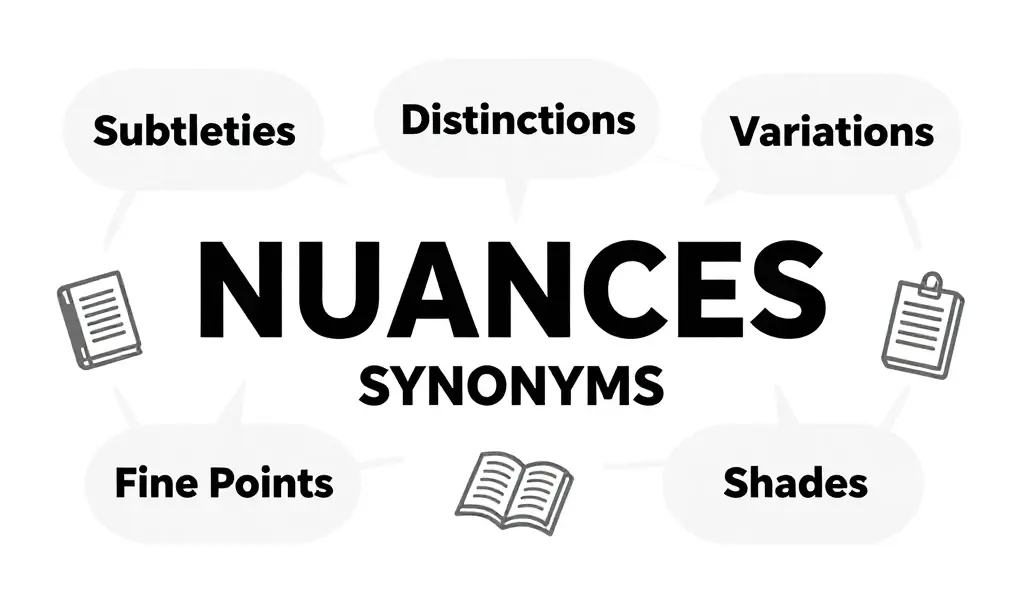
Nuances synonyms include subtleties, shades, fine distinctions, variations, undertones, implications, details, gradations, and fine points.
These words describe small differences that may not be easy to notice at first.
For example, two people may say the same words but use a different tone.
That slight change in tone is a nuance.
A color may also have many small shades.
Each shade can be called a nuance of that color.
The best synonym depends on the context.
Use subtleties for hidden details, shades for small changes in meaning or color, and distinctions for clear but minor differences.
What Does Nuances Mean?
The word “nuance” refers to small or slight differences in meaning, feeling, tone, sound, color, behavior, or expression.
A nuance is often hard to notice. You may need to listen, look, or think with care.
For example:
- A smile can show joy, fear, anger, or doubt.
- A word can sound kind or rude based on the speaker’s tone.
- Two blue paints may look alike, but one may have a green tint.
- Two ideas may seem the same but have one small difference.
Each of these small changes is a nuance.
The singular form is nuance. The plural form is nuances.
A simple definition is:
A nuance is a small difference that changes how something looks, sounds, feels, or means.
People often search for nuances synonyms because they want a clearer or easier word. They may also need a formal term for school, work, writing, art, or research.
Nuances Meaning in Different Contexts
The meaning of nuances can change slightly based on the topic.
Nuances in Language
In language, nuances are small changes in meaning. Two words may have similar meanings, but they may not create the same feeling.
For example, slim and skinny both describe a thin person. However, slim often sounds positive. Skinny can sound negative.
That difference is a nuance.
Nuances in Tone
Tone shows how a person feels while speaking or writing.
The words “That’s great” may show true joy. They may also show anger or sarcasm. The words stay the same, but the tone changes the meaning.
Nuances in Art
In art, nuances can be small changes in light, color, shape, or texture.
An artist may use several shades of brown to make a tree look real. These slight changes add depth.
Nuances in Behavior
A small change in a person’s face or body can show emotion.
A person may say they are fine, but their quiet voice and lowered eyes may show sadness. These signs are nuances in behavior.
Nuances in Ideas
Two people may agree on the main point but disagree on a small part.
For example, both may support better schools. One may want more teachers. The other may want better technology. The small difference in their views is a nuance.
How to Pronounce Nuances
The common American English pronunciation of nuances is:
NOO-ahns-iz
Phonetic form:
/ˈnuː.ɑːn.sɪz/
The singular word nuance is commonly pronounced:
NOO-ahns
Phonetic form:
/ˈnuː.ɑːns/
Say it in three simple parts:
NOO + AHNS + IZ
The first part sounds like “new.” The middle part sounds like “ahns.” The last part sounds like “iz.”
Do not pronounce it as “new-ances.” The word should flow smoothly.
Example:
She noticed the NOO-ahns-iz in his voice.
Some speakers place a little more stress on the second part of the singular word. Both versions may be heard, but “NOO-ahns” is very common in American speech.
Part of Speech and Word Forms
The word nuance is mainly a noun.
Nuance as a Noun
A noun names a person, place, thing, feeling, or idea.
Nuance names a small difference.
Example:
There was a slight nuance in her answer.
The plural form is nuances.
Example:
He understood the cultural nuances of the meeting.
Nuance as a Verb
Nuance can also be used as a verb, but this use is less common.
As a verb, it means to give something small differences or layers.
Example:
The writer nuanced the character’s feelings through small actions.
In daily English, people are more likely to use the adjective nuanced.
Nuanced as an Adjective
Nuanced means showing careful thought or small differences.
Example:
She gave a nuanced answer.
This means her answer was not too simple. It showed several sides of the issue.
Common Word Forms
| Word | Part of Speech | Meaning | Example |
| Nuance | Noun | A small difference | I heard a nuance in his tone. |
| Nuances | Plural noun | Several small differences | The book explains social nuances. |
| Nuanced | Adjective | Showing fine differences | Her view was thoughtful and nuanced. |
| Nuancing | Verb form | Adding subtle differences | The actor was nuancing each line. |
Nuances Synonyms at a Glance
The following table lists useful nuance synonyms and shows when each word works best.
| Word | Meaning | Usage | Formality | Example | Difficulty Level |
| Subtleties | Small details that are not easy to notice | Language, behavior, art | Neutral to formal | She understood the subtleties of his joke. | Medium |
| Shades | Small changes in meaning, color, or feeling | Writing, color, opinion | Neutral | The word has several shades of meaning. | Easy |
| Distinctions | Differences between two things | Study, work, comparison | Formal | The teacher explained the key distinctions. | Medium |
| Differences | Ways in which things are not the same | General use | Neutral | We noticed small differences in the plans. | Easy |
| Variations | Slightly changed forms of something | Music, science, design | Neutral | The song has many regional variations. | Easy |
| Gradations | Small steps from one level to another | Color, quality, rank | Formal | The painting shows gradations of light. | Hard |
| Undertones | Hidden feelings or meanings | Speech, writing, color | Neutral | Her words had an undertone of fear. | Medium |
| Overtones | Extra meanings or feelings that are suggested | Speech, politics, music | Formal | The speech had political overtones. | Medium |
| Implications | Meanings or results that are suggested | Work, law, study | Formal | We must consider the wider implications. | Medium |
| Connotations | Feelings linked to a word | Language, writing | Formal | The word has negative connotations. | Hard |
| Fine points | Small but important details | Rules, skills, plans | Neutral | He explained the fine points of the deal. | Easy |
| Intricacies | Small and complex details | Systems, art, law | Formal | She studied the intricacies of the design. | Hard |
| Complexities | Difficult or connected parts | Problems, ideas, systems | Neutral to formal | The report covers the complexities of trade. | Medium |
| Details | Small pieces of information | General use | Neutral | Pay attention to the details. | Easy |
| Refinements | Small improvements or changes | Design, process, skill | Formal | The team made several refinements. | Medium |
| Inflections | Changes in voice or word form | Speech, grammar, music | Formal | His vocal inflections showed doubt. | Hard |
Best Nuances Synonyms Explained
There is no single synonym that fits every sentence. Each alternative has its own meaning and tone.
Subtleties
Subtleties are small details that are hard to notice or understand.
This is one of the closest nuance synonyms. It works well when the difference is hidden, delicate, or easy to miss.
Example:
A skilled reader can notice the subtleties in the poem.
Use subtlety when discussing humor, emotion, art, culture, language, or behavior.
Best situation:
She understood the subtleties of local customs.
Difference:
A nuance is a slight difference. A subtlety is often a hidden or clever detail.
Common mistake:
Do not use subtleties for large or obvious differences.
Shades
Shades means small changes in color, meaning, feeling, or opinion.
Example:
The phrase can have many shades of meaning.
This word is simple and natural. It often appears in writing about language, emotions, colors, and ideas.
Best situation:
His story included many shades of sadness.
Difference:
Nuance is a general word. Shade often shows movement from one level or meaning to another.
Common mistake:
Do not assume shade only refers to color. It can also describe meaning and emotion.
Distinctions
Distinctions are differences that help separate one thing from another.
Example:
The guide explains the distinctions between formal and casual English.
Use this synonym in school, law, business, science, or detailed comparisons.
Best situation:
We must understand the legal distinctions between the two cases.
Difference:
A nuance may be hard to notice. A distinction can be small, but it is often clearer and more direct.
Common mistake:
Do not use distinction when there is no real point of difference.
Differences
Differences is the easiest and broadest synonym.
Example:
There are small differences between the two plans.
It works in almost every type of conversation. It is a good choice when the reader may not know the word nuance.
Best situation:
The teacher showed us the differences in tone.
Difference:
A difference can be large or small. A nuance is almost always small.
Common mistake:
Using difference may remove the idea that the change is slight. Add “small,” “slight,” or “fine” when needed.
Variations
Variations are different forms or versions of the same basic thing.
Example:
There are several variations of this recipe.
Use variations for music, language, design, food, weather, biology, or repeated patterns.
Best situation:
The word has regional variations in pronunciation.
Difference:
A nuance is a fine difference in meaning or feeling. A variation is a changed version or form.
Common mistake:
Do not use variation when the difference is only emotional and does not create another form.
Gradations
Gradations are small steps between levels, colors, qualities, or states.
Example:
The sky showed soft gradations from pink to blue.
This is a formal word. It is common in art, design, science, and careful descriptions.
Best situation:
The chart shows gradations of risk from low to high.
Difference:
Nuances are small differences. Gradations are small steps in a clear range.
Common mistake:
Do not use gradations for random differences. The changes should follow an order.
Undertones
Undertones are hidden feelings, meanings, or colors below the main surface.
Example:
His polite reply had an undertone of anger.
Use this word when the main message says one thing but a quieter feeling appears beneath it.
Best situation:
The story has dark undertones.
Difference:
A nuance is any slight difference. An undertone is a hidden feeling or quality.
Common mistake:
An undertone is not always negative. It may show hope, love, humor, fear, or doubt.
Overtones
Overtones are extra meanings, feelings, or ideas suggested by something.
Example:
The debate had strong political overtones.
This word often appears in formal writing, news, music, culture, and social discussion.
Best situation:
The ad carried overtones of wealth and power.
Difference:
An undertone feels hidden below the surface. An overtone is often easier to notice and may affect the whole message.
Common mistake:
Do not treat overtone and undertone as exact matches in every case.
Implications
Implications are meanings, effects, or results that are suggested but not directly stated.
Example:
The change has serious implications for small businesses.
Use this word in law, study, work, health, policy, and decision-making.
Best situation:
We need to think about the long-term implications.
Difference:
A nuance is a small difference. An implication is a suggested meaning or possible result.
Common mistake:
Do not use implication only to mean something bad. An implication may be positive, negative, or neutral.
Connotations
Connotations are ideas or feelings linked to a word beyond its basic meaning.
Example:
The word “home” has warm connotations.
This is an important word in language study and writing.
Best situation:
Writers should think about the connotations of the words they choose.
Difference:
A nuance is a fine change in meaning. A connotation is an added feeling or idea connected to a word.
Common mistake:
Do not confuse connotation with definition. A definition gives the direct meaning. A connotation gives the feeling around it.
Fine Points
Fine points are small but important details.
Example:
The coach taught us the fine points of the game.
This phrase is easy to understand and works in both formal and casual English.
Best situation:
The lawyer explained the fine points of the contract.
Difference:
Nuances may involve tone or meaning. Fine points often involve rules, skills, or exact details.
Common mistake:
Do not use fine points for details that have no value. The phrase suggests that the details matter.
Intricacies
Intricacies are small and complex parts of something.
Example:
She learned the intricacies of the tax system.
Use this word for detailed systems, laws, machines, art, music, or relationships.
Best situation:
The book explains the intricacies of human memory.
Difference:
A nuance may be simple but slight. An intricacy is usually both detailed and complex.
Common mistake:
Do not use intricacies when the subject is very simple.
Complexities
Complexities are parts that make something hard to understand or manage.
Example:
The manager understood the complexities of the project.
Best situation:
The report looks at the social complexities of the problem.
Difference:
Nuances are small differences. Complexities are difficult parts that may include many connected issues.
Common mistake:
Do not replace nuances with complexities when you only mean a slight change in tone.
Details
Details are small pieces of information or parts of a larger thing.
Example:
She remembers every detail of the trip.
This is the easiest alternative in daily speech.
Best situation:
We need to discuss the details before we agree.
Difference:
Every nuance may be a detail, but not every detail is a nuance. A phone number is a detail, but it is not a nuance.
Common mistake:
Do not use details when you need to stress a small difference in meaning.
Refinements
Refinements are small changes that improve something.
Example:
The designer made a few refinements to the logo.
Use this word for plans, designs, systems, products, skills, or methods.
Best situation:
The latest version includes several useful refinements.
Difference:
A nuance is a small difference. A refinement is usually a small improvement.
Common mistake:
Do not call a harmful or random change a refinement.
Inflections
Inflections are changes in the sound or shape of words.
In speech, inflection often means a change in pitch, stress, or tone.
Example:
Her voice inflections made the story exciting.
Best situation:
The actor used soft inflections to show fear.
Difference:
Nuance is broad. Inflection refers more directly to changes in speech, voice, grammar, or music.
Common mistake:
Do not use inflection as a general word for every type of detail.
Antonyms of Nuances
There is no perfect opposite for every use of nuance. The best antonym depends on the sentence.
| Antonym | Meaning | Best Context | Example |
| Obviousness | A quality that is easy to notice | Meaning, behavior | The obviousness of his anger surprised us. |
| Sameness | A lack of difference | General use | The sameness of the designs made them dull. |
| Uniformity | A state in which things remain the same | Systems, appearance | The uniforms created visual uniformity. |
| Simplicity | A lack of complex detail | Ideas, design | She explained the issue with simplicity. |
| Bluntness | Direct speech without soft detail | Tone, communication | His bluntness upset the team. |
| Directness | Clear and open expression | Speech, writing | I liked the directness of her answer. |
| Clarity | A quality of being easy to understand | Language, ideas | The report needs more clarity. |
| Plainness | A lack of decoration or fine difference | Style, writing | The plainness of the room felt peaceful. |
| Exactness | A fixed and clear quality | Rules, facts | The exactness of the figures left no doubt. |
| Generalization | A broad statement without fine detail | Study, discussion | That claim is an unfair generalization. |
Obviousness
Obviousness is the quality of being easy to see or understand. Nuances are often hidden or slight, so obviousness may act as an opposite.
Sameness
Sameness means there is little or no difference. Nuances depend on small differences, so sameness removes them.
Uniformity
Uniformity means that things follow the same form or pattern. It is useful when talking about design, behavior, rules, or appearance.
Simplicity
Simplicity can be the opposite when nuance means complexity or layers. However, simple things may still contain small nuances.
Bluntness
Bluntness means speaking in a direct way without softening the message. It may be the opposite of nuanced speech.
Directness
Directness gives the message openly. It leaves less room for hidden meaning, hints, or subtle changes.
Clarity
Clarity makes meaning easy to understand. Nuance does not always reduce clarity, but a highly nuanced idea may need more thought.
Plainness
Plainness means something has few special details. It can describe speech, writing, clothing, art, or design.
Exactness
Exactness removes uncertainty. Nuance often leaves space for small shades of meaning.
Generalization
A generalization gives a broad view. It may ignore the small differences and special cases that nuances reveal.
30 Real-World Examples of Nuances
These examples show how nuances appear in daily life, work, school, art, and relationships.
- A manager says, “That may work,” instead of “That will work.” The word may shows doubt.
- A friend says, “I’m fine,” but avoids eye contact. The body language adds a sad nuance.
- A child smiles before answering a question. The smile may show that the child is hiding something.
- A teacher uses a softer voice with a nervous student. The tone shows care.
- A customer says the food is “interesting.” In some cases, this may mean they did not like it.
- A job ad asks for a “self-starter.” This may suggest that the worker will receive little guidance.
- A red color may look warm, dark, bright, or soft. Each shade creates a different feeling.
- Two perfumes may both smell sweet, but one has a light flower note.
- A person pauses before saying yes. The pause may show doubt.
- An email that starts with “As I said before” may sound annoyed.
- A short reply such as “Okay” can sound calm, cold, angry, or tired.
- A poet chooses “home” instead of “house” because home has warmer connotations.
- A movie character laughs during a sad moment. The laugh may hide pain.
- A speaker says, “With respect,” before disagreeing. The phrase softens the message.
- A student calls a rule “strict,” while the teacher calls it “fair.” The word choice shows different views.
- Two news reports cover the same event but use different words to shape the reader’s feeling.
- A person wears black to a formal event. The color may show style, respect, or sadness.
- A musician plays the same note softly and then loudly. The change creates a new feeling.
- An actor raises one eyebrow without speaking. The movement may show doubt or humor.
- A doctor says a result is “not ideal” instead of “bad.” The softer phrase reduces fear.
- A parent says, “We’ll talk later.” The tone may show calmness or warning.
- A coworker writes “Thanks.” with a period. Some readers may think it sounds less friendly than “Thanks!”
- A product is called “affordable” instead of “cheap.” Affordable usually sounds more positive.
- A person is called “confident” rather than “proud.” The first word often sounds kinder.
- A restaurant uses dim light to create a calm and private mood.
- A speaker slows down before an important point. The change tells listeners to pay attention.
- A writer leaves the ending open. This allows readers to find their own meaning.
- A designer changes the space between two words in a logo. The small change improves balance.
- A friend says, “Do what you think is best.” The words may show trust or quiet disagreement.
- Two cultures may use silence in different ways. In one place, silence may show respect. In another, it may feel uncomfortable.
25 Sentences Using Nuances and Its Synonyms
- She understands the nuances of polite conversation.
- The actor captured every nuance of the character’s fear.
- Good writers pay attention to small shades of meaning.
- The report explains the fine distinctions between the two plans.
- I missed the subtlety in his joke at first.
- The painting uses soft gradations of blue and gray.
- Her reply had an undertone of disappointment.
- The speech carried strong political overtones.
- We should study the wider implications of this decision.
- The two words have different emotional connotations.
- The coach taught the fine points of good footwork.
- It takes time to learn the intricacies of the system.
- The book explores the complexities of family life.
- Please check every detail before sending the form.
- The team made small refinements to the design.
- His vocal inflections made the story feel real.
- There are slight variations in the way people say the word.
- The teacher showed us the differences between fact and opinion.
- Her nuanced view helped both sides understand each other.
- You need cultural awareness to notice these social subtleties.
- The color changes in small shades from green to blue.
- Their plans seem alike, but there are important distinctions.
- The legal language contains several hidden implications.
- The film has comic moments with dark undertones.
- A careful reader will notice the nuances in the final scene.
Formal vs Informal Usage
The word nuances appears more often in formal, academic, professional, and thoughtful writing. In casual speech, people may use easier words such as small differences, details, or little changes.
| Situation | Formal Version | Informal Version |
| Work meeting | We should consider the nuances of the proposal. | We should look at the small details. |
| School | The essay explores the nuances of the character’s behavior. | The essay shows the small changes in how the character acts. |
| Daily talk | There are subtle distinctions between the options. | The choices are a little different. |
| Art review | The painting contains delicate tonal gradations. | The colors change little by little. |
| Business | We must understand the cultural implications. | We need to know what this may mean in that culture. |
| Writing | The words have different connotations. | The words give different feelings. |
Formal Use
Formal writing often needs exact words. Nuance, distinction, implication, connotation, and gradation can help writers explain fine differences.
Example:
The study examines the nuances of communication between age groups.
This sentence sounds clear and professional.
Informal Use
In daily conversation, simple words often sound more natural.
Instead of saying:
I noticed several nuances in your response.
You might say:
I noticed a few small changes in the way you answered.
Both sentences are correct. The second one sounds more casual.
Academic Usage of Nuances
The word nuances is useful in essays, reports, research papers, and classroom talks. It shows that the writer sees more than one side of a topic.
In Literature
Students may discuss small changes in a character’s feelings, actions, or speech.
Example:
The novel shows the nuances of the main character’s relationship with her mother.
This means the relationship is not simply good or bad. It contains many small feelings.
In History
Historical events often involve different goals, beliefs, and points of view.
Example:
A full study of the event must include its political and social nuances.
In Psychology
Researchers may study small changes in mood, behavior, or expression.
Example:
The researcher observed subtle nuances in the children’s responses.
In Language Study
Words with similar meanings may create different feelings.
Example:
The lesson explains the nuances between “childlike” and “childish.”
“Childlike” often sounds positive. “Childish” often sounds negative.
In Law
Legal words must be read with care because a small difference may change a rule or result.
Example:
The judge considered the nuances of the agreement.
Academic Writing Tip
Do not add the word nuances only to make a sentence sound smart. Explain the actual difference.
Weak:
There are many nuances in this topic.
Better:
The topic includes social, legal, and cultural differences that affect how the rule is applied.
Nuances in Daily Conversation
Nuances are part of almost every conversation, even when people do not use the word.
Tone of Voice
A soft voice may show care. A sharp voice may show anger. A slow voice may show doubt or sadness.
Compare:
“Come here.”
This can sound loving, serious, angry, or afraid. The tone creates the nuance.
Word Choice
Small changes in words can change how a message feels.
Compare:
- “You made a mistake.”
- “There may be a small issue here.”
- “Let’s check this part again.”
All three sentences may point to the same problem. However, the last two sound softer.
Pauses
A pause may show thought, doubt, fear, or surprise.
Example:
“I think…we should wait.”
The pause adds meaning.
Facial Expression
A smile may be warm, nervous, polite, or false. The rest of the face helps us understand it.
Text Messages
Punctuation can create small changes in tone.
Compare:
- Sure
- Sure.
- Sure!
- Sure?
Each form feels different, even though the main word stays the same.
Grammar Tips for Nuance and Nuances
The grammar of nuance is simple once you know whether you are talking about one difference or several.
Use Nuance for One Difference
Use a nuance when you mean one small difference.
Correct:
I noticed a nuance in her tone.
Incorrect:
I noticed nuance in her tone.
The incorrect version may appear in rare abstract uses, but a nuance sounds more natural in most sentences.
Use Nuances for More Than One
Use nuances when you mean several small differences.
Example:
The guide explains the nuances of business culture.
Common Prepositions
The word often appears with of, in, and between.
Nuances of
Use this for small details within a subject.
She understands the nuances of the language.
Nuances in
Use this for small differences found inside a place, action, voice, or work.
I heard several nuances in his voice.
Nuances between
Use this when comparing two or more things.
The lesson covers the nuances between the two terms.
Use Nuanced as an Adjective
Place nuanced before a noun.
She gave a nuanced response.
It can also come after a linking verb.
Her response was nuanced.
Avoid Unneeded Plural Forms
Do not write nuanceses. The correct plural is nuances.
Choose Clear Verbs
Useful verbs include:
- Notice nuances
- Understand nuances
- Explain nuances
- Explore nuances
- Capture nuances
- Recognize nuances
- Miss nuances
- Appreciate nuances
Common Collocations with Nuances
A collocation is a group of words that often appear together.
Subtle Nuances
This means very small differences that may be hard to notice.
The camera captured subtle nuances in her expression.
Cultural Nuances
These are small rules, habits, or meanings within a culture.
Travelers should learn the cultural nuances of polite behavior.
Emotional Nuances
These are slight differences in feelings.
The actor showed the emotional nuances of grief.
Linguistic Nuances
These are fine differences in language, word choice, grammar, or meaning.
Translators must understand linguistic nuances.
Social Nuances
These are small rules or signals in social behavior.
He found it hard to understand the social nuances of the new office.
Political Nuances
These are fine differences in political ideas, goals, or messages.
The report explains the political nuances of the debate.
Legal Nuances
These are small but important details in laws or agreements.
A lawyer can help you understand the legal nuances.
Important Nuances
This phrase points to small differences that have a strong effect.
The summary leaves out several important nuances.
Fine Nuances
This phrase is close in meaning to subtle nuances.
The writer noticed the fine nuances between the two terms.
Hidden Nuances
These are meanings or differences that do not appear at once.
The final scene contains hidden nuances.
Capture the Nuances
This means to show small details correctly.
The photo failed to capture the nuances of the sunset.
Understand the Nuances
This means to fully learn the small differences in a subject.
You must understand the nuances before making a choice.
Miss the Nuances
This means to fail to notice important small details.
A quick translation may miss the nuances of the original text.
Appreciate the Nuances
This means to value and understand small differences.
Experience helped her appreciate the nuances of the music.
Common Phrases Using Nuance or Nuances
A Subtle Nuance
A very small difference.
There was a subtle nuance in the way she said his name.
Shades of Nuance
Several fine levels of meaning or feeling.
The poem contains many shades of nuance.
Add Nuance
To make an idea, story, or answer less simple.
The new facts add nuance to the debate.
Bring Nuance
To add careful thought or small distinctions.
Her experience brought nuance to the discussion.
Lack Nuance
To be too simple or one-sided.
The article lacks nuance and ignores other views.
Full of Nuance
To contain many fine meanings or feelings.
His performance was full of nuance.
Nuance of Meaning
A slight change in what a word or sentence means.
The translation missed an important nuance of meaning.
Nuance in Tone
A small change in how a voice or message sounds.
I heard a nuance in his tone when he answered.
Understand Every Nuance
To notice and understand all small details.
A native speaker may understand every nuance of the joke.
Lost in Translation
This phrase does not include the word nuance, but it often describes a case where nuances disappear when words move from one language to another.
Some of the humor was lost in translation.
Related Idioms and Expressions
The word nuance is not common in traditional idioms, but several expressions carry a similar idea.
Read Between the Lines
This means to look for a hidden meaning.
You need to read between the lines to understand her message.
It relates to nuances because the true meaning may not be directly stated.
A Fine Line
A fine line is a very small difference between two things.
There is a fine line between confidence and pride.
This expression is useful when two ideas are close but not the same.
Gray Area
A gray area is a situation without a simple right or wrong answer.
The rule creates a legal gray area.
Gray areas often contain many nuances.
Split Hairs
This means to argue about very small differences.
We agree on the main point, so let’s not split hairs.
Be careful. Not every fine distinction is useless. Sometimes a small difference matters.
The Devil Is in the Details
This means small details may cause a problem or change the result.
The plan looks simple, but the devil is in the details.
More Than Meets the Eye
This means something has hidden details or meaning.
The story is simple, but there is more to it than meets the eye.
Tone It Down
This means to make language, color, sound, or behavior less strong.
You may need to tone down the final paragraph.
Changing strength often creates a different nuance.
Similar Words and Their Differences
Several words look like nuances synonyms but do not mean exactly the same thing.
| Word | Main Meaning | Difference from Nuance | Example |
| Detail | A small piece of information | It may not show a difference | The address is an important detail. |
| Subtlety | A hidden or delicate quality | It is often harder to notice | I missed the subtlety of the joke. |
| Difference | A way two things are not alike | It may be large or small | There is a big difference in price. |
| Variation | A changed form | It often creates another version | This dish is a variation of the original. |
| Distinction | A clear point of difference | It is often more exact | The law makes a distinction between the acts. |
| Implication | A suggested meaning or result | It points beyond the direct statement | The decision has serious implications. |
| Connotation | A feeling linked to a word | It applies mainly to language and symbols | “Cheap” has a negative connotation. |
| Undertone | A hidden feeling or quality | It sits below the main message | His answer had an undertone of anger. |
| Overtone | An added or suggested quality | It may be easier to notice | The speech had religious overtones. |
| Complexity | A difficult feature | It may be large, not slight | The system has many complexities. |
| Ambiguity | More than one possible meaning | It creates uncertainty | The sentence contains ambiguity. |
| Precision | Exactness and care | It helps explain nuances but is not one | Scientific writing needs precision. |
Nuance vs Detail
A detail is any small part. A nuance is a small difference that changes meaning, tone, or effect.
The meeting time is a detail.
The manager’s careful tone is a nuance.
Nuance vs Subtlety
These words are very close. A subtlety is often hidden or hard to understand. A nuance is a slight difference.
The subtlety of the joke was easy to miss.
The change from “could” to “should” creates a nuance.
Nuance vs Difference
A difference can be large.
A car and a bicycle have many differences.
A nuance is small.
There is a nuance between being quiet and being shy.
Nuance vs Implication
A nuance changes the way something feels or means. An implication is a meaning or result that is suggested.
Her softer tone added nuance.
Her warning had serious implications.
Nuance vs Connotation
A nuance may appear in tone, color, art, behavior, or language. A connotation is a feeling linked to a word or symbol.
“Slim” and “skinny” have different connotations.
The difference between those connotations is a nuance of word choice.
How to Choose the Right Nuanced Synonym
Start by asking what kind of small difference you mean.
For Hidden Meaning
Use:
- Subtlety
- Undertone
- Implication
- Connotation
Example:
Her polite words carried an undertone of anger.
For Small Changes in Color or Level
Use:
- Shade
- Gradation
- Variation
Example:
The wall has several shades of blue.
For Clear Comparisons
Use:
- Distinction
- Difference
- Fine line
Example:
The teacher explained the distinction between fact and belief.
For Complex Details
Use:
- Intricacy
- Complexity
- Fine point
Example:
The manual covers the intricacies of the machine.
For Small Improvements
Use:
- Refinement
- Adjustment
- Modification
Example:
The designer made a final refinement to the layout.
For Voice and Speech
Use:
- Inflection
- Tone
- Emphasis
- Vocal change
Example:
Her inflection showed that she was joking.
For Simple Daily English
Use:
- Small difference
- Little detail
- Slight change
- Different shade
These options work well for young readers and general audiences.
Common Mistakes When Using Nuances Synonyms
Treating All Synonyms as Exact Matches
Synonyms often share a main idea, but they may not fit the same sentence.
Incorrect:
The contract has many vocal inflections.
Correct:
The contract has many fine points.
Inflections relate to voice or grammar, not legal details.
Using Nuance for a Large Difference
A nuance should be small.
Weak:
The nuance between a dog and an airplane is clear.
Better:
The difference between a dog and an airplane is clear.
Using Too Many Formal Words
A sentence can become hard to read when it includes several advanced terms.
Hard:
The intricate gradations and multifaceted connotations reveal semantic complexities.
Clear:
The small changes in meaning show that the words create different feelings.
Calling Every Detail a Nuance
A date, name, or phone number is a detail. It is not usually a nuance.
A nuance must involve a slight change in meaning, tone, quality, feeling, or effect.
Confusing Undertone and Overtone
An undertone is usually hidden below the main message. An overtone is an added quality that may be easier to notice.
Forgetting the Context
The best synonym depends on the topic.
Use shade for color, inflection for voice, connotation for words, and fine point for rules or skills.
Suggested Image ALT Text
Image ALT text should describe an image in a clear and useful way. It should not be filled with repeated keywords.
Possible ALT text for this article includes:
- Nuances synonyms table with meanings and examples
- Small shades of color showing the meaning of nuance
- Nuances in tone of voice and facial expression
- Comparison of subtleties, distinctions, and variations
- Nuances meaning with real-world sentence examples
- Formal and informal alternatives for the word nuances
- Common nuances synonyms used in English writing
- Visual guide to shades of meaning in English words
Use only the ALT text that truly matches the image.
FAQs
1. What is the best synonym for nuances?
The best synonym for nuances is subtleties. Other alternatives include shades, distinctions, undertones, and fine points, depending on the context.
2. What is a simple word for nuances?
A simple word for nuances is differences or small differences. You can also say little details or slight changes.
3. Are nuances and subtleties the same?
They are very similar but not always identical. Nuances are slight differences, while subtleties often refer to delicate or hidden details.
4. What does nuance mean in simple words?
A nuance is a small difference that changes meaning, feeling, tone, or appearance.
5. What are nuances in language?
Language nuances are small differences in meaning, tone, or emotion created by word choice, context, or pronunciation.
6. What are nuances in communication?
Communication nuances include tone of voice, pauses, facial expressions, body language, and word choice that add extra meaning.
7. Is nuance a positive or negative word?
Nuance is generally a neutral word. It can describe positive, negative, or neutral differences.
8. What is the opposite of nuances?
Possible opposites include sameness, simplicity, directness, obviousness, and uniformity.
9. How do you use nuances in a sentence?
Example: “She understands the nuances of business culture.” This means she understands its subtle details and social signals.
10. What is another word for subtle nuances?
Alternatives include fine distinctions, slight variations, hidden details, faint undertones, and shades of meaning.
11. Can nuance mean detail?
Sometimes. A nuance is a type of detail that changes meaning, feeling, or effect.
12. What are cultural nuances?
Cultural nuances are small social rules, customs, and meanings that influence behavior and communication within a culture.
13. What is the difference between nuance and connotation?
A nuance is a slight difference in meaning or feeling, while a connotation is an emotional or cultural association linked to a word.
14. What does a nuanced answer mean?
A nuanced answer considers different perspectives and recognizes complexity instead of giving a simple yes-or-no response.
15. Why are nuances important in writing?
Nuances help writers express precise emotions, hidden meanings, and realistic characters and situations.
16. How can I notice nuances more easily?
Pay attention to tone, word choice, context, facial expressions, and body language. Practice comparing similar words and meanings.
Expert Tips for Using Nuances Synonyms
Match the Word to the Topic
Do not choose a synonym only because it sounds formal.
Use:
- Inflection for voice
- Shade for color or meaning
- Connotation for words
- Undertone for hidden feelings
- Refinement for improvements
- Distinction for comparisons
- Intricacy for complex details
This makes your writing more exact.
Explain the Actual Difference
Do not write:
There are many nuances.
Tell the reader what those nuances are.
Better:
The words both describe thin people, but “slim” sounds more positive than “skinny.”
The second version gives useful information.
Keep the Main Sentence Simple
A complex idea does not need a complex sentence.
Hard:
The semantic nuances demonstrate multifaceted interpretive variations.
Clear:
Small changes in the words create different meanings.
Clear writing often sounds more expert because the reader can understand it at once.
Use Examples
An example can explain a nuance faster than a long definition.
For instance:
“Confident” often sounds positive, while “arrogant” sounds negative.
That one sentence clearly shows a shade of meaning.
Read the Sentence Aloud
When writing about emotional or spoken nuances, read the sentence aloud. Listen for stress, speed, pauses, and tone.
A word that looks fine on the page may sound cold or harsh when spoken.
Think About the Reader
A school student may understand “small differences” more easily than “semantic gradations.” A lawyer or researcher may need a more exact term.
Choose words based on the reader’s needs.
Avoid False Precision
Do not create a distinction when no useful difference exists. Fine language should make meaning clearer, not harder.
Check Connotations
Two dictionary synonyms may create very different feelings.
Compare:
- Curious and nosy
- Confident and arrogant
- Thin and skinny
- Firm and stubborn
- Careful and fearful
- Affordable and cheap
Always ask how the word may make the reader feel.
Protect Meaning During Translation
A direct translation may carry the basic definition but lose humor, respect, emotion, or cultural meaning.
Look at the full sentence and situation. Sometimes a different word gives a more accurate result.
Use Nuance Without Losing Clarity
Nuanced writing should not confuse the reader. State the main point first. Then add limits, exceptions, or other views.
Example:
The plan may reduce costs. However, it could also increase the team’s workload.
This sentence is nuanced but still easy to follow.
Conclusion:
The most useful nuance synonyms are subtleties, shades, distinctions, variations, undertones, implications, connotations, fine points, gradations, details, and intricacies.
Choose the word that matches the kind of difference you want to describe.
Use subtleties for details that are hard to notice.
Use shades for small changes in color, feeling, or meaning.
Use distinctions when comparing ideas.
Use undertones for hidden feelings.
Use connotations for feelings linked to words.
Use fine points for small but important rules or skills.
Nuances matter because small details can change the full message.
A pause can show doubt. A softer word can show care.
A slight color change can create a new mood.
Learning these differences can improve your writing, speech, reading, and understanding of other people.

Charlotte Evans is a language researcher and vocabulary writer from New York, USA. She specializes in English synonyms, word usage, and educational content that helps readers improve their communication skills.