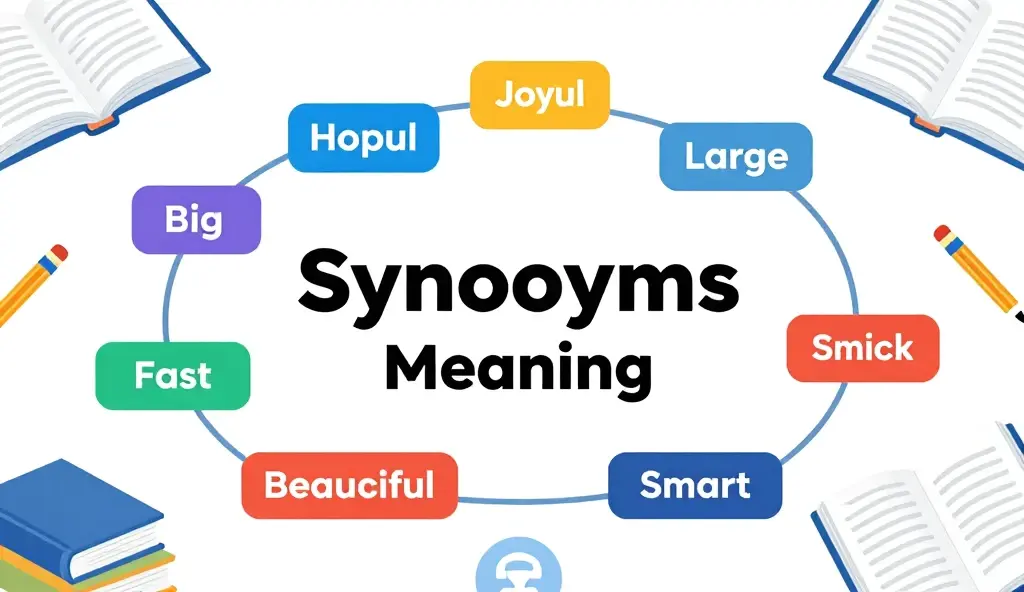
Synonyms meaning: Synonyms are words or phrases that have the same or nearly the same meaning.
For example, big and large are synonyms. So are happy and glad. Synonyms help you understand new words, avoid repetition, and express an idea more clearly.
However, two synonyms may differ in strength, tone, formality, or grammar, so they cannot always replace each other in every sentence.
What Is the Meaning of Synonyms?
Synonyms are two or more words or expressions that share the same or a very similar meaning.
Merriam-Webster defines a synonym as one of two or more words or expressions in the same language that have the same or nearly the same meaning in some or all senses. Cambridge gives a similar definition and explains that a synonym may be a word or phrase with the same or almost the same meaning as another. (Merriam-Webster)
Simple examples include:
- Big and large
- Small and little
- Fast and quick
- Happy and glad
- Begin and start
- Smart and clever
- Beautiful and pretty
- Help and assist
Consider these two sentences:
- The house is big.
- The house is large.
Both sentences give almost the same information.
Now consider:
- She is happy.
- She is glad.
These sentences also have similar meanings, but “glad” often describes happiness about a specific event.
For example:
- I am glad you came.
- She is happy with her life.
This small difference shows that synonyms are not always perfect replacements.
Synonyms Meaning in Simple English
In simple English, synonyms are:
Different words that mean the same thing or almost the same thing.
For example:
- Quick means almost the same as fast.
- Pretty means almost the same as beautiful.
- Start means almost the same as begin.
- Silent means almost the same as quiet.
- Angry means almost the same as mad.
Synonyms make language more flexible.
Instead of writing:
“The movie was good. The acting was good. The story was good.”
You can write:
“The movie was enjoyable. The acting was impressive, and the story was engaging.”
The second version sounds better because each word gives more detail.
Synonyms Meaning With Examples
Here are some easy examples of synonyms:
| Original Word | Synonym | Example |
| Angry | Mad | He was mad about the delay. |
| Answer | Reply | She gave a short reply. |
| Beautiful | Pretty | She wore a pretty dress. |
| Begin | Start | The class will start soon. |
| Big | Large | They live in a large house. |
| Brave | Courageous | The courageous firefighter entered the building. |
| Buy | Purchase | We purchased a new table. |
| Calm | Peaceful | The garden is peaceful. |
| Clever | Smart | That was a smart answer. |
| Cold | Chilly | It was a chilly morning. |
| Difficult | Hard | The test was hard. |
| Easy | Simple | The instructions are simple. |
| Fast | Quick | She gave a quick response. |
| Funny | Amusing | The story was amusing. |
| Good | Excellent | Her work was excellent. |
| Happy | Glad | I am glad you are here. |
| Help | Assist | A worker will assist you. |
| Honest | Truthful | He gave a truthful answer. |
| Huge | Enormous | We saw an enormous ship. |
| Important | Significant | The study found a significant change. |
| Kind | Caring | She is caring toward animals. |
| Quiet | Silent | The room became silent. |
| Rich | Wealthy | He came from a wealthy family. |
| Sad | Unhappy | She looked unhappy. |
| Small | Tiny | They live in a tiny apartment. |
| Strong | Powerful | It has a powerful engine. |
| Tired | Exhausted | I was exhausted after work. |
| Use | Employ | The study employed two methods. |
| Wrong | Incorrect | Your answer is incorrect. |
Why Do People Search for Synonyms Meaning?
People search for the meaning of synonyms for many reasons.
They may want to:
- Understand a school lesson
- Improve their English vocabulary
- Avoid repeating the same word
- Write better essays
- Find another word for an idea
- Prepare for an English test
- Understand a thesaurus
- Improve formal writing
- Learn the difference between similar words
- Speak more naturally
A student may search for “synonyms meaning” after seeing a question such as:
Write a synonym for “happy.”
A writer may search because a paragraph repeats the same word too many times.
For example:
“John was angry. His angry voice scared everyone. He left the room in an angry mood.”
A better version is:
“John was furious. His harsh voice scared everyone, and he left the room in a bitter mood.”
The meaning stays clear, but the wording becomes less repetitive.
Pronunciation of Synonym and Synonyms
Synonym Pronunciation
The word synonym is pronounced:
/ˈsɪn.ə.nɪm/
A simple pronunciation guide is:
SIN-uh-nim
The stress falls on the first syllable:
SIN-uh-nim
Synonyms Pronunciation
The plural synonyms is pronounced:
/ˈsɪn.ə.nɪmz/
A simple guide is:
SIN-uh-nimz
The final letter “s” sounds like a “z.”
Say it naturally:
“Can you give me two synonyms for happy?”
Do not pronounce “synonym” like:
- Sy-no-nime
- Sin-on-eem
- Syn-o-nym
The first part should sound like “sin.”
Origin of the Word Synonym
The English word “synonym” entered the language in the early 1400s. It came through French and Latin from a Greek word meaning a word with the same name or sense. The Greek parts connect to the ideas of “same” or “together” and “name.” (Etymology Online)
This history matches the modern meaning:
A synonym is another name or word used for the same or a closely related idea.
What Part of Speech Is Synonym?
Synonym is a noun.
A noun names a person, place, object, idea, or concept.
Examples:
- “Fast” is a synonym for “quick.”
- I need a better synonym.
- The dictionary lists several synonyms.
- This word has no exact synonym.
- Can you find a suitable synonym?
The plural form is:
Synonyms
Example:
“Glad,” “pleased,” and “cheerful” are synonyms for “happy.”
Synonymous Meaning
Synonymous is the adjective form of “synonym.”
It means:
- Having the same or nearly the same meaning
- Closely connected with an idea or quality
Example:
“In this sentence, ‘begin’ and ‘start’ are synonymous.”
It can also describe a strong connection:
“The brand became synonymous with quality.”
This means people strongly connect the brand with quality.
Merriam-Webster explains that “synonymous” may describe words that are alike in meaning or things that carry the same implications or associations. (Merriam-Webster)
Synonymously Meaning
Synonymously is an adverb.
It means:
In a way that treats two words or terms as having the same meaning.
Example:
“The terms are often used synonymously.”
This means people often use them as if they mean the same thing.
However, two words used synonymously may still have small differences.
For example:
“Job” and “career” are sometimes used as if they mean the same thing, but they are not exact synonyms.
- A job is a paid position.
- A career is a longer work path.
Quick Synonyms Meaning Table
| Term | Meaning | Usage | Formality | Example | Difficulty |
| Synonym | A word with a similar meaning | Grammar and vocabulary | Neutral | “Fast” is a synonym for “quick.” | Easy |
| Equivalent | Something equal in meaning or value | Formal comparison | Formal | The phrase has no English equivalent. | Medium |
| Alternative | Another available choice | General use | Neutral | We need an alternative word. | Easy |
| Substitute | Something used in place of another | Replacement | Neutral | “Large” can be a substitute for “big.” | Easy |
| Parallel | Something similar in key ways | Comparison | Formal | The two expressions have close parallels. | Medium |
| Counterpart | A matching person or thing | Roles and systems | Formal | The term has a French counterpart. | Medium |
| Analogue | Something similar in function or form | Academic use | Formal | The system has no modern analogue. | Hard |
| Related word | A word connected by topic or meaning | Vocabulary | Neutral | “Doctor” is related to “hospital.” | Easy |
| Near synonym | A word with a close but different meaning | Language study | Neutral | “Angry” is a near synonym for “annoyed.” | Easy |
| Exact synonym | A word with almost the same meaning | Language study | Neutral | “Begin” can be an exact synonym for “start.” | Easy |
Best Synonyms for Synonym
Words related to “synonym” include:
- Equivalent
- Alternative
- Substitute
- Counterpart
- Parallel
- Analogue
- Match
- Similar word
- Related expression
- Near equivalent
These words may be useful, but they are not exact replacements in every context.
Equivalent
Meaning: Something equal or nearly equal in meaning, value, purpose, or effect.
Example:
“This phrase has no exact English equivalent.”
Difference From Synonym
A synonym is usually another word in the same language with a similar meaning.
An equivalent can be:
- A word
- A phrase
- A number
- An object
- A qualification
- An amount
Examples:
- “Large” is a synonym for “big.”
- One kilometer is the equivalent of 1,000 meters.
Best Situation
Use “equivalent” when two things have the same value, meaning, level, or function.
Common Mistake
Do not call every equivalent a synonym.
Two objects can be equivalent in value, but objects are not words.
Alternative
Meaning: Another possible choice.
Example:
“Use ‘rapid’ as an alternative to ‘fast.’”
Difference From Synonym
An alternative does not always have a similar meaning.
For example:
Tea may be an alternative to coffee, but tea is not a synonym for coffee.
In vocabulary, an alternative word may be a synonym when it keeps the same meaning.
Best Situation
Use “alternative” when discussing another word or choice that could be used.
Common Mistake
Do not assume every alternative is equal in meaning.
Substitute
Meaning: Something used in place of something else.
Example:
“‘Large’ is a suitable substitute for ‘big’ in this sentence.”
Difference From Synonym
A substitute focuses on replacement.
A synonym focuses on similar meaning.
A synonym may be a good substitute, but only when it fits the sentence.
Best Situation
Use “substitute” when one word, object, or person replaces another.
Common Mistake
A word may be related but still be a poor substitute because the tone or grammar is different.
Counterpart
Meaning: A person or thing that has a similar role or function in another place, group, or system.
Example:
“This English word has no direct counterpart in the other language.”
Difference From Synonym
A counterpart does not have to share the same meaning.
It may share:
- A role
- A position
- A function
- A place in a system
Best Situation
Use “counterpart” for matching roles, systems, terms, or objects.
Common Mistake
Do not use it as a simple replacement for “synonym” in basic vocabulary lessons.
Parallel
Meaning: Something similar or comparable.
Example:
“The writer draws a parallel between the two stories.”
Difference From Synonym
A parallel shows similarity between larger ideas, situations, or structures.
A synonym normally describes a relationship between words or phrases.
Best Situation
Use “parallel” when comparing events, ideas, stories, or patterns.
Analogue
Meaning: A person or thing that is similar to another in form, role, or function.
Example:
“The older tool was a simple analogue of the modern machine.”
Difference From Synonym
“Analogue” is wider and more formal than “synonym.”
It is common in:
- Science
- History
- Technology
- Academic comparisons
It is not commonly used for basic synonym questions.
Main Types of Synonyms
There are several types of synonyms.
Understanding these types helps you choose words more accurately.
Exact Synonyms
Exact synonyms have the same or nearly the same meaning in a certain context.
Examples include:
- Begin and start
- Purchase and buy
- Reply and answer
- Infant and baby
- Finish and complete
Example:
“The meeting will begin at noon.”
“The meeting will start at noon.”
The meaning remains almost the same.
However, even close synonyms may have different levels of formality.
- Buy is common and simple.
- Purchase is more formal.
Daily speech:
“I need to buy a new phone.”
Formal writing:
“The office plans to purchase new equipment.”
Truly perfect synonyms are rare because words often have different tones, histories, or common uses.
Near Synonyms
Near synonyms have similar meanings, but they are not exact matches.
Examples include:
- Angry and annoyed
- Beautiful and pretty
- Thin and slim
- Walk and stroll
- Look and stare
- Tired and exhausted
Consider this group:
- Annoyed
- Angry
- Furious
All three relate to anger.
However:
- Annoyed means slightly angry.
- Angry is stronger.
- Furious means extremely angry.
Another example is:
- Walk
- Stroll
- March
- Wander
These words all involve movement on foot, but the actions differ.
- Stroll means walk slowly and calmly.
- March means walk in a firm or organized way.
- Wander means move without a clear direction.
Contextual Synonyms
Contextual synonyms have similar meanings only in certain sentences.
For example, bright can mean intelligent.
- She is a bright student.
- She is a smart student.
In this context, “bright” and “smart” are synonyms.
But in this sentence:
“The light is bright.”
You cannot replace “bright” with “smart.”
Another example is cold.
“The weather is cold.”
Possible synonyms include:
- Chilly
- Freezing
- Icy
But in this sentence:
“He gave me a cold response.”
“Cold” means unfriendly or lacking emotion.
Possible alternatives include:
- Distant
- Unfriendly
- Uncaring
- Harsh
The weather words do not fit.
Absolute Synonyms
Absolute synonyms are words that can replace each other in every context without changing meaning, tone, or grammar.
True absolute synonyms are very rare.
Why?
Words often differ in:
- Formality
- Emotion
- Common usage
- Word partnerships
- Regional use
- History
- Strength
For example, “buy” and “purchase” share a meaning, but they do not have the same tone.
- Buy is common.
- Purchase is more formal.
They are close synonyms, not perfect matches in every situation.
Partial Synonyms
Partial synonyms share one meaning but not every meaning.
For example:
“Strong” and “powerful” may be synonyms in:
“A strong engine.”
“A powerful engine.”
But “strong” also works in:
- Strong coffee
- Strong smell
- Strong evidence
- Strong relationship
“Powerful coffee” sounds less natural.
The two words overlap, but they do not match in every use.
Formal and Informal Synonyms
Some synonyms mainly differ in formality.
| Informal Word | Formal Synonym | Example |
| Ask | Inquire | Please inquire at the front desk. |
| Buy | Purchase | The company purchased new equipment. |
| Check | Verify | Please verify the information. |
| End | Conclude | The meeting concluded at four. |
| Fix | Repair | A worker repaired the door. |
| Get | Obtain | You must obtain permission. |
| Give | Provide | The school provides free books. |
| Help | Assist | A member of staff will assist you. |
| Need | Require | The role requires experience. |
| Show | Demonstrate | The results demonstrate improvement. |
| Start | Commence | The ceremony will commence soon. |
| Tell | Inform | Please inform the manager. |
| Try | Attempt | The team attempted to solve the issue. |
| Use | Employ | The study employed two methods. |
| Keep | Retain | Please retain a copy of the form. |
Informal Synonyms
Informal words work well in:
- Daily conversations
- Text messages
- Friendly emails
- Personal stories
- Casual posts
Examples:
- Can you help me?
- I need to buy a phone.
- Let’s start now.
- Please check this.
Formal Synonyms
Formal words work well in:
- Reports
- Business emails
- Academic papers
- Official documents
- Legal notices
Examples:
- Please assist the customer.
- The company will purchase new equipment.
- The event will commence at noon.
- Please verify the figures.
Formal words are not always better. The best word is the one that suits the reader and situation.
Positive, Negative, and Neutral Synonyms
Some synonyms have similar meanings but different emotional tones.
Consider words that describe a person who avoids spending money.
Positive Words
- Careful
- Economical
- Thrifty
Neutral Words
- Frugal
Negative Words
- Cheap
- Stingy
- Miserly
The basic idea is connected, but the feeling changes.
Another example involves a person’s body shape:
- Slim often sounds positive.
- Thin is more neutral.
- Skinny can sound negative.
Examples:
“She has a slim figure.”
“The book is thin.”
“The hungry dog looked skinny.”
Choosing the wrong synonym may make a sentence rude or unfair.
Strong and Weak Synonyms
Words with similar meanings may show different levels of strength.
Anger Scale
- Annoyed
- Irritated
- Angry
- Furious
- Enraged
Happiness Scale
- Pleased
- Glad
- Happy
- Delighted
- Overjoyed
Size Scale
- Small
- Tiny
- Minute
Or:
- Large
- Huge
- Enormous
- Gigantic
Fear Scale
- Worried
- Nervous
- Afraid
- Frightened
- Terrified
Tiredness Scale
- Tired
- Weary
- Exhausted
- Drained
A strong synonym must match the real situation.
Do not say someone was “terrified” if the person was only slightly nervous.
Common Synonyms by Context
The best synonym depends on what the word describes.
Synonyms for Good
Possible synonyms for good include:
- Great
- Excellent
- Fine
- Useful
- Helpful
- Kind
- Pleasant
- Suitable
- Skilled
- Reliable
The right word depends on the meaning.
Good Quality
- Excellent
- High-quality
- Superior
- Well-made
- Reliable
Good Person
- Kind
- Honest
- Caring
- Decent
- Thoughtful
Good Idea
- Smart
- Wise
- Practical
- Sensible
- Effective
Good Food
- Delicious
- Tasty
- Flavorful
- Fresh
- Appetizing
Example:
“She is a good doctor.”
Possible meanings include:
- She is skilled.
- She is kind.
- She is reliable.
- She is experienced.
Synonyms for Happy
Common synonyms include:
- Glad
- Cheerful
- Joyful
- Pleased
- Delighted
- Content
- Satisfied
- Excited
- Thrilled
- Overjoyed
Examples:
“I am glad you came.”
“She felt pleased with her work.”
“The children were excited about the trip.”
“He was overjoyed by the news.”
“Content” suggests quiet satisfaction.
“Thrilled” suggests strong excitement.
Synonyms for Beautiful
Common alternatives include:
- Pretty
- Lovely
- Attractive
- Gorgeous
- Stunning
- Elegant
- Charming
- Graceful
- Breathtaking
- Magnificent
Examples:
“She wore a pretty dress.”
“The sunset was stunning.”
“The room had an elegant design.”
“The view was breathtaking.”
“Pretty” is softer than “stunning.”
“Elegant” often describes simple, polished beauty.
Synonyms for Big
Possible synonyms include:
- Large
- Huge
- Enormous
- Massive
- Giant
- Vast
- Major
- Important
- Significant
- Serious
Physical Size
- Large building
- Huge truck
- Massive wall
- Enormous tree
Importance
- Major problem
- Important decision
- Significant event
- Serious mistake
Example:
“It was a big mistake.”
Clearer alternatives include:
- It was a serious mistake.
- It was a major error.
- It was a costly mistake.
Synonyms for Small
Common synonyms include:
- Little
- Tiny
- Miniature
- Compact
- Minor
- Slight
- Narrow
- Limited
Examples:
“They live in a tiny apartment.”
“The phone has a compact design.”
“There was a slight change.”
“The report contained a minor error.”
Use:
- Tiny for physical size
- Compact for small but well arranged
- Minor for low importance
- Slight for a small amount
Synonyms for Fast
Common synonyms include:
- Quick
- Rapid
- Swift
- Speedy
- Brisk
- Prompt
- Immediate
Examples:
“She gave a quick answer.”
“The city experienced rapid growth.”
“The bird made a swift movement.”
“We received a prompt response.”
“Rapid” often describes change or development.
“Prompt” means done without delay.
Synonyms for Smart
Common alternatives include:
- Clever
- Intelligent
- Bright
- Wise
- Brilliant
- Sharp
- Knowledgeable
- Gifted
Examples:
“She is an intelligent student.”
“That was a clever solution.”
“He made a wise decision.”
“The scientist had a brilliant idea.”
“Intelligent” describes learning and understanding.
“Wise” describes good judgment.
“Clever” often describes quick problem-solving.
Synonyms for Important
Possible synonyms include:
- Significant
- Essential
- Critical
- Major
- Meaningful
- Valuable
- Necessary
- Vital
- Central
- Key
Examples:
“Water is essential for life.”
“This is a critical stage.”
“She played a key role.”
“The research found a significant difference.”
“Essential” means fully necessary.
“Critical” means extremely important.
Synonyms for Sad
Common synonyms include:
- Unhappy
- Upset
- Gloomy
- Miserable
- Sorrowful
- Heartbroken
- Disappointed
- Down
- Melancholy
- Distressed
Examples:
“She felt disappointed by the result.”
“He looked gloomy.”
“The family was heartbroken.”
“Miserable” is stronger than “unhappy.”
“Disappointed” often means something did not happen as expected.
Synonyms for Angry
Common alternatives include:
- Mad
- Annoyed
- Irritated
- Upset
- Furious
- Enraged
- Frustrated
- Outraged
Examples:
“I was annoyed by the noise.”
“She became angry.”
“He was furious about the lie.”
“The public was outraged.”
“Frustrated” often describes anger caused by a blocked goal.
“Outraged” often describes anger about unfair behavior.
Synonyms for Said
Common alternatives for “said” include:
- Replied
- Asked
- Explained
- Added
- Whispered
- Shouted
- Suggested
- Announced
- Admitted
- Warned
- Promised
- Claimed
Examples:
“I am ready,” she replied.
“Be careful,” he warned.
“The shop will close early,” the manager announced.
“I made a mistake,” she admitted.
Choose a speech verb that matches the action.
“Whispered” means spoken quietly.
“Shouted” means spoken loudly.
“Claimed” may suggest that the statement has not been proven.
Synonyms for Very
A stronger word can sometimes replace “very” plus an adjective.
| Phrase | Stronger Synonym |
| Very angry | Furious |
| Very beautiful | Gorgeous |
| Very big | Enormous |
| Very cold | Freezing |
| Very dirty | Filthy |
| Very fast | Rapid |
| Very happy | Delighted |
| Very hungry | Starving |
| Very old | Ancient |
| Very scared | Terrified |
| Very small | Tiny |
| Very tired | Exhausted |
“Very” is still a normal and useful English word.
Use a stronger synonym only when the stronger meaning is accurate.
Antonyms of Synonym
The direct opposite concept of a synonym is an antonym.
A synonym shows similarity in meaning.
An antonym shows opposition in meaning.
| Word | Meaning | Usage | Example |
| Antonym | A word with an opposite meaning | Vocabulary | “Cold” is an antonym of “hot.” |
| Opposite | Something completely different | General use | Small is the opposite of big. |
| Contrary | Opposed in meaning or direction | Formal use | The evidence suggests the contrary. |
| Contrast | A clear difference | Comparison | The colors create a strong contrast. |
| Antithesis | A direct or complete opposite | Formal writing | His actions were the antithesis of kindness. |
| Reverse | Something changed to the opposite direction | Actions and order | The reverse of increase is decrease. |
| Difference | A way in which things are not the same | General use | There is a difference in tone. |
| Dissimilarity | Lack of similarity | Formal use | The study found major dissimilarities. |
Synonym vs. Antonym
A synonym has a similar meaning.
An antonym has an opposite meaning.
| Word | Synonym | Antonym |
| Big | Large | Small |
| Happy | Glad | Sad |
| Fast | Quick | Slow |
| Strong | Powerful | Weak |
| Easy | Simple | Difficult |
| Honest | Truthful | Dishonest |
| Clean | Tidy | Dirty |
| Rich | Wealthy | Poor |
| Safe | Secure | Dangerous |
| Quiet | Silent | Noisy |
Example:
“Quick” is a synonym for “fast.”
“Slow” is an antonym of “fast.”
30 Real-World Synonym Examples
- “Large” is a common synonym for “big.”
- The child was glad to see her father.
- The new train is rapid and comfortable.
- She gave a clever answer.
- We stayed in a tiny room.
- The workers completed the task early.
- His explanation was clear.
- The mountain view was stunning.
- The teacher asked us to begin the test.
- The company will purchase new computers.
- A staff member will assist you.
- The doctor gave a prompt response.
- The children looked cheerful.
- The new bridge is strong.
- The book contains valuable advice.
- Her dress looked elegant.
- The dog became agitated during the storm.
- We need a practical solution.
- The manager announced the policy.
- The film was entertaining.
- He felt exhausted after the journey.
- The road was narrow.
- She gave a truthful reply.
- The city experienced rapid growth.
- The garden looked lovely in spring.
- The researcher made a significant discovery.
- The instructions were straightforward.
- He showed courage during the emergency.
- The method proved effective.
- We received a friendly welcome.
25 Sentences About Synonyms
- A synonym is a word with a similar meaning.
- “Quick” is a synonym for “fast.”
- “Large” and “big” have nearly the same meaning.
- She used “cheerful” instead of “happy.”
- The word “tiny” is stronger than “small.”
- “Purchase” is a formal synonym for “buy.”
- “Assist” can replace “help” in formal writing.
- The writer used synonyms to avoid repetition.
- “Annoyed” is weaker than “furious.”
- Not all synonyms are interchangeable.
- Context helps us choose the correct synonym.
- “Silent” and “quiet” are near synonyms.
- “Stroll” means a slow and relaxed walk.
- “Exhausted” means extremely tired.
- A thesaurus can suggest possible synonyms.
- A dictionary explains how each synonym is used.
- “Content” describes calm happiness.
- “Enormous” is stronger than “large.”
- Formal synonyms may sound unnatural in casual speech.
- Some synonyms carry a negative tone.
- The best synonym matches the meaning and grammar.
- Key academic terms should remain consistent.
- A synonym may require a different preposition.
- Exact synonyms are rare in natural language.
- Good word choice makes writing clearer.
Formal vs. Informal Use of Synonyms
Synonyms can change the tone of a sentence.
Informal Examples
- Can you help me?
- I need to buy a phone.
- Let’s start now.
- Please check the form.
- Tell me what happened.
Formal Examples
- Can you assist me?
- I need to purchase a phone.
- We will commence shortly.
- Please verify the form.
- Please inform me of what happened.
Comparison Table
| Informal | Formal | Meaning |
| Help | Assist | Give support |
| Buy | Purchase | Pay for something |
| Start | Commence | Begin |
| Check | Verify | Confirm |
| Tell | Inform | Give information |
| End | Conclude | Finish |
| Need | Require | Must have |
| Get | Obtain | Receive |
| Use | Employ | Put into use |
| Show | Demonstrate | Make clear |
Avoid making every sentence overly formal.
Unnatural:
“The children commenced the utilization of the recreational apparatus.”
Natural:
“The children started using the playground equipment.”
Academic Use of Synonyms
Synonyms can make academic writing more precise, but writers must use them carefully.
A word should not be changed only to avoid repetition.
Some terms need to remain consistent.
For example, if a study measures student motivation, replacing that term with student excitement changes the meaning.
Common Academic Alternatives
| Simple Word | Academic Alternative |
| About | Regarding |
| Ask | Examine |
| Big | Significant |
| Change | Modify |
| Find | Identify |
| Get | Obtain |
| Help | Support |
| Main | Primary |
| Need | Require |
| Show | Demonstrate |
| Start | Initiate |
| Use | Employ |
| Look at | Analyze |
| Deal with | Address |
| Point out | Indicate |
Academic Example
Basic:
“The study looked at how sleep helps students.”
Improved:
“The study examined how sleep supports student learning.”
More precise:
“The study examined the relationship between sleep duration and student performance.”
The final sentence does more than replace words. It makes the meaning exact.
Synonyms in Daily Conversation
People use synonyms every day.
They may not say the word “synonym,” but they choose similar words to explain how they feel.
Question:
“How was the movie?”
Possible answers:
- It was good.
- It was funny.
- It was exciting.
- It was entertaining.
- It was touching.
- It was brilliant.
Question:
“How do you feel?”
Possible answers:
- I feel fine.
- I feel happy.
- I feel relaxed.
- I feel excited.
- I feel tired.
- I feel nervous.
Each word gives a different level or kind of meaning.
Grammar Tips for Using Synonyms
A synonym must fit the grammar of the sentence.
Match the Part of Speech
Replace a noun with a noun, a verb with a verb, and an adjective with an adjective.
Adjectives
- She is happy.
- She is cheerful.
Nouns
- Her happiness was clear.
- Her joy was clear.
Verbs
- He began the work.
- He started the work.
Adverbs
- She spoke quietly.
- She spoke softly.
Incorrect:
“She is joy.”
Correct:
“She is joyful.”
Or:
“She feels joy.”
Check the Preposition
Near synonyms may require different prepositions.
Examples:
- Interested in
- Curious about
- Afraid of
- Frightened by
- Responsible for
- Similar to
Compare:
“She is interested in science.”
“She is curious about science.”
The meaning is related, but the preposition changes.
Check the Verb Pattern
Related verbs may use different sentence structures.
Say and Tell
Use:
- Say something
- Tell someone something
Correct:
“She said that she was tired.”
“She told me that she was tired.”
Incorrect:
“She said me that she was tired.”
Suggest and Recommend
Correct:
“She suggested leaving early.”
“She recommended that we leave early.”
Incorrect:
“She suggested us to leave early.”
Check Countable and Uncountable Nouns
Some synonyms follow different number rules.
Advice and Suggestion
“Advice” is usually uncountable.
Correct:
- Some advice
- A piece of advice
“Suggestion” is countable.
Correct:
- A suggestion
- Two suggestions
Incorrect:
- An advice
- Two advices
Check Word Strength
Do not replace a mild word with an extreme word unless the meaning supports it.
Examples:
- Warm, hot, boiling
- Tired, exhausted
- Happy, delighted
- Afraid, terrified
- Big, enormous
“Terrified” is not a simple replacement for “nervous.”
“Nervous” may describe mild worry.
“Terrified” describes extreme fear.
Check Tone
Some synonyms have different emotional meanings.
Confident, Proud, and Arrogant
- Confident is usually positive.
- Proud may be positive or negative.
- Arrogant is negative.
Curious and Nosy
- Curious is often positive.
- Nosy is negative.
Examples:
“She is curious about other cultures.”
“She is nosy about her neighbors.”
The general ideas are related, but the tone is very different.
Common Collocations With Synonym
A collocation is a group of words that commonly appear together.
Close Synonym
A word with a very similar meaning.
Example:
“Glad” is a close synonym for “happy.”
Exact Synonym
A word with almost the same meaning in one use.
Example:
“Begin” is an exact synonym for “start” in this sentence.
Near Synonym
A word with a close but different meaning.
Example:
“Annoyed” is a near synonym for “angry.”
Suitable Synonym
A word that works naturally in the sentence.
Example:
“Purchase” is a suitable synonym for “buy” in the report.
Possible Synonym
One of several possible alternatives.
Example:
“Rapid” is a possible synonym for “fast.”
Common Synonym
A widely used similar word.
Example:
“Large” is a common synonym for “big.”
Formal Synonym
A more formal alternative.
Example:
“Assist” is a formal synonym for “help.”
Informal Synonym
A casual alternative.
Example:
“Mad” is an informal American English synonym for “angry.”
Synonym List
A list of words with similar meanings.
Example:
The website provides a synonym list for each word.
Synonym Finder
A tool that suggests similar words.
Example:
A synonym finder can help you explore word choices.
Common Phrases Related to Synonyms
Another Word for
This phrase asks for a synonym.
Example:
“What is another word for happy?”
Similar in Meaning
This explains that two words have close meanings.
Example:
“Quick” and “rapid” are similar in meaning.
Means the Same As
This gives a simple synonym explanation.
Example:
“Begin” means almost the same as “start.”
Closest in Meaning
This phrase is common in vocabulary tests.
Example:
“Choose the word closest in meaning to ‘brave.’”
Can Be Replaced With
This explains a possible word substitution.
Example:
“In this sentence, ‘large’ can be replaced with ‘big.’”
Used Interchangeably
This means people often use two terms in the same way.
Example:
“The two expressions are often used interchangeably.”
Words used interchangeably may still have small differences.
Idioms Related to Similarity
Like Two Peas in a Pod
Meaning: Two people or things are very similar.
Example:
“The twins are like two peas in a pod.”
On the Same Wavelength
Meaning: Thinking in a similar way.
Example:
“The two designers are on the same wavelength.”
Birds of a Feather
Meaning: People with similar interests or qualities often stay together.
Example:
“They both love old books. Birds of a feather flock together.”
The Spitting Image
Meaning: Looking extremely similar to another person.
Example:
“She is the spitting image of her mother.”
Cut From the Same Cloth
Meaning: Having similar qualities or behavior.
Example:
“The two leaders are cut from the same cloth.”
In the Same Ballpark
Meaning: Close in amount, idea, or estimate.
Example:
“Our price estimates are in the same ballpark.”
Similar Words and Concepts
| Term | Meaning | Difference From Synonym | Example |
| Antonym | A word with an opposite meaning | Shows contrast | Hot and cold are antonyms. |
| Homonym | Same spelling or sound, different meaning | Not based on similar meaning | Bat can mean an animal or sports tool. |
| Homophone | Same sound, different spelling | Based on pronunciation | Sea and see are homophones. |
| Homograph | Same spelling, different meaning or sound | Based on spelling | Lead can have different meanings. |
| Related word | Connected by subject | May not share meaning | Doctor and hospital are related. |
| Definition | Explanation of meaning | Explains rather than replaces | A dictionary gives a definition. |
| Paraphrase | Same idea in different words | Changes a phrase or sentence | She rewrote the full sentence. |
| Equivalent | Equal in meaning or value | Broader than synonym | The term has no exact equivalent. |
| Word family | Words from the same root | Different grammar forms | Help, helpful, helpless |
| Hyponym | A more specific category word | Shows a type relationship | Rose is a type of flower. |
Synonym vs. Definition
A synonym gives another word with a similar meaning.
A definition explains the meaning fully.
Example:
Word: Generous
Synonym:
- Giving
Definition:
- Willing to give money, time, or help freely
A synonym provides a quick clue.
A definition gives fuller information.
Synonym vs. Paraphrase
A synonym usually replaces one word.
A paraphrase rewrites a phrase or full sentence.
Original word:
“Happy”
Synonym:
“Glad”
Original sentence:
“She was happy because she passed the test.”
Paraphrase:
“She felt pleased after learning that she had passed.”
A paraphrase may change several words while keeping the main idea.
Synonym vs. Homonym
Synonyms have similar meanings.
Homonyms share a spelling or sound but have different meanings.
Synonym example:
- Big and large
Homonym example:
- Bat: a flying animal
- Bat: a tool used in sports
The two meanings of “bat” are not synonyms.
Synonym vs. Related Word
A synonym has a similar meaning.
A related word is connected by topic but may mean something completely different.
Example:
- Doctor and physician are synonyms.
- Doctor and hospital are related words.
A hospital is connected to doctors, but it is not another word for doctor.
Synonym vs. Equivalent
A synonym usually refers to words in the same language.
An equivalent may refer to:
- A translation
- An amount
- A value
- A qualification
- A similar object
Example:
“Large” is a synonym for “big.”
“This foreign phrase has no exact English equivalent.”
How to Find the Right Synonym
Follow these steps.
Step 1: Read the Whole Sentence
Do not study the word alone.
Example:
“The exam was hard.”
Here, “hard” means difficult.
Possible synonyms:
- Difficult
- Challenging
- Demanding
Now consider:
“The floor is hard.”
Here, “hard” means firm.
Possible synonyms:
- Solid
- Firm
- Rigid
Step 2: Identify the Part of Speech
Ask whether the word is:
- A noun
- A verb
- An adjective
- An adverb
Step 3: Check the Strength
Does the synonym express the same level?
- Tired
- Exhausted
“Exhausted” is much stronger.
Step 4: Check the Tone
Is the new word:
- Positive
- Negative
- Formal
- Informal
- Neutral
Step 5: Test the Sentence
Read the new sentence aloud.
Make sure it:
- Sounds natural
- Keeps the meaning
- Fits the grammar
- Matches the tone
How to Use a Thesaurus
A thesaurus is a book or tool that lists synonyms and related words. Merriam-Webster describes a thesaurus especially as a collection of words and their synonyms. (Merriam-Webster)
A thesaurus is useful, but it should not choose the final word for you.
Use this process:
- Search for the original word.
- Read the suggested alternatives.
- Check the meaning of each word.
- Review example sentences.
- Check the tone and grammar.
- Choose the most natural option.
Suppose you search for synonyms for “walk.”
You may find:
- Stroll
- March
- Wander
- Hike
- Step
These words do not describe exactly the same action.
- Stroll means walk slowly and calmly.
- March means walk firmly or in an organized way.
- Wander means walk without a clear direction.
- Hike means take a long walk, often outdoors.
The thesaurus gives choices. Context helps you choose correctly.
Common Mistakes When Using Synonyms
Treating All Synonyms as Exact
Most synonyms have small differences.
Example:
- Watch
- See
- Look
Correct uses:
- Watch the movie.
- I can see the mountain.
- Look at the picture.
They cannot always replace one another.
Ignoring Formality
“Kids” and “children” are close in meaning.
- Kids is informal.
- Children is neutral or formal.
Ignoring Tone
“Confident” and “arrogant” are related, but they do not create the same feeling.
Ignoring Grammar
“Help” and “assistance” are related, but one may be a verb and the other a noun.
Correct:
- Please help me.
- I need assistance.
Incorrect:
- Please assistance me.
Choosing a Long Word to Sound Smart
Longer words are not always better.
Overly formal:
“The organization will commence the utilization of the newly acquired apparatus.”
Clear:
“The organization will begin using the new equipment.”
Replacing Key Terms Too Often
In technical or academic writing, repeated key terms may be necessary.
Changing an important term to an inaccurate synonym may confuse the reader.
Synonyms Meaning for Kids
A child-friendly definition is:
Synonyms are different words that have the same or almost the same meaning.
Easy Synonym Pairs
- Big — Large
- Small — Little
- Happy — Glad
- Fast — Quick
- Smart — Clever
- Funny — Silly
- Angry — Mad
- Begin — Start
- Gift — Present
- Quiet — Silent
- Beautiful — Pretty
- Easy — Simple
- Answer — Reply
- Close — Shut
- End — Finish
Easy Practice Question
Choose a synonym for “happy”:
- Glad
- Cold
- Slow
Correct answer: Glad
Choose a synonym for “big”:
- Large
- Tiny
- Quiet
Correct answer: Large
Replace the bold word:
“The rabbit is small.”
Answer:
“The rabbit is little.”
Expert Tips for Learning Synonyms
Learn Words in Groups
Study connected words together.
For happiness:
- Pleased
- Glad
- Happy
- Delighted
- Overjoyed
For size:
- Tiny
- Small
- Medium
- Large
- Huge
Learn Common Word Partnerships
Do not study only single words.
Learn phrases such as:
- Heavy rain
- Strong coffee
- Powerful engine
- Firm decision
- Rapid growth
- Prompt reply
These phrases show natural English use.
Make a Strength Scale
For fear:
- Worried
- Nervous
- Afraid
- Frightened
- Terrified
For anger:
- Annoyed
- Irritated
- Angry
- Furious
- Enraged
Mark the Tone
Write whether a word is:
- Positive
- Negative
- Formal
- Informal
- Neutral
Write Your Own Sentences
A word is easier to remember when you use it.
Review Often
Short, regular practice works better than memorizing a long list once.
Check a Dictionary
A thesaurus gives choices.
A dictionary explains:
- Meaning
- Pronunciation
- Grammar
- Usage
- Example sentences
Cambridge’s thesaurus, for example, groups synonyms and antonyms with explanations and examples to show how similar words differ in real use. (Cambridge Dictionary)
Frequently Asked Questions About Synonyms Meaning
What Is the Meaning of Synonyms?
Synonyms are words or phrases that have the same or nearly the same meaning. For example, “big” and “large” are synonyms. “Happy” and “glad” are also synonyms. They help speakers and writers avoid repetition and choose words that fit the exact meaning, strength, and tone of a sentence.
What Is a Synonym in Simple Words?
A synonym is another word with the same or almost the same meaning. For example, “quick” is a synonym for “fast,” and “pretty” is a synonym for “beautiful.” Synonyms may not work in every sentence because they can differ in tone, strength, formality, or grammar.
What Are Five Examples of Synonyms?
Five common synonym pairs are “big and large,” “small and little,” “happy and glad,” “fast and quick,” and “smart and clever.” These words share similar meanings, but their exact use may differ. For example, “clever” may suggest quick or creative thinking.
What Are 10 Examples of Synonyms?
Ten examples are: big–large, small–little, happy–glad, fast–quick, smart–clever, begin–start, beautiful–pretty, quiet–silent, angry–mad, and answer–reply. These pairs have similar meanings, but some words may be stronger, more formal, or more natural in a certain sentence.
Why Are Synonyms Used?
Synonyms are used to avoid repetition, improve vocabulary, clarify meaning, and adjust tone. A writer may replace “good” with “excellent,” “useful,” “kind,” or “delicious,” depending on the context. The best synonym adds useful information instead of merely making the sentence sound different.
Are Synonyms Exactly the Same?
Most synonyms are not exactly the same. They may differ in strength, emotion, formality, grammar, or common usage. “Angry” and “furious” are synonyms, but “furious” is stronger. “Buy” and “purchase” are similar, but “purchase” is more formal.
What Is a Synonym for Good?
Synonyms for good include great, excellent, fine, useful, helpful, pleasant, kind, and suitable. The correct word depends on the context. Good food may be “delicious,” a good worker may be “skilled,” and a good decision may be “wise.”
What Is a Synonym for Happy?
Synonyms for happy include glad, cheerful, joyful, pleased, delighted, content, satisfied, and thrilled. “Content” suggests quiet satisfaction, while “thrilled” shows strong excitement. “Glad” often describes happiness about a specific event, such as being glad that someone arrived safely.
What Is a Synonym for Beautiful?
Synonyms for beautiful include pretty, lovely, attractive, gorgeous, stunning, elegant, charming, and breathtaking. “Pretty” is soft and common. “Gorgeous” and “stunning” are stronger. “Elegant” often describes polished, simple, and stylish beauty.
What Is a Synonym for Important?
Synonyms for important include significant, essential, critical, major, meaningful, vital, key, and necessary. “Essential” means fully necessary. “Critical” means extremely important. “Significant” may mean important or measurable, especially in academic or research writing.
What Is the Difference Between a Synonym and an Antonym?
A synonym has a similar meaning, while an antonym has an opposite meaning. “Large” is a synonym for “big.” “Small” is an antonym of “big.” Synonyms help add variety and precision, while antonyms help show contrast, difference, or change.
What Is an Exact Synonym?
An exact synonym is a word that has almost the same meaning as another word in a specific context. “Begin” and “start” are close examples. However, truly exact synonyms are rare because words often differ in tone, formality, history, or common word partnerships.
What Is a Near Synonym?
A near synonym has a similar but not identical meaning. “Angry” and “annoyed” are near synonyms because both describe displeasure, but “angry” is stronger. “Walk” and “stroll” are near synonyms, but “stroll” means walking slowly and calmly.
What Does Synonymous Mean?
“Synonymous” means having the same or nearly the same meaning. It can describe words, phrases, or ideas. For example, “begin” and “start” are synonymous in many sentences. It can also mean strongly associated with something, as in “The company is synonymous with quality.”
What Does Used Synonymously Mean?
“Used synonymously” means two words or terms are used as if they have the same meaning. However, they may still have small differences. For example, people sometimes use “job” and “career” synonymously, but a job is one position while a career is a longer work path.
How Can I Find a Synonym?
Read the full sentence, identify the word’s meaning, and check its part of speech. Then use a dictionary or thesaurus to find alternatives. Compare their strength, tone, formality, and grammar. Finally, place the new word in the sentence to make sure it sounds natural.
What Is a Thesaurus?
A thesaurus is a reference book or digital tool that lists synonyms, related words, and often antonyms. It helps writers explore alternatives. However, a thesaurus does not guarantee that every listed word will fit the sentence. Always check the meaning and examples in a dictionary.
Can One Word Have Many Synonyms?
Yes. A common word can have many synonyms because it may have several meanings. “Good” can mean excellent, kind, useful, skilled, pleasant, or suitable. Each meaning needs a different synonym. The best choice depends on the sentence and the noun being described.
How Do Synonyms Improve Writing?
Synonyms improve writing by reducing unnecessary repetition and making ideas more exact. Instead of saying a meal was “good,” you can say it was “delicious.” Instead of saying a worker is “good,” you can say the person is “skilled,” “reliable,” or “efficient.”
How Can Children Learn Synonyms?
Children can learn synonyms through simple word pairs, matching games, flashcards, short stories, and sentence practice. Start with easy pairs such as big–large, small–little, happy–glad, and fast–quick. Ask the child to use each word in a sentence to confirm understanding.
Conclusion
The synonyms meaning is simple: synonyms are words or phrases with the same or nearly the same meaning. Examples include big and large, happy and glad, fast and quick, and begin and start.
Synonyms help us improve vocabulary, avoid repetition, and express ideas more clearly. However, most synonyms are not perfect matches. They may differ in strength, tone, formality, grammar, or common usage.
The best synonym is not always the longest or most unusual word. It is the word that keeps the intended meaning, fits the sentence, and sounds natural.

Alexander Price is a language researcher based in Salt Lake City, Utah. He focuses on English word relationships and practical vocabulary development.