Understanding a word deeply helps you speak and write better.
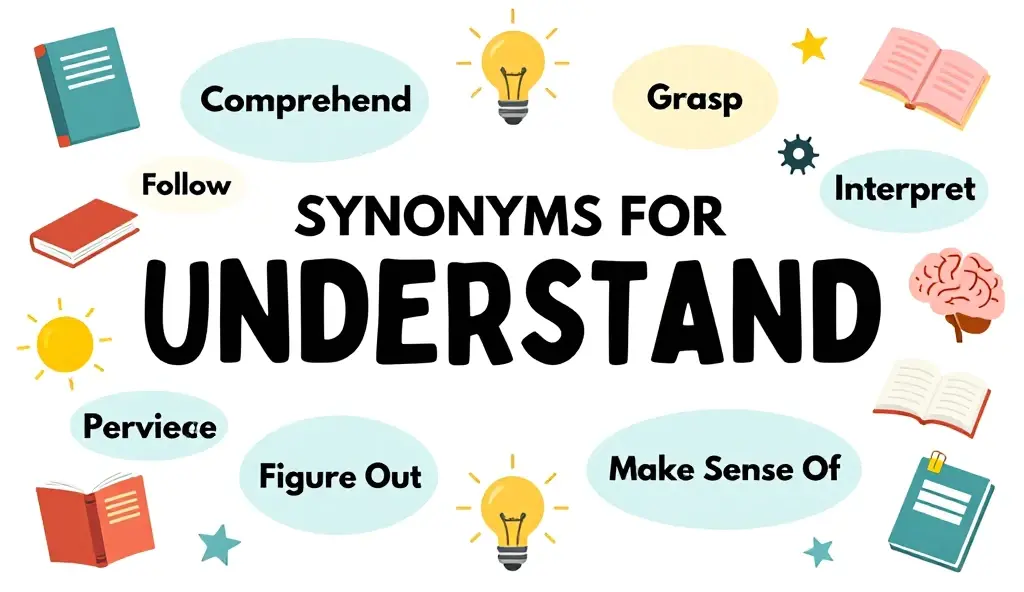
If you’re looking for synonyms for understand, there are many great choices, including comprehend, grasp, recognize, realize, perceive, know, follow, interpret, appreciate, and fathom.
The best synonym depends on your sentence, your audience, and how formal you want to sound.
What Does “Understand” Mean?
The word understand means to know the meaning of something or to fully grasp an idea, fact, feeling, instruction, or situation. It is one of the most common verbs in English and is used in everyday conversations, schools, workplaces, books, and professional writing.
People search for synonyms for understand because they want to:
- Avoid repeating the same word
- Improve their vocabulary
- Write better essays
- Sound more natural in conversations
- Create engaging content
- Learn the right word for different situations
For example:
- I understand your concern.
- I comprehend your concern.
- I grasp your concern.
Each sentence is correct, but each word creates a slightly different tone.
Meaning of Understand
Definition
Understand means:
- To know what something means.
- To grasp an idea or concept.
- To realize how something works.
- To recognize another person’s feelings or thoughts.
- To learn information clearly.
It can describe both mental understanding and emotional understanding.
Examples
- I understand the lesson.
- She understands the rules.
- They understand each other well.
- We finally understood why the project failed.
Pronunciation
Phonetic Pronunciation (American English)
understand
/ˌʌn.dɚˈstænd/
How to Pronounce It Naturally
Break it into four parts:
Un – der – STAND
The strongest stress is on stand.
Practice saying it naturally:
“I understand what you mean.”
Speak smoothly without pausing between the syllables.
Part of Speech
Understand is primarily a verb.
It describes an action that happens in the mind.
Examples
| Form | Example |
| Base Verb | understand |
| Past Tense | understood |
| Past Participle | understood |
| Present Participle | understanding |
Example Sentences
- I understand your question.
- She understood the assignment.
- We are understanding the new process better every day.
Synonyms for Understand
| Word | Meaning | Usage | Formality | Example | Difficulty |
| comprehend | fully understand | Academic | Formal | Students must comprehend the lesson. | Medium |
| grasp | understand quickly | Everyday | Neutral | I finally grasp the idea. | Easy |
| recognize | identify or acknowledge | Daily | Neutral | I recognize the problem. | Easy |
| realize | become aware | Daily | Neutral | She realized her mistake. | Easy |
| perceive | notice or understand | Academic | Formal | We perceive the changes clearly. | Medium |
| interpret | explain the meaning | Professional | Formal | Scientists interpret the data. | Medium |
| appreciate | fully understand the value | Daily | Neutral | I appreciate your effort. | Easy |
| know | have knowledge | Everyday | Informal | I know the answer. | Easy |
| follow | understand what someone says | Conversation | Informal | I can’t follow your explanation. | Easy |
| fathom | understand something difficult | Literature | Formal | I can’t fathom his decision. | Hard |
| discern | recognize clearly | Professional | Formal | She discerned the pattern. | Hard |
| decode | understand hidden meaning | Technical | Neutral | Detectives decoded the message. | Medium |
| infer | reach a conclusion | Academic | Formal | Readers infer the meaning. | Medium |
| identify | recognize clearly | Daily | Neutral | I identified the issue. | Easy |
| absorb | learn completely | Education | Neutral | Children absorb new ideas quickly. | Easy |
Best Synonyms for Understand
Comprehend
Meaning
To understand something fully after careful thought or study.
Difference
Comprehend often suggests a deeper level of understanding than understand.
Example
- Students must comprehend the chapter before the test.
Best Situation
Use it in:
- Schools
- Colleges
- Research papers
- Professional reports
Common Mistake
Don’t use comprehend for very simple situations.
Less natural:
I comprehended your hello.
Better:
I understood your greeting.
Grasp
Meaning
To understand something quickly or clearly.
Difference
Grasp often suggests that understanding comes after some effort.
Example
- It took me a few minutes to grasp the instructions.
Best Situation
Perfect for:
- Learning new skills
- Math problems
- Work training
- Explaining ideas
Common Mistake
Don’t confuse the mental meaning with the physical meaning.
Correct:
- I grasped the concept.
Also correct:
- She grasped the rope.
The meaning changes based on the context.
Recognize
Meaning
To identify or acknowledge something.
Difference
Recognizing is not always the same as fully understanding.
Example
- I recognize the name, but I don’t know the person.
Best Situation
Useful when talking about:
- Faces
- Problems
- Patterns
- Sounds
- Changes
Common Mistake
Don’t replace understand with recognize when discussing deep knowledge.
Incorrect:
- I recognize advanced physics.
Better:
- I understand advanced physics.
Realize
Meaning
To suddenly become aware of something.
Difference
Realize focuses on discovering or becoming aware, while understand focuses on already knowing.
Example
- She realized she had forgotten her keys.
Best Situation
Use it when someone notices something for the first time.
Common Mistake
Don’t use realize when talking about long-term knowledge.
Perceive
Meaning
To notice or understand something through observation or thought.
Difference
It often refers to how someone sees or interprets a situation.
Example
- Customers perceive the brand as trustworthy.
Best Situation
Common in:
- Psychology
- Business
- Marketing
- Research
Common Mistake
Avoid using perceive in very casual conversations unless the context is formal.
Interpret
Meaning
To explain or understand the meaning of something.
Difference
Interpret involves explaining meaning, while understand simply means knowing it.
Example
- Lawyers interpret laws.
- Teachers help students interpret poems.
Best Situation
Use for:
- Books
- Data
- Art
- Research
- Statistics
Common Mistake
Interpreting and understanding are related, but interpreting usually requires giving an explanation.
Appreciate
Meaning
To understand the value, importance, or effort behind something.
Difference
This word includes both understanding and gratitude.
Example
- I appreciate your honesty.
- We appreciate your support.
Best Situation
Ideal for:
- Professional emails
- Thank-you messages
- Workplace communication
- Personal conversations
Common Mistake
Don’t use appreciate when you simply mean “know.”
Correct:
- I appreciate your help.
Better than:
- I appreciate the math formula.
Know
Meaning
To have information or knowledge.
Difference
Knowing something does not always mean understanding it deeply.
Example
- I know the answer.
- I know her name.
Best Situation
Perfect for everyday conversations.
Common Mistake
People often confuse knowing with understanding.
For example:
- I know the formula.
- I understand how the formula works.
The second sentence shows deeper knowledge.
More Best Synonyms for Understand
Follow
Meaning
Follow means to understand what someone is saying, explaining, or showing. It often refers to keeping up with spoken or written information.
Difference
Unlike understand, follow usually describes understanding information as it is being presented.
Examples
- I couldn’t follow the teacher’s explanation.
- Can you speak more slowly? I’m trying to follow you.
- Everyone followed the presentation easily.
Best Situation
Use follow when talking about:
- Conversations
- Meetings
- Instructions
- Presentations
- Stories
- Videos
Common Mistake
Incorrect:
I followed advanced chemistry for ten years.
Better:
I understood advanced chemistry.
Fathom
Meaning
Fathom means to understand something that is very difficult, surprising, or confusing.
Difference
Fathom expresses deep understanding of something that is hard to explain.
Examples
- I can’t fathom why he left.
- It’s hard to fathom the size of the universe.
- She couldn’t fathom his decision.
Best Situation
Use it when discussing:
- Complex ideas
- Deep emotions
- Unexpected events
- Difficult problems
Common Mistake
Don’t use fathom for simple situations.
Less natural:
I fathomed your phone number.
Better:
I understood your phone number.
Discern
Meaning
Discern means to recognize or understand something that is difficult to notice.
Difference
It focuses on careful observation before understanding.
Examples
- She discerned a hidden pattern.
- Experts discern small differences quickly.
- He discerned the truth after reading the report.
Best Situation
Common in:
- Business
- Science
- Literature
- Research
- Professional writing
Common Mistake
Don’t confuse discern with guess. Discerning is based on evidence, not chance.
Decode
Meaning
Decode means to understand hidden, secret, or coded information.
Difference
It involves figuring out information rather than simply knowing it.
Examples
- The detective decoded the message.
- Scientists decoded the DNA sequence.
- Children enjoy decoding puzzles.
Best Situation
Use for:
- Secret messages
- Technology
- Computers
- Cryptography
- Puzzles
Common Mistake
Avoid using decode for ordinary conversations.
Infer
Meaning
Infer means to reach a conclusion using evidence instead of direct information.
Difference
You infer something by thinking carefully about clues.
Examples
- We can infer that it rained because the streets are wet.
- Readers infer the character’s feelings.
- Scientists infer results from experiments.
Best Situation
Useful in:
- Academic writing
- Reading comprehension
- Research
- Data analysis
Common Mistake
Many learners confuse infer with imply.
- A speaker implies.
- A listener infers.
Identify
Meaning
To recognize or determine exactly what something is.
Difference
You identify something before you fully understand it.
Examples
- Doctors identified the illness.
- We identified the problem quickly.
- Police identified the suspect.
Best Situation
Perfect for:
- Healthcare
- Business
- Science
- Everyday conversations
Common Mistake
Identifying something doesn’t always mean you understand it completely.
Absorb
Meaning
To learn or understand information gradually.
Difference
Absorb suggests learning over time through experience or study.
Examples
- Children absorb new languages quickly.
- Take your time to absorb the information.
- She absorbed every lesson from the course.
Best Situation
Ideal for:
- Learning
- Reading
- Training
- Education
Common Mistake
Don’t confuse the learning meaning with the physical meaning.
- The sponge absorbed the water.
- The student absorbed the lesson.
Antonyms for Understand
| Word | Meaning | Common Usage | Formality | Example |
| Misunderstand | Understand incorrectly | Everyday | Neutral | I misunderstood your message. |
| Misinterpret | Explain incorrectly | Academic | Formal | The report was misinterpreted. |
| Ignore | Pay no attention | Daily | Neutral | Please don’t ignore the instructions. |
| Overlook | Fail to notice | Professional | Neutral | We overlooked an important detail. |
| Confuse | Make unclear | Daily | Neutral | The directions confused me. |
| Forget | Fail to remember | Everyday | Informal | I forgot the answer. |
| Misjudge | Form a wrong opinion | Professional | Formal | We misjudged the situation. |
| Doubt | Feel uncertain | Daily | Neutral | I doubt his explanation. |
| Disregard | Ignore deliberately | Professional | Formal | They disregarded the warning. |
| Miss | Fail to notice | Everyday | Informal | I missed the main point. |
Understanding the Antonyms
Misunderstand
This is the direct opposite of understand.
Meaning
To understand something incorrectly.
Examples
- I misunderstood your email.
- She misunderstood the assignment.
- They misunderstood our intentions.
Tip: Always ask questions if you’re unsure instead of making assumptions.
Misinterpret
Meaning
To explain or understand something in the wrong way.
Examples
- The statement was misinterpreted.
- Readers misinterpreted the article.
- His joke was misinterpreted.
Best Used In
- Academic writing
- Legal documents
- Business communication
Ignore
Meaning
To choose not to pay attention.
Examples
- Don’t ignore safety rules.
- He ignored my advice.
- They ignored the warning signs.
Ignoring information is different from not understanding it.
Overlook
Meaning
To fail to notice something important.
Examples
- We overlooked a spelling mistake.
- The manager overlooked an important email.
- She overlooked a key detail.
Confuse
Meaning
To make something difficult to understand.
Examples
- The instructions confused me.
- Similar words often confuse learners.
- His explanation confused everyone.
Forget
Meaning
To lose information from memory.
Examples
- I forgot the password.
- She forgot today’s meeting.
- We forgot his phone number.
Forgetting is different from never understanding something.
Misjudge
Meaning
To make an incorrect decision or opinion.
Examples
- I misjudged the situation.
- The coach misjudged the player’s ability.
- We misjudged the weather.
Doubt
Meaning
To feel uncertain about something.
Examples
- I doubt that answer.
- She doubts his story.
- They doubted the results.
Disregard
Meaning
To intentionally ignore something.
Examples
- Drivers should never disregard traffic laws.
- He disregarded medical advice.
- The company disregarded customer feedback.
Miss
Meaning
To fail to notice or understand something.
Examples
- I missed the point.
- She missed an important fact.
- We missed the joke.
30 Real-World Examples of “Understand”
- I understand your question.
- She understands the lesson well.
- We understand the company policy.
- They understand each other perfectly.
- Do you understand this math problem?
- He understands basic coding.
- My parents understand my goals.
- The doctor understands my symptoms.
- Teachers understand different learning styles.
- Children understand simple stories quickly.
- I finally understand the instructions.
- We understand why the project failed.
- She understands English very well.
- They understand the risks involved.
- Our customers understand the product.
- I understand how the machine works.
- He understands computer security.
- We understand your concerns.
- She understands the legal process.
- The manager understands the market.
- Scientists understand climate patterns better today.
- Students understand the topic after practice.
- Dogs can understand simple commands.
- I understand your point of view.
- They understand the importance of teamwork.
- Everyone understands the emergency plan.
- She understands financial planning.
- We understand the customer’s expectations.
- He understands the value of honesty.
- I understand exactly what you mean.
25 Naturally Written Sentences Using Understand
These sentences show how understand is used in everyday life, school, work, and professional communication.
- I understand what you’re trying to say.
- She understands the rules better than anyone else.
- We finally understand why the computer stopped working.
- They understand the importance of teamwork.
- My brother understands math very well.
- Do you understand this question?
- I don’t understand why the store is closed.
- The teacher understands each student’s learning style.
- He understands how the engine works.
- We understand your concerns and will help.
- The children understand simple instructions.
- She understands the value of honesty.
- I understand your decision, even if I don’t agree.
- They understand how to solve the problem.
- Our customers understand the benefits of the service.
- He understands both English and Spanish.
- We understand that mistakes happen.
- I understand your point of view now.
- She understands the assignment perfectly.
- The manager understands the market very well.
- Students understand the lesson after practicing.
- I understand why you made that choice.
- Everyone understands the safety rules.
- We understand the project’s goals.
- After reading the guide twice, I finally understand every step.
Formal vs. Informal Usage
The word understand works well in both casual conversations and professional writing. However, some synonyms fit certain situations better.
| Situation | Better Word | Example |
| Talking with friends | understand | I understand what you mean. |
| Casual conversation | get (informal) | I get it now. |
| School essays | comprehend | Students should comprehend the text. |
| Business emails | understand | We understand your concerns. |
| Research papers | perceive | Researchers perceive the trend differently. |
| Legal writing | interpret | Courts interpret the law carefully. |
| Technical writing | comprehend | Users must comprehend the instructions. |
Informal Examples
- I get it.
- I understand now.
- Oh, I see.
- That makes sense.
- I know what you mean.
These expressions are common in everyday American English.
Formal Examples
- We understand your request and will respond shortly.
- The committee understands the potential risks.
- Researchers comprehended the findings after reviewing the data.
- The report was interpreted correctly.
- Employees should understand company policies.
Formal vs. Informal Comparison
| Informal | Formal |
| I get it. | I understand completely. |
| I see. | I comprehend the issue. |
| That makes sense. | The explanation is clear. |
| I know what you mean. | I understand your perspective. |
| Got it. | Your instructions are understood. |
Which Should You Use?
Choose your word based on your audience.
- Friends: “I get it.”
- Teachers: “I understand the lesson.”
- Managers: “I understand your expectations.”
- Clients: “We understand your requirements.”
Academic Usage
In academic writing, understand often appears alongside words like analyze, evaluate, interpret, and comprehend.
Examples
- Students should understand the author’s purpose before answering questions.
- Scientists understand complex systems through observation.
- Researchers understand data by analyzing patterns.
- Teachers help students understand difficult concepts.
- Understanding vocabulary improves reading comprehension.
Academic Writing Tips
Instead of repeating understand, vary your vocabulary.
For example:
- comprehend
- interpret
- analyze
- recognize
- infer
- identify
- evaluate
- perceive
This makes essays sound more polished and natural.
Daily Conversation
People use understand every day because it is simple, clear, and polite.
Everyday Examples
At Home
- I understand why you’re upset.
- Mom understands my schedule.
At School
- I understand today’s homework.
- Do you understand this chapter?
At Work
- I understand the deadline.
- My manager understands the problem.
Shopping
- I understand your return policy.
- The cashier understood my request.
Travel
- I couldn’t understand the train announcement.
- The guide spoke slowly so everyone could understand.
Grammar Tips
Using understand correctly makes your English more natural.
1. Understand Is a Verb
Correct:
- I understand.
- She understands.
- They understand.
Incorrect:
- I am understand.
- She understandsed.
2. Past Tense
The past tense of understand is understood.
Correct:
- I understood the lesson yesterday.
- She understood the instructions.
Incorrect:
- I understanded the lesson.
3. Present Continuous
You can use understanding when talking about an action that is developing.
Examples:
- I’m understanding the process better each day.
- We’re understanding customer needs more clearly.
In everyday speech, native speakers often prefer:
- I’m starting to understand.
- I’m beginning to understand.
These sound more natural.
4. Common Sentence Patterns
Pattern 1
Understand + noun
Examples:
- understand English
- understand science
- understand the rules
Pattern 2
Understand + clause
Examples:
- I understand why you left.
- She understands how it works.
- We understand what happened.
Pattern 3
Understand + person
Examples:
- I understand you.
- She understands her children.
- They understand each other.
5. Common Grammar Mistakes
Incorrect
I am understand you.
Correct
I understand you.
Incorrect
She understand the lesson.
Correct
She understands the lesson.
Incorrect
Yesterday I understand everything.
Correct
Yesterday I understood everything.
Incorrect
He don’t understand.
Correct
He doesn’t understand.
Common Collocations with Understand
Collocations are words that naturally appear together in English. Learning them helps your speech and writing sound more fluent.
| Collocation | Meaning | Example |
| understand clearly | know completely | I understand clearly now. |
| fully understand | know everything about something | We fully understand the risks. |
| understand completely | have total understanding | She understands completely. |
| understand better | improve knowledge | I understand the lesson better today. |
| understand why | know the reason | I understand why you left. |
| understand how | know the method | He understands how the system works. |
| understand the importance | know the value | Students understand the importance of reading. |
| understand the difference | recognize distinctions | She understands the difference between the two products. |
| understand the concept | grasp an idea | Children understand the concept quickly. |
| understand the situation | know what is happening | We understand the situation now. |
| understand the problem | recognize the issue | Engineers understand the problem. |
| understand the instructions | know what to do | Everyone understands the instructions. |
Explaining Common Collocations
Fully Understand
This means to know every important detail.
Example
- Before signing the contract, make sure you fully understand the terms.
Understand Better
Used when your knowledge improves over time.
Example
- After practicing every day, I understand grammar much better.
Understand the Difference
Used when comparing two or more things.
Example
- It’s important to understand the difference between “infer” and “imply.”
Understand the Situation
Used when discussing events or problems.
Example
- Our support team understands the situation and is working on a solution.
Understand the Importance
Used when talking about value or significance.
Example
- Successful leaders understand the importance of clear communication.
Understand How
Often followed by a process or method.
Example
- She understands how the software works after completing the training.
Common Phrases Using Understand
English speakers use understand in many common phrases. Learning these expressions will help you sound more natural in conversations and writing.
| Phrase | Meaning | Example |
| understand the point | Know the main idea | I understand the point you’re making. |
| understand the reason | Know why something happened | She understands the reason for the delay. |
| understand the problem | Know what is wrong | We understand the problem now. |
| understand the instructions | Know what to do | Everyone understands the instructions. |
| understand the situation | Know what is happening | They understand the situation well. |
| understand the difference | Know how two things are different | Students understand the difference between fact and opinion. |
| understand each other | Share the same meaning or feelings | Good friends understand each other. |
| understand perfectly | Know something completely | I understand perfectly. |
| understand better | Improve your knowledge | I understand the lesson better today. |
| come to understand | Learn over time | I came to understand the value of patience. |
| make yourself understood | Speak clearly so others understand | Please speak slowly and make yourself understood. |
| be easy to understand | Be simple and clear | The guide is easy to understand. |
Explaining Common Phrases
Understand the Point
This phrase means to recognize the main idea someone is trying to express.
Examples
- I understand your point.
- She understands the point of the discussion.
- We understand the point you’re making.
Best Use
- Meetings
- Debates
- Conversations
- Essays
Understand Each Other
This phrase describes two or more people who communicate well and share similar thoughts or feelings.
Examples
- We understand each other very well.
- Good teammates understand each other.
- They understand each other without many words.
Come to Understand
This expression means your understanding grows over time.
Examples
- I came to understand the importance of practice.
- She came to understand her parents’ advice.
- We came to understand the customer’s needs.
Make Yourself Understood
This means speaking or writing clearly so others know exactly what you mean.
Examples
- Please make yourself understood.
- He repeated the instructions to make himself understood.
- Speak slowly if you want everyone to understand you.
Easy to Understand
Used to describe information that is simple and clear.
Examples
- The book is easy to understand.
- Her explanation was easy to understand.
- The teacher uses easy-to-understand examples.
Idioms Related to Understanding
Although understand itself is not part of many idioms, several English idioms express the idea of understanding, learning, or realizing something.
| Idiom | Meaning | Example |
| Get the picture | Understand the situation | I get the picture now. |
| Catch on | Begin to understand | She caught on quickly. |
| Light bulb moment | Suddenly understand something | I had a light bulb moment during class. |
| Put two and two together | Reach the correct conclusion | He put two and two together and solved the mystery. |
| Read between the lines | Understand hidden meaning | You need to read between the lines. |
| See the light | Finally understand | After the explanation, everyone saw the light. |
| It clicked | Suddenly became clear | After one example, it clicked. |
| Be on the same page | Share the same understanding | Our team is on the same page. |
Understanding These Idioms
Get the Picture
Meaning
To understand what someone is trying to explain.
Example
- Thanks for explaining it again. I get the picture now.
Catch On
Meaning
To begin understanding something after some practice or explanation.
Example
- The new employee caught on quickly.
Read Between the Lines
Meaning
To understand information that isn’t stated directly.
Example
- You have to read between the lines to understand the author’s opinion.
Be on the Same Page
Meaning
To have the same understanding or agreement.
Example
- Before we begin, let’s make sure we’re on the same page.
Similar Words to Understand
Many English words have meanings close to understand, but they are not always interchangeable. Choosing the right word makes your writing clearer and more precise.
| Word | Meaning | Main Difference | Example |
| Understand | Know the meaning | General term | I understand your question. |
| Know | Have information | May not include deep understanding | I know her name. |
| Comprehend | Fully understand | More formal and deeper | Students comprehend the lesson. |
| Grasp | Understand quickly | Often after some effort | I finally grasped the idea. |
| Realize | Become aware | Focuses on discovery | I realized my mistake. |
| Recognize | Identify | Focuses on noticing | I recognized his voice. |
| Perceive | Notice or interpret | Often based on observation | People perceive risk differently. |
| Interpret | Explain meaning | Involves analysis | She interpreted the poem well. |
| Appreciate | Understand value | Includes respect or gratitude | I appreciate your support. |
| Discern | Notice subtle differences | Careful observation | Experts discern quality quickly. |
| Infer | Reach a conclusion | Based on evidence | Readers infer the author’s message. |
| Decode | Discover hidden meaning | Used for codes or symbols | Detectives decoded the message. |
Word Comparison
Understand vs. Know
| Understand | Know |
| Means to grasp meaning. | Means to possess information. |
| Usually deeper. | May be basic knowledge only. |
| I understand how the engine works. | I know the engine’s model number. |
Key Difference
You can know a fact without fully understanding it.
Example
- I know the formula.
- I understand how to use the formula.
Understand vs. Comprehend
| Understand | Comprehend |
| Everyday word | More formal |
| Common in conversation | Common in education and research |
| Easier vocabulary | More advanced vocabulary |
Example
- I understand the lesson.
- Students must comprehend the chapter before the exam.
Understand vs. Grasp
| Understand | Grasp |
| General understanding | Often after effort |
| Used everywhere | Common when learning something difficult |
Example
- I understand your explanation.
- It took me a while to grasp the concept.
Understand vs. Realize
| Understand | Realize |
| Means to know | Means to become aware |
| Ongoing knowledge | Sudden discovery |
Example
- I understand the rules.
- I realized I forgot my wallet.
Understand vs. Recognize
| Understand | Recognize |
| Know the meaning | Identify someone or something |
| Focus on knowledge | Focus on identification |
Example
- I understand the instructions.
- I recognize your handwriting.
Understand vs. Interpret
| Understand | Interpret |
| Know the meaning | Explain or analyze the meaning |
| Simpler | More analytical |
Example
- I understand the article.
- She interpreted the article differently.
Understand vs. Appreciate
| Understand | Appreciate |
| Know the meaning | Recognize value or importance |
| Mental understanding | Includes gratitude or respect |
Example
- I understand your advice.
- I appreciate your advice.
Understand vs. Perceive
| Understand | Perceive |
| General knowledge | Personal observation or impression |
| Direct meaning | May vary by individual |
Example
- I understand the instructions.
- Customers perceive the brand as reliable.
Expert Tips for Choosing the Best Synonym
Choosing the right synonym depends on your purpose. Here are some practical tips:
- Use understand for everyday conversations because it is clear and natural.
- Use comprehend in academic or formal writing when discussing deep understanding.
- Use grasp when someone learns a difficult idea after some effort.
- Use realize when talking about a sudden discovery or awareness.
- Use interpret when explaining the meaning of data, literature, laws, or art.
- Use appreciate when you want to express both understanding and gratitude.
- Use recognize when identifying people, objects, or patterns.
- Use perceive when discussing opinions, impressions, or observations.
FAQs
Q1. What are the best synonyms for “understand”?
A: Some of the best synonyms for understand include comprehend, grasp, realize, recognize, perceive, interpret, appreciate, know, follow, and fathom. Each has a slightly different meaning, so choose the one that best fits your sentence and tone.
Q2. Is “comprehend” the same as “understand”?
A: Not exactly. Both words refer to understanding something, but comprehend suggests a deeper or more complete understanding. It is more common in academic, technical, and professional writing, while understand works well in everyday English.
Q3. When should I use “grasp” instead of “understand”?
A: Use grasp when someone understands an idea after some effort or when the concept is difficult. For example, “It took me a while to grasp the lesson.” Understand is a broader word that fits almost any situation.
Q4. What is the difference between “know” and “understand”?
A: Know means having information or facts, while understand means knowing how or why something works. For example, you may know a formula, but you understand it only when you can explain and apply it correctly.
Q5. Is “realize” a synonym for “understand”?
A: Sometimes. Realize means becoming aware of something, often suddenly, while understand means comprehending the meaning or significance of something. They overlap in some situations but are not always interchangeable.
Q6. What is a formal synonym for “understand”?
A: Formal alternatives include comprehend, perceive, interpret, discern, and apprehend. These words are commonly used in academic papers, legal documents, business reports, and professional communication.
Q7. What is the easiest synonym for “understand”?
A: Simple alternatives include know, get (informal), see (in conversation), and follow. These words are common in everyday English and are easy for learners to use.
Q8. Can “understand” be used in professional writing?
A: Yes. Understand is perfectly acceptable in business emails, reports, presentations, and customer communication. However, in technical or research contexts, words like comprehend, interpret, or analyze may sound more precise.
Q9. What is the opposite of “understand”?
A: Common antonyms include misunderstand, misinterpret, ignore, overlook, confuse, doubt, and disregard. The best opposite depends on the specific context.
Q10. How can I improve my understanding of English vocabulary?
A: Read books, articles, and news regularly. Practice using new words in speaking and writing, and learn synonyms, antonyms, collocations, and example sentences together. Reviewing vocabulary consistently helps improve long-term understanding and retention.
Q11. Why should I use synonyms for “understand” in writing?
A: Using different synonyms prevents repetition, improves readability, and makes your writing more engaging. It also helps you express precise meanings—for example, interpret suits data or text analysis, while appreciate can express understanding combined with gratitude or recognition.
Q12. Which synonym for “understand” is best for academic writing?
A: Academic writing commonly uses comprehend, interpret, infer, analyze, perceive, and discern. These words provide greater precision and match the formal tone expected in essays, research papers, and scholarly writing.
Q13. Which synonym for “understand” is best for everyday conversation?
A: In casual conversations, understand, get, see, know, and follow are the most natural choices. Native English speakers use these words frequently because they sound clear, simple, and conversational.
Q14. How do I choose the right synonym for “understand”?
A: Consider your audience and purpose. For everyday conversations, understand or get works well. For academic, business, or professional writing, choose more precise alternatives such as comprehend, interpret, perceive, or discern. Always select the word that best matches the meaning and tone you want to convey.
Expert Writing Tips
If you want your English to sound more natural and polished, keep these tips in mind:
- Use understand in everyday speech because it is clear and universally accepted.
- Replace repeated uses of understand with suitable synonyms to improve readability.
- Match the synonym to the context. For example, use interpret for analyzing information and appreciate when expressing value or gratitude.
- Learn words through real examples rather than memorizing definitions alone.
- Practice writing sentences with different synonyms to build confidence and vocabulary.
- Read high-quality English books, articles, and blogs to see how native writers use these words naturally.
- Review new vocabulary regularly so it becomes part of your everyday language.
Conclusion:
The word understand is one of the most useful verbs in English because it helps express knowledge, awareness, learning, and empathy.
However, using the same word repeatedly can make your writing feel repetitive.
Expanding your vocabulary with synonyms such as comprehend, grasp, recognize, realize, interpret, perceive, appreciate, follow, and fathom allows you to communicate more precisely and naturally.
Remember that no single synonym works in every situation.
The best choice depends on your audience, tone, and context. By learning the meanings, differences, examples, grammar, collocations, phrases, and comparisons covered in this guide, you’ll be able to choose the most accurate word with confidence in both everyday conversations and professional writing.
If you’re writing an essay, preparing a business report, improving your English vocabulary, or simply trying to avoid repetition, mastering these synonyms for understand will mke your communication clearer, stronger, and more engaging.

Alexander Price is a language researcher based in Salt Lake City, Utah. He focuses on English word relationships and practical vocabulary development.