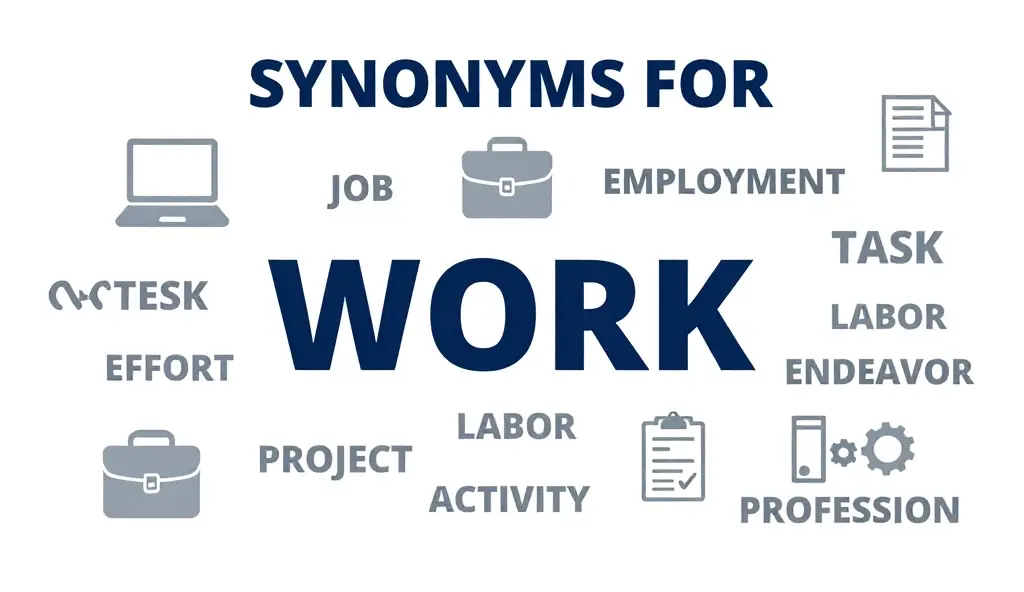
The word work is one of the most common and useful words in English.
We use it when talking about jobs, school, daily tasks, physical effort, creative projects, machines, relationships, and even ideas.
For example:
- I have a lot of work today.
- She works at a bank.
- This computer doesn’t work.
- His hard work paid off.
- We need to work together.
- The plan worked well.
These sentences use the same word, but work has a different meaning in each one.
That is why finding good synonyms for work can be tricky.
You cannot simply replace work with job in every sentence. A job is a type of work, but not all work is a job.
Likewise, effort describes energy put into something, while labor often suggests physical or demanding work.
Career refers to a person’s long-term professional path, while task usually means a specific piece of work.
The best synonym depends on your meaning, audience, and writing style.
In everyday conversation, words such as job, task, effort, duty, and employment are useful.
In academic or professional writing, you may prefer assignment, occupation, profession, endeavor, activity, or undertaking.
In creative writing, words such as craft, labor, toil, and endeavor can add more detail and emotion.
This guide explains the most useful alternatives, when to use them, common mistakes, formal and informal choices, grammar tips, examples, and the difference between closely related words.
Meaning of Work
Work has several meanings because it can function as both a noun and a verb.
Definition as a Noun
As a noun, work can mean:
- An activity that requires effort.
- A job or employment.
- A task or duty.
- A person’s professional activity.
- A product or creation, especially in art or literature.
- The physical or mental effort used to accomplish something.
Examples:
I have some work to finish.
She found work after graduation.
His work is highly respected.
The painting is one of her finest works.
Definition as a Verb
As a verb, work can mean:
- To perform a job.
- To make an effort.
- To function correctly.
- To produce a desired result.
- To operate something.
- To cooperate with someone.
Examples:
I work from home.
We worked all night.
The machine works perfectly.
This method works well.
She works with children.
Pronunciation
The pronunciation of work is:
/wɝːk/ in American English.
It sounds roughly like “wurk.”
The vowel is important. It is not pronounced like walk or woke.
How to Pronounce Work Naturally
Start with the w sound, then use the stressed vowel sound found in words such as bird or turn, followed by the k sound.
Say it naturally:
work
working
worked
worker
The word is usually pronounced with one strong syllable.
Part of Speech
Work can be a noun and a verb.
Work as a Noun
I have a lot of work.
Here, work is a noun.
Work as a Verb
I work every Saturday.
Here, work is a verb.
Work as an Adjective in Compounds
The word can also appear in compound expressions:
- workplace
- workload
- work-related
- workday
- workforce
- teamwork
- homework
These compounds are common in professional and everyday English.
Synonyms for Work: Quick Reference Table
| Word | Meaning | Usage | Formality | Example | Difficulty |
| Job | Paid position or task | Everyday | Neutral | She found a new job. | Easy |
| Task | Specific piece of work | General | Neutral | Finish this task. | Easy |
| Employment | Paid work | Professional | Formal | He is seeking employment. | Medium |
| Labor | Physical or demanding work | General/Formal | Neutral | The project requires labor. | Medium |
| Effort | Energy used to achieve something | General | Neutral | Her effort was impressive. | Easy |
| Occupation | Regular profession or job | Formal | Formal | Teaching is his occupation. | Medium |
| Profession | Skilled career | Professional | Formal | Medicine is her profession. | Medium |
| Career | Long-term professional path | Professional | Neutral | He wants a career in law. | Easy |
| Duty | Responsibility or required task | General | Neutral | It is my duty to help. | Easy |
| Assignment | Specific piece of work | School/Business | Neutral | I finished the assignment. | Easy |
| Activity | Something done or performed | General | Neutral | The activity took an hour. | Easy |
| Function | Purpose or operation | Technical | Formal | The device performs this function. | Medium |
| Operation | Act of operating | Technical/Business | Formal | The machine is in operation. | Medium |
| Endeavor | Serious attempt or effort | Formal | Formal | The project was a major endeavor. | Advanced |
| Undertaking | Organized or difficult task | Formal | Formal | It was a challenging undertaking. | Advanced |
| Toil | Hard or tiring work | Literary | Formal/Literary | Years of toil produced results. | Advanced |
| Labor | Hard physical work | General | Neutral | The workers performed manual labor. | Medium |
| Craft | Skilled creative work | Creative | Neutral | Writing is her craft. | Medium |
| Profession | Skilled occupation | Professional | Formal | Law is his profession. | Medium |
| Service | Work performed for others | Business | Neutral | The company provides repair services. | Easy |
| Business | Commercial activity or one’s work | General | Neutral | She runs her own business. | Easy |
| Employment | State of having a job | Formal | Formal | Employment increased last year. | Medium |
| Practice | Professional activity | Specialized | Neutral | She runs a medical practice. | Medium |
| Performance | How well work is done | Professional | Formal | His performance improved. | Medium |
| Productivity | Amount of useful work completed | Business | Formal | Productivity increased this month. | Advanced |
Best Synonyms for Work
Job
Job is one of the most common synonyms for work, but the two words are not identical.
A job is usually a specific position or type of paid employment.
I got a new job.
She has a part-time job.
Best situation: Talking about employment or a particular position.
Common mistake: Don’t use job when you simply mean an activity.
I have a lot of job.
This is incorrect.
Say:
I have a lot of work.
Task
A task is a specific piece of work that needs to be completed.
My first task is to answer these emails.
Difference: Work can be broad, while a task is usually specific.
Best situation: School, office, household, and project-related writing.
Employment
Employment means having paid work or the state of being employed.
The company provides employment for hundreds of people.
It sounds more formal than job.
Best situation: Business, government, economics, resumes, and professional writing.
Labor
Labor refers to work, especially physical or demanding work.
Building the house required a great deal of labor.
In American English, labor is the standard spelling. In British English, labour is commonly used.
Best situation: Construction, farming, manufacturing, economics, and discussions of physical work.
Effort
Effort focuses on the energy or attempt someone puts into an activity.
She put a lot of effort into the project.
Difference: Work describes the activity itself; effort describes the energy invested in it.
His work was excellent.
His effort was impressive.
Both sentences focus on different things.
Occupation
An occupation is a person’s regular job or profession.
What is your occupation?
It sounds more formal than job.
Best situation: Forms, official documents, research, and professional writing.
Profession
A profession usually refers to a skilled occupation that requires education, training, or specialized knowledge.
Examples include:
- medicine
- law
- teaching
- engineering
- accounting
Teaching is a rewarding profession.
Best situation: Formal and professional contexts.
Career
A career describes a person’s long-term professional journey.
She wants a career in technology.
Difference: A job may be temporary, while a career can include many jobs over many years.
Duty
A duty is something a person is responsible or expected to do.
Helping customers is part of my job duties.
Best situation: Responsibilities, workplaces, military contexts, and formal writing.
Assignment
An assignment is a specific piece of work given to someone.
The teacher gave us a difficult assignment.
It is common in education and workplaces.
My manager gave me a new assignment.
Activity
Activity is a broad word for something someone does.
The students completed a group activity.
It can refer to work, exercise, learning, business, or leisure.
Difference: Not every activity is work.
Function
Function means the purpose or job that something performs.
The main function of this button is to start the machine.
It is especially useful when talking about technology, systems, machines, and organizations.
Operation
Operation refers to the way something works or the process of operating it.
The machine is now in operation.
It is common in technical and business contexts.
Endeavor
Endeavor means a serious attempt or effort, often involving a significant goal.
Writing the book was a major endeavor.
It sounds formal and can make writing feel more polished.
Best situation: Formal writing, speeches, biographies, and professional descriptions.
Undertaking
An undertaking is a task, project, or responsibility that may be difficult or important.
Building the bridge was a huge undertaking.
It is more formal than task.
Toil
Toil means hard, tiring, or prolonged work.
Years of toil finally produced results.
This word often has a literary or emotional tone.
Best situation: Creative writing, historical writing, and descriptions of difficult labor.
Craft
Craft refers to skilled work, especially creative work.
Writing is her craft.
He has mastered the craft of woodworking.
It emphasizes skill and practice.
Service
Service can mean work performed for customers or other people.
The company provides repair services.
Best situation: Business, customer support, hospitality, and professional services.
Business
Business can refer to commercial activity or the work of running a company.
She started her own business.
It is not always a direct synonym for work, but it can replace the word in certain contexts.
Practice
Practice can describe the professional work of someone such as a doctor, lawyer, or dentist.
She runs a successful dental practice.
It can also mean repeated training:
Practice is essential for good work.
Productivity
Productivity refers to how efficiently useful work is produced.
The new system improved productivity.
It is common in business and economics.
Antonyms of Work
There is no single opposite of work because the word has many meanings.
Depending on context, possible opposites include:
| Word | Opposite Meaning | Example |
| Rest | Stop working to recover | I need to rest. |
| Leisure | Free time | She enjoys leisure activities. |
| Idleness | Lack of activity | He spent the day in idleness. |
| Unemployment | Lack of paid work | Unemployment increased. |
| Play | Activity for enjoyment | The children went outside to play. |
| Relaxation | Rest from effort | The weekend was for relaxation. |
| Vacation | Time away from work | I’m on vacation. |
| Failure | Not producing the intended result | The plan failed. |
| Dysfunction | Failure to function | The system has a serious dysfunction. |
Rest
Rest is the most natural opposite when work means physical or mental effort.
After eight hours of work, I needed rest.
Leisure
Leisure means free time when you are not working.
She spends her leisure time reading.
Unemployment
Unemployment refers to being without a job.
The region has high unemployment.
This is an opposite of employment, not necessarily every meaning of work.
Play
Play contrasts with work when discussing children’s activities or recreational behavior.
The children spent the afternoon playing instead of working.
Failure
When work means “function successfully,” the opposite may be fail.
The machine works.
The machine fails.
30 Real-World Examples
- I have a lot of work to finish today.
- She found a new job last month.
- The teacher gave us a difficult task.
- He works at a local hospital.
- Her hard work paid off.
- The project required months of labor.
- He put a lot of effort into the presentation.
- Teaching is a rewarding profession.
- She wants a career in medicine.
- What is your current occupation?
- Answering emails is part of my daily duties.
- I finished the assignment before lunch.
- The machine isn’t working properly.
- This method works well for beginners.
- We need to work together.
- The company provides employment for local residents.
- Writing is both his job and his craft.
- Building the new school was a major undertaking.
- The team completed the project through years of toil.
- Her latest work received excellent reviews.
- The device has several important functions.
- The factory resumed operations yesterday.
- The team showed great effort during the final game.
- She provides professional services to small businesses.
- Productivity improved after the company changed its system.
- The doctor runs a busy medical practice.
- He has several tasks to complete before Friday.
- The project was a difficult but rewarding endeavor.
- I need some rest after a long day at work.
- The computer stopped working during the meeting.
25 Naturally Written Sentences
- My work starts at eight every morning.
- She loves her new job.
- The team has an important task to complete.
- Hard work can lead to great results.
- He put considerable effort into the project.
- Her career began in a small office.
- Engineering is a demanding profession.
- The company offers stable employment.
- The workers completed the labor-intensive project.
- I finished my assignment before dinner.
- Customer service is part of his daily duties.
- The machine stopped working suddenly.
- This solution works better than the old one.
- We need to work together to solve the problem.
- The research project was a major undertaking.
- Years of toil helped build the business.
- She takes pride in her craft.
- The program improved workplace productivity.
- He runs a successful medical practice.
- The organization provides essential services.
- I need a short break after all this work.
- She is looking for employment in marketing.
- The team’s performance improved after training.
- The students completed the activity in groups.
- After work, he likes to relax with his family.
Formal vs. Informal Usage
The word work itself is neutral and works in almost every setting. Its alternatives can change the tone.
| Informal | Neutral | Formal |
| Job | Work | Employment |
| Stuff to do | Task | Assignment |
| Hard work | Effort | Labor |
| Job | Occupation | Profession |
| Big project | Project | Undertaking |
| Try | Effort | Endeavor |
| Work | Activity | Operation |
| Skill | Craft | Professional practice |
Informal Example
I have a lot of work to do.
Neutral Example
I have several tasks to complete.
Formal Example
I have several assigned responsibilities to complete.
The formal version is not automatically better. If you are speaking with a friend, the first sentence is much more natural.
Academic Usage
Academic writing often uses work in several ways.
Work as Research
Previous work has examined the effects of stress.
Here, work means previous research.
You can sometimes write:
Previous research has examined the effects of stress.
In this context, research is more specific than work.
Work as an Assignment
Students must complete the required work.
A more precise alternative might be:
Students must complete the required assignments.
Work as Effort
Considerable work was required to complete the study.
Possible alternative:
Considerable effort was required to complete the study.
The best choice depends on whether you mean the actual activity or the energy invested.
Work as a Field
His work focuses on language development.
This means his research or professional activity focuses on that topic.
Daily Conversation
Work is extremely common in everyday English.
People say:
How was work?
I’m going to work.
I’m at work.
I have to work tomorrow.
What time do you finish work?
I’m looking for work.
I don’t feel like going to work today.
In casual conversation, job is also common:
Do you like your job?
I need a new job.
She got a better job.
When talking about effort, people often use effort:
You need to put more effort into it.
When talking about a specific responsibility, task works well:
I have one more task to finish.
Grammar Tips
1. Work Can Be Countable or Uncountable
When work means general activity or effort, it is usually uncountable.
I have a lot of work.
Not:
I have many works.
When work refers to artistic or literary creations, it can be countable.
The museum displayed several works by the artist.
2. Job Is Countable
You can say:
I have a job.
She has two jobs.
But normally:
I have a lot of work.
Not:
I have three works.
3. Work as a Verb
I work every day.
She works at home.
They worked together.
4. Work With
Work with often means cooperate with a person or use something.
I work with children.
She works with computers.
5. Work On
Work on means spend time developing or completing something.
I’m working on a new project.
He is working on his homework.
6. Work For
Work for can identify an employer.
She works for a software company.
7. Work At
Work at can identify a workplace.
He works at a hospital.
It can also mean making an effort to improve something.
We need to work at our communication.
8. Work Out
Work out has several meanings.
The plan worked out well.
It can mean “succeed.”
It can also mean exercise:
I work out every morning.
9. Work Through
Work through means deal with something step by step.
We need to work through this problem.
Common Collocations With Work
Hard Work
Success requires hard work.
This means serious effort.
Good Work
Good work on the report.
This praises someone’s performance.
Full-Time Work
She is looking for full-time work.
This describes work that normally occupies a standard full working schedule.
Part-Time Work
He found part-time work while studying.
Manual Work
Manual work can be physically demanding.
Creative Work
She enjoys creative work.
Office Work
He does office work during the week.
Remote Work
Many employees prefer remote work.
Teamwork
Good teamwork improves results.
Work Experience
The position requires two years of work experience.
Work Environment
The company has a friendly work environment.
Workload
My workload is heavy this week.
Work Ethic
She has a strong work ethic.
Work Life
He is trying to improve his work-life balance.
Work Schedule
My work schedule changes every week.
Common Phrases With Work
Work Hard
If you work hard, you can improve your skills.
Work Together
We need to work together.
Work From Home
She works from home three days a week.
Work Full-Time
He works full-time at a hospital.
Work Part-Time
She works part-time while studying.
Work on Something
I’m working on a new website.
Work With Someone
I work with a small team.
Work for Someone
He works for a large company.
Work Out
Everything worked out in the end.
Get to Work
We need to get to work.
At Work
I’ll call you when I’m at work.
Out of Work
He has been out of work for several months.
Idioms Related to Work
Work Your Fingers to the Bone
This means to work extremely hard.
She worked her fingers to the bone to support her family.
It is an idiomatic expression and should not be understood literally.
Work Like a Dog
This means to work very hard.
He works like a dog during the busy season.
It is informal.
All in a Day’s Work
This means something is a normal part of someone’s job or responsibility.
Fixing small problems is all in a day’s work for her.
Make Short Work of Something
This means to complete something quickly or easily.
The experienced technician made short work of the repair.
Work Against the Clock
This means to work quickly because there is limited time.
We were working against the clock to finish the report.
Work Hand in Hand
This means to cooperate closely.
The two departments work hand in hand.
Work Around the Clock
This means to work continuously or for a very long period.
The emergency team worked around the clock.
Get Down to Work
This means to begin working seriously.
It’s time to get down to work.
Similar Words
| Word | Meaning | Difference | Example |
| Work | Activity requiring effort | Broadest term | I have work to do. |
| Job | Position or specific piece of work | Often paid or specific | I found a new job. |
| Task | Specific duty | Usually limited in scope | Finish this task. |
| Career | Long-term professional path | Covers many jobs | She has a career in law. |
| Profession | Skilled occupation | Usually specialized | Teaching is her profession. |
| Labor | Physical or demanding work | Focuses on effort | The job requires labor. |
| Effort | Energy or attempt | Focuses on exertion | He made an effort. |
| Duty | Responsibility | Focuses on obligation | It is my duty. |
| Assignment | Work given to someone | Often school or business | Complete the assignment. |
| Occupation | Regular job | Formal term | What is your occupation? |
Work vs. Job
These are two of the most commonly confused words.
Work
Work usually refers to activity, effort, or employment in a general sense.
I have too much work.
Job
Job usually refers to a specific position or piece of work.
I have a new job.
Compare:
I love my job.
This means you like your position.
I love my work.
This can mean you enjoy the activity or professional field itself.
Work vs. Career
A career is broader and longer than a job.
She changed jobs twice this year.
She is building a career in finance.
A career can contain several jobs.
Work vs. Task
A task is a specific part of your work.
My work involves managing customers.
One of my tasks is answering customer emails.
Think of work as the larger category and task as one part of it.
Work vs. Effort
Work describes what you do.
Effort describes how much energy you put into doing it.
His work was excellent.
His effort was excellent.
The first focuses on the result or activity. The second focuses more on his dedication.
Work vs. Labor
Labor often suggests physical or difficult work.
The construction project required skilled labor.
Work is much broader.
I have work to do.
You would not normally replace every instance of work with labor.
Work vs. Profession
A profession is a specialized career or occupation.
Medicine is her profession.
But:
I have work to finish.
You cannot replace the second sentence with profession.
Work vs. Employment
Employment is formal and usually refers to the condition or state of having paid work.
The company provides employment.
Work is more natural in everyday speech.
I need work.
Work vs. Occupation
Occupation is a formal term for a person’s regular job.
His occupation is teaching.
It is common on forms and official documents.
Work vs. Endeavor
An endeavor is a serious attempt or project.
Starting the company was a major endeavor.
It has a more formal and ambitious tone than work.
Choosing the Right Synonym
The easiest way to select a synonym is to identify the exact meaning.
If You Mean a Paid Position
Use:
- job
- employment
- occupation
- profession
Example:
She is looking for a new job.
If You Mean a Specific Piece of Work
Use:
- task
- assignment
- duty
- project
Example:
I have one more task to complete.
If You Mean Effort
Use:
- effort
- labor
- exertion
- toil
Example:
His effort helped the team succeed.
If You Mean a Long-Term Professional Path
Use:
- career
- profession
- occupation
Example:
She wants a career in education.
If You Mean a Difficult Project
Use:
- undertaking
- endeavor
- task
- project
Example:
Building the new hospital was a major undertaking.
If You Mean Creative Skill
Use:
- craft
- practice
- art
Example:
Writing is a craft that takes years to develop.
If You Mean How Something Operates
Use:
- function
- operate
- perform
- operate successfully
Example:
The new system works perfectly.
Common Mistakes With Synonyms for Work
Mistake 1: Using Job as an Uncountable Noun
Incorrect:
I have too much job.
Correct:
I have too much work.
But:
I have too many jobs.
Mistake 2: Using Work for a Specific Position
She found a new work.
In standard English, say:
She found a new job.
Or:
She found work.
Mistake 3: Confusing Career and Job
A job is a specific position.
A career is the larger professional journey.
Mistake 4: Using Labor for Every Type of Work
Labor often emphasizes physical or demanding work.
Manual labor is exhausting.
It does not always fit intellectual or creative activity.
Mistake 5: Using Profession for Any Job
A profession usually suggests specialized work.
Calling every temporary position a profession can sound unnatural.
Mistake 6: Confusing Work and Effort
I did a lot of effort.
This is usually incorrect.
Say:
I made a lot of effort.
Or more naturally:
I put a lot of effort into it.
Mistake 7: Overusing Formal Words
Instead of:
The completion of this undertaking required considerable exertion.
Simple writing may be better:
Finishing this project took a lot of effort.
Clear English is often stronger English.
Expert Tips
1. Use Job for Employment
If you can ask “What position does this person have?”, job is usually the right word.
She got a new job.
2. Use Work for General Activity
If you mean activity or effort in general, choose work.
I have a lot of work today.
3. Use Task for One Specific Duty
My next task is to call the client.
4. Use Career for Long-Term Goals
He wants a career in engineering.
5. Use Profession for Specialized Fields
Nursing is a demanding profession.
6. Use Effort for Dedication
Her effort made a difference.
7. Use Labor for Physical Work
The project required manual labor.
8. Use Craft for Creative Skill
Writing is a difficult craft to master.
9. Use Undertaking for a Large Project
The renovation was a major undertaking.
10. Don’t Replace Work Just for Variety
Repeated use of work is not automatically bad writing. If the meaning is clear, work may be better than an unusual synonym.
11. Choose Precision Over Complexity
A precise simple word is better than an impressive word that slightly changes the meaning.
12. Read the Sentence Aloud
If a synonym sounds unnatural when spoken, choose a simpler alternative.
13. Think About Your Audience
A child may understand job and task more easily than occupation or undertaking.
14. Match the Tone
Use toil for a literary tone, employment for a formal tone, and job for everyday conversation.
15. Don’t Force Keyword Repetition
If you’re writing for search engines, natural language should come first. A useful article should answer the reader’s question clearly rather than repeating the exact keyword in every paragraph.
FAQs
Q1. What are the best synonyms for “work”?
A: The best synonyms for work include job, task, employment, labor, effort, occupation, profession, career, duty, assignment, activity, endeavor, undertaking, craft, service, and operation. The right word depends on the meaning. For paid employment, use job; for a specific responsibility, use task; for energy or dedication, use effort; and for a long-term professional path, use career.
Q2. What is another word for “work”?
A: Another word for work can be job, task, labor, effort, employment, occupation, duty, or assignment, depending on the context. Job is the most common alternative when referring to employment. Task works for a specific piece of work, while effort describes the energy invested in achieving something. There is no single synonym that works naturally in every sentence.
Q3. What is a formal synonym for “work”?
A: Formal alternatives include employment, occupation, profession, endeavor, undertaking, labor, activity, operation, and engagement. The best choice depends on the sentence. Employment works well in business and economic writing, while occupation is common in official contexts. Endeavor describes a serious effort or undertaking. Choose a word for precision rather than simply because it sounds sophisticated.
Q4. What is a simple synonym for “work”?
A: The simplest alternatives are usually job, task, effort, and duty. Each has a different meaning: a job can mean paid employment, a task is a specific piece of work, effort refers to energy invested in something, and a duty is something you are responsible for doing.
Q5. Is “job” a synonym for “work”?
A: Yes, but only in some contexts. Job usually refers to a specific position or piece of work, especially paid employment. Work has a broader meaning and can refer to employment, effort, activity, tasks, or professional output. For example, “I need a job” means you need employment, while “I have a lot of work” means you have many things to do.
Q6. What is the difference between “work” and “job”?
A: Work is a broad term for activity, effort, tasks, or employment. Job usually refers to a specific position or assignment. You can say, “I have a lot of work,” but you would not normally say, “I have a lot of job.” You can say, “I have a new job,” because job identifies a particular position.
Q7. What is a synonym for “work” in a professional context?
A: In professional writing, useful alternatives include employment, occupation, profession, assignment, responsibility, duty, activity, and operation. If you’re discussing someone’s paid position, employment or occupation may work best. For professional responsibilities, duties or responsibilities are more precise. For long-term professional development, career is usually the better choice.
Q8. What is a synonym for “hard work”?
A: Common alternatives for hard work include effort, labor, toil, exertion, dedication, diligence, and endeavor. Effort is the most general. Labor can suggest physical work, while toil emphasizes difficult or tiring work. Diligence focuses on careful and persistent effort, while dedication emphasizes commitment.
Q9. What is the best synonym for “work” in an essay?
A: The best synonym depends on the intended meaning. Research can replace work when referring to academic studies, effort when referring to energy or dedication, and task when referring to a specific assignment. Employment works when discussing jobs, while profession or occupation can describe a career. In many cases, however, work itself is perfectly appropriate in academic writing.
Q10. What is a synonym for “work” on a resume?
A: On a resume, useful alternatives include employment, experience, position, role, responsibilities, achievements, and professional experience. Instead of saying “my work at the company,” describe your role, responsibilities, and achievements. For example, “Managed customer accounts” is more precise and compelling than “Did customer work.”
Q11. What is the difference between “work” and “effort”?
A: Work describes the activity being performed, while effort describes the energy, attempt, or dedication invested in that activity. For example, “She completed the work” focuses on the task itself, whereas “She made a great effort” focuses on how much energy she invested. The two words are related but are not interchangeable in every context.
Q12. What is the difference between “work” and “career”?
A: Work can describe what someone does now, while career refers to their longer-term professional path. A person can have several jobs during one career. For example, someone might work as an assistant, become a manager, and later start a company. Those are separate positions, but together they may form one career.
Q13. What is the opposite of “work”?
A: The opposite of work depends on its meaning. If work means physical or mental effort, rest or leisure may be the opposite. If it means employment, unemployment can be the opposite. If it means functioning correctly, failure or malfunction may be appropriate. Because work has several meanings, it has no single antonym that fits every context.
Q14. What is a sophisticated word for “work”?
A: Sophisticated or formal alternatives include endeavor, undertaking, occupation, profession, enterprise, labor, and exertion. However, the best word is the one that expresses the intended meaning precisely. Endeavor suggests a serious attempt, undertaking suggests a significant project, and occupation refers to a person’s regular job. A simpler word is often better when it communicates the idea more clearly.
Q15. What are good synonyms for “work” in academic writing?
A: Useful academic alternatives include research, study, activity, effort, investigation, assignment, analysis, labor, and endeavor, depending on the context. For example, “previous work” can become “previous research” when referring specifically to earlier studies. Similarly, “considerable work was required” could become “considerable effort was required.” The goal is to choose a word that makes the academic meaning more precise rather than simply making the writing sound more formal.
Conclusion:
The best synonyms for “work” depend on the exact meaning you want to convey.
Work is a broad word that can describe employment, effort, tasks, professional activity, creative production, or the operation of a machine.
Use job when you mean a specific position.
Choose task for a particular piece of work.
Use effort when you want to emphasize energy or dedication.
Choose labor for physical or demanding work.
Career refers to a long-term professional path, while profession and occupation refer to a person’s field or regular job.
For formal writing, endeavor and undertaking can describe serious or challenging projects.
Craft works especially well for skilled creative activity.
The most important rule is simple: don’t replace work just because you think a synonym sounds more advanced.
Choose the word that gives your reader the clearest meaning.
Sometimes that word is job. Sometimes it is task, effort, career, or employment.
And sometimes, the most natural and accurate word is simply work.

Alexander Price is a language researcher based in Salt Lake City, Utah. He focuses on English word relationships and practical vocabulary development.