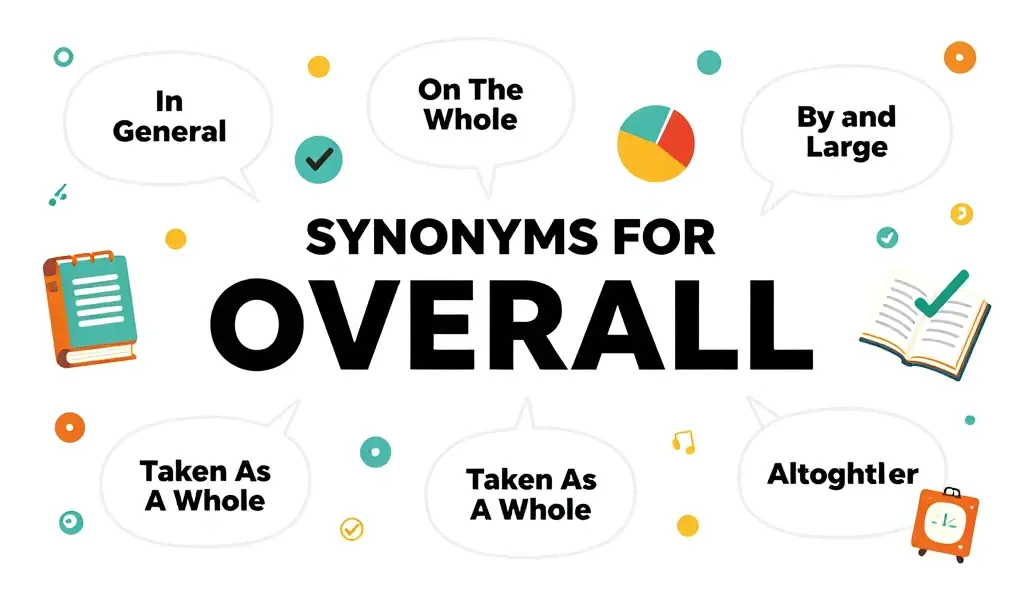
The word “overall” is a versatile term in the English language.
People search for synonyms for overall because relying on the same transition or modifier repeatedly makes writing sound monotonous and uninspired.
Depending on how it is used, “overall” can mean a high-level summary, a total count, or something that covers everything.
When you write a research paper, summarize quarterly performance for your team, or describe a complete experience, picking a precise synonym helps you communicate your exact point.
Knowing whether you need an adjective or an adverbial transition ensures your writing remains clear, authoritative, and engaging.
Meaning
The word “overall” refers to taking everything into account, covering everything, or viewing a situation as a whole.
- Definition: Including or considering everything; regarded as a whole; general or total.
- Context: Used to summarize findings, state complete totals, describe general trends, or refer to protective outerwear (e.g., work overalls).
- Common Usage: Extremely common across academic papers, financial reports, news writing, and daily business communication.
- Pronunciation: /ˈoʊ.vɚ.ɑːl/ (sounds like OH-ver-ahl). To pronounce it naturally, stress the first syllable “OH,” move smoothly through “ver,” and finish with an open “ahl” sound.
Part of Speech
“Overall” is unique because it functions as an adverb, an adjective, and occasionally a noun.
- As an Adverb (Transition): “Overall, the campaign performed exceptionally well.” (Function: summarizing a broad statement).
- As an Adjective: “The overall cost of the project exceeded our estimates.” (Function: describing a total or complete noun).
- As a Noun: “He put on his denim overalls before working in the garden.” (Function: naming protective garments; usually plural).
Note: This guide focuses on synonyms for overall in its primary adjective and adverb forms.
Synonyms Table
Here is a quick overview of the top synonyms for “overall” categorized by form, usage, and difficulty level:
| Word / Phrase | Meaning | Usage | Formality | Example | Difficulty Level |
| In general | Considering main aspects rather than details | General, Writing | Neutral | In general, the new policy was well received. | Easy |
| On the whole | Considering everything together | Reports, Essays | Neutral | On the whole, the team achieved its targets. | Easy |
| Comprehensive | Including all or nearly all elements | Academic, Business | Formal | We need a comprehensive strategy for growth. | Medium |
| All-inclusive | Including everything without extra charges | Travel, Business | Neutral | They booked an all-inclusive vacation package. | Easy |
| Taken together | When evaluated as a combined group | Analysis, Science | Formal | Taken together, the stats reveal a trend. | Medium |
| Gross | The total amount before deductions | Finance, Math | Formal | The company reported a high gross revenue. | Easy |
| By and large | Everything considered in broad terms | Casual, Articles | Informal | By and large, the event ran smoothly. | Medium |
| Sweeping | Wide in range or effect | Criticism, Policy | Formal | The law made sweeping changes to tax code. | Medium |
| Total | The complete amount or sum | Math, General | Neutral | The total cost came out to fifty dollars. | Easy |
| Global | Covering or affecting the entire system | Business, Tech | Formal | We need a global solution to this issue. | Medium |
Best Synonyms Explained
1. In General
- Meaning: Considering the main features or majority of cases rather than small details.
- Difference from “Overall”: “In general” emphasizes common trends rather than a strict mathematical total.
- Example: “In general, students prefer interactive lessons over traditional lectures.”
- Best Situation: Introducing broad statements, general observations, and survey takeaways.
- Common Mistakes: Using it when you need to state an exact numerical total.
2. On the Whole
- Meaning: Considering everything; broadly speaking.
- Difference from “Overall”: “On the whole” functions purely as an adverbial transition, whereas “overall” can also be an adjective.
- Example: “On the whole, the conference was a major professional success.”
- Best Situation: Concluding essay paragraphs, performance reviews, and general summaries.
- Common Mistakes: Placing it directly before a noun (e.g., say “the overall impact,” not “the on the whole impact”).
3. Comprehensive
- Meaning: Complete and including all or nearly all elements, aspects, or details.
- Difference from “Overall”: “Comprehensive” is an adjective that highlights thoroughness and depth rather than just a high-level summary.
- Example: “The audit provided a comprehensive review of firm finances.”
- Best Situation: Describing plans, reports, insurance policies, and academic research.
- Common Mistakes: Using it as a sentence-starting transition adverb.
4. Taken Together
- Meaning: When considered as a collective unit or combined group of factors.
- Difference from “Overall”: Explicitly connects multiple individual pieces of evidence to a final conclusion.
- Example: “Taken together, these three studies prove our core hypothesis.”
- Best Situation: Scientific papers, legal arguments, and complex data analysis.
- Common Mistakes: Using it without having listed distinct points or items beforehand.
5. By and Large
- Meaning: On the whole; considering everything in broad terms.
- Difference from “Overall”: “By and large” is more conversational and idiomatic.
- Example: “By and large, the community supports building the new park.”
- Best Situation: Speeches, opinion columns, podcasts, and casual articles.
- Common Mistakes: Using it in rigid academic dissertations or formal legal briefs.
6. Total
- Meaning: Constituting the full number, quantity, or degree of something.
- Difference from “Overall”: Focuses strictly on numerical sums or absolute completeness.
- Example: “The total expenditure exceeded our initial projections.”
- Best Situation: Financial accounting, budget reports, math problems, and inventory counts.
- Common Mistakes: Substituting “total” when you mean a vague general mood rather than a measurable amount.
7. Sweeping
- Meaning: Wide-ranging, extensive, or affecting a vast array of things at once.
- Difference from “Overall”: Implies dramatic, broad impact rather than a simple summary view.
- Example: “The new CEO introduced sweeping reforms across every department.”
- Best Situation: Discussing major policy shifts, organizational restructuring, and historical changes.
- Common Mistakes: Using it for small, minor updates.
Antonyms
Antonyms for “overall” are words that focus on specific details, individual components, or partial amounts:
| Word / Phrase | Meaning | Usage | Example |
| Specific | Clearly defined, exact, or particular | General | We need to focus on specific customer needs. |
| Partial | Not total or complete; incomplete | Formal | The team achieved partial success on the task. |
| Individual | Single or separate when considered apart | Analysis | Each individual piece of data was verified. |
| Narrow | Limited in extent, degree, or scope | Technical | The study had a narrow focus on urban areas. |
| Detailed | Including many small items or specifics | Reports | Please send a detailed breakdown of costs. |
| Particular | Relating to a single distinct person or thing | Everyday | She paid attention to that particular step. |
| Piece-by-piece | One item or step at a time | Conversational | We fixed the machine piece-by-piece. |
30 Real-World Examples
- In general, customer satisfaction scores improved this quarter.
- The director outlined a comprehensive strategy for international expansion.
- On the whole, the test results aligned with our initial predictions.
- Taken together, these clues point to a clear conclusion.
- By and large, attendees expressed enthusiasm for the new workshop.
- The total cost of repairs came to under five hundred dollars.
- Government officials proposed sweeping changes to environmental policy.
- The resort offers an all-inclusive rate for families.
- A global perspective helps companies navigate complex markets.
- The gross revenue reached record levels before taxes.
- In broad terms, the two proposals share identical goals.
- Her overall impression of the candidate was very positive.
- All in all, the trip was a memorable adventure for everyone.
- The manual provides an all-encompassing guide to machine setup.
- Generally speaking, colder climates require higher home insulation standards.
- The paper evaluates the cumulative impact of urban growth.
- For the most part, the software update resolved system glitches.
- They conducted a thorough examination of the building foundation.
- The net benefit of the trade deal far outweighs the costs.
- As a whole, the community rallied together during the emergency.
- The report highlights the entire scope of the restoration project.
- In the aggregate, small donations funded the entire charity drive.
- He took an overarching view of the company’s long-term mission.
- In sum, our team secured three major contracts this month.
- The plan incorporates a wide-ranging set of features.
- In short, the experiment yielded conclusive results.
- The document outlines broad-brush goals without minor details.
- Her complete dedication earned her a promotion.
- When all is said and done, customer trust matters most.
- The manager commended the team’s collective effort.
25 Naturally Written Sentences
Here are 25 sentences showcasing various writing styles using synonyms for overall:
- Simple: In general, the warm weather made everyone happy.
- Academic: Taken together, the empirical data validates our primary research model.
- Conversational: All in all, we had a fantastic time at the concert.
- Professional: The board approved a comprehensive roadmap for product development.
- Creative: A broad canopy of stars covered the quiet sleeping valley.
- Technical: The total bandwidth consumption spiked during peak hours.
- Descriptive: The museum offers an all-encompassing view of regional art history.
- Direct: In short, sales are up by fifteen percent.
- Informal: By and large, the party was a big success.
- Formal: On the whole, the committee supported the proposed amendments.
- Explanatory: Broadly speaking, automation speeds up routine manufacturing steps.
- Journalistic: The governor announced sweeping economic reforms this morning.
- Narrative: As a whole, the village stood resilient against the severe storm.
- Persuasive: A global strategy ensures long-term stability in shifting markets.
- Instructional: Review the complete set of instructions before assembling the unit.
- Medical: The patient shows a healthy general condition across all vitals.
- Literary: Ultimately, the novel explores the overarching human desire for belonging.
- Business: The gross margin remained steady despite supply chain challenges.
- Casual: For the most part, I agree with your idea.
- Scientific: Cumulative observations confirm a steady rise in temperature.
- Analytical: In the aggregate, consumer spending drives economic recovery.
- Expressive: Taken as a whole, this artwork represents a masterpiece of modern design.
- Informative: The report provides a thorough overview of energy efficiency options.
- Brief: Overall, it worked.
- Detailed: Taken together, these three strategic adjustments produced an immediate increase in quarterly profits.
Formal vs Informal Usage
Choosing the right synonyms for overall depends on your format and audience. Using casual idioms in academic papers lowers credibility, while using heavy terms in informal chats can sound stiff.
| Word / Phrase | Formality | Best Setting | Example |
| Overall | Neutral | General writing, summaries | “The overall result was positive.” |
| Comprehensive | Highly Formal | Academic papers, reports | “We conducted a comprehensive review.” |
| Taken together | Formal | Research analysis, law | “Taken together, the facts prove the claim.” |
| On the whole | Neutral / Formal | Essays, business reviews | “On the whole, morale is high.” |
| By and large | Informal | Blogs, podcasts, speeches | “By and large, people liked the show.” |
| All in all | Casual | Friendly chats, personal blogs | “All in all, it was a good day.” |
Academic Usage
Academic writing values precision. Repeating “overall” can make essay conclusions sound repetitive. Replacing it with precise terms clarifies whether you mean a sum, a trend, or a thorough analysis.
- Instead of: “Overall, the experiment was a success.”
- Use: “Taken together, the experimental findings support the original hypothesis.”
- Instead of: “The overall project was detailed.”
- Use: “The study presents a comprehensive analysis of urban planning.”
- Instead of: “Overall, the data shows growth.”
- Use: “In the aggregate, the data indicates a consistent upward trend.”
Daily Conversation
In everyday speech, formal transition words sound overly rigid. Use natural phrases to summarize experiences or thoughts casually.
- Casual: “The overall movie was okay.” -> “All in all, the movie was pretty good.”
- Casual: “The overall food was good.” -> “For the most part, the food tasted great.”
- Casual: “The overall trip was fun.” -> “By and large, we had a blast on our trip.”
Grammar Tips
When replacing “overall” with a synonym, keep these key grammar rules in mind:
- Distinguish Adjectives from Adverbs:
- Adverb transitions start sentences: “Overall,…” / “On the whole,…”
- Adjectives modify nouns: “the overall cost” / “the total cost” / “the comprehensive plan”.
- Use Commas with Introductory Phrases: Always place a comma after sentence-starting transitions.
- Correct: “In general, results met expectations.”
- Correct: “On the whole, the budget balanced.”
- Avoid Doubling Up: Never pair two concluding modifiers together.
- Incorrect: “In general, overall, the team won.”
- Correct: “In general, the team won.”
Collocations
Collocations are words and phrases that naturally pair with specific synonyms for overall:
- Comprehensive review: “The auditor published a comprehensive review.”
- Sweeping changes: “The new law brought sweeping changes to healthcare.”
- Gross margin: “The finance team calculated the company’s gross margin.”
- Overall impression: “The jury shared a favorable overall impression.”
- Taken together: “Taken together, these data points establish a clear pattern.”
- Global impact: “Climate patterns produce a global impact on agriculture.”
Phrases & Idioms
Here are common English phrases and idioms used to express “overall” concepts:
- All in all: Taking everything into consideration.
- When all is said and done: After everything has been taken into account.
- By and large: Generally speaking; on the whole.
- Big picture: Looking at the entire situation rather than micro details.
- For the most part: In most cases; generally.
Word Comparison
Understanding subtle differences helps you pick the right word:
| Word / Phrase | Primary Focus | Best For | Avoid When |
| Comprehensive | Exhaustive thoroughness | Reports & academic plans | Stating a simple numerical total |
| On the whole | Broad general summary | Essay conclusions | Modifying a single noun directly |
| Total | Absolute numerical sum | Math, finance & budgets | Summarizing qualitative feelings |
| Taken together | Combined evidence | Synthesizing research points | Writing a simple single-point sentence |
| Sweeping | Broad dramatic impact | Reforms, policy & critiques | Describing minor routine updates |
FAQs
Q1. What is the most formal synonym for overall?
A: Common formal alternatives include comprehensive, taken together, in the aggregate, and on the whole.
Q2. What can I use instead of overall in an essay?
A: Use on the whole, taken together, in general, or comprehensive, depending on the context.
Q3. Is in general identical to overall?
A: No. In general describes broad trends, while overall summarizes the complete picture.
Q4. How do I choose between total and overall?
A: Total refers to an exact sum, while overall gives a general summary.
Q5. Can overall be used at the beginning of a sentence?
A: Yes. It is commonly followed by a comma, such as “Overall, the results were positive.”
Q6. What is a good synonym for overall in business reports?
A: Comprehensive, in the aggregate, and gross are common business alternatives.
Q7. What is the difference between comprehensive and overall?
A: Overall summarizes, while comprehensive covers every detail.
Q8. What are good antonyms for overall?
A: Common opposites include specific, individual, partial, and detailed.
Q9. How can I replace overall in daily conversations?
A: Try all in all, by and large, for the most part, or in general.
Q10. Is overall an overused word in writing?
A: It can be. Using varied alternatives improves readability.
Q11. Which synonym works best for financial figures?
A: Gross, net, total, and cumulative are appropriate, depending on the context.
Q12. What does sweeping mean?
A: It means broad, wide-ranging, or far-reaching.
Q13. Why is semantic variety important in SEO content?
A: It improves readability, reduces repetition, and helps search engines better understand your content.
Expert Tips for Using Synonyms
- Check the Part of Speech: Ensure your chosen synonym matches whether you need an adjective (e.g., a comprehensive plan) or an adverb (e.g., on the whole, it worked).
- Align with Content Depth: Use comprehensive only when you have thoroughly covered every angle. Use in general for high-level summaries.
- Punctuate Sentence Connectors: Always place a comma after sentence-starting transitions like on the whole or taken together.
- Vary Your Transitions: Avoid replacing every instance of “overall” with the exact same alternative phrase; rotate your options based on sentence flow.
Conclusion:
Expanding your vocabulary with synonyms for overall is an easy way to refine your writing style.
Swapping generic terms for precise alternatives like in general, on the whole, comprehensive, taken together, and total ensures your messages remain clear, structured, and engaging.
Keep this guide handy whenever you write to pick the perfect transition or descriptor for every document.

Chloe Ward is a vocabulary content specialist from Tampa, Florida. She enjoys helping readers build stronger communication skills through better word choices.