
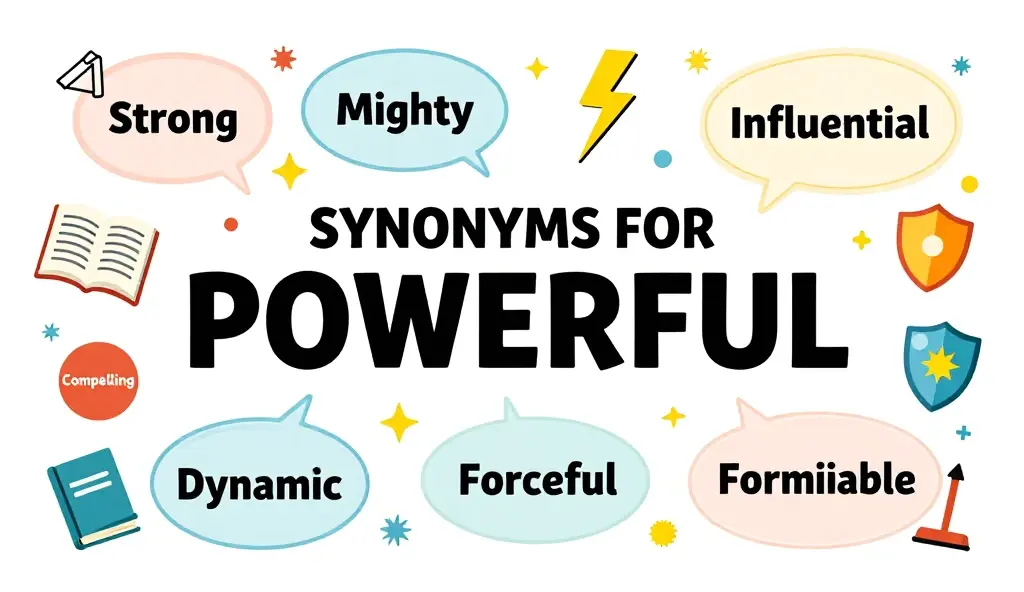
The word “powerful” is one of the most widely used adjectives in the English language.
People search for synonyms for powerful because repeating the same word across essays, stories, speeches, or business reports makes writing feel repetitive and dull.
Strength comes in many forms, from a heavy industrial engine and a dominant world leader to a deeply moving poem or a persuasive speech.
When you describe a compelling character, write an academic paper, or craft a pitch for your company, choosing a specific synonym conveys the exact type and intensity of force you mean.
Replacing “powerful” with a richer alternative instantly elevates your tone and leaves a lasting impression on your readers.
Meaning
The word “powerful” describes having great power, physical force, authority, or a strong effect on the mind or senses.
- Definition: Possessing great power, strength, or authority; producing a large or overwhelming physical, mental, or emotional effect.
- Context: Used to describe physical strength, political influence, persuasive arguments, loud sounds, dynamic machinery, or potent medicine.
- Common Usage: Widely used in literature, news journalism, political speeches, fitness, and scientific writing.
- Pronunciation: /ˈpaʊ.ɚ.fəl/ (sounds like POW-er-ful). To pronounce it naturally, emphasize the first syllable “POW,” move through a light “er,” and end with a soft “ful” sound.
Part of Speech
“Powerful” functions primarily as an adjective, but it derives from the noun power and can be transformed into an adverb (powerfully).
- As an Adjective: “The company made a powerful impact on the market.” (Function: describing a noun with force or influence).
- As an Adverb: “She spoke powerfully about the need for environmental protection.” (Function: modifying a verb to show intensity).
- As a Noun (Root): “Knowledge grants incredible power to those who seek it.” (Function: naming the quality or state itself).
Note: This guide focuses on synonyms for powerful in their primary adjective form.
Synonyms Table
Here is a quick overview of the top synonyms for “powerful” categorized by form, usage, and difficulty level:
| Word | Meaning | Usage | Formality | Example | Difficulty Level |
| Mighty | Having immense physical, military, or natural power | Epic, Physical, Nature | Neutral | A mighty storm swept across the coastline. | Easy |
| Potent | Having a strong chemical, medical, or emotional effect | Science, Emotions | Formal | The doctor prescribed a potent medication. | Medium |
| Influential | Having the power to shape thoughts, actions, or events | Leadership, Business | Neutral | She is one of the most influential leaders today. | Easy |
| Compelling | Evoking interest, attention, or admiration in a powerful way | Writing, Arguments | Neutral | He presented a compelling case for the project. | Medium |
| Dominant | Most powerful, influential, or prominent | Sports, Biology, Market | Neutral | The team maintained a dominant position all season. | Easy |
| Robust | Strong, healthy, and capable of enduring strain | Systems, Health, Tech | Formal | The software boasts a robust security framework. | Medium |
| Formidable | Inspiring fear, awe, or respect through being powerful | Challenges, Opponents | Formal | They faced a formidable opponent in the finals. | Hard |
| Forceful | Expressed with vigor, determination, or physical energy | Speech, Actions | Neutral | She delivered a forceful response to the critics. | Easy |
| Redoubtable | Formidable, especially as an adversary | Literature, History | Highly Formal | The redoubtable general led his troops to victory. | Hard |
| Heavy-duty | Designed to withstand tough use or immense force | Machinery, Tools | Informal | He bought heavy-duty equipment for construction. | Easy |
Best Synonyms Explained
1. Mighty
- Meaning: Possessing massive physical strength, vast power, or impressive size.
- Difference from “Powerful”: “Mighty” carries a legendary, dramatic, or grand poetic quality.
- Example: “The mighty oak tree stood tall against the roaring gale.”
- Best Situation: Creative storytelling, descriptions of nature, historical tales, and heroic writing.
- Common Mistakes: Avoid using “mighty” in technical, scientific, or formal business reports where precision is needed.
2. Potent
- Meaning: Highly effective, chemically strong, or producing a deep emotional effect.
- Difference from “Powerful”: Focuses on internal concentration or concentrated effectiveness rather than sheer external physical force.
- Example: “Garlic serves as a potent natural remedy for minor colds.”
- Best Situation: Medical research, chemistry, perfume descriptions, and discussions of symbolism.
- Common Mistakes: Do not use “potent” to describe a physically large person lifting weights.
3. Influential
- Meaning: Having the capacity to alter beliefs, decisions, or developments without direct physical force.
- Difference from “Powerful”: Pertains specifically to social, political, intellectual, or financial clout.
- Example: “The author published an influential essay on artificial intelligence.”
- Best Situation: Business profiles, political analysis, academic citations, and career reviews.
- Common Mistakes: Using “influential” for inanimate physical tools or mechanical engines.
4. Compelling
- Meaning: Demanding attention or belief through irresistible force, logic, or emotion.
- Difference from “Powerful”: Focuses on how strongly an argument, story, or visual draws a person in.
- Example: “The attorney offered a compelling argument that convinced the entire jury.”
- Best Situation: Debates, essays, book reviews, marketing pitches, and legal cases.
- Common Mistakes: Confusing “compelling” with physical physical strength or raw muscle power.
5. Formidable
- Meaning: Inspiring respect, awe, or fear because of impressive power, skill, or size.
- Difference from “Powerful”: Adds a layer of difficulty, challenge, or intimidation to power.
- Example: “The chess grandmaster remains a formidable rival on the international circuit.”
- Best Situation: Sports coverage, strategic analysis, military history, and high-stakes competitions.
- Common Mistakes: Using it for positive, gentle things that are not challenging or intimidating.
6. Robust
- Meaning: Strong, sturdy, healthy, or built to handle heavy demands without failing.
- Difference from “Powerful”: Emphasizes endurance, structural integrity, and durability rather than raw explosive energy.
- Example: “The company developed a robust system to prevent data leaks.”
- Best Situation: Technology, engineering, financial systems, health evaluations, and coffee descriptions.
- Common Mistakes: Using “robust” to describe a person’s verbal persuasion or political voting rights.
7. Forceful
- Meaning: Expressed with conviction, physical force, or energetic determination.
- Difference from “Powerful”: Suggests active, assertive, and direct application of force or speech.
- Example: “He made a forceful statement demanding immediate structural reforms.”
- Best Situation: Speeches, management directives, physical actions, and opinion articles.
- Common Mistakes: Using it when you want to describe quiet, subtle influence.
Antonyms
Antonyms for “powerful” are words that describe weakness, lack of influence, vulnerability, or fragility:
| Word | Meaning | Usage | Example |
| Weak | Lacking physical strength, energy, or power | General | The sick puppy had a weak bark. |
| Feeble | Lacking physical strength, especially as a result of age or illness | Formal | The old man gave a feeble wave from his bed. |
| Impotent | Lacking power or ability to take effective action | Formal / Legal | The law remained impotent without enforcement. |
| Powerless | Without ability, influence, or control | General | Citizens felt powerless against the sudden price hikes. |
| Fragile | Easily broken, damaged, or destroyed | General | Handle the fragile glass vase with care. |
| Ineffective | Not producing any significant effect | Business / Science | The old security policy proved entirely ineffective. |
| Frail | Delicate and easily hurt | General | Her frail health required constant care. |
30 Real-World Examples
- The sports car features a mighty V8 engine built for peak racing speed.
- The medicine proved to be a potent treatment against the infection.
- She became one of the most influential voices in modern journalism.
- The documentary presented a compelling look at ocean conservation.
- Tech giants maintain a dominant share in the global smartphone market.
- Engineers built a robust bridge capable of withstanding severe earthquakes.
- The championship team proved to be a formidable challenger on the field.
- He delivered a forceful speech that motivated the audience to act.
- A heavy-duty crane was brought in to lift the steel beams.
- The storm produced cataclysmic winds that knocked out regional power.
- Her commanding presence immediately silenced the noisy room.
- The historical nation maintained an invincible fleet during the war.
- His cogent reasoning won over the board of directors.
- The volcano released an explosive burst of ash and hot steam.
- She wrote a poignant memoir about overcoming severe adversity.
- The boxer relied on his punishing jab to control every round.
- A dynamic leader inspires teams to achieve ambitious targets.
- The defense deployed an impenetrable wall against the opposing offense.
- The country maintained a stout defense along its border regions.
- The CEO issued a trenchant critique of current market practices.
- The amplifier delivered shattering sound throughout the arena.
- Heat waves created an overwhelming surge in power consumption.
- The law firm built an unassailable defense for their client.
- A vigorous workout routine builds functional muscle tone over time.
- The nation established an authoritative regulatory commission.
- Her muscular frame helped her set new weightlifting records.
- The company introduced a high-powered server designed for cloud AI.
- The novel features a striking portrayal of human resilience.
- They faced a daunting task trying to clean the massive oil spill.
- His herculean effort made completing the mountain trek possible.
25 Naturally Written Sentences
Here are 25 sentences showcasing various writing styles using synonyms for powerful:
- Simple: The mighty storm blew down big branches in the park.
- Academic: The study provides compelling evidence linking sleep to cognitive recall.
- Conversational: She has a pretty influential blog that everyone in our office reads.
- Professional: We must build a robust infrastructure to handle rising user traffic.
- Creative: A potent wave of nostalgia swept over him as he opened the dusty trunk.
- Technical: The server relies on a high-powered processor to handle data streams.
- Descriptive: His commanding voice echoed across the open courtyard.
- Direct: The team faced a formidable rival in the tournament opener.
- Informal: You need heavy-duty tools if you plan to tear down that wall.
- Formal: The diplomat offered a forceful defense of international peace treaties.
- Explanatory: Potent ingredients mean you only need a single drop of serum.
- Journalistic: The firm solidified its dominant market position through the merger.
- Narrative: With a mighty heave, the blacksmith lifted the glowing iron bar.
- Persuasive: These cogent facts demonstrate why our proposal deserves funding.
- Instructional: Ensure the safety harness is attached to a stout anchor point.
- Medical: The hospital administers a potent antibiotic to fight severe infections.
- Literary: The redoubtable general guided his army through treacherous winter mountain passes.
- Business: The executive presented an authoritative strategy for international growth.
- Casual: That speaker gave a really moving talk today.
- Scientific: Empirical data confirms a dynamic shift in global weather cycles.
- Analytical: The candidate made trenchant points during the televised debate.
- Expressive: Her intense performance left the audience sitting in total awe.
- Informative: Heavy-duty trucks transport raw materials across long highway distances.
- Brief: The argument was compelling.
- Detailed: Thanks to a robust financial foundation and an influential network, the startup expanded smoothly across three continents.
Formal vs Informal Usage
Choosing the right synonyms for powerful depends on your setting and reader. Using poetic words in technical papers can sound out of place, while using casual slang in formal essays lowers your credibility.
| Word | Formality | Best Setting | Example |
| Powerful | Neutral | General writing, speech | “He gave a powerful performance.” |
| Compelling | Formal | Academic essays, legal briefs | “The essay makes a compelling case.” |
| Robust | Formal / Professional | Tech, engineering, business | “We built a robust system.” |
| Redoubtable | Highly Formal | Historical prose, literature | “The redoubtable leader stood firm.” |
| Heavy-duty | Informal / Practical | Tools, machinery, casual talk | “I need heavy-duty tape.” |
| Mighty | Artistic / Informal | Storytelling, sports, nature | “The mighty river flooded.” |
Academic Usage
Academic writing values precision. Repeating “powerful” can make research papers sound overly simple. Replacing it with targeted terms clarifies whether you mean persuasive logic, data strength, or political influence.
- Instead of: “The writer makes a powerful point about history.”
- Use: “The author articulates a cogent argument regarding historical trends.”
- Instead of: “The study used a powerful method.”
- Use: “The researchers employed a robust methodology.”
- Instead of: “The leader was very powerful.”
- Use: “The executive exercised influential authority over policy decisions.”
Daily Conversation
In everyday speech, you want natural words that express intensity without sounding like a dictionary.
- Casual: “That was a powerful movie.” -> “That was a really moving movie.”
- Casual: “He has a powerful car.” -> “He drives a super fast car.”
- Casual: “She gave a powerful hit.” -> “She delivered a really hard hit.”
Grammar Tips
When replacing “powerful” with a synonym, keep these key grammar rules in mind:
- Match the Domain: Ensure the synonym fits the target noun.
- Arguments / Ideas: compelling, cogent, trenchant, persuasive.
- Systems / Products: robust, heavy-duty, high-powered.
- People / Leaders: influential, formidable, commanding, dominant.
- Chemical / Physical Impact: potent, explosive, mighty.
- Watch Preposition Pairings:
- Influential in a field / over a group.
- Formidable against an opponent.
- Dominant in a market.
- Check Intensity Levels:
- Moderate: strong, forceable, robust.
- High: potent, compelling, formidable.
- Extreme: cataclysmic, invincible, earth-shattering.
Collocations
Collocations are words and phrases that naturally pair with specific synonyms for powerful:
- Compelling evidence: “The prosecutor introduced compelling evidence to court.”
- Formidable opponent: “The champion respected his formidable opponent.”
- Robust framework: “Our team constructed a robust framework for project management.”
- Potent combination: “Diet and exercise create a potent combination for health.”
- Dominant force: “The country remains a dominant force in global trade.”
- Commanding lead: “The runner established a commanding lead early in the race.”
Phrases & Idioms
Here are common English phrases and idioms used to express power and strength:
- Packs a punch: Has a strong, immediate impact or effect.
- A force to be reckoned with: Someone or something so strong it cannot be ignored.
- Heavy hitter: An influential or powerful person or organization.
- Tower of strength: A person who provides strong emotional support.
- Pulls weight: Uses power or authority to influence a situation.
Word Comparison
Understanding subtle differences prevents word misuse:
| Word | Primary Focus | Best For | Avoid When |
| Compelling | Persuasive logic & emotion | Essays, arguments, speeches | Describing mechanical engines |
| Robust | Structural durability & health | Systems, tech, health | Describing a speech or poem |
| Potent | Concentrated internal impact | Medicine, smells, symbols | Describing physical body size |
| Formidable | Intimidating skill or power | Rivals, challenges, sports | Describing friendly, easy tasks |
| Influential | Shaping actions and thoughts | People, media, leadership | Describing physical tools |
FAQs
Q1. What is the most formal synonym for powerful?
A: Common formal alternatives include formidable, authoritative, cogent, and redoubtable.
Q2. What should I use instead of powerful in an essay?
A: Use compelling, robust, influential, or potent, depending on the context.
Q3. Is potent identical to powerful?
A: No. Potent emphasizes concentrated effectiveness, while powerful has a broader meaning.
Q4. How do I describe a powerful person in writing?
A: Use influential, commanding, formidable, or dominant.
Q5. Can robust replace powerful for machines or systems?
A: Yes. Robust highlights strength, durability, and reliability.
Q6. What is a good synonym for powerful when describing weather?
A: Mighty, ferocious, devastating, and cataclysmic are excellent choices.
Q7. What is the difference between compelling and forceful?
A: Compelling persuades through logic or emotion, while forceful emphasizes strength and directness.
Q8. What are good antonyms for powerful?
A: Common opposites include weak, feeble, powerless, and ineffective.
Q9. How can I replace powerful in business emails?
A: Use impactful, robust, influential, or compelling.
Q10. Is powerful considered an overused word in writing?
A: It can be. Using more specific synonyms makes writing stronger and more engaging.
Q11. Which synonym works best for emotions?
A: Poignant, moving, intense, profound, and potent are excellent options.
Q12. How do I use mighty correctly?
A: Use it to describe great physical strength or impressive natural forces.
Q13. What is a casual alternative to powerful?
A: Try strong, hard-hitting, heavy-duty, or packs a punch.
Q14. Why is semantic variety important in writing?
A: It improves readability, adds precision, and avoids repetitive language.
Expert Tips for Using Synonyms
- Match the Context: Always match your word choice to the subject. Use compelling for arguments, robust for systems, and potent for treatments.
- Consider Emotional Tone: Words like formidable add a touch of fear or respect, while mighty adds a sense of grandeur and awe.
- Observe Collocations: Pair words naturally (e.g., compelling evidence, formidable opponent, robust framework).
- Vary Your Vocabulary: Keep a selection of alternatives on hand so you don’t swap one overused word for another.
Conclusion:
Expanding your vocabulary with synonyms for powerful is a quick way to make your writing more precise, engaging, and impactful.
Replacing a generic term with tailored alternatives like mighty, potent, influential, compelling, dominant, and robust ensures your message resonates clearly across essays, business documents, and creative stories.
Keep this guide handy whenever you write to select the perfect word for every context.

Emily Sanders is an English language content creator from Columbus, Ohio. She develops informative vocabulary guides for students and professionals.