
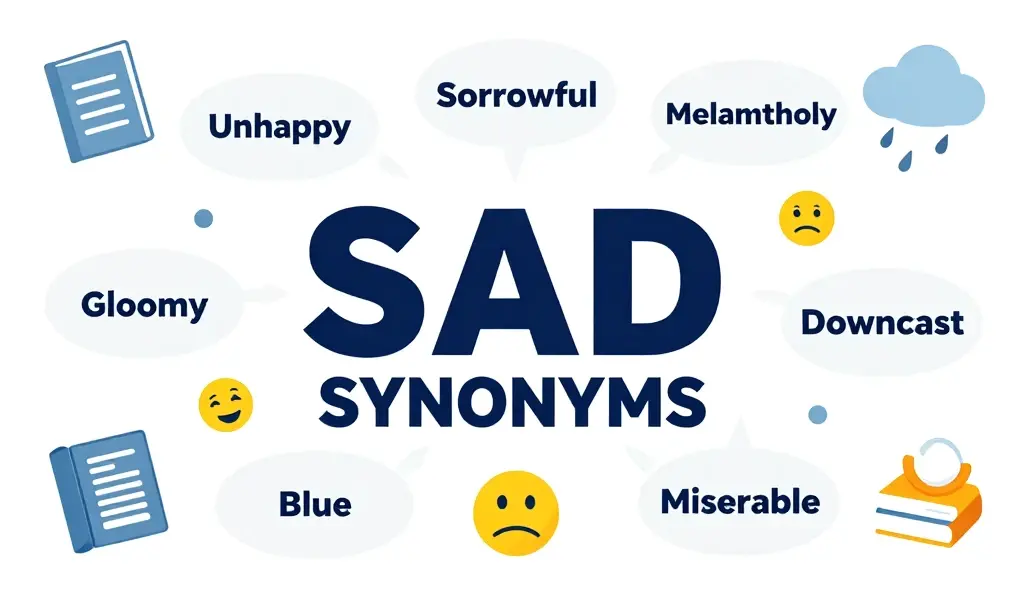
The word “sad” is one of the most basic emotional descriptors in the English language.
People search for sad synonyms because repeating “sad” over and over makes writing feel flat, generic, and uninspired.
Sadness comes in many different forms from a mild blue mood on a rainy day to intense, soul-crushing grief.
When you describe a character in a story, write a personal reflection, or talk about a difficult experience, choosing a specific synonym conveys the exact depth and nuance of the feeling.
Swapping “sad” for a richer alternative makes your message far more engaging, emotional, and powerful.
Meaning
The word “sad” describes a feeling of sorrow, unhappy mood, or causing grief and disappointment.
- Definition: Affected with or expressing grief, unhappiness, or sorrow; causing disappointment or regret.
- Context: It describes human emotions, dreary atmospheres, unfortunate events, or pathetic conditions.
- Common Usage: Used everywhere—from casual daily talk and children’s books to classic literature and medical evaluations.
- Pronunciation: /sæd/ (sounds like sadd). To pronounce it naturally, start with a crisp “s” sound, open into a short “a” sound as in “cat,” and finish with a soft “d.”
Part of Speech
“Sad” primarily functions as an adjective, but it can be modified into an adverb (sadly) or a noun (sadness).
- As an Adjective: “She felt sad after watching the movie.” (Function: describing a state of feeling).
- As an Adverb: “He sadly packed away his childhood photos.” (Function: describing how an action is performed).
- As a Noun: “An overwhelming sense of sadness filled the quiet room.” (Function: naming the emotion itself).
Note: This guide focuses on sad synonyms in their primary adjective form.
Synonyms Table
Here is a quick overview of the top synonyms for “sad” categorized by form, usage, and difficulty level:
| Word | Meaning | Usage | Formality | Example | Difficulty Level |
| Gloomy | Dark, dim, or feeling low in spirits | Moods, Weather | Neutral | The gloomy sky matched his quiet mood. | Easy |
| Sorrowful | Full of deep distress or sadness | Literature, Grief | Formal | She gave a sorrowful sigh after reading the letter. | Medium |
| Melancholy | A gentle, lingering, or thoughtful sadness | Creative, Poetry | Formal | Soft piano music often creates a melancholy mood. | Hard |
| Heartbroken | Suffering from intense grief or heartbreak | Personal, Relationships | Neutral | He was heartbroken when his dog passed away. | Easy |
| Downcast | Feeling low, disheartened, or looking down | Behavior, Appearance | Neutral | She had a downcast expression after losing the match. | Medium |
| Dejected | Low in spirits due to failure or rejection | Personal, Failure | Formal | The team walked off the field feeling dejected. | Medium |
| Despondent | Feeling extreme discouragement or hopelessness | Mental State, Crisis | Formal | After months without work, he became despondent. | Hard |
| Dismal | Causing gloom, misery, or depression | Situations, Atmosphere | Neutral | The weather forecast for the weekend looks dismal. | Medium |
| Miserable | Unhappy, uncomfortable, or wretched | Physical/Mental State | Neutral | He felt miserable sitting in the freezing rain. | Easy |
| Down in the dumps | Feeling blue or temporarily unhappy | Casual Conversation | Informal | She felt down in the dumps after a long week. | Easy |
Best Synonyms Explained
1. Gloomy
- Meaning: Feeling low in spirits or describing a dark, shadowy atmosphere.
- Difference from “Sad”: “Gloomy” connects emotional sadness with physical darkness or dreary surroundings.
- Example: “He sat in the corner of the gloomy room, lost in his thoughts.”
- Best Situation: Describing bad weather, dark settings, or lingering mild sadness.
- Common Mistakes: Do not use it for intense, traumatic grief; “gloomy” implies a lower, dimmer intensity.
2. Sorrowful
- Meaning: Full of sorrow, grief, or deep regret.
- Difference from “Sad”: “Sorrowful” carries a heavier, more formal emotional weight than plain “sad.”
- Example: “The sorrowful widow thanked everyone for attending the memorial service.”
- Best Situation: Formal writing, eulogies, tragic literature, and deep emotional reflections.
- Common Mistakes: Using it for minor daily annoyances (like a canceled plan) can sound melodramatic.
3. Melancholy
- Meaning: A thoughtful, gentle, or long-lasting state of sadness, often with no clear cause.
- Difference from “Sad”: “Melancholy” has an artistic, reflective quality, blending sadness with quiet introspection.
- Example: “Autumn leaves always bring a feeling of melancholy to the quiet park.”
- Best Situation: Creative writing, poetry, music reviews, and deeply reflective prose.
- Common Mistakes: Misspelling the word or using it to describe sudden, aggressive anger.
4. Heartbroken
- Meaning: Suffering deeply from grief, loss, or emotional heartbreak.
- Difference from “Sad”: Specific to emotional pain caused by losing someone or something you love deeply.
- Example: “She was heartbroken when her childhood home was sold.”
- Best Situation: Relationship stories, personal essays, family tragedies, and emotional drama.
- Common Mistakes: Using it for small physical injuries or light disappointments.
5. Dejected
- Meaning: Unhappy, disappointed, and lacking hope due to rejection or failure.
- Difference from “Sad”: Focuses specifically on the sadness that follows being turned down or failing at something.
- Example: “After receiving the rejection letter, he felt completely dejected.”
- Best Situation: Sports losses, job rejection stories, and personal setbacks.
- Common Mistakes: Confusing it with physical illness; “dejected” is about spirit and confidence.
6. Despondent
- Meaning: Feeling extreme discouragement, hopelessness, or loss of courage.
- Difference from “Sad”: Much stronger than “sad,” indicating a near-total loss of hope.
- Example: “The stranded hikers grew despondent as night began to fall.”
- Best Situation: Dramatic storytelling, crisis situations, and serious psychological descriptions.
- Common Mistakes: Using it casually for everyday mild disappointments.
7. Downcast
- Meaning: Disheartened, sad, or literally directing eyes downward due to sadness or shame.
- Difference from “Sad”: Highlights the physical posture (slouched shoulders, looking at the floor) that accompanies sadness.
- Example: “He walked into the room with downcast eyes and a silent sigh.”
- Best Situation: Describing body language, character expressions, and quiet disappointment.
- Common Mistakes: Using it to describe abstract situations rather than people or facial expressions.
Antonyms
Antonyms for “sad” are words that describe feelings of happiness, joy, excitement, and cheerfulness:
| Word | Meaning | Usage | Example |
| Happy | Feeling or showing pleasure and contentment | General | The children were happy to play outside. |
| Joyful | Feeling or causing great happiness and delight | Formal / Expressive | The family celebrated the joyful news together. |
| Cheerful | Noticeably happy, bright, and optimistic | Everyday | She gave a cheerful wave as she walked past. |
| Elated | Extremely happy and excited over a victory | High Emotion | He was elated when he passed the final exam. |
| Jubilant | Expressing great happiness and triumph | Public / Victory | The crowd grew jubilant when the team scored. |
| Delighted | Feeling or showing great pleasure | Friendly / Polite | I am delighted to meet you today. |
| Upbeat | Cheerful, optimistic, and full of positive energy | Casual / Business | She maintained an upbeat attitude despite the delay. |
30 Real-World Examples
- The movie had such a sorrowful ending that everyone in the theater fell silent.
- Rain kept falling on the window, adding to the gloomy mood of the afternoon.
- She felt heartbroken when her best friend moved to another state.
- The soft piano melody created a gentle melancholy throughout the quiet house.
- The job applicant left the office looking dejected after the difficult interview.
- He became despondent when his car broke down in the middle of nowhere.
- Her downcast eyes revealed how much the harsh criticism hurt her feelings.
- Working in a dark, windowless basement can make anyone feel miserable.
- The gray fog over the bay created a dismal scene for the sailors.
- Feeling a bit down in the dumps, he decided to go for a long walk.
- The old dog gave a sorrowful glance as his owner grabbed the suitcase.
- A melancholy silence settled over the room after the news broadcast.
- They were heartbroken to see the ancient oak tree cut down.
- The sales team looked dejected after losing their top client.
- He felt miserable throughout the entire winter season.
- The gloomy weather forced the organizers to cancel the outdoor picnic.
- Her face turned downcast the moment she read the test score.
- Tragic news leaves people feeling grief-stricken and overwhelmed.
- Without any remaining options, the stranded group turned despondent.
- The abandoned park looked dismal under the cloudy gray sky.
- A woeful expression washed over his face as he admitted his mistake.
- The letter contained disconsolate thoughts from a lonely traveler.
- She tried to smile, but her eyes remained heavy-hearted.
- The long delay made all the waiting passengers feel glum.
- He offered a crestfallen apology after spilling the coffee.
- Her doleful singing voice filled the cathedral with emotion.
- The news of the accident sent a somber mood across the entire town.
- After the arguments, a heavy atmosphere hung over the family dinner.
- He walked away from the field with a disappointed expression.
- The orphan looked forlorn sitting on the wooden porch alone.
25 Naturally Written Sentences
Here are 25 sentences showcasing various writing styles using sad synonyms:
- Simple: The dreary morning made her feel gloomy.
- Academic: Literature often uses melancholy themes to explore human vulnerability.
- Conversational: I felt pretty down in the dumps when my favorite restaurant closed.
- Professional: The board maintained a somber tone while discussing the financial losses.
- Creative: Autumn leaves danced slowly down, weaving a cloak of melancholy across the park.
- Technical: Prolonged despondent behavior can be a key indicator of clinical depression.
- Descriptive: His downcast gaze and slouched posture showed his deep disappointment.
- Direct: She was heartbroken by the bad news.
- Informal: He walked home feeling glum after missing his flight.
- Formal: The country observed a national day of mourning in sorrowful remembrance.
- Explanatory: People often feel miserable when physical exhaustion mixes with emotional stress.
- Journalistic: Crestfallen fans slowly flooded out of the stadium after the loss.
- Narrative: As the ship sailed away, she gave one last forlorn wave to the shore.
- Persuasive: We cannot leave these families in such dismal conditions without offering aid.
- Instructional: Approach grieving individuals with gentle empathy rather than forced cheerfulness.
- Medical: The patient appears disconsolate following the recent medical diagnosis.
- Literary: A doleful wind howled through the empty corridors of the ancient castle.
- Business: The team felt dejected after working weeks on a proposal that was rejected.
- Casual: Rain on a weekend is always a bummer.
- Scientific: Test subjects exhibited gloomy facial expressions when exposed to low lighting.
- Analytical: Data shows a drop in morale, with many workers feeling disencouraged.
- Expressive: Her heavy-hearted sigh spoke louder than any words ever could.
- Informative: The report highlights dismal living conditions in flood-affected regions.
- Brief: He stood crestfallen.
- Detailed: After losing his life savings in the failed business venture, he became completely despondent about the future.
Formal vs Informal Usage
Choosing the right sad synonyms depends heavily on your setting and reader. Using poetic or formal words in casual chats can sound melodramatic, while using slang in essays can lower your credibility.
| Word | Formality | Best Setting | Example |
| Sad | Neutral | Casual talk, basic writing | “I feel sad today.” |
| Despondent | Highly Formal | Literature, psychology, essays | “He grew despondent over time.” |
| Melancholy | Formal / Artistic | Creative writing, poetry, reviews | “The film has a melancholy tone.” |
| Dejected | Neutral / Formal | Business, sports, reports | “The losing team looked dejected.” |
| Down in the dumps | Informal | Everyday speech, friendly texts | “She is down in the dumps.” |
| Bummer | Very Informal | Casual chats among friends | “That rainy weather was a total bummer.” |
Academic Usage
In academic writing, precision and tone matter. Repeating “sad” sounds overly simple in essays, research papers, and literary analyses.
- Instead of: “The poet feels sad in the poem.”
- Use: “The poet conveys a profound sense of melancholy throughout the verse.”
- Instead of: “The characters live in a sad city.”
- Use: “The characters reside in a dismal urban environment.”
- Instead of: “The test subjects felt sad after failing.”
- Use: “The test subjects exhibited dejected behavior following the failure.”
Daily Conversation
In everyday speech, you want natural words that express feelings without sounding like a textbook.
- Casual: “She is sad about her grades.” -> “She is pretty bummed out about her grades.”
- Casual: “He looks sad today.” -> “He looks a bit down today.”
- Casual: “I had a sad weekend.” -> “I had a really gloomy weekend.”
Grammar Tips
When replacing “sad” with a synonym, keep these key grammar rules in mind:
- Adjective-Noun Pairings: Match the word to what it modifies.
- People: heartbroken, despondent, dejected, downcast.
- Environments / Weather: gloomy, dismal, dreary, somber.
- Preposition Shifts: Different synonyms pair with different prepositions.
- Sad about a situation.
- Despondent over or about a loss.
- Heartbroken by or over a breakup.
- Intensity Levels: Rank your synonyms before picking one.
- Mild: glum, blue, low.
- Medium: gloomy, downcast, dejected.
- Extreme: heartbroken, despondent, grief-stricken.
Collocations
Collocations are words that naturally pair with specific sad synonyms:
- Melancholy mood: “The rainy afternoon put her in a melancholy mood.”
- Deeply heartbroken: “He was deeply heartbroken by the sudden tragedy.”
- Gloomy outlook: “Economists painted a gloomy outlook for the quarter.”
- Downcast eyes: “She walked past with downcast eyes.”
- Despondent state: “He remained in a despondent state for weeks.”
- Dismal failure: “The product launch turned out to be a dismal failure.”
Phrases & Idioms
Here are common English phrases and idioms used to express sadness:
- Feeling blue: Feeling slightly sad or depressed.
- Down in the dumps: Feeling low in spirits or unhappy.
- Heavy heart: Carrying deep sadness or sorrow.
- In low spirits: Feeling unmotivated and sad.
- Lump in one’s throat: A tight feeling in the throat before crying.
Word Comparison
Understanding subtle differences prevents word misuse:
| Word | Primary Focus | Best For | Avoid When |
| Melancholy | Gentle, reflective sadness | Creative writing & poetry | Describing sudden rage or trauma |
| Dejected | Disappointment from failure | Rejection, sports, business | Describing weather or rooms |
| Heartbroken | Intense personal loss/grief | Relationships & tragedy | Describing minor inconveniences |
| Gloomy | Dark atmosphere or low mood | Weather, rooms & mild low moods | Describing high-stakes tragedy |
| Despondent | Complete loss of hope | Crises, severe distress | Describing minor daily setbacks |
FAQs
Q1. What is the strongest synonym for sad?
A: Strong alternatives include heartbroken, grief-stricken, despondent, and disconsolate.
Q2. What synonym for sad should I use in an essay?
A: Use melancholy, sorrowful, dejected, or despondent, depending on the context.
Q3. What is the difference between gloomy and sad?
A: Sad describes unhappiness, while gloomy also suggests darkness or a depressing atmosphere.
Q4. How do I describe a sad face in creative writing?
A: Words like crestfallen, downcast, doleful, and woeful work well.
Q5. Can melancholy be used as both a noun and an adjective?
A: Yes. It functions as both a noun and an adjective.
Q6. What is a good synonym for sad when talking about weather?
A: Gloomy, dreary, dismal, and somber are suitable choices.
Q7. What is the difference between dejected and despondent?
A: Dejected is temporary disappointment, while despondent suggests deep hopelessness.
Q8. What are good antonyms for sad?
A: Common opposites include happy, joyful, cheerful, delighted, and elated.
Q9. How can I replace sad in business emails?
A: Use unfortunate, regrettable, disappointing, or concerning.
Q10. Is sad considered a weak word in writing?
A: Not always, but using varied synonyms makes writing more engaging.
Q11. Which synonym works best for broken relationships?
A: Heartbroken and grief-stricken are the strongest choices.
Q12. How do I express mild sadness casually?
A: Use phrases like feeling blue, bummed out, or feeling low.
Q13. What does crestfallen mean?
A: It means feeling sad, disappointed, or embarrassed after a setback.
Q14. Why is semantic variety important in writing?
A: It improves readability, adds precision, and reduces repetitive wording.
Expert Tips for Using Synonyms
- Match the Emotional Intensity: Always match the word to the severity of the event. Don’t use despondent for a missed bus or bummed for a major family loss.
- Observe Physical Cues: In creative stories, use words like downcast or crestfallen to describe physical body language along with feelings.
- Check the Environment: When describing settings, blend emotional words like gloomy or dismal with sensory details like dark skies or cold rain.
- Rotate Your Vocabulary: Keep a variety of alternatives on hand so you don’t swap one overused word for another.
Conclusion:
Expanding your vocabulary with sad synonyms is one of the most effective ways to make your writing more emotional, precise, and engaging.
Replacing basic words with rich alternatives like gloomy, melancholy, sorrowful, dejected, and heartbroken allows you to communicate exact feelings across essays, stories, and everyday talks.
Keep this guide handy whenever you write to pick the perfect word for every emotional tone.

Charlotte Evans is a language researcher and vocabulary writer from New York, USA. She specializes in English synonyms, word usage, and educational content that helps readers improve their communication skills.