
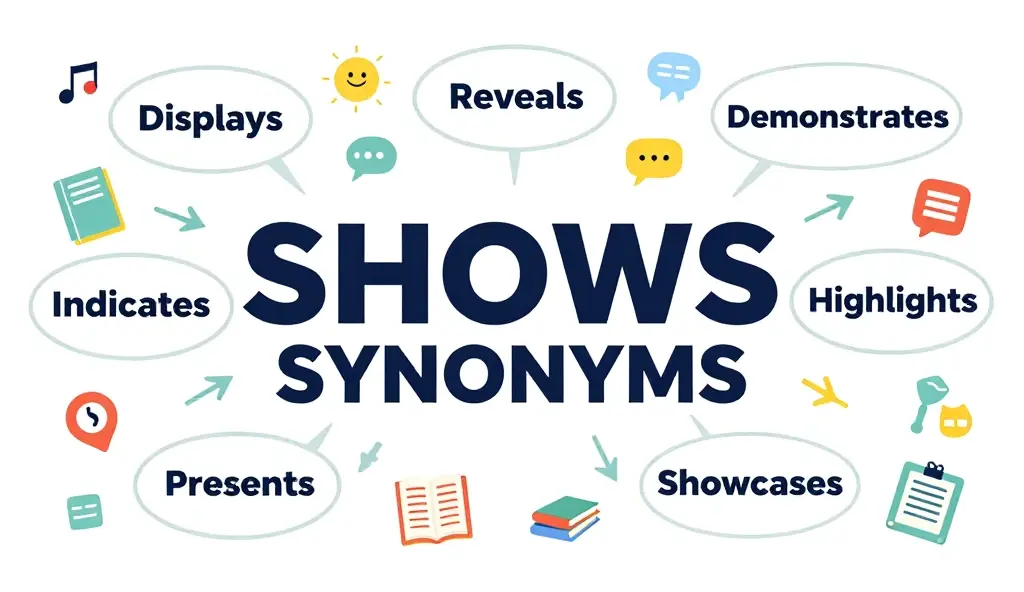
The word “shows” is one of the most common verbs in the English language.
People search for show synonyms because repeating the same word over and over makes writing feel plain and boring.
When you write a school essay, an email to your boss, or a story, picking a precise synonym helps you express your exact thought.
You use “shows” when you point to evidence, explain a chart, describe feelings, or display an object.
Because the word has so many different meanings, swapping it for a better alternative makes your message instant and powerful.
Meaning
The word “shows” means to allow something to be seen, to make something clear, or to display a sign or quality.
- Definition: To cause or allow something to be seen; to display, demonstrate, or make visible.
- Context: It can describe physical actions (like showing a picture) or abstract ideas (like showing proof in an argument).
- Common Usage: Used across casual talk, academic papers, news reports, and creative writing.
- Pronunciation: /ʃoʊz/ (sounds like shohz). To pronounce it naturally, start with the soft “sh” sound, blend into a long “oh”, and finish with a smooth “z” sound.
Part of Speech
“Shows” primarily functions as a verb (third-person singular present form of show), but it can also be a plural noun.
- As a Verb: “The report shows an increase in sales.” (Action: revealing or proving data).
- As a Noun: “She bought tickets for two Broadway shows.” (Thing: public performances or broadcasts).
Note: This guide focuses on shows synonyms for the action (verb) form.
Synonyms Table
Here is a quick overview of the top synonyms for “shows” categorized by form, usage, and difficulty level:
| Word | Meaning | Usage | Formality | Example | Difficulty Level |
| Demonstrates | Proves something with logic or evidence | Academic, Business | Formal | The data demonstrates clear progress. | Easy |
| Displays | Puts something out for people to view | General, Visual | Neutral | The museum displays rare art. | Easy |
| Reveals | Uncovers hidden information | Storytelling, News | Neutral | The study reveals surprising facts. | Easy |
| Illustrates | Makes an idea clear using examples | Academic, Teaching | Formal | This chart illustrates our monthly growth. | Medium |
| Exhibits | Shows a trait, quality, or symptom | Science, Medical, Formal | Formal | He exhibits strong leadership skills. | Medium |
| Indicates | Points to or acts as a sign of something | Technical, Formal | Formal | A high fever indicates an infection. | Easy |
| Depicts | Represents something through art or words | Creative, Literature | Neutral | The painting depicts a quiet village. | Medium |
| Proves | Gives undeniable evidence | Law, Science | Formal | The test result proves the theory. | Easy |
| Highlights | Draws special attention to something | Business, General | Neutral | The report highlights top risks. | Easy |
| Exposes | Uncovers something usually hidden or secret | News, Journalism | Neutral | The investigation exposes wrongdoing. | Medium |
Best Synonyms Explained
1. Demonstrates
- Meaning: To show clearly by giving proof or evidence.
- Difference from “Shows”: “Demonstrates” is more formal and carries a strong sense of proof and logic.
- Example: “The scientific experiment demonstrates how plants react to light.”
- Best Situation: Use this in research papers, business presentations, and formal arguments.
- Common Mistakes: Do not use it for simple physical acts (e.g., say “He showed me his watch,” not “He demonstrated me his watch” unless he is teaching you how it works).
2. Displays
- Meaning: To put something in a place where people can easily see it.
- Difference from “Shows”: “Displays” usually refers to physical objects, emotions, or visual arrangements.
- Example: “The store displays new shoes in the front window.”
- Best Situation: Use when talking about art, shop products, physical signs, or outward emotions.
- Common Mistakes: Avoid using “displays” when talking about logical proof or abstract data arguments.
3. Reveals
- Meaning: To make known something that was previously secret, hidden, or unknown.
- Difference from “Shows”: “Reveals” implies a surprise or the uncovering of hidden truth.
- Example: “The final chapter reveals the identity of the secret guest.”
- Best Situation: Great for news stories, mystery writing, research findings, and personal secrets.
- Common Mistakes: Don’t use “reveals” for common, obvious things that were never hidden.
4. Illustrates
- Meaning: To explain or make something clear by using examples, pictures, or stories.
- Difference from “Shows”: Focuses specifically on making complex ideas easier to understand.
- Example: “This story illustrates the importance of honesty.”
- Best Situation: Teaching, presentations, essays, and explanatory writing.
- Common Mistakes: Do not confuse with drawing pictures, though pictures can also illustrate an idea.
5. Indicates
- Meaning: To point out, signify, or serve as a sign of something.
- Difference from “Shows”: “Indicates” suggests a clue or sign rather than total absolute proof.
- Example: “The red light indicates that the machine is active.”
- Best Situation: Technical manuals, medical diagnoses, weather reports, and statistics.
- Common Mistakes: Using it when you want to make a very strong, passionate claim; “indicates” sounds neutral and objective.
6. Exhibits
- Meaning: To show a particular trait, behavior, quality, or physical feature.
- Difference from “Shows”: More formal, often used in scientific, psychological, or legal contexts.
- Example: “The patient exhibits symptoms of a mild cold.”
- Best Situation: Science reports, medical evaluations, and formal descriptions of behavior.
- Common Mistakes: Using it casually in daily conversation can make you sound overly rigid.
7. Depicts
- Meaning: To represent or show someone or something through painting, drawing, or written words.
- Difference from “Shows”: Focuses on artistic or descriptive representation.
- Example: “The novel depicts life in a small coastal town.”
- Best Situation: Book reviews, art critiques, and creative descriptions.
- Common Mistakes: Using “depicts” for raw statistics or numerical charts.
Antonyms
Antonyms are words that mean the opposite of “shows.” Here are the main antonyms:
| Word | Meaning | Usage | Example |
| Hides | Keeps something out of sight | General | She hides the key under the mat. |
| Conceals | Carefully prevents something from being seen or known | Formal | The envelope conceals sensitive documents. |
| Covers | Places something over an object to protect or hide it | General | Snow covers the ground in winter. |
| Disguises | Changes appearance to hide identity | General | He disguises his voice on the phone. |
| Masks | Prevents a feeling or quality from being noticed | Neutral | Her smile masks her true sadness. |
| Obscures | Makes something difficult to see or understand | Formal | Fog obscures the mountain view. |
| Suppresses | Forcibly holds back or keeps secret | Formal | The government suppresses the news report. |
30 Real-World Examples
- The line graph demonstrates a steady rise in sales over five years.
- The museum displays ancient artifacts from around the world.
- Her bright smile reveals how happy she feels today.
- The teacher uses a short story to illustrate the lesson.
- The dog exhibits signs of great energy when playing outdoors.
- A drop in pressure indicates that rain is on the way.
- The movie depicts the daily struggles of young musicians.
- DNA evidence clearly proves who was present at the scene.
- The summary highlights three main areas for growth.
- The newspaper article exposes poor conditions in the factory.
- The dashboard light indicates low fuel levels.
- The artist depicts natural landscapes with vibrant oil paints.
- Recent surveys demonstrate high customer satisfaction.
- The store clerk displays fresh fruits near the entrance.
- Her expression reveals total surprise at the news.
- The pie chart illustrates how we spend our household budget.
- The test subject exhibits normal reaction times.
- The audit exposes several accounting errors.
- Strong test scores prove that the study plan worked well.
- The map highlights all major historic landmarks.
- The satellite image shows cloud movement over the coast.
- Her tone of voice reveals her true hesitation.
- The photograph captures the quiet beauty of the forest.
- The user manual illustrates each step of assembly.
- The medical report indicates full recovery within two weeks.
- The gallery displays modern sculptures this month.
- The research paper demonstrates strong links between sleep and health.
- The film depicts historic events with great accuracy.
- The safety sign highlights potential hazards in the workshop.
- The investigation reveals new details about the event.
25 Naturally Written Sentences
Here are 25 sentences showcasing various writing styles using shows synonyms:
- Simple: The guide shows us where to walk.
- Academic: The empirical evidence demonstrates a clear relationship between reading and vocabulary growth.
- Conversational: Her face really shows how tired she is after that long drive.
- Professional: The quarterly deck highlights key accomplishments across all sales teams.
- Creative: The sunrise reveals golden hues across the sleeping city.
- Technical: The sensor indicates an immediate drop in system pressure.
- Descriptive: The painting depicts a lone traveler standing beside a quiet lake.
- Direct: The test proves your theory is correct.
- Informal: His post displays his passion for vintage cars.
- Formal: The organization exhibits a strong commitment to ethical practices.
- Explanatory: This case study illustrates how small changes produce big results.
- Journalistic: The leaked document exposes major flaws in the original safety plan.
- Narrative: As the smoke cleared, the quiet valley revealed its peaceful charm.
- Persuasive: These numbers demonstrate why we must update our equipment now.
- Instructional: The diagram illustrates proper hand positioning for typing.
- Medical: The patient displays no symptoms of discomfort today.
- Literary: The novel portrays human resilience during tough times.
- Business: Our sales tracker reflects strong demand across all regions.
- Casual: The review highlights the best dishes on the menu.
- Scientific: The lab findings indicate a high concentration of minerals.
- Analytical: Table 3 proves that response times improved by twenty percent.
- Expressive: Her laughter reveals genuine joy.
- Informative: The map displays current traffic flow across the city center.
- Brief: The study indicates progress.
- Detailed: The updated report demonstrates significant cost reductions over the last fiscal quarter.
Formal vs Informal Usage
Choosing the right shows synonyms depends heavily on who you are talking to. Using a formal word in casual conversation can sound stiff, while using informal words in academic papers can lower your credibility.
| Word | Formality | Best Setting | Example |
| Shows | Neutral | Casual talk, basic writing | “This photo shows my cat.” |
| Demonstrates | Highly Formal | Academic papers, reports | “The study demonstrates high efficiency.” |
| Reveals | Neutral / Dramatic | News, stories, casual talk | “The ending reveals the truth.” |
| Displays | Neutral / Formal | Retail, art, sports | “He displays great skill.” |
| Points out | Informal | Everyday speech, emails | “She points out a small typo.” |
| Uncovers | Neutral | Investigative reporting | “The team uncovers new clues.” |
Academic Usage
In academic writing, precision is essential. Words like “shows” sound too vague for research papers, thesis statements, and lab reports.
- Instead of: “The data shows that students learn faster with visual aids.”
- Use: “The data demonstrates that students learn faster with visual aids.”
- Instead of: “Figure 2 shows the growth rate.”
- Use: “Figure 2 illustrates the growth rate.”
- Instead of: “The test shows a positive result.”
- Use: “The test indicates a positive result.”
Daily Conversation
In everyday speech, you want natural, easy-flowing words. Overly complex words can sound unnatural in casual chats.
- Casual: “Her smile shows she is happy.” -> “Her smile says it all.”
- Casual: “The map shows where the shop is.” -> “The map points out the shop.”
- Casual: “His actions show he cares.” -> “His actions prove he cares.”
Grammar Tips
When replacing “shows” with a synonym, keep these key grammar rules in mind:
- Subject-Verb Agreement: Make sure your synonym matches the subject.
- Singular: “The chart demonstrates…”
- Plural: “The charts demonstrate…”
- Preposition Shifts: Changing the verb often changes the preposition that follows.
- “Shows that…” -> “Points to…”
- “Displays in…” -> “Exhibits at…”
- Active vs. Passive Voice:
- Active: “The study demonstrates a link.”
- Passive: “A link is demonstrated by the study.”
Collocations
Collocations are words that naturally go together with specific shows synonyms:
- Demonstrates clearly: “The trial demonstrates clearly that the drug works.”
- Directly indicates: “The signal directly indicates a system fault.”
- Vividly depicts: “The movie vividly depicts life in the 1920s.”
- Proudly displays: “She proudly displays her award on the shelf.”
- Reluctantly reveals: “He reluctantly reveals his true motives.”
- Powerfully illustrates: “This story powerfully illustrates the value of patience.”
Phrases & Idioms
Here are common English phrases and idioms related to “showing” or revealing things:
- Shows your true colors: Reveals your real personality or intentions.
- Shows someone the ropes: Teaches someone how to do a task or job.
- Shows off: Tries to attract attention by displaying abilities or possessions.
- Lays cards on the table: Reveals plans or thoughts completely and honestly.
- Puts on a display: Shows a skill or performance publicly.
Word Comparison
Understanding subtle differences prevents word misuse:
| Word | Primary Focus | Best For | Avoid When |
| Demonstrates | Logical proof | Scientific & academic work | Describing simple feelings |
| Displays | Visual viewing | Physical objects & art | Explaining abstract logic |
| Reveals | Uncovering secrets | Surprising news & secrets | Describing obvious things |
| Illustrates | Clarifying concepts | Examples & diagrams | Stating raw unproven facts |
| Indicates | Giving signs/clues | Data, instruments, signs | Making 100% absolute claims |
FAQs
Q1. What is the most formal synonym for shows?
A: Demonstrates, exhibits, and evinces are among the most formal alternatives.
Q2. What synonym for shows should I use in an essay?
A: Use demonstrates, illustrates, indicates, or reveals, depending on the context.
Q3. Is displays a good synonym for shows?
A: Yes. It works best for physical objects, visuals, or observable actions.
Q4. How do I choose between “demonstrates” and “illustrates”?
A: Demonstrates proves a point, while illustrates explains with examples.
Q5. Can “reveals” replace “shows” in every sentence?
A: No. Reveals implies something was previously hidden.
Q6. What is a good synonym for shows in statistics?
A: Indicates, demonstrates, highlights, and reflects are excellent choices.
Q7. What is the difference between shows and depicts?
A: Shows is general, while depicts refers to artistic or visual representation.
Q8. What are good antonyms for shows?
A: Common antonyms include hides, conceals, masks, and obscures.
Q9. How can I replace shows in business emails?
A: Use highlights, indicates, outlines, or reflects.
Q10. Is shows considered a weak word?
A: Not always, but repeating it too often can make writing less engaging.
Q11. Which synonym works best for emotions?
A: Reveals, displays, reflects, and conveys work well for emotions.
Q12. How is shows used as a noun?
A: It refers to TV programs, performances, or public events.
Q13. What is a casual alternative to shows?
A: Try points out, makes clear, or lets you see.
Q14. Why is semantic variety important in SEO writing?
A: It improves readability, avoids keyword stuffing, and helps search engines understand your content better.
Expert Tips for Using Synonyms
- Match the Context: Always match your chosen word to the tone of your writing. Use formal words like demonstrates for essays and casual words like points out for everyday talks.
- Read Out Loud: When you swap “shows” for another word, read the full sentence out loud to ensure the rhythm and meaning sound natural.
- Check Prepositions: Remember that changing the verb often changes the preposition that follows (e.g., “shows that” vs. “points to”).
- Vary Your Choices: Avoid picking just one substitute word to replace every instance of “shows.” Use a variety of synonyms across your article or essay.
Conclusion:
Finding the right shows synonyms is one of the easiest ways to elevate your writing style immediately.
Swapping basic words for precise alternatives like demonstrates, reveals, illustrates, displays, and indicates ensures your message is accurate, engaging, and clear.
Use the tables, examples, and tips in this guide whenever you write to pick the perfect word for every situation.

Alexander Price is a language researcher based in Salt Lake City, Utah. He focuses on English word relationships and practical vocabulary development.