
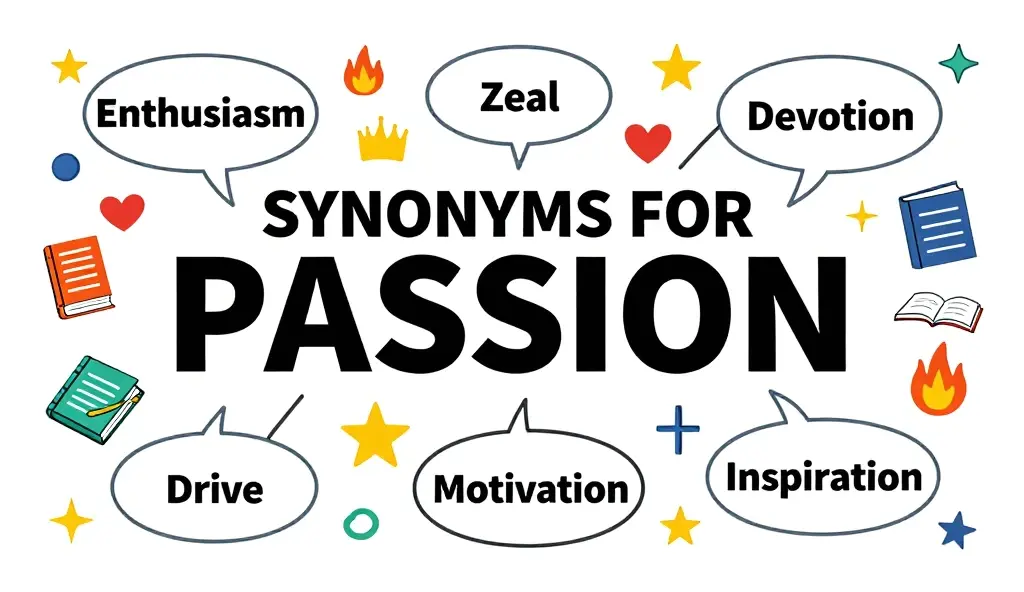
Why search for synonyms for passion? Overusing “passion” in cover letters, business proposals, creative writing, and everyday conversation makes it feel like generic corporate fluff.
We frequently rely on “passion” to cover everything from job motivations (passion for marketing) to deep hobbies (passion for baking) to intense love (romantic passion).
Swapping out this default noun for context-specific alternatives adds weight, authenticity, and precision to your message.
Meaning
The word passion operates as a noun with four primary definitions in English:
- Intense Enthusiasm or Drive: A strong liking, desire, or devotion for an activity, cause, or concept (e.g., “a passion for music”).
- Strong Romantic or Physical Desire: Powerful sexual or romantic feeling toward someone (e.g., “bound by passion”).
- Outburst of Emotion or Anger: An intense, temporarily overpowering emotion or state of excitement (e.g., “in a fit of passion”).
- The Suffering of a Martyr (Theological): The suffering and death of Jesus Christ or a religious martyr (e.g., “the Passion of Christ”).
Pronunciation
How to Pronounce “Passion”
- 🗣️ Phonetic Spelling: /ˈpæʃ.ən/
- 🎵 Rhymes with: Fashion, ration.
- Natural Sounding Guide: Starts with a crisp “p-ah” sound, shifting smoothly into a soft “shun” sound.
Part of Speech
1. Noun (Countable / Uncountable)
Refers to intense feeling, drive, or a specific beloved pursuit:
- 📝 Example: “She speaks with immense passion about environmental protection.” (Uncountable – intense emotion)
- 📝 Example: “Gardening became his main passion in retirement.” (Countable – beloved pursuit)
Synonyms Table
| Word | Meaning | Usage Context | Formality | Example Sentence | Difficulty Level |
| Zeal | Great energy or enthusiasm in pursuit of a cause | Advocacy / Religion | Formal | Her zeal for social justice inspired the entire community. | Intermediate |
| Fervor | Intense and passionate feeling | Politics / Speech | Formal | He spoke with revolutionary fervor at the rally. | Advanced |
| Ardor | Great warmth or intensity of emotion or love | Romantic / Creative | Formal | Their romantic ardor burned brightly for years. | Advanced |
| Enthusiasm | Intense and eager enjoyment, interest, or approval | General / Hobbies | Neutral | The students showed great enthusiasm for the science project. | Easy |
| Drive | An innate determination and ambition to succeed | Business / Resumes | Neutral | His relentless drive led the startup to market leadership. | Easy |
| Devotion | Love, loyalty, or enthusiasm for a person or activity | Family / Faith / Work | Formal | Her lifelong devotion to medicine earned her national praise. | Intermediate |
| Infatuation | An intense but short-lived passion or admiration | Romance / Obsession | Neutral | His interest turned out to be mere teenage infatuation. | Intermediate |
| Compulsion | An irresistible urge to behave in a certain way | Creative / Psychological | Neutral | Writing felt like a natural compulsion he couldn’t ignore. | Intermediate |
| Zest | Great enthusiasm, energy, and eagerness for life | Life / Work | Neutral | She approaches every new project with a zest for learning. | Intermediate |
| Predilection | A preference or special liking for something | Academic / Formal | Formal | He displayed a predilection for classical philosophy. | Advanced |
| Dedication | The quality of being committed to a task or purpose | Professional / Sports | Neutral | The team’s dedication resulted in a championship win. | Easy |
Best Synonyms for “Passion” (Explained)
1. Zeal
- 🔍 Meaning: Intense enthusiasm and tireless devotion to a cause, belief, or objective.
- 🔄 Difference from Passion: “Zeal” focuses heavily on energetic action, advocacy, and goal-driven activity rather than pure emotion.
- 💬 Example: “The volunteers worked with impressive zeal to distribute aid.”
- 🎯 Best Situation: Activism, religious/philosophical causes, mission-driven organizations, and political campaigns.
- ⚠️ Common Mistake: Avoid overusing “zeal” if it risks sounding fanatical or aggressive.
2. Ardor
- 🔍 Meaning: Great warmth of emotion, fiery intensity, or deep romantic feeling.
- 🔄 Difference from Passion: “Ardor” carries a poetic, fiery, and deeply emotional connotation often linked to romance or deep artistic creation.
- 💬 Example: “He declared his love with heartfelt ardor.”
- 🎯 Best Situation: Literature, creative arts, romance writing, and historical drama.
- ⚠️ Common Mistake: Avoid using “ardor” in sterile corporate environments or technical reports.
3. Fervor
- 🔍 Meaning: Intense, burning emotion or passionate excitement.
- 🔄 Difference from Passion: “Fervor” implies a high-energy, collective, or infectious state of emotion.
- 💬 Example: “Patriotic fervor swept through the stadium during the national anthem.”
- 🎯 Best Situation: Public speeches, sports crowds, political movements, and dramatic storytelling.
- ⚠️ Common Mistake: Ensure the context matches a high level of intensity; don’t use it for minor preferences.
4. Drive
- 🔍 Meaning: An inner urge that compels a person toward achieving specific goals.
- 🔄 Difference from Passion: “Drive” focuses on discipline, output, and goal execution rather than emotional feeling.
- 💬 Example: “Her analytical skills and personal drive made her an exceptional manager.”
- 🎯 Best Situation: Resumes, cover letters, executive performance reviews, and business strategy.
- ⚠️ Common Mistake: Do not use “drive” when describing romantic or purely aesthetic experiences.
Antonyms
| Word | Meaning | Usage Context | Example Sentence |
| Apathy | Lack of interest, enthusiasm, or concern | General | Voter apathy led to low turnout at the polls. |
| Indifference | Unconcern or lack of preference | General | He viewed the outcome with complete indifference. |
| Lethargy | A state of tiredness, sluggishness, or lack of energy | Health / Mood | A feeling of lethargy prevented her from working out. |
| Coldness | Lack of emotion, warmth, or affection | Relationships | Her coldness made it difficult to connect with her. |
| Disinterest | Freedom from bias, or lack of interest | Professional / Mindset | His disinterest in office politics kept him focused on code. |
30 Real-World Examples
🎯 Bullet Points of Contextual Usage
- Her zeal for reform transformed the department’s culture.
- The crowd cheered with electric fervor as the team scored.
- He wrote letters filled with romantic ardor during the war.
- Students showed boundless enthusiasm for the robotics workshop.
- Relentless drive helped him overcome early career setbacks.
- Her devotion to animal welfare spans over three decades.
- What started as an infatuation quickly faded after a few weeks.
- He brings a genuine zest for life to every conversation.
- The scientist displayed a strong predilection for empirical research.
- The award honors her tireless dedication to public health.
- She tackled the project with unyielding determination.
- His obsession with detail made him a master watchmaker.
- She spoke about art with infectious eagerness.
- The novel captures the intensity of youth.
- He pursued his vocation with deep spiritual conviction.
- The founder’s vision rallied investors behind the startup.
- The musician performed with fiery emotion on stage.
- The community rallied with unified spirit after the storm.
- He has a natural affinity for complex mathematics.
- Her penchant for storytelling enriched her historical writing.
- The team demonstrated remarkable commitment to quality.
- He approached coding not as a job, but as his true calling.
- She defended her thesis with intellectual vigor.
- The design reflects an undeniable flair for modern aesthetics.
- His gusto for adventure led him to explore remote mountain ranges.
- She possesses a deep attachment to traditional customs.
- The director poured immense energy into the film’s production.
- The chef works with an unwavering loyalty to local ingredients.
- He expressed a keen fascination with deep-sea biology.
- Her perseverance ensured the completion of the marathon.
25 Naturally Written Sentences
Formal Styles
- The candidate demonstrates an exceptional drive for strategic innovation.
- Her research reflects a lifelong dedication to marine conservation.
- The ambassador addressed the assembly with profound diplomatic fervor.
- The organization relies on the zeal of its global network of volunteers.
- He demonstrated an intellectual predilection for economic theory.
Informal Styles
- She’s got a real thing for vintage record collecting.
- He tackled the home renovation with total gusto.
- You can really see his love for cooking in every dish.
- She’s got so much fire in her when she talks about her ideas.
- He went into the project with tons of energy.
Academic Styles
- The author analyzes the revolutionary fervor of the late eighteenth century.
- Subjects displayed a marked predilection for visual learning tools.
- The study examines how intrinsic motivation influences student retention.
- Historical records document the religious ardor of the era’s pilgrims.
- The findings highlight the critical role of professional commitment in health outcomes.
Formal vs. Informal Usage
| Usage Category | Formal Option | Informal Option | Practical Context |
| Business / Career | Drive / Commitment | Fire / Bug | “Executive drive” vs “Bitten by the coding bug” |
| Romantic Feeling | Ardor / Devotion | Crush / Spark | “Romantic ardor” vs “A special spark” |
| Hobbies & Pursuits | Predilection / Vocation | Thing / Obsession | “Academic predilection” vs “His main thing” |
| Public / Group Energy | Fervor / Zeal | Buzz / Hype | “Political fervor” vs “Fan hype” |
Academic Usage
In academic writing, using “passion” often sounds subjective or conversational. Select terms that clearly define the underlying cognitive, emotional, or behavioral drivers:
- 🎓 Use intrinsic motivation, drive, or commitment when discussing psychological studies or workplace productivity.
- 🎓 Use fervor, zeal, or ardor when describing historical movements, religious trends, or political ideologies.
- 🎓 Use predilection, penchant, or affinity when describing observed preferences or analytical tendencies.
Daily Conversation
In everyday speech, overusing “passion” can sound overly dramatic or like a job interview cliché:
- 🗣️ “I have a passion for coffee.”
- 🗣️ “He has a passion for playing video games.”
- 🗣️ “She spoke with passion about her trip.”
Upgrade your daily speech to sound natural yet expressive:
- Replace “I have a passion for coffee” with “I’m a huge coffee enthusiast“ or “I’m obsessed with good coffee.”
- Replace “He has a passion for video games” with “He loves gaming” or “He’s super into gaming.”
- Replace “She spoke with passion…” with “She spoke so eagerly about her trip.”
Grammar Tips
Essential Rules for “Passion”
- Prepositions Following “Passion”: Use “passion FOR [something]” (“a passion for design”) when referring to an activity or topic. Use “passion IN [an area]” when referring to a domain (“her passion in life”). Use “passion BETWEEN [people]” for romantic feelings.
- Avoid Corporate Tautology: Phrases like “passionate commitment” or “passionate drive” are redundant. Pick one strong noun or verb phrase instead.
- Countable vs. Uncountable: When referring to the general emotional state, “passion” is uncountable (“He spoke with passion”). When referring to specific hobbies or interests, it is countable (“One of my passions is gardening”).
Collocations
🔗 Common Word Pairings with “Passion”
- Pursue a passion: To actively follow a deeply loved interest or career. (e.g., “She left corporate law to pursue her passion for painting.”)
- Lifelong passion: An interest or commitment maintained throughout one’s life. (e.g., “Astronomy has been his lifelong passion.”)
- Fuel someone’s passion: To provide resources or encouragement that increases enthusiasm. (e.g., “Her mentor helped fuel her passion for scientific research.”)
- Passion project: A task or project undertaken for personal fulfillment rather than money. (e.g., “The indie film was a passion project for the director.”)
Phrases and Idioms
💬 Popular Expressions
- In the heat of passion: Spontaneously, while under the influence of intense emotion or anger. (e.g., “Words spoken in the heat of passion are often regretted later.”)
- Follow your passion: A common advice phrase encouraging people to build careers around what they love. (e.g., “Career counselors often tell graduates to follow their passion.”)
- Crime of passion: A violent crime committed because of sudden, strong emotional impulse. (e.g., “The defense argued the action was a crime of passion.”)
Similar Words & Word Comparison
📊 Comparing Emotional & Motivational Nouns
| Word | Primary Meaning | Subtle Difference | Best Example |
| Passion | Intense emotion or beloved pursuit | Broad, high-emotion term | A passion for music. |
| Drive | Determination to achieve goals | Action-oriented, focused on results and effort | Strong corporate drive. |
| Zeal | Tireless devotion to a cause | Focused on active advocacy, religion, or reform | Religious zeal. |
| Ardor | Warmth and intensity of feeling | Highly emotional, often romantic or artistic | Romantic ardor. |
FAQs
Q1. What is the best overall synonym for passion?
A: It depends on the context. Use drive or dedication for work, enthusiasm for hobbies, zeal for causes, and ardor for romance.
Q2. What is a resume synonym for passion?
A: Good resume alternatives include drive, dedication, commitment, motivation, initiative, and track record.
Q3. What is a formal word for passion?
A: Formal alternatives include zeal, fervor, ardor, predilection, and intrinsic motivation.
Q4. What can I say instead of follow your passion?
A: Try pursue your ambition, build on your strengths, cultivate your interests, or dedicate yourself to your vocation.
Q5. What is a synonym for romantic passion?
A: Common choices include ardor, devotion, infatuation, desire, and attraction.
Q6. What is an academic synonym for passion?
A: In academic writing, use intrinsic motivation, intellectual curiosity, scholarly commitment, or predilection.
Q7. What is the primary antonym for passion?
A: The most common opposites are apathy and indifference.
Expert Tips for Choosing the Right Synonym
- De-buzzword your resume: Recruiters often skip over “passionate professional.” Show impact instead by using action nouns like drive, initiative, or commitment.
- Match emotional intensity: Use enthusiasm for everyday hobbies, but reserve high-potency words like fervor and ardor for deep emotional or literary contexts.
- Check your prepositions: Double-check sentence flow when replacing words (“passion for”, “zeal for”, “devotion to”, “affinity for”).
Conclusion
Expanding your vocabulary beyond passion transforms how you express motivation, love, and commitment in your writing.
If you choose drive to power a resume, zeal to champion a cause, or ardor to capture deep emotion, selecting the exact word adds authority, tone, and authenticity to your language.

Alexander Price is a language researcher based in Salt Lake City, Utah. He focuses on English word relationships and practical vocabulary development.