
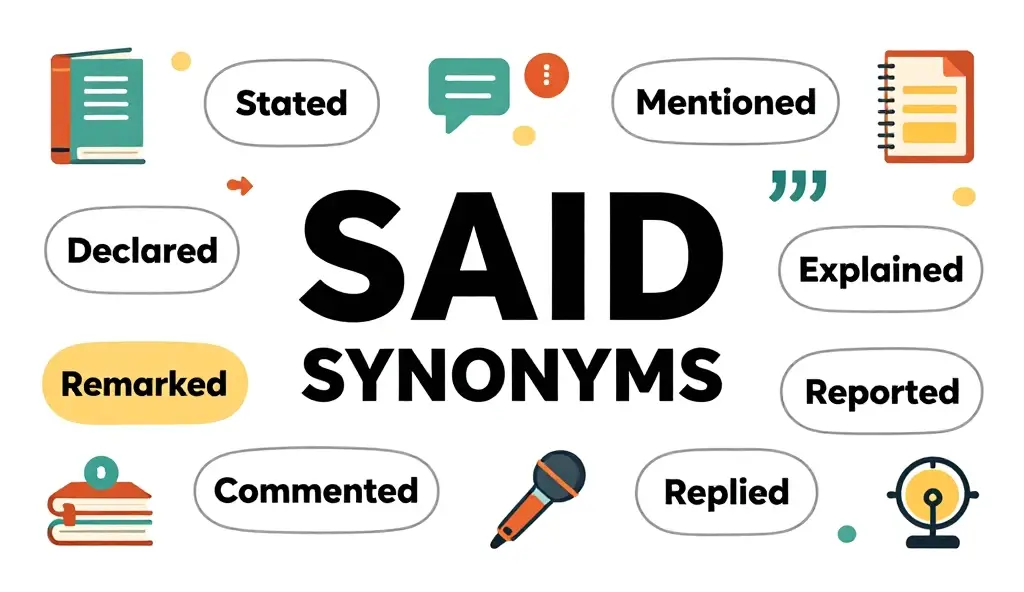
Why search for synonyms for said? Using “said” repeatedly across lines of dialogue creates monotonous, flat prose that bores readers and weakens story momentum.
While dialogue tags like “said” are often invisible to readers in small amounts, overusing them makes your writing sound repetitive and uninspired.
We frequently rely on “said” to cover everything from quiet admissions (he said quietly) to loud outbursts (she said loudly).
Replacing simple dialogue tags with descriptive, targeted verbs instantly conveys emotion, tone, and character intent without needing extra adverbs.
Meaning
The word said functions primarily as the past tense and past participle of the verb say, carrying four main definitions in English:
- Uttered or Spoken Aloud: Expressed thoughts, feelings, or information using spoken words.
- Stated in Writing: Expressed or recorded in written text, articles, or official documents.
- Indicated or Shown: Conveyed a message, direction, or meaning through signs, instruments, or symbols.
- Mentioned Previously (Adjective): Referring to a person, item, or topic already cited in legal or formal contexts (the said property).
Pronunciation
How to Pronounce “Said”
- 🗣️ Phonetic Spelling: /sɛd/
- 🎵 Rhymes with: Bed, head, red, shed, thread.
- 💡 Natural Sounding Guide: Pronounce with a soft “s” sound, transition into a short “eh” vowel sound, and end on a crisp “d.”
Part of Speech
1. Verb (Past Tense / Past Participle)
Modifies dialogue or statements to show who spoke or wrote a message:
- 📝 Example: “I will be there on time,” she said. (Uttered spoken words)
- 📝 Example: The article said that interest rates would drop soon. (Stated in writing)
2. Adjective (Formal / Legal)
Used in legal or technical documents to denote something previously named:
- 📝 Example: The tenant agrees to maintain the said premises in good condition. (Previously mentioned)
Synonyms Table
| Word | Meaning | Usage Context | Formality | Example Sentence | Difficulty Level |
| Stated | Expressed something clearly or formally | Official / Writing | Formal | The official stated that the report was ready. | Easy |
| Remarked | Made a casual comment or observation | Dialogue / Writing | Neutral | “It looks like rain,” she remarked. | Intermediate |
| Declared | Announced something with force or authority | Speeches / Drama | Formal | He declared his intention to run for office. | Intermediate |
| Mentioned | Referred to something briefly or casually | Conversation | Neutral | She mentioned that she might move next year. | Easy |
| Replied | Answered or responded to a question | Dialogue | Neutral | “I don’t know the answer,” he replied. | Easy |
| Exclaimed | Spoke suddenly and loudly with emotion | Emotional Dialogue | Neutral | “We won the game!” she exclaimed. | Intermediate |
| Whispered | Spoke very softly using breath rather than voice | Secretive Dialogue | Neutral | “Keep your voice down,” he whispered. | Easy |
| Asserted | Stated a fact or belief confidently | Debates / Academic | Formal | The lawyer asserted that her client was innocent. | Advanced |
| Articulated | Expressed an idea fluidly and clearly | Speeches / Research | Formal | She articulated her vision for the company. | Advanced |
| Muttered | Spoke indistinctly in a low tone | Discontent / Anger | Neutral | “This is ridiculous,” he muttered under his breath. | Intermediate |
| Affirmed | Confirmed or stated as a solemn truth | Legal / Formal | Highly Formal | The witness affirmed the accuracy of the record. | Advanced |
Best Synonyms for “Said” (Explained)
1. Stated
- 🔍 Meaning: Expressed an idea, fact, or opinion clearly and definitively in speech or writing.
- 🔄 Difference from Said: “Stated” adds formal weight and objectivity, making it ideal for business, journalism, and academic work.
- 💬 Example: “The spokesperson stated that all safety protocols were followed.”
- 🎯 Best Situation: News reports, research papers, legal testimony, and official announcements.
- ⚠️ Common Mistake: Avoid using “stated” in emotional fiction dialogue where it can sound overly dry and robotic.
2. Remarked
- 🔍 Meaning: Mentioned casually or made an observational comment about something noticed.
- 🔄 Difference from Said: “Remarked” implies the speaker is reacting to something they just observed in their surroundings.
- 💬 Example: “The coffee here is surprisingly good,” he remarked after taking a sip.
- 🎯 Best Situation: Fiction dialogue, casual commentary, narrative prose, and observational writing.
- ⚠️ Common Mistake: Don’t use “remarked” for loud shouts, urgent commands, or formal legal statements.
3. Declared
- 🔍 Meaning: Stated publicly, emphatically, or with legal and moral authority.
- 🔄 Difference from Said: “Declared” carries a high level of drama, confidence, and finality compared to plain speech.
- 💬 Example: “I will not back down from this fight,” she declared to the crowd.
- 🎯 Best Situation: Speeches, dramatic story climaxes, political statements, and press releases.
- ⚠️ Common Mistake: Overusing “declared” in everyday casual conversations makes dialogue sound theatrical.
4. Articulated
- 🔍 Meaning: Expressed an idea, argument, or feeling clearly, precisely, and coherently.
- 🔄 Difference from Said: “Articulated” emphasizes the skill, clarity, and precision with which the thought was delivered.
- 💬 Example: “The professor articulated the complex quantum theory with remarkable ease.”
- 🎯 Best Situation: Academic writing, executive summaries, presentations, and character critiques.
- ⚠️ Common Mistake: Do not use “articulated” for simple one-word answers or casual, emotional outbursts.
Antonyms
| Word | Meaning | Usage Context | Example Sentence |
| ✨ Concealed | Kept secret; hid from view or speech | General | He concealed his true feelings from his colleagues. |
| ✨ Suppressed | Prevented the expression or publication of | Formal | The committee suppressed the sensitive report. |
| ✨ Withheld | Refused to give, disclose, or grant | Legal / Finance | She withheld her testimony until her lawyer arrived. |
| ✨ Silenced | Prevented from speaking or expressing views | Authority | The government silenced dissent through censorship. |
| ✨ Denied | Refused to admit the truth or existence of | Debates | The suspect denied all allegations made against him. |
30 Real-World Examples
🎯 Bullet Points of Contextual Usage
- The CEO stated that quarterly revenues exceeded expectations.
- “That painting is extraordinary,” she remarked while touring the gallery.
- The referee declared the match a draw after twelve rounds.
- He briefly mentioned his plans to travel across Europe.
- “I will handle the project,” she replied without hesitation.
- “Look at the fireworks!” the children exclaimed with joy.
- “Meet me behind the library,” he whispered in the dark.
- The defense attorney asserted that the evidence was tainted.
- She articulated a brilliant strategy during the board meeting.
- “I hate waiting in long lines,” he muttered under his breath.
- The witness affirmed that the testimony was completely true.
- “We need help right now!” she shouted across the field.
- The scientist explained how the compound reacts with water.
- “I lost my passport,” he gasped in sudden panic.
- The author noted that historical context was crucial.
- She insisted on paying for the entire dinner bill.
- “Please don’t tell anyone,” he pleaded with tears in his eyes.
- The manual indicated that the blue wire connects to the ground.
- He argued that the proposed budget was unsustainable.
- “I can’t believe we made it,” she sighed with deep relief.
- The officer commanded the crowd to clear the intersection.
- She confided her deepest fears to her closest friend.
- The customer complained about the cold food service.
- “Are you coming with us?” he queried curiously.
- The study demonstrated a clear link between exercise and sleep.
- “That was a terrible mistake,” she admitted candidly.
- The guide warned the tourists about the steep cliff edge.
- He conceded that his opponent had made a valid point.
- “I will return tomorrow,” the traveler promised solemnly.
- The editor suggested removing the second paragraph.
25 Naturally Written Sentences
Formal Styles
- 🔹 The lead investigator stated that no further warrants would be issued.
- 🔹 In her keynote address, the director articulated three key pillars for growth.
- 🔹 The diplomat asserted her country’s right to territorial sovereignty.
- 🔹 The research team noted significant variations in baseline trial data.
- 🔹 The tribunal affirmed the ruling delivered by the appellate judge.
Informal Styles
- 🔹 “Let’s grab pizza tonight,” he suggested after finishing work.
- 🔹 “I totally forgot my wallet,” she gasp in total shock.
- 🔹 “That movie was so boring,” he muttered on the way out.
- 🔹 “Check out this crazy video!” she exclaimed holding up her phone.
- 🔹 “I’m heading out now,” he shouted from the front doorway.
Academic Styles
- 🔹 The historian argued that economic pressures drove political reforms.
- 🔹 The primary author concluded that further clinical trials were necessary.
- 🔹 Survey data indicated a strong preference for renewable energy options.
- 🔹 The study demonstrated the profound social impact of urbanization.
- 🔹 Researchers posited that early intervention yields superior long-term results.
Formal vs. Informal Usage
| Usage Category | Formal Option | Informal Option | Practical Context |
| 🏷️ Clear Statement | Stated / Asserted | Said / Mentioned | “Stated facts” vs “Said facts” |
| 🏷️ Emotional Utterance | Exclaimed / Declared | Shouted / Yelled | “Declared victory” vs “Yelled victory” |
| 🏷️ Low Volume Speech | Murmured / Whispered | Muttered / Soft-spoken | “Murmured agreement” vs “Muttered agreement” |
| 🏷️ Answering Questions | Responded / Replied | Answered / Said back | “Responded formally” vs “Said back casually” |
Academic Usage
In academic writing, using “said” sounds overly conversational and imprecise. Replace it with analytical signal verbs that explain how the source presents its evidence:
- 🎓 Use asserts, argues, or contends when referencing an author’s primary position or thesis.
- 🎓 Use demonstrates, illustrates, or indicates when showing how data or evidence reveals a conclusion.
- 🎓 Use concedes, acknowledges, or posits when referring to counterarguments or theoretical ideas.
Daily Conversation
In daily speech, “said” is fine, but substituting descriptive dialogue tags makes storytelling livelier:
- 🗣️ “He said he was going to be late.”
- 🗣️ “She said that the food was terrible.”
- 🗣️ “They said we should leave now.”
Elevate your casual storytelling with these alternatives:
- ✨ Replace “He said he was going to be late” with “He warned me he’d be late.”
- ✨ Replace “She said the food was terrible” with “She complained about the food.”
- ✨ Replace “They said we should leave” with “They urged us to leave.”
Grammar Tips
💡 Essential Rules for “Said”
- Punctuation with Dialogue Tags: Always place commas, periods, question marks, and exclamation points inside quotation marks (“I’m ready,” she said.).
- Inversion in Storytelling: In fiction, inverting the verb and noun (said John vs John said) is acceptable, but keep it natural (“Wait!” said John).
- Avoiding Over-Attribution: If it is clear who is speaking based on paragraph breaks, omit the dialogue tag entirely to let the dialogue flow naturally.
Collocations
🔗 Common Word Pairings with “Said”
- Easier said than done: Expressing that a task is simpler to talk about than perform. (e.g., “Finding a cheap apartment is easier said than done.”)
- When all is said and done: When everything has been considered or finished. (e.g., “When all is said and done, we did our best.”)
- That being said: A transitional phrase introducing a contrasting point. (e.g., “The weather was cold; that being said, we enjoyed the hike.”)
- Needless to say: Self-evident or obvious information. (e.g., “Needless to say, she passed the exam easily.”)
Phrases and Idioms
💬 Popular Expressions
- Never said a word: Maintained complete silence or kept a secret. (e.g., “He never said a word about the surprise party.”)
- You can say that again: Expressing enthusiastic agreement with a statement. (e.g., “It’s boiling outside!” “You can say that again!”)
- To say the least: Used to imply that a situation is even more extreme than described. (e.g., “The movie was disappointing, to say the least.”)
- Have a say: Possessing the right or power to influence a decision. (e.g., “Employees want to have a say in remote work policies.”)
Similar Words & Word Comparison
📊 Comparing Dialogue Verbs
| Word | Primary Meaning | Subtle Difference | Best Example |
| 🔸 Said | Uttered words | Neutral, basic dialogue tag | “Hello,” he said. |
| 🔸 Stated | Expressed formally | Emphasizes clarity and official capacity | The memo stated the rules. |
| 🔸 Declared | Announced loudly/authoritatively | Focuses on confidence, emotion, or drama | “I win!” she declared. |
| 🔸 Whispered | Spoke in a quiet breath | Focuses on secretiveness or low volume | “Quiet,” he whispered. |
FAQs
Q1. What is the best overall synonym for said?
A: Use stated or mentioned for formal writing, replied for responses, and exclaimed or shouted for emotional dialogue.
Q2. What is a formal word for said?
A: Formal alternatives include stated, asserted, declared, affirmed, articulated, and noted.
Q3. Is it wrong to use said in writing?
A: No. Said is natural, but varying dialogue tags and action beats improves readability.
Q4. What is a synonym for said quietly?
A: Use whispered, murmured, muttered, mumbled, or breathed.
Q5. What is a synonym for said loudly?
A: Common choices include shouted, yelled, exclaimed, bellowed, and roared.
Q6. What can I use instead of he said/she said?
A: Use action beats or specific dialogue verbs to identify the speaker naturally.
Q7. What is an academic synonym for said?
A: In academic writing, use argues, asserts, contends, posits, or concludes.
Q8. What is a synonym for said angrily?
A: Good options include snapped, snarled, barked, fumed, and retorted.
Q9. What is a synonym for said happily?
A: Use beamed, cheered, gushed, chirped, or laughed.
Q10. What does said mean in legal writing?
A: In legal contexts, said means previously mentioned or aforesaid.
Q11. What is the past tense of say?
A: The past tense and past participle of say is said.
Q12. What is the opposite of said?
A: Common opposites include withheld, concealed, denied, and suppressed.
Q13. Why should I avoid overusing said in fiction?
A: Mixing dialogue tags with action beats makes conversations more engaging and natural.
Expert Tips for Choosing the Right Synonym
- 💡 Match the emotion: Pick dialogue tags like shouted, whispered, or snapped that reflect the character’s internal feelings.
- 💡 Use action beats: Instead of adding tags after dialogue, describe a physical action before or after speech to create immersive scene pacing.
- 💡 Elevate academic writing: Replace “said” with analytical signal verbs like argues, posits, or demonstrates in research essays.
Conclusion
Expanding your vocabulary beyond said transforms dialogue and narrative prose.
If you are describing a stated policy, a whispered confession, or an articulated research theory, choosing the right dialogue tag brings emotion, precision, and authority to your writing.

Grace Anderson is an English language editor based in Chicago, Illinois. She creates easy-to-understand vocabulary resources and enjoys making complex language concepts simple for everyday learners.