
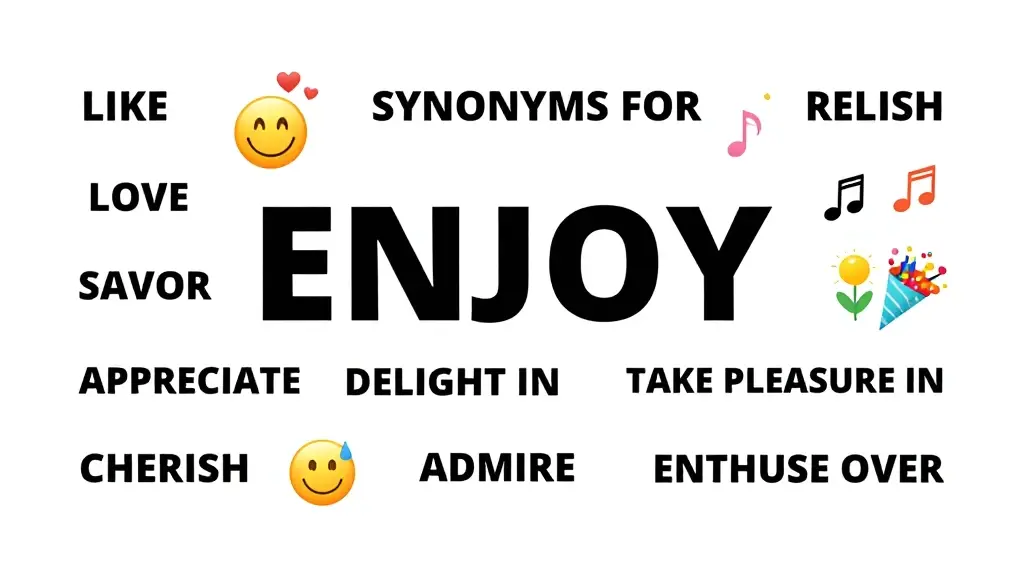
The word enjoy is used when you want to say that something gives you pleasure, happiness, satisfaction, or a positive experience. It is common in everyday conversations, emails, essays, reviews, and social media posts.
But if you use “enjoy” too many times, your writing can start to sound repetitive.
Learning useful synonyms for enjoy can help you express the exact feeling you mean.
Common alternatives include like, love, appreciate, relish, savor, delight in, take pleasure in, have fun, cherish, and admire. However, these words are not always interchangeable. “Like” is a simple and broad choice, while “love” expresses a stronger feeling. “Appreciate” often means recognizing the value or quality of something. “Relish” and “savor” suggest taking special pleasure in an experience, taste, or moment. “Cherish” is often used for people, memories, and meaningful experiences.
In this guide, you will learn the best synonyms for enjoy, how they differ, when to use them, common mistakes, everyday examples, formal and casual alternatives, and useful phrases for essays, emails, and professional writing.
Enjoy Synonyms – Quick Answer
The best synonyms for enjoy depend on the situation and the feeling you want to express.
- Like – to have a positive feeling about something.
- Love – to enjoy something very strongly.
- Appreciate – to recognize the value or quality of something.
- Relish – to take great pleasure in something.
- Savor – to enjoy something slowly and fully.
- Delight in – to get great pleasure from something.
- Take pleasure in – to enjoy something, often in a formal way.
- Have fun – to enjoy yourself during an activity.
- Cherish – to value someone or something deeply.
- Admire – to enjoy or respect something because of its qualities.
- Treasure – to value something greatly.
- Revel in – to take great pleasure in an experience or situation.
- Appreciate – to enjoy or understand the value of something.
- Experience – to go through and enjoy something as an event or activity.
The closest simple synonym is usually like, but the best word depends on the context.
The Origin of Enjoy
The word enjoy has roots in Old French and ultimately comes from Latin roots connected with joy and pleasure.
The word developed in English with the meaning of taking pleasure or satisfaction from something.
Today, enjoy can describe many types of positive experiences.
For example:
I enjoy reading.
Here, enjoy means that reading gives the speaker pleasure.
It can also describe an experience:
We enjoyed the concert.
In this sentence, enjoyed means that the concert was a pleasant or satisfying experience.
Enjoy can also be used with a quality, benefit, or situation:
The hotel enjoys a good reputation.
Here, the meaning is closer to possess or benefit from a favorable condition.
This makes enjoy a flexible English word with several related uses.
British English vs American English Spelling
The word enjoy is spelled the same in British and American English.
| English Variety | Spelling | Example |
| American English | enjoy | I enjoy reading. |
| British English | enjoy | I enjoy reading. |
There is no standard British spelling such as “enjoi” or another regional form.
The same applies to most common synonyms:
| Word | American English | British English |
| Enjoy | enjoy | enjoy |
| Like | like | like |
| Love | love | love |
| Appreciate | appreciate | appreciate |
| Relish | relish | relish |
| Savor | savor | savour |
| Cherish | cherish | cherish |
| Admire | admire | admire |
| Treasure | treasure | treasure |
One notable spelling difference is savor/savour.
American English generally uses:
savor
British English generally uses:
savour
For example:
American: Take time to savor the meal.
British: Take time to savour the meal.
Both spellings are correct within their respective English varieties.
Which Spelling Should You Use?
If your content targets a U.S. audience, use savor.
If your content targets a British audience, use savour.
For most other enjoy synonyms, the spelling is identical in British and American English.
The most important rule is consistency.
For example, if you are writing in American English:
She savored every moment of her vacation.
If you are writing in British English:
She savoured every moment of her holiday.
Both are correct. Choose the spelling that matches your target audience.
Common Mistakes with Synonyms for Enjoy
Not every positive word can replace enjoy in every sentence.
1. Using “Love” When You Mean Simple Enjoyment
“I love coffee” expresses a stronger feeling than:
I enjoy coffee.
If you only mean that something gives you pleasure, enjoy may be more accurate.
2. Confusing “Appreciate” With “Enjoy”
Appreciate often means recognizing the value, quality, or importance of something.
I appreciate your help.
This does not simply mean:
I enjoy your help.
The meanings are different.
3. Using “Savor” for Every Activity
Savor usually suggests enjoying something slowly and fully.
She savored every bite of the dessert.
It can also describe moments:
He savored the moment.
It would sound unusual to say:
I savored going to work every morning.
unless you specifically mean you took deep pleasure in the experience.
4. Confusing “Cherish” With “Enjoy”
Cherish means to value something deeply.
I cherish our memories.
Enjoy simply means experiencing pleasure.
I enjoyed our vacation.
Cherish usually carries a deeper emotional meaning.
5. Using “Have Fun” in Formal Writing
“Have fun” is natural in conversation:
Have fun at the party!
But it may be too casual for formal writing.
Instead:
I hope you enjoy the event.
Enjoy in Everyday Examples
The word enjoy is extremely common in everyday English.
Enjoying Activities
I enjoy reading books.
She enjoys painting.
They enjoy hiking.
We enjoy traveling.
Enjoying Food
I really enjoy Italian food.
He enjoys cooking.
We enjoyed the dinner.
Enjoying Experiences
Did you enjoy the movie?
We enjoyed our vacation.
She enjoyed the concert.
Enjoying Time
I enjoyed spending time with my family.
They enjoyed their weekend.
We enjoyed every moment.
Enjoying Someone’s Company
I enjoy spending time with you.
She enjoys his company.
This use often means that being with someone is pleasant.
Enjoy Synonyms Comparison Table
| Synonym | Main Meaning | Tone | Example |
| Like | Have a positive feeling | Neutral | I like this song. |
| Love | Enjoy very strongly | Strong | I love this book. |
| Appreciate | Recognize value | Neutral/Formal | I appreciate your help. |
| Relish | Take great pleasure | Strong/Formal | She relished the opportunity. |
| Savor | Enjoy slowly and fully | Descriptive | He savored every bite. |
| Delight in | Take great pleasure | Formal/Warm | She delights in helping others. |
| Have fun | Enjoy yourself | Casual | Have fun at the party! |
| Cherish | Value deeply | Emotional | I cherish these memories. |
| Admire | Respect or value qualities | Neutral/Formal | I admire her courage. |
| Treasure | Value greatly | Emotional | We treasure our friendship. |
| Revel in | Take great pleasure | Strong | He reveled in the success. |
| Take pleasure in | Enjoy something | Formal | She takes pleasure in teaching. |
Enjoy vs Like
Like is one of the closest simple synonyms for enjoy.
I enjoy music.
I like music.
Both sentences show a positive feeling.
However, enjoy often focuses more on the pleasure you get from an activity or experience.
I enjoy playing tennis.
Like can describe a general preference:
I like tennis.
Simple Difference
Like = have a positive opinion or preference.
Enjoy = get pleasure from something.
In many everyday sentences, they can be used similarly.
Enjoy vs Love
Love expresses a stronger feeling than enjoy.
I enjoy this movie.
I love this movie.
The second sentence shows greater enthusiasm.
You can enjoy something without loving it.
For example:
I enjoy classical music, but I don’t listen to it often.
Love usually suggests a deeper or stronger positive feeling.
Enjoy vs Appreciate
These words are often confused.
Enjoy means to get pleasure from something.
I enjoyed the concert.
Appreciate means to recognize the value, quality, or importance of something.
I appreciate the musician’s skill.
You can do both:
I enjoyed the concert and appreciated the musicians’ talent.
This sentence shows the difference clearly.
Enjoy vs Relish
Relish means to take great pleasure in something.
She relished the chance to compete.
It is stronger and often more expressive than enjoy.
Compare:
He enjoyed the meal.
He relished every bite.
The second sentence suggests a deeper or more enthusiastic experience.
Enjoy vs Savor
Savor means to enjoy something slowly and fully.
It is often used with food:
She savored the chocolate.
But it can also describe experiences:
We savored the peaceful moment.
The word encourages the idea of slowing down and appreciating the experience.
Enjoy vs Delight In
Delight in means to take great pleasure in something.
She delights in helping children.
It sounds more formal or literary than:
She enjoys helping children.
Both are correct, but delight in gives the sentence a stronger sense of pleasure.
Enjoy vs Cherish
These words express different levels of emotional attachment.
Enjoy:
I enjoyed the trip.
Cherish:
I cherish the memories of that trip.
Cherish means to value something deeply and hold it dear.
You can enjoy a moment without cherishing it.
Enjoy vs Have Fun
Have fun is an informal way to describe enjoyment.
We had fun at the party.
A more neutral version is:
We enjoyed the party.
Both are natural.
Use have fun in casual conversations, texts, and friendly messages.
Use enjoy when you want a more general or neutral expression.
Formal Synonyms for Enjoy
For professional, academic, or formal writing, consider:
- appreciate
- take pleasure in
- derive pleasure from
- relish
- delight in
- value
- benefit from
Examples:
The organization benefits from strong community support.
She takes pleasure in mentoring young professionals.
The audience appreciated the quality of the presentation.
The best option depends on whether you mean pleasure, value, or benefit.
Casual Synonyms for Enjoy
For casual English, use:
- like
- love
- have fun
- have a great time
- be into
- dig
- enjoy
Examples:
I really like this song.
We had a great time at the beach.
She’s really into photography.
Some expressions, such as be into, are strongly conversational and should generally be avoided in formal writing.
Synonyms for Enjoy Food
When talking about food, several words can add more detail.
Enjoy
I enjoyed the meal.
Savor
I savored every bite.
Relish
She relished the spicy dish.
Taste
We tasted the local food.
Appreciate
I appreciated the fresh ingredients.
Savor is especially useful when you want to show that someone enjoyed food slowly and carefully.
Synonyms for Enjoy a Vacation
Useful alternatives include:
- have a great time
- relax
- unwind
- explore
- experience
- savor
- make the most of
Examples:
We had a great time on vacation.
We made the most of our trip.
She savored every moment of her holiday.
They explored the local area.
These alternatives can make travel writing more descriptive.
Synonyms for Enjoy Life
If you want alternatives to enjoy life, consider:
- live fully
- make the most of life
- appreciate life
- savor life
- embrace life
- experience life
- live joyfully
Examples:
Make the most of every day.
Take time to appreciate the little things.
She believes in living life fully.
These phrases often sound more inspirational than simply saying “enjoy life.”
Synonyms for Enjoy Yourself
Common alternatives include:
- have fun
- have a good time
- have a great time
- have a wonderful time
- relax
- have a blast
- make the most of it
Examples:
Enjoy yourself at the party.
Have fun at the party.
Have a great time!
Make the most of your weekend.
For formal situations, enjoy yourself is usually more appropriate than slang expressions such as “have a blast.”
Synonyms for Enjoy Your Time
Instead of repeating “enjoy your time,” you can say:
- have a great time
- have a wonderful time
- make the most of your time
- spend your time happily
- savor the moment
- appreciate the experience
Examples:
I hope you have a wonderful time.
Make the most of your time here.
Take time to savor the moment.
Synonyms for Enjoy in Professional Writing
Professional writing requires precision.
Instead of:
Customers enjoy many benefits.
You could write:
Customers receive several benefits.
Or:
Customers benefit from several features.
Instead of:
Employees enjoy flexible working hours.
You might write:
Employees have flexible working hours.
Here, enjoy means have or benefit from, rather than simply experiencing pleasure.
This is an important use of the word.
Different Meanings of Enjoy
The word enjoy has more than one common use.
1. Get Pleasure From Something
I enjoy reading.
2. Have a Good Experience
We enjoyed the concert.
3. Take Pleasure in Someone’s Company
I enjoy spending time with my friends.
4. Have or Benefit From Something
The company enjoys a strong reputation.
In the fourth meaning, synonyms such as have, possess, benefit from, or experience may be more accurate than like or love.
Google Trends & Usage Data
Enjoy is a common English verb used across many types of searches and written content. It appears frequently in everyday conversation, travel content, product reviews, entertainment writing, food descriptions, lifestyle articles, greetings, and professional communication.
People may search for related phrases such as:
- synonyms for enjoy
- enjoy synonyms
- another word for enjoy
- synonyms of enjoy
- words similar to enjoy
- formal synonyms for enjoy
- enjoy meaning
- another way to say enjoy
- synonyms for enjoy yourself
- synonyms for enjoy life
- synonyms for enjoy your time
Search interest can vary by country, season, and user intent. For example, searches involving enjoyment may appear in travel, holiday, food, entertainment, and lifestyle topics.
For SEO writing, related words such as like, love, appreciate, relish, savor, delight, cherish, and have fun can provide useful semantic variety. However, each term should be used only when its meaning fits the sentence.
For exact current search volume or trend comparisons, use Google Trends or a keyword research platform for the target country and date range.
How to Choose the Right Synonym for Enjoy
Think about the feeling or meaning you want to communicate.
Use “Like” for a General Preference
I like this restaurant.
Use “Love” for Strong Enjoyment
I love this restaurant.
Use “Appreciate” for Value or Quality
I appreciate the chef’s attention to detail.
Use “Relish” for Strong Pleasure
She relished the opportunity.
Use “Savor” for Slow, Full Enjoyment
He savored every bite.
Use “Cherish” for Deep Emotional Value
I cherish our memories.
Use “Have Fun” for Casual Enjoyment
Have fun at the party!
Use “Benefit From” When Enjoy Means Receiving an Advantage
Employees benefit from flexible hours.
This simple approach helps you choose a word that matches the actual meaning instead of using synonyms randomly.
FAQs
Q.1. What is the best synonym for enjoy?
A: The closest general synonym is like, but other choices include love, appreciate, relish, savor, delight in, cherish, and have fun, depending on context.
Q.2. What is a simple word for enjoy?
A: Like is the simplest common alternative to enjoy.
Q.3. What is a strong synonym for enjoy?
A: Strong alternatives include love, relish, revel in, delight in, and cherish, depending on what you are describing.
Q.4. What is a formal synonym for enjoy?
A: Formal alternatives include appreciate, take pleasure in, derive pleasure from, relish, and benefit from.
Q.5. What is a casual synonym for enjoy?
A: Casual alternatives include like, love, have fun, have a great time, and have a blast.
Q.6. Is like a synonym for enjoy?
A: Yes, in many contexts. Like expresses a positive preference, while enjoy usually focuses on getting pleasure from something.
Q.7. Is love a synonym for enjoy?
A: Yes, but love is generally stronger. You can enjoy something without loving it.
Q.8. Is appreciate a synonym for enjoy?
A: Sometimes. Appreciate often means recognizing the value or quality of something rather than simply getting pleasure from it.
Q.9. What is another word for “enjoy yourself”?
A: You can say have fun, have a good time, have a great time, relax, or make the most of it.
Q.10. What is another word for “enjoy life”?
A: You can say make the most of life, live fully, appreciate life, savor life, embrace life, or live joyfully.
Q.11. What is another word for “enjoy your time”?
A: Good alternatives include have a great time, have a wonderful time, make the most of your time, and savor the moment.
Q.12. What is another word for enjoy food?
A: Depending on the meaning, you can use savor, relish, appreciate, taste, or simply love.
Q.13. What is the difference between enjoy and savor?
A: Enjoy means to get pleasure from something. Savor means to enjoy something slowly and fully, often paying close attention to the experience.
Q.14. What is the difference between enjoy and relish?
A: Relish usually suggests taking strong or special pleasure in something. It is often more expressive than enjoy.
Q.15. What is the difference between enjoy and cherish?
A: Enjoy means to take pleasure in something. Cherish means to value something deeply, especially a person, relationship, or memory.
Q.16. What is the opposite of enjoy?
A: Possible opposites include dislike, hate, dislike, suffer, endure, or detest, depending on the context.
Q.17. What is a synonym for enjoy in an essay?
A: Useful choices include appreciate, experience, take pleasure in, relish, and benefit from, depending on the sentence.
Q.18. What is a synonym for enjoy in professional writing?
A: Appreciate, benefit from, experience, value, and take pleasure in can work depending on the intended meaning.
Q.19. Can “enjoy” mean “benefit from”?
A: Yes. For example:
The company enjoys a strong reputation.
Here, enjoy means to have or benefit from a favorable condition.
Q.20. What are the most common synonyms for enjoy?
A: Common alternatives include like, love, appreciate, relish, savor, delight in, cherish, admire, treasure, and have fun.
Conclusion:
Learning the right synonyms for enjoy can make your writing more natural, varied, and precise.
Although like is often the closest simple alternative, other words express different types or levels of enjoyment.
Love shows stronger positive feelings, while appreciate focuses on recognizing value or quality.
Relish suggests taking great pleasure in something, and savor suggests enjoying something slowly and fully.
Cherish is better when you want to express deep emotional value, especially for people, memories, and relationships.
For casual conversations, phrases such as have fun, have a great time, and have a blast are natural.
In professional writing, words such as appreciate, benefit from, experience, and take pleasure in may be more suitable.
The phrase enjoy can also mean “have or benefit from,” as in “The company enjoys a strong reputation,” so context matters.
You should not replace “enjoy” simply because another word looks similar in a thesaurus.
First, decide what you mean.
Are you talking about pleasure, preference, appreciation, deep emotional value, or a benefit? Once you know the intended meaning, choosing the right synonym becomes much easier.
If you are writing an essay, blog post, email, travel article, review, social media caption, or professional document, accurate word choice is more important than using complicated vocabulary.
The best synonym is the one that sounds natural and communicates your exact idea.

Alexander Price is a language researcher based in Salt Lake City, Utah. He focuses on English word relationships and practical vocabulary development.