Have you ever used the same word too many times and wished there was another way to say it? That is where synonyms become useful.
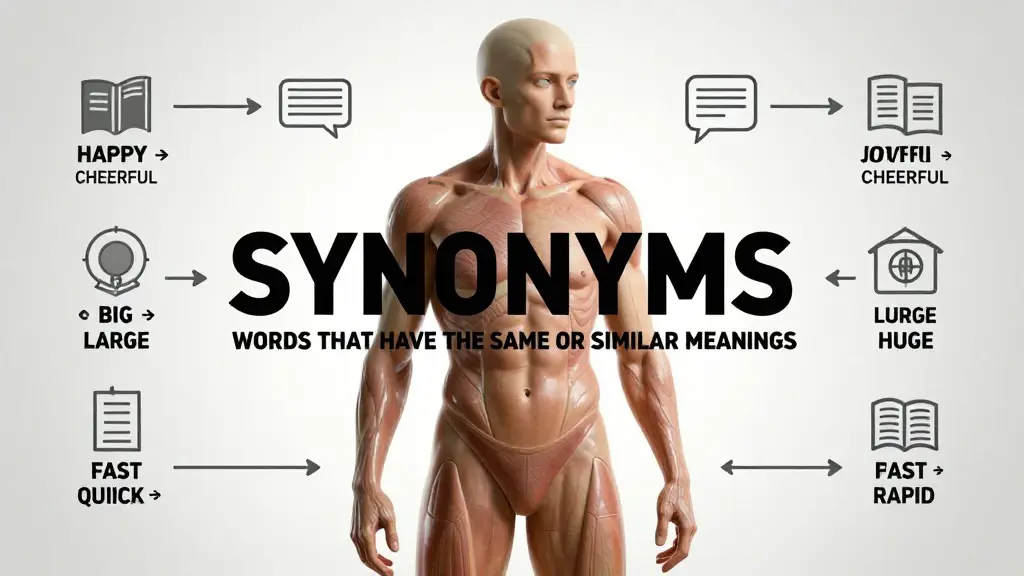
A simple synonyms definition is that synonyms are words that have the same or nearly the same meaning as another word.
For example, happy and joyful are synonyms because both describe a positive feeling.
Big and large are also common examples. However, synonyms do not always have exactly the same meaning or work in every sentence.
Some words may have slightly different tones, levels of formality, or uses.
This is why understanding the definition of synonyms is more useful than simply memorizing lists of similar words.
Synonyms can make writing clearer, more varied, and more interesting.
They are widely used in everyday conversations, essays, books, emails, business writing, and online content.
In this guide, you will learn the synonyms definition, different types of synonyms, clear examples, common mistakes, spelling differences, and practical ways to choose the right synonym.
Synonyms Definition – Quick Answer
The definition of synonyms is:
Synonyms are words that have the same or nearly the same meaning as another word.
For example:
| Word | Synonym |
| Happy | Joyful |
| Big | Large |
| Fast | Quick |
| Begin | Start |
| Smart | Clever |
| Easy | Simple |
| Angry | Mad |
| Beautiful | Attractive |
| Help | Assist |
| End | Finish |
For example:
She is happy.
You could write:
She is joyful.
The basic meaning remains similar, although the tone may change slightly.
Another example is:
The car is fast.
You could say:
The car is quick.
Synonyms are useful because they allow writers and speakers to express similar ideas in different ways.
However, two synonyms are not always perfect replacements for each other. Context matters.
The Origin of Synonyms
The word synonym comes from Ancient Greek. It is formed from syn, meaning “together” or “with,” and onyma, meaning “name” or “word.”
The idea behind the word is therefore connected to words that share meaning.
The term entered English through Latin and French before becoming established in English.
Synonyms have always played an important role in language because languages naturally develop multiple words for similar ideas.
English has an especially large number of synonyms because it developed from several language influences, including:
- Old English
- Old Norse
- French
- Latin
- Greek
- other European languages
For example, English has several words related to the idea of “help”:
help
assist
aid
support
serve
These words overlap in meaning but are not always interchangeable.
This history helps explain why English often offers several ways to express one general idea.
British English vs American English Spelling
The word synonym is spelled the same in British and American English.
| English Variety | Spelling | Example |
| American English | synonym | “Happy” is a synonym for “joyful.” |
| British English | synonym | “Happy” is a synonym for “joyful.” |
The plural is also the same:
synonym → synonyms
There is no standard British spelling such as “synonim.”
The word synonymous is also spelled the same in both varieties.
The two terms are synonymous.
However, some synonyms themselves may have British and American spelling differences.
For example:
| American English | British English |
| Color | Colour |
| Favorite | Favourite |
| Center | Centre |
| Organize | Organise |
| Analyze | Analyse |
These are not different meanings. They are spelling differences between English varieties.
Which Spelling Should You Use?
The spelling synonym works for American, British, Canadian, Australian, and other major forms of English.
If you are writing for a specific audience, keep the spelling style consistent throughout your content.
For example, American English generally uses:
favorite
color
organize
British English generally uses:
favourite
colour
organise
But the word synonym itself remains unchanged.
For global content, either major spelling system can work. The key is consistency and audience awareness.
If your website targets readers in the United States, American English is usually the natural choice.
If your website targets readers in the United Kingdom, British English may be more appropriate.
Common Mistakes with Synonyms
Understanding synonyms is easy, but using them correctly requires attention to context.
1. Assuming Every Synonym Is Identical
Two synonyms may have similar meanings without being exact replacements.
For example:
big
and
enormous
are related, but enormous describes something much larger.
2. Using Formal Words in Casual Situations
Consider:
I appreciate your assistance.
This is correct, but in a casual conversation:
Thanks for your help.
may sound more natural.
Assistance and help are related, but they have different levels of formality.
3. Ignoring Context
The word bright can mean different things.
The room is bright.
Here, bright means well-lit.
She is a bright student.
Here, bright means intelligent.
A synonym must match the intended meaning.
4. Changing the Tone
Consider:
He was angry.
Possible alternatives include:
He was furious.
He was annoyed.
These words are related, but they describe different levels of emotion.
5. Choosing a Synonym That Sounds Unnatural
A thesaurus may provide many alternatives, but not all of them will sound natural in every sentence.
For example:
I consumed breakfast.
This is grammatically possible, but:
I ate breakfast.
is much more natural in everyday English.
Synonyms in Everyday Examples
Synonyms appear everywhere in everyday language.
In Emails
Instead of:
Thank you for your help.
You could write:
Thank you for your assistance.
The second version sounds more formal.
In News
A news report might use:
The company announced a new plan.
Another article might say:
The company revealed a new plan.
Both announced and revealed can describe sharing information, although their exact meanings may differ.
In Social Media
People often use simple synonyms:
That movie was amazing!
That movie was incredible!
Both express strong approval.
In Formal Writing
Instead of:
The results were good.
A formal report might say:
The results were positive.
Or:
The results were favorable.
The choice depends on the exact meaning.
In School Writing
Instead of repeating:
The story was interesting. The ending was interesting. The characters were interesting.
A writer might use:
The story was engaging. The ending was surprising, and the characters were memorable.
Synonyms can make the paragraph more varied.
Synonyms Definition Comparison Table
| Term | Simple Definition | Example |
| Synonym | A word with the same or similar meaning | Big / large |
| Antonym | A word with an opposite meaning | Hot / cold |
| Homonym | Words that share spelling or sound but have different meanings | Bat / bat |
| Homophone | Words that sound alike but have different meanings | See / sea |
| Homograph | Words spelled the same but with different meanings | Bat / bat |
| Paronym | Words that are similar in form but differ in meaning | Economic / economical |
This table shows why synonyms should not be confused with other word relationships.
What Are Synonyms?
Synonyms are words with identical or similar meanings.
Examples include:
- small – little
- quick – fast
- begin – start
- finish – end
- smart – intelligent
- beautiful – attractive
- angry – furious
- quiet – silent
However, some pairs are only partially synonymous.
For example:
angry
and
furious
are related, but furious is much stronger.
Therefore, it is useful to think of synonyms as words that share a meaning area rather than assuming they are always interchangeable.
Types of Synonyms
There are several ways to understand different types of synonyms.
Exact Synonyms
Exact synonyms have almost identical meanings and can often replace each other.
These are relatively uncommon.
Near Synonyms
Near synonyms have similar meanings but differ in tone, strength, or use.
For example:
happy
cheerful
joyful
delighted
All describe positive feelings, but each has a slightly different meaning.
Contextual Synonyms
Some words act as synonyms only in particular situations.
For example:
bright
can mean intelligent in:
She is a bright student.
But it cannot always be replaced with intelligent.
The bright room was comfortable.
Here, bright refers to light.
Register-Based Synonyms
Some synonyms differ mainly in formality.
For example:
help — casual/neutral
assist — more formal
Both can refer to providing help, but the context determines which is more natural.
Synonyms vs Antonyms
Synonyms and antonyms have opposite relationships.
Synonyms have similar meanings:
happy — joyful
Antonyms have opposite meanings:
happy — sad
Another example:
hot — warm
These can sometimes be related in meaning, but they are not necessarily exact synonyms.
And:
hot — cold
are antonyms because their meanings contrast.
A simple way to remember this is:
Synonym = similar meaning.
Antonym = opposite meaning.
Synonyms vs Homonyms
Homonyms are different from synonyms.
Synonyms share similar meanings.
quick — fast
Homonyms may have the same spelling or pronunciation but different meanings.
For example:
bat
can mean an animal.
bat
can also mean a piece of sports equipment.
The two meanings are unrelated.
Therefore:
Synonyms = similar meanings.
Homonyms = same or similar form, different meanings.
Synonyms vs Homophones
Homophones sound the same but have different meanings and often different spellings.
Examples include:
sea — see
right — write
flower — flour
These are not synonyms.
For example, flower and flour sound alike but mean completely different things.
Why Are Synonyms Important?
Synonyms are important because they make communication more flexible.
They can help you:
Avoid Repetition
Instead of repeating “good” several times, you might use:
excellent
useful
effective
positive
when those words match the meaning.
Improve Writing
Synonyms can make paragraphs more varied.
Match Your Audience
You can choose simpler words for children and more formal words for professional readers.
Add Precision
Different synonyms can express different levels of meaning.
For example:
upset
angry
furious
show increasing intensity.
Improve Style
Writers can choose words that fit the mood of a sentence.
Synonyms in Academic Writing
Synonyms can be useful in essays and research writing, but accuracy is more important than variety.
For example:
The study found important results.
You might write:
The study produced significant findings.
However, important and significant do not always mean exactly the same thing.
In academic writing, do not change a word simply to avoid repetition. First, make sure the replacement has the correct meaning.
Useful academic alternatives include:
| Common Word | Possible Academic Alternative |
| Show | Demonstrate |
| Help | Assist |
| Use | Utilize |
| Start | Begin |
| End | Conclude |
| Need | Require |
| Explain | Clarify |
| Change | Modify |
Not every alternative is better. Simple words are often clearer.
Synonyms in Professional Writing
Professional writing often uses synonyms to adjust tone.
For example:
We need your help.
can become:
We require your assistance.
The second sentence sounds more formal.
Another example:
We found a problem.
could become:
We identified an issue.
The second version may sound more professional in a business report.
Still, professional writing should remain clear. Complex words should not be used just to sound impressive.
Synonyms in SEO and Online Writing
Synonyms can also help online content sound natural.
For example, if an article is about beautiful places, related terms might include:
- stunning places
- attractive destinations
- scenic locations
- breathtaking spots
- picturesque places
These terms can help cover related language naturally.
However, synonyms should not be used simply to manipulate search rankings.
Good SEO writing focuses on answering the reader’s question clearly.
Search engines can understand related words and concepts, so natural language is usually more useful than repeating one exact phrase.
How to Find the Right Synonym
When choosing a synonym, ask three questions.
1. What Exactly Do I Mean?
Do you mean:
- happy?
- excited?
- satisfied?
- pleased?
These are related but different.
2. Who Is Reading It?
A word that works in an academic paper may sound strange in a text message.
3. What Tone Do I Want?
Choose a word that sounds:
- casual
- neutral
- formal
- professional
- emotional
- academic
For example:
help
is neutral.
assist
is more formal.
lend a hand
is more casual.
Google Trends & Usage Data
The topic synonyms definition has broad educational and language-learning intent. People searching for this phrase may want a basic definition, examples, types of synonyms, or help understanding how synonyms differ from related word concepts.
Related searches can include:
- synonyms definition
- definition of synonyms
- what are synonyms
- synonym meaning
- synonyms examples
- types of synonyms
- synonym and antonym
- synonyms and antonyms
- synonym definition and examples
- examples of synonyms
- what does synonym mean
Interest can vary by country and audience. Students, teachers, English learners, writers, and people improving their vocabulary may all search for information about synonyms.
The topic also appears in educational content, dictionaries, grammar resources, writing guides, and language-learning materials.
For SEO, closely related terms such as similar words, same meaning, word alternatives, vocabulary, antonyms, homonyms, and examples of synonyms can help cover the topic naturally.
Exact current search volume and regional trend data should be checked using a live keyword research platform or Google Trends for the selected country and date range.
Synonyms Definition in Simple Words
If you need a very simple explanation:
Synonyms are different words that have the same or a similar meaning.
For example:
Happy = joyful
Big = large
Fast = quick
Smart = clever
Begin = start
Think of synonyms as different words that can sometimes express the same basic idea.
However, they may not always work in exactly the same sentence.
For example:
I am happy.
I am joyful.
Both are correct.
But:
I am delighted.
is stronger and may suggest a higher level of happiness.
This is why context matters when choosing synonyms.
FAQs
Q.1. What is the definition of synonyms?
A: Synonyms are words that have the same or nearly the same meaning as another word.
Q.2. What is a simple definition of a synonym?
A: A synonym is a word that has a similar meaning to another word.
Q.3. What is an example of a synonym?
A: Happy and joyful are examples of synonyms. Both describe a positive emotional state.
Q.4. What are 10 examples of synonyms?
A: Ten common synonym pairs are:
- Happy — joyful
- Big — large
- Small — little
- Fast — quick
- Smart — clever
- Begin — start
- End — finish
- Easy — simple
- Angry — mad
- Beautiful — attractive
Q.5. What is the difference between a synonym and an antonym?
A: A synonym has a similar meaning, while an antonym has an opposite meaning.
For example:
happy — joyful = synonyms
happy — sad = antonyms
Q.6. Are synonyms exactly the same?
A: Not always. Many synonyms have similar meanings but differ in tone, strength, context, or formality.
Q.7. What are near synonyms?
A: Near synonyms are words with similar but not identical meanings. For example, happy, cheerful, delighted, and joyful are related but can express different levels or types of happiness.
Q.8. Why are synonyms important?
A: Synonyms help reduce repetition, improve vocabulary, add precision, and make writing more varied.
Q.9. What is the opposite of a synonym?
A: A synonym does not have one direct opposite, but the contrasting word relationship is an antonym.
Q.10. What is a synonym and an example?
A: A synonym is a word with a similar meaning to another word. For example, quick is a synonym for fast.
Q.11. What are synonyms used for?
A: Synonyms are used to express similar ideas in different ways, avoid repetition, adjust tone, and improve communication.
Q.12. Can synonyms always replace each other?
A: No. Synonyms can have different meanings, levels of intensity, or grammatical uses. Context determines whether a replacement works.
Q.13. What is the difference between synonym and homonym?
A: Synonyms have similar meanings. Homonyms have the same spelling or pronunciation but different meanings.
Q.14. What is the difference between synonym and homophone?
A: Synonyms have similar meanings, while homophones sound alike but have different meanings, such as see and sea.
Q.15. What are exact synonyms?
A: Exact synonyms are words with almost identical meanings and uses. They are relatively uncommon because most synonyms have small differences.
Q.16. What are contextual synonyms?
A: Contextual synonyms are words that can have similar meanings only in certain situations.
Q.17. What are formal synonyms?
A: Formal synonyms are alternatives that are more suitable for academic, professional, legal, or official writing.
Q.18. How can I find synonyms?
A: You can use a dictionary, thesaurus, vocabulary resource, or language-learning tool. Always check the example sentences to make sure the synonym fits your context.
Q.19. Are synonyms important for writing?
A: Yes. They can help writers avoid unnecessary repetition and choose words that match the intended meaning and tone.
Q.20. What is the plural of synonym?
A: The plural of synonym is synonyms.
Q.21. Is “synonim” the correct spelling?
A: No. The correct spelling is synonym.
Conclusion:
The synonyms definition is simple: synonyms are words that have the same or nearly the same meaning as another word.
Examples include happy and joyful, big and large, and fast and quick.
They give speakers and writers more ways to express ideas and help make communication clearer and more varied.
However, synonyms are not always exact replacements.
Words can differ in strength, tone, formality, context, and emotional meaning.
For example, happy, delighted, and ecstatic all describe positive feelings, but they do not express the same level of emotion.
Similarly, help and assist are closely related, but assist usually sounds more formal.
Synonyms are useful in everyday conversation, school assignments, business writing, emails, articles, books, and online content.
They can reduce repetition and help you select language that fits your audience.
Still, using a complicated synonym is not always an improvement.
The clearest word is often the best word.
When choosing a synonym, first consider what you actually mean, who will read your writing, and what tone you want.
Check the word in context before replacing the original.
This simple habit will help you use synonyms accurately and naturally.
Whether you are learning English or improving your writing, understanding synonyms is an important part of building a stronger vocabulary.

Alexander Price is a language researcher based in Salt Lake City, Utah. He focuses on English word relationships and practical vocabulary development.