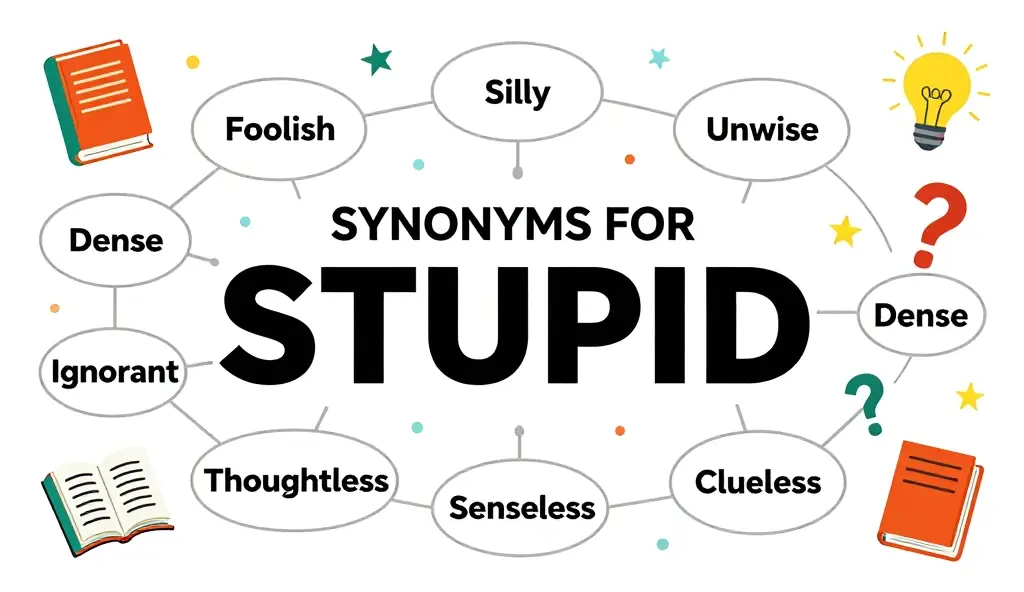
Why search for synonyms for stupid? Using “stupid” repeatedly makes writing sound blunt, repetitive, and informal.
In professional, academic, or creative settings, “stupid” often feels too harsh or vague.
We frequently rely on “stupid” to describe everything from minor lapses in judgment (a stupid mistake) to highly complex, flawed ideas (a stupid policy).
Replacing it with targeted, descriptive vocabulary elevates your prose, conveys precise meaning, and enhances SEO performance for vocabulary guides.
Meaning
The word stupid functions primarily as an adjective with four main definitions:
- Lacking Intelligence or Judgment: Lacking normal intelligence, quick perception, or sound judgment.
- Foolish or Ill-Considered: Showing a lack of good sense or thought; senseless or absurd.
- Dull or Slow: Slow-witted, sluggish, or lacking mental sharpness.
- Annoying or Worthless (Informal): Used to express annoyance or frustration toward an object or situation.
Pronunciation
How to Pronounce “Stupid”
- 🗣️ Phonetic Spelling: /ˈstjuː.pɪd/ or /ˈstuː.pɪd/
- 🎵 Rhymes with: Cupid.
- Natural Sounding Guide: Start with “stoo” (or “stew”), follow with a soft “p,” and end with “id.”
Part of Speech
1. Adjective
Modifies nouns to indicate foolishness, lack of intelligence, or poor planning:
- 📝 Example: “It was a stupid error that could have easily been avoided.” (Foolish)
- 📝 Example: “He felt stupid after forgetting his own password.” (Embarrassed / Slow-witted)
2. Noun (Informal / Slang)
Used informally to refer to a foolish or unintelligent person (often plural or combined with “the”):
- 📝 Example: “Don’t act like a stupid.” (Informal / Non-standard)
3. Adverb (Informal / Slang)
Used casually as an intensifier meaning “extremely” or “excessively”:
- 📝 Example: “That game was stupid fun.” (Extremely / Informal)
Synonyms Table
| Word | Meaning | Usage Context | Formality | Example Sentence | Difficulty Level |
| Foolish | Lacking good sense or judgment | General / Actions | Neutral | It would be foolish to ignore the warnings. | Easy |
| Absurd | Wildly unreasonable or illogical | Ideas / Statements | Neutral | He made an absurd proposal during the meeting. | Intermediate |
| Senseless | Lacking meaning, purpose, or sound logic | Actions / Violence | Neutral | They engaged in a senseless argument. | Easy |
| Imprudent | Not showing care for consequences | Decisions / Finance | Formal | It is imprudent to invest without research. | Advanced |
| Unwise | Showing a lack of wisdom or thought | Decisions / Plans | Formal | Taking that route in the snow was unwise. | Easy |
| Irrational | Not logical or reasonable | Thought / Behavior | Formal | Her fear of small spaces was irrational. | Intermediate |
| Inane | Silly, stupid, or lacking significance | Remarks / Humor | Formal | He kept making inane comments during class. | Advanced |
| Asinine | Extremely stupid or foolish | Behavior / Actions | Formal | That was an asinine comment to make. | Advanced |
| Mindless | Done without thought or consideration | Tasks / Media | Neutral | Scrolling social media can be mindless work. | Easy |
| Naive | Lacking experience, wisdom, or judgment | People / Views | Neutral | She had a naive view of corporate politics. | Intermediate |
| Fatuous | Pointlessly foolish or silly | Statements / Ideas | Highly Formal | The politician offered a fatuous response. | Advanced |
Best Synonyms for “Stupid” (Explained)
1. Foolish
- 🔍 Meaning: Lacking good sense, judgment, or discretion.
- 🔄 Difference from Stupid: “Foolish” focuses on poor choices and judgment rather than inherent mental capability.
- 💬 Example: “It was foolish to leave the doors unlocked.”
- 🎯 Best Situation: Personal advice, literature, general writing, and feedback.
- ⚠️ Common Mistake: Avoid using it to describe complex system failures; opt for “flawed” or “ineffective.”
2. Absurd
- 🔍 Meaning: Utterly illogical, unreasonable, or ridiculous.
- 🔄 Difference from Stupid: “Absurd” highlights how bizarre or irrational an idea is, rather than insulting a person’s intelligence.
- 💬 Example: “The claim that the Earth is flat is completely absurd.”
- 🎯 Best Situation: Debates, critiques, formal reviews, and creative writing.
- ⚠️ Common Mistake: Do not use “absurd” for simple human mistakes like a typo.
3. Imprudent
- 🔍 Meaning: Lacking discretion, wisdom, or caution; reckless regarding outcomes.
- 🔄 Difference from Stupid: “Imprudent” is a professional, polite way to call a decision risky or foolish.
- 💬 Example: “It would be imprudent to sign the contract without legal review.”
- 🎯 Best Situation: Business communication, financial reports, academic essays, and policy reviews.
- ⚠️ Common Mistake: Do not use “imprudent” for casual personal habits or humor.
4. Asinine
- 🔍 Meaning: Extremely foolish, senseless, or stubborn.
- 🔄 Difference from Stupid: “Asinine” is an elevated, sharp word reserved for behavior that is exceptionally ridiculous or irritating.
- 💬 Example: “Interrupting the speaker with asinine questions wasted everyone’s time.”
- 🎯 Best Situation: Formal critiques, literary reviews, and strong opinions.
- ⚠️ Common Mistake: Because it sounds strong, using it in polite company can seem overly aggressive.
Antonyms
| Word | Meaning | Usage Context | Example Sentence |
| Wise | Having or showing experience, knowledge, and good judgment | General | She gave wise counsel during the crisis. |
| Intelligent | Having high mental capacity or intellect | People / Work | He offered an intelligent critique of the paper. |
| Prudent | Acting with or showing care and thought for the future | Business / Decisions | Making a budget is a prudent choice. |
| Rational | Based on or in accordance with reason or logic | Logic / Argument | They reached a rational conclusion based on data. |
| Astute | Having an ability to accurately assess situations | Analysis / Business | Her astute observation saved the project money. |
30 Real-World Examples
🎯 Bullet Points of Contextual Usage
- The manager warned against making foolish financial choices.
- The jury dismissed the defense’s absurd claims.
- Vandals caused senseless damage to the park.
- It is imprudent to drive in extreme blizzards.
- Taking that shortcut proved to be an unwise decision.
- Her irrational fear prevented her from flying.
- The article was filled with inane gossip.
- The committee rejected his asinine suggestion.
- Assembly line work can feel mindless after long hours.
- He had a naive belief that everyone was trustworthy.
- The spokesperson gave a fatuous answer to a serious query.
- The plot contained several ill-advised storyline turns.
- They made a daft mistake on their tax form.
- His witless joke fell completely flat.
- The movie featured a simple-minded hero.
- She regretted her obtuse refusal to compromise.
- The software crashed due to a flawed line of code.
- The driver executed a reckless maneuver on the highway.
- It was a pointless exercise with no real benefit.
- The reviewer called the play a ludicrous failure.
- He gave a vapid speech that lacked real substance.
- The plan was shortsighted and failed long-term goals.
- Her brainless stunt ended up on social media.
- They fell victim to a gullible scheme.
- The rule was deemed ridiculous by all employees.
- A thoughtless remark ruined their friendship.
- The strategy suffered from illogical assumptions.
- He paid a heavy price for his gormless oversight.
- The proposal was unreasonable given the budget.
- The team avoided misguided marketing campaigns.
25 Naturally Written Sentences
Formal Styles
- The board concluded that expanding into that market was imprudent.
- Historical analysis demonstrates the disastrous outcomes of such policies.
- The report criticized the agency’s shortsighted resource allocation.
- Relying on unverified sources is a flawed research methodology.
- Economists condemned the irrational spending habits of the administration.
Informal Styles
- That was a super dumb idea; let’s try something else.
- I made a foolish mistake and forgot my keys inside.
- Spending money on that game felt pretty silly.
- He gave a really lame excuse for skipping the meeting.
- That whole argument was completely ridiculous.
Academic Styles
- Data indicates that the original thesis relied on illogical assumptions.
- Researchers avoided misguided approaches by reviewing past literature.
- The hypothesis was rejected due to unsatisfactory logic.
- The study highlights the deleterious effects of impulsive decisions.
- Analysts noted inadequate planning during initial test phases.
Formal vs. Informal Usage
| Usage Category | Formal Option | Informal Option | Practical Context |
| Poor Judgment | Imprudent / Unwise | Dumb / Silly | “Imprudent choice” vs “Dumb choice” |
| Illogical Idea | Absurd / Irrational | Ridiculous / Crazy | “Absurd claim” vs “Crazy claim” |
| Silly Behavior | Inane / Fatuous | Brainless / Goofy | “Inane comment” vs “Brainless comment” |
| Lack of Experience | Naive / Uninformed | Clueless / Gullible | “Uninformed view” vs “Clueless view” |
Academic Usage
In academic writing, never use “stupid.” It is emotional, informal, and subjective. Replace it with precise terms that analyze the flaw objectively:
- 🎓 Use ill-advised, imprudent, or shortsighted when criticizing decisions or policies.
- 🎓 Use flawed, illogical, or unfounded when analyzing research arguments or data.
- 🎓 Use irrational, unsubstantiated, or untenable when evaluating theories or positions.
Daily Conversation
In everyday speech, “stupid” is often used to express mild annoyance or self-deprecation:
- 🗣️ “I made a stupid mistake.”
- 🗣️ “This stupid phone won’t turn on.”
- 🗣️ “That was a stupid movie.”
Upgrade your daily speech by using these alternatives:
- Replace “I made a stupid mistake” with “I made a careless error” or “I made a silly mistake.”
- Replace “Stupid phone” with “Frustrating phone” or “Faulty phone.”
- Replace “Stupid movie” with “Terrible movie” or “Ridiculous movie.”
Grammar Tips
Essential Rules for “Stupid”
- Adjective Usage: “Stupid” modifies nouns directly (“a stupid error”) or follows linking verbs (“that sounds stupid”).
- Comparative & Superlative Forms: The comparative form is stupider (or more stupid), and the superlative is stupidest (or most stupid). While both are grammatically correct, more stupid and most stupid sound more formal.
- Preposition Pairings: Use “stupid to [verb]” when describing an action (“It is stupid to gamble”), and “stupid about [topic]” when describing lack of knowledge (“He was stupid about financial matters”).
Collocations
🔗 Common Word Pairings with “Stupid”
- Stupid mistake: A careless or easily avoidable error. (e.g., “A stupid mistake cost them the game.”)
- Stupid question: A question that shows lack of thought. (e.g., “There are no stupid questions in this class.”)
- Stupid idea: A proposal lacking logic or planning. (e.g., “Launching without testing was a stupid idea.”)
- Stupid joke: A joke that is unfunny or silly. (e.g., “He laughed at his own stupid joke.”)
Phrases and Idioms
💬 Popular Expressions
- Stupid is as stupid does: A phrase meaning actions define a person’s intelligence, popularized by Forrest Gump.
- Bored stupid: Extremely bored to the point of numbness. (e.g., “I was bored stupid during the lecture.”)
- Scared stupid: So terrified that one cannot think or act clearly. (e.g., “The loud noise scared them stupid.”)
- Stupid o’clock: An extraordinarily early or late time of day. (e.g., “I had to wake up at stupid o’clock for my flight.”)
Similar Words & Word Comparison
📊 Comparing Foolish Adjectives
| Word | Primary Meaning | Subtle Difference | Best Example |
| Stupid | Lacking intelligence or sense | General, blunt, informal adjective | That was a stupid move. |
| Foolish | Lacking good sense or judgment | Focuses on poor choices rather than intellect | He made a foolish choice. |
| Absurd | Illogical or ridiculous | Focuses on extreme unreasonableness | The idea is absurd. |
| Imprudent | Unwise or rash | Focuses on lack of foresight or caution | It was an imprudent risk. |
FAQs
Q1. What is the best formal synonym for stupid?
A: Formal alternatives include imprudent, unwise, absurd, and flawed, depending on the context.
Q2. What is a polite word for stupid?
A: Use unwise, ill-advised, misguided, or careless for a more respectful tone.
Q3. Is stupider a real word?
A: Yes. It is grammatically correct, though more stupid is often preferred in formal writing.
Q4. What is a synonym for a stupid person?
A: Common alternatives include fool, simpleton, dunce, or foolish person in formal contexts.
Q5. What can I say instead of stupid mistake?
A: Try careless error, oversight, foolish mistake, or lapse in judgment.
Q6. What is a synonym for stupid rules?
A: Use absurd regulations, unreasonable guidelines, pointless policies, or arbitrary restrictions.
Q7. What is the difference between stupid and ignorant?
A: Stupid suggests poor judgment, while ignorant means lacking knowledge.
Q8. What is a polite way to say that’s a stupid idea?
A: Say “That approach may be ill-advised” or “I see some flaws in that idea.”
Q9. What is an advanced academic word for stupid?
A: Depending on the context, use fatuous, asinine, inane, or untenable.
Q10. Is dumb the same as stupid?
A: In modern informal English, they are often used similarly, but dumb originally meant unable to speak.
Q11. What is the primary antonym for stupid?
A: Common opposites include wise, intelligent, smart, prudent, and astute.
Q12. Why should I avoid using stupid in essays?
A: It can sound subjective or offensive. More precise words create a clearer and more professional tone.
Expert Tips for Choosing the Right Synonym
- Identify the core issue: Decide whether you are describing an action (foolish), logic (absurd), or foresight (imprudent).
- Mind your audience: Reserve blunt words like dumb for informal speech, while using unwise or ill-advised in professional settings.
- Elevate written work: Always replace “stupid” in academic essays, emails, and articles with precise vocabulary that articulates why something is flawed.
Conclusion:
Expanding your vocabulary beyond stupid transforms how you express critiques and opinions.
If you describe an imprudent investment, an absurd statement, or a foolish mistake, choosing the right word adds clarity, sophistication, and impact to your writing.

Emily Sanders is an English language content creator from Columbus, Ohio. She develops informative vocabulary guides for students and professionals.