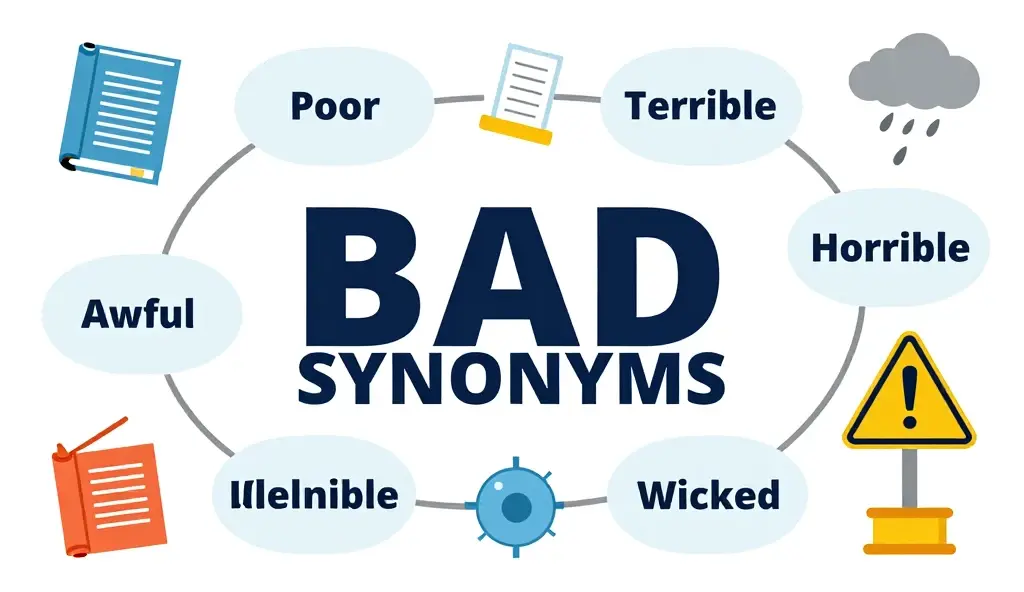
Why search for synonyms for bad? Using the word “bad” repeatedly dilutes your message and makes your prose feel repetitive and plain.
We often rely on “bad” to describe everything from minor daily annoyances to extreme catastrophes (a bad accident).
Because one short word carries so many distinct meanings, replacing it with descriptive, targeted vocabulary immediately improves readability, enhances SEO, and demonstrates strong language mastery.
Meaning
The word bad functions primarily as an adjective with four main definitions:
- Low Quality or Performance: Unsatisfactory, subpar, or falling short of standard expectations.
- Harmful or Unfavorable: Likely to cause damage, physical injury, distress, or adverse outcomes.
- Immoral or Evil: Morally wrong, malicious, or offensive in behavior and character.
- Decayed or Spoiled: Unfit for human consumption due to natural rot or decomposition.
Pronunciation
How to Pronounce “Bad”
- 🗣️ Phonetic Spelling: /bæd/
- 🎵 Rhymes with: Dad, glad, mad, rad, sad.
- Natural Sounding Guide: Pronounce with a firm “b” sound, transition into a short “ah” vowel sound, and end on a soft “d.”
Part of Speech
1. Adjective
Modifies nouns to indicate poor quality, harm, or immorality:
- 📝 Example: “She received bad feedback on her initial manuscript draft.” (Low quality)
- 📝 Example: “Sitting for extended periods is bad for posture.” (Harmful)
2. Adverb (Informal / Non-standard)
Used informally in spoken English in place of “badly” (grammatically, “badly” is preferred in formal writing):
- 📝 Example: “Our team wanted to win that match so bad.” (Strongly / Informal)
3. Noun (Idiomatic)
Used informally to acknowledge a mistake or assign fault:
- 📝 Example: “I forgot to save the document before closing—my bad.” (My fault)
Synonyms Table
| Word | Meaning | Usage Context | Formality | Example Sentence | Difficulty Level |
| Poor | Lacking in quality, value, or skill | Performance / Work | Neutral | The team delivered a poor presentation. | Easy |
| Awful | Extremely unpleasant or disagreeable | Weather / Experience | Informal | We had awful weather during our vacation. | Easy |
| Harmful | Causing damage, injury, or hurt | Health / Environment | Neutral | Excessive screen exposure can be harmful. | Easy |
| Severe | Very intense, harsh, or serious | Conditions / Injuries | Formal | The storm caused severe structural damage. | Intermediate |
| Wicked | Morally wrong, evil, or malicious | Morality / Characters | Neutral | The movie features a wicked antagonist. | Easy |
| Spoiled | Decayed or rotten; no longer edible | Food / Ingredients | Neutral | The milk turned spoiled in the heat. | Easy |
| Substandard | Below established quality standards | Business / Products | Formal | The contractor installed substandard piping. | Advanced |
| Dreadful | Causing great distress or annoyance | Events / News | Formal | They received dreadful news this morning. | Intermediate |
| Atrocious | Horrifyingly wicked or exceptionally poor | Behavior / Quality | Formal | His customer service manners were atrocious. | Advanced |
| Subpar | Below an expected or average level | Academics / Business | Formal | The quarter’s sales metrics were subpar. | Intermediate |
| Deleterious | Causing harm or damage over time | Academic / Science | Highly Formal | Pollution has a deleterious impact on habitats. | Advanced |
Best Synonyms for “Bad” (Explained)
1. Poor
- 🔍 Meaning: Deficient in quality, skill, standard, or financial value.
- 🔄 Difference from Bad: “Poor” is more professional and analytical when reviewing work, health status, or business metrics.
- 💬 Example: “The organization suffered from poor communication between departments.”
- 🎯 Best Situation: Work evaluations, academic papers, medical updates, and financial reviews.
- ⚠️ Common Mistake: Ensure context clarifies whether you mean low quality or economic poverty.
2. Awful
- 🔍 Meaning: Extremely unpleasant, offensive, or disagreeable.
- 🔄 Difference from Bad: “Awful” carries a significantly stronger emotional weight than a simple “bad.”
- 💬 Example: “An awful smell was coming from the clogged drain.”
- 🎯 Best Situation: Storytelling, personal anecdotes, casual dialogue, and reviews.
- ⚠️ Common Mistake: Avoid using “awful” in formal academic essays; opt for “unsatisfactory” or “adverse.”
3. Harmful
- 🔍 Meaning: Capable of causing physical damage, injury, or adverse outcomes.
- 🔄 Difference from Bad: “Harmful” specifically emphasizes health, safety, and security rather than simple personal dislike.
- 💬 Example: “Unfiltered emissions have harmful effects on urban air quality.”
- 🎯 Best Situation: Scientific studies, policy documents, health guides, and safety instructions.
- ⚠️ Common Mistake: Do not use “harmful” to describe minor, non-damaging things like a weak storyline.
4. Atrocious
- 🔍 Meaning: Shockingly bad, extremely cruel, or exceptionally poor in quality.
- 🔄 Difference from Bad: “Atrocious” represents an extreme grade of badness reserved for severe offenses or terrible quality.
- 💬 Example: “The hotel offered atrocious service despite charging high rates.”
- 🎯 Best Situation: Dramatic narratives, formal critiques, and legal or human rights discussions.
- ⚠️ Common Mistake: Using “atrocious” for minor daily inconveniences can sound dramatic or hyperbolic.
Antonyms
| Word | Meaning | Usage Context | Example Sentence |
| Good | Of high quality, favorable, or moral | General | She did a good job organizing the event. |
| Excellent | Remarkably good or outstanding | Performance / Work | The restaurant offers excellent customer service. |
| Beneficial | Producing good results; helpful | Health / Business | Exercise is highly beneficial for heart health. |
| Virtuous | Exhibiting high moral standards | Character / Ethics | He was remembered as a virtuous and fair leader. |
| Exemplary | Serving as a desirable model; ideal | Achievement | Her research paper was praised as exemplary. |
30 Real-World Examples
🎯 Bullet Points of Contextual Usage
- The client rejected the proposal due to poor market research.
- We experienced awful traffic congestion on the freeway.
- Single-use plastics inflict harmful damage on marine habitats.
- Coastal regions prepared for severe weather conditions.
- The classic novel centers around a wicked plot to usurp the throne.
- Discard any spoiled produce to keep the pantry fresh.
- The audit exposed substandard manufacturing practices.
- She received dreadful results on her preliminary examination.
- Critics slammed the play for its atrocious dialogue.
- Prolonged stress has a detrimental impact on physical immunity.
- The medicine left an unpleasant metallic taste.
- The sports franchise had an abysmal record this year.
- Economists presented a grim outlook for the coming quarter.
- Cheating on tests is a dishonorable practice.
- The athlete suffered a grievous knee injury during practice.
- Unrefrigerated butter quickly turns rancid.
- The investigation revealed a flawed safety protocol.
- Hikers avoided the mountain due to treacherous ice paths.
- He offered a lousy excuse for missing the deadline.
- Viewers turned off the show because of its terrible pacing.
- The neglected building fell into a dilapidated state.
- Misinformation caused irreparable damage to the brand.
- Damp basements often emit a foul odor.
- The presenter faced a hostile audience during Q&A.
- Investing without research is an ill-advised strategy.
- The emergency patient remains in critical condition.
- Citizens protested against the corrupt municipal government.
- The technician replaced the defective power module.
- Refueling infrastructure remained in deplorable shape.
- High inflation creates adverse conditions for first-time buyers.
25 Naturally Written Sentences
Formal Styles
- The official review cited substandard safety measures across all facilities.
- Chronic sleep deprivation leads to detrimental effects on cognitive function.
- Human rights advocacy groups condemned the deplorable living conditions.
- Miscalculating operational expenses caused disastrous quarterly losses.
- The international tribunal addressed atrocious war violations.
Informal Styles
- That was a totally lousy movie; save your money and skip it.
- The rain was absolutely awful throughout our entire camping trip.
- I felt rotten after staying up past midnight finishing chores.
- He gave a really lame explanation for being late to practice.
- Dinner at that roadside diner tasted pretty terrible.
Academic Styles
- Empirical evidence reveals a negative correlation between noise pollution and test scores.
- Researchers analyzed the adverse consequences of deforestation on regional rainfall patterns.
- The initial hypothesis was discarded due to flawed collection methodology.
- Socioeconomic inequality remains a deleterious factor in public health outcomes.
- Trial participants logged unsatisfactory recovery rates during phase one.
Formal vs. Informal Usage
| Usage Category | Formal Option | Informal Option | Practical Context |
| Low Quality | Substandard / Deficient | Lousy / Lame | “Substandard work” vs “Lousy work” |
| Extreme Badness | Deplorable / Atrocious | Awful / Terrible | “Deplorable conditions” vs “Awful conditions” |
| Harmful Result | Detrimental / Adverse | Nasty / Rough | “Adverse reaction” vs “Nasty reaction” |
| Moral Misconduct | Unethical / Immoral | Mean / Shady | “Unethical conduct” vs “Shady conduct” |
Academic Usage
In academic and formal research writing, avoid using “bad.” It is subjective, overly vague, and informal. Replace it with precise terms that define the exact nature of the defect:
- 🎓 Use adverse, detrimental, or deleterious when analyzing negative consequences or health risks.
- 🎓 Use flawed, defective, or deficient when analyzing arguments, research methodology, or data.
- 🎓 Use unsatisfactory, substandard, or inadequate when evaluating metrics, performance, or standards.
Daily Conversation
In everyday speech, “bad” gets used for feelings, weather, and basic mistakes:
- 🗣️ “I feel bad about missing your call.”
- 🗣️ “We are having bad weather today.”
- 🗣️ “That was a bad move.”
Upgrade your everyday conversation by switching to these alternatives:
- Replace “I feel bad” with “I feel guilty” or “I feel terrible.”
- Replace “Bad weather” with “Awful weather” or “Nasty weather.”
- Replace “Bad move” with “Poor decision” or “Unfortunate choice.”
Grammar Tips
Essential Rules for “Bad”
- Adjective vs. Adverb (Bad vs. Badly): Use “bad” after linking verbs like feel, look, smell, sound, taste (“I feel bad” = feeling regretful). Use “badly” to modify action verbs (“The engine performed badly”).
- Comparative & Superlative Forms: The comparative form of bad is worse, and the superlative form is worst (“Today’s traffic is worse than yesterday’s”). Never write “badder” or “baddest” in formal English.
- Preposition Pairings: Use “bad for [someone/something]” when discussing harm (“Fast food is bad for your body”), and “bad at [activity]” when referring to skill (“He is bad at public speaking”).
Collocations
🔗 Common Word Pairings with “Bad”
- Bad news: Unexpected or disappointing information. (e.g., “The manager delivered bad news to the team.”)
- Bad habit: A repetitive, undesirable behavior. (e.g., “Procrastination is a hard bad habit to break.”)
- Bad mood: A state of irritability or sadness. (e.g., “She was in a bad mood after missing her bus.”)
- Bad breath: Unpleasant mouth odor. (e.g., “Garlic and onions often cause bad breath.”)
Phrases and Idioms
💬 Popular Expressions
- In bad shape: In poor physical condition, health, or disrepair. (e.g., “The vintage car was in bad shape.”)
- Go from bad to worse: Deteriorate rapidly. (e.g., “The storm went from bad to worse overnight.”)
- Bad blood: Persistent hostility or anger between groups or individuals. (e.g., “There is bad blood between the rival firms.”)
- My bad: An informal phrase accepting responsibility for a small error. (e.g., “My bad, I brought the wrong folder.”)
Similar Words & Word Comparison
📊 Comparing Negative Adjectives
| Word | Primary Meaning | Subtle Difference | Best Example |
| Bad | Below standard or unpleasant | Broad, multi-purpose basic adjective | It was a bad experience. |
| Poor | Lacking standard quality | Focuses on deficiency in skill or value | He exhibited poor leadership. |
| Harmful | Causing damage or hurt | Focuses specifically on safety or health consequences | Toxic fumes are harmful. |
| Severe | Very harsh or extreme | Refers to intensity of weather, pain, or punishment | They faced severe weather. |
FAQs
Q1. What is the best overall synonym for bad?
A: It depends on the context. Use poor for quality, harmful for health or safety, and awful or terrible for unpleasant experiences.
Q2. What is a formal word for bad?
A: Formal alternatives include substandard, unsatisfactory, adverse, detrimental, and deplorable.
Q3. What is the comparative form of bad?
A: The comparative form is worse, and the superlative form is worst.
Q4. Is lousy an acceptable synonym for bad?
A: Yes. Lousy is a common informal alternative used in everyday conversation.
Q5. What is a synonym for bad behavior?
A: Common choices include misconduct, inappropriate behavior, and deplorable actions.
Q6. What is a synonym for bad health?
A: Use poor health, ill health, frail condition, or failing health.
Q7. What can I say instead of bad weather?
A: Try inclement weather, severe weather, foul weather, or dreadful weather.
Q8. What is the difference between bad and evil?
A: Bad refers to poor quality or undesirable conditions, while evil describes intentional moral wrongdoing.
Q9. What is a synonym for bad smell?
A: Use foul odor, stench, reek, or unpleasant smell.
Q10. What does deleterious mean?
A: Deleterious means causing harm or damage, especially over time.
Q11. Is my bad grammatically correct?
A: It is a common informal expression but should be avoided in formal writing.
Q12. What is the primary antonym for bad?
A: Common opposites include good, excellent, beneficial, and favorable.
Q13. Why should I avoid overusing bad in writing?
A: Using more specific synonyms improves clarity, variety, and overall writing quality.
Expert Tips for Choosing the Right Synonym
- Identify the core meaning: Figure out if your context refers to quality (poor), safety (harmful), morality (wicked), or physical health (frail).
- Match the tone and intensity: Avoid extreme words like atrocious or catastrophic for minor annoyances like a late train.
- Elevate formal work: Always replace “bad” in essays, business reports, and emails with targeted vocabulary such as adverse, deficient, or detrimental.
Conclusion
Expanding your vocabulary beyond the basic word bad enhances your writing and spoken communication.
If you are describing substandard work, harmful habits, or an awful experience, choosing the precise synonym adds clarity, authority, and depth to your language.

Chloe Ward is a vocabulary content specialist from Tampa, Florida. She enjoys helping readers build stronger communication skills through better word choices.