
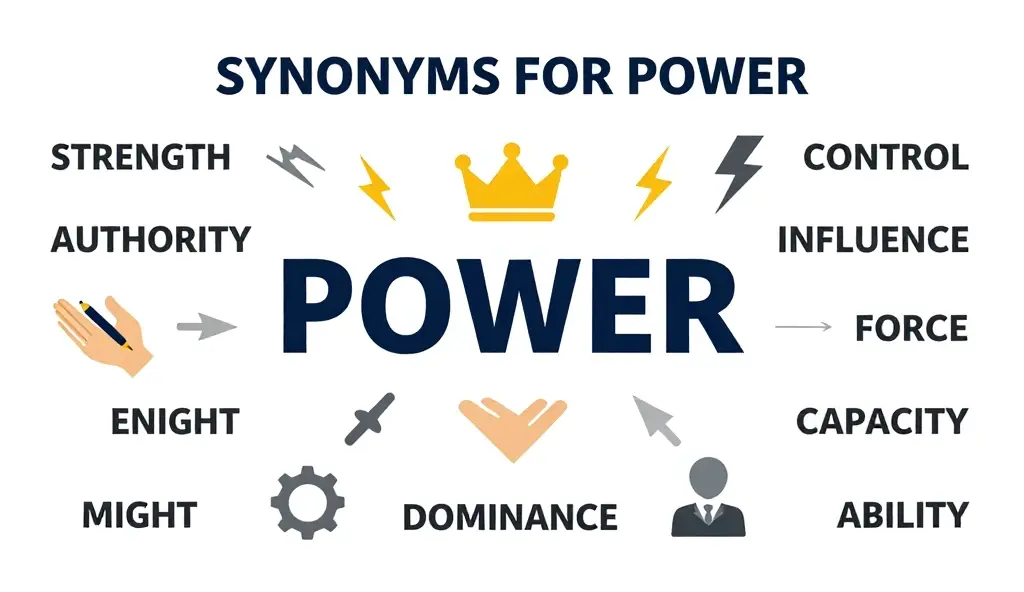
The word power has many meanings.
It can describe physical strength, political authority, personal influence, electrical energy, control over others, or the ability to do something.
For example:
She has the power to change the policy.
You could write:
She has the authority to change the policy.
Or:
She has enough influence to change the policy.
Or:
She has the ability to change the policy.
These alternatives are related, but each one highlights a different kind of power.
People search for synonyms for power when they want stronger vocabulary for essays, resumes, speeches, business writing, academic work, creative writing, or everyday conversation.
Choosing the right alternative makes your sentence more precise.
Meaning of Power
Power can mean the ability, strength, authority, or influence needed to control, affect, or accomplish something.
Definition
Power: the ability or capacity to do something, control something, or influence people or events.
Common Uses
The president has political power.
The machine requires electrical power.
She has the power to make decisions.
Exercise can increase physical power.
Knowledge gives people power.
The meaning changes depending on context.
Pronunciation of Power
Power is pronounced:
/ˈpaʊər/
It sounds approximately like:
POW-er
Example:
The government has significant power.
Part of Speech
Power can be used as both a noun and a verb.
Noun
The leader has enormous power.
Verb
The battery powers the device.
As a noun, it can refer to authority, strength, energy, or ability.
As a verb, it means to provide energy or operate something.
Synonyms for Power
| Word | Meaning | Usage | Formality | Example | Difficulty |
| Strength | Physical or mental force | General | Neutral | He showed great strength. | Easy |
| Authority | Official right to control | Government/work | Formal | She has the authority to decide. | Easy |
| Control | Ability to direct something | General | Neutral | He has control over the project. | Easy |
| Influence | Ability to affect people/events | Social/business | Neutral | She has strong influence. | Easy |
| Force | Physical power or pressure | Physical/general | Neutral | The force pushed the door open. | Easy |
| Ability | Capacity to do something | General | Neutral | She has the ability to lead. | Easy |
| Energy | Capacity for activity/work | Science/general | Neutral | Solar energy provides power. | Easy |
| Capacity | Ability or potential | Academic/business | Formal | The system has greater capacity. | Medium |
| Might | Great strength or power | Literary/general | Neutral | The army demonstrated its might. | Easy |
| Command | Authority or control | Military/business | Formal | She has command of the team. | Medium |
| Dominance | Superior control | Competition/social | Formal | The team established dominance. | Medium |
| Supremacy | Highest authority or position | Political/competitive | Formal | The country sought military supremacy. | Advanced |
| Rule | Control over people or territory | Political | Neutral | The king’s rule lasted decades. | Easy |
| Leadership | Power to guide others | Work/social | Neutral | Her leadership inspired the team. | Easy |
| Governance | Exercise of authority | Government | Formal | Good governance builds trust. | Advanced |
| Leverage | Advantage used to influence | Business | Formal | The company has financial leverage. | Medium |
| Clout | Influence or power | Social/business | Informal | She has political clout. | Medium |
| Sway | Influence over decisions | Social/general | Neutral | He has considerable sway. | Medium |
| Potency | Strength or effectiveness | Medicine/general | Formal | The treatment has high potency. | Advanced |
| Capability | Ability to perform | Technical/business | Formal | The system has advanced capabilities. | Medium |
| Efficacy | Ability to produce a result | Academic/technical | Formal | The study tested the treatment’s efficacy. | Advanced |
| Vigor | Physical or mental energy | General | Formal | He worked with vigor. | Medium |
| Vitality | Energy and liveliness | General | Formal | Exercise can improve vitality. | Medium |
| Intensity | Degree of strength | General/science | Neutral | The storm increased in intensity. | Medium |
| Potency | Degree of power/effectiveness | Technical/general | Formal | The chemical has high potency. | Advanced |
| Muscle | Strength or influence | Informal/business | Informal | The company has financial muscle. | Medium |
| Punch | Strength or impact | Informal | Casual | The speech had real punch. | Easy |
| Impact | Ability to produce an effect | General/business | Neutral | The campaign had a strong impact. | Easy |
| Effect | Resulting influence | General | Neutral | The policy had a major effect. | Easy |
| Persuasion | Ability to convince | Social | Formal | She has great powers of persuasion. | Medium |
| Empowerment | Giving power or confidence | Social/work | Formal | Education promotes empowerment. | Medium |
| Autonomy | Ability to act independently | Professional/political | Formal | Employees need greater autonomy. | Advanced |
| Independence | Freedom from control | General | Neutral | The country gained independence. | Easy |
| Freedom | Ability to act without restriction | General | Neutral | Everyone deserves freedom. | Easy |
| Liberty | Freedom from oppressive control | Political/formal | Formal | The constitution protects liberty. | Medium |
| Privilege | Special right or advantage | Social/legal | Neutral | The position carries special privileges. | Medium |
| Right | Legal or moral entitlement | Legal/general | Neutral | She has the right to decide. | Easy |
| Jurisdiction | Official authority over an area | Legal | Formal | The court has jurisdiction. | Advanced |
| Dominion | Control over territory or people | Historical/formal | Advanced | The empire expanded its dominion. | Advanced |
| Mastery | Complete control or skill | Academic/general | Formal | He achieved mastery of the craft. | Medium |
| Command | Control or authority | Professional | Formal | She has command over the department. | Medium |
| Agency | Ability to act independently | Academic/social | Formal | People need a sense of agency. | Advanced |
| Potential | Possibility or capacity | General | Neutral | The technology has great potential. | Easy |
| Forcefulness | Strength of expression/action | General | Formal | His argument had forcefulness. | Medium |
| Resilience | Ability to recover and remain strong | General | Neutral | Her resilience impressed everyone. | Medium |
| Fortitude | Mental strength during hardship | Formal | Advanced | He showed remarkable fortitude. | Advanced |
| Mightiness | Great strength or power | Literary | Advanced | The poem celebrates the mightiness of nature. | Advanced |
Best Synonyms for Power
1. Strength
Strength refers to physical, mental, emotional, or structural power.
She showed great strength during the crisis.
Best Situation
Use strength when talking about:
- physical ability
- emotional resilience
- mental toughness
- strong qualities
- physical force
2. Authority
Authority means the official right or ability to make decisions and control something.
The manager has the authority to approve the request.
Best Situation
Use it for:
- government
- management
- law
- organizations
- official positions
3. Influence
Influence means the ability to affect someone’s actions, opinions, or decisions.
She has considerable influence within the organization.
Unlike authority, influence doesn’t necessarily come from an official position.
4. Control
Control means the ability to direct or manage someone or something.
He has complete control over the project.
It emphasizes management rather than strength.
5. Force
Force means physical strength, pressure, or power that produces movement or change.
The force of the wind damaged the roof.
It can also describe social or political pressure.
6. Ability
Ability means the capacity to do something.
She has the ability to solve difficult problems.
Use ability when power means capability rather than authority.
7. Energy
Energy refers to the capacity to do physical work or activity.
The device needs electrical energy to operate.
It is especially useful in science and technology.
8. Capacity
Capacity means the ability or potential to contain, produce, or accomplish something.
The organization has the capacity to expand.
It is common in business, science, and academic writing.
9. Might
Might means great strength or power.
The army demonstrated its military might.
It often sounds dramatic or literary.
10. Command
Command means authority or control over people or resources.
She has command of the entire department.
It is especially common in military and professional contexts.
11. Dominance
Dominance means having greater power or control than others.
The company maintained its dominance in the market.
It is useful when one person, group, or organization is stronger than competitors.
12. Leverage
Leverage means an advantage or source of power that can be used to influence a situation.
The company used its market position as leverage.
This is especially useful in business and negotiation writing.
13. Clout
Clout means influence or power, especially in politics, business, or social settings.
She has considerable political clout.
It is more informal than influence or authority.
14. Sway
Sway means the ability to influence someone’s decisions or opinions.
He has considerable sway over the board.
It often describes indirect influence.
15. Fortitude
Fortitude means mental and emotional strength during difficult situations.
She showed remarkable fortitude during the crisis.
It is a strong formal alternative when discussing courage and endurance.
Power Synonyms by Context
Physical Power
Best choices:
- strength
- force
- might
- energy
- vigor
- intensity
The machine produces tremendous force.
The athlete demonstrated remarkable strength.
Political Power
Use:
- authority
- influence
- control
- dominance
- rule
- governance
- supremacy
- jurisdiction
The government has significant authority.
Social Power
Use:
- influence
- sway
- clout
- persuasion
- status
- authority
She has considerable influence within the community.
Business Power
Use:
- influence
- leverage
- authority
- control
- dominance
- market strength
- clout
The company has significant market influence.
Electrical Power
Use:
- energy
- electricity
- electrical energy
- output
- wattage
The solar panels generate enough electrical energy to power the building.
Personal Power
Use:
- strength
- confidence
- authority
- influence
- autonomy
- resilience
- empowerment
Education gave her a greater sense of empowerment.
Antonyms of Power
| Antonym | Meaning | Example |
| Weakness | Lack of strength | His weakness limited his performance. |
| Powerlessness | Lack of control or influence | They felt powerless. |
| Helplessness | Inability to act or control events | She experienced a sense of helplessness. |
| Inability | Lack of ability | His inability to act caused delays. |
| Dependence | Reliance on others | Financial dependence reduced her freedom. |
| Submission | Acceptance of another’s authority | The group showed submission. |
| Subordination | Lower position or authority | The employee remained in a position of subordination. |
| Vulnerability | Exposure to harm or control | The system has several vulnerabilities. |
| Ineffectiveness | Lack of ability to produce results | The policy showed ineffectiveness. |
| Insignificance | Lack of importance or influence | His role was considered insignificant. |
| Passivity | Lack of action or resistance | Passivity allowed the problem to grow. |
| Constraint | Restriction of freedom or ability | Legal constraints limited the project. |
30 Real-World Examples
- She has the power to make important decisions.
- He showed incredible strength during the competition.
- The manager has authority over the department.
- Her influence extends across the industry.
- The storm had enormous force.
- She has the ability to solve complex problems.
- Solar energy provides clean power.
- The company has the capacity to expand.
- The country demonstrated its military might.
- She has command of the entire team.
- The company maintains dominance in the market.
- The king ruled with absolute power.
- Good leadership can inspire people.
- The organization needs stronger governance.
- The company used its size as leverage.
- He has considerable political clout.
- She has significant sway over the board.
- The medicine has high potency.
- The machine has greater operating capacity.
- The team worked with energy and enthusiasm.
- His speech had a powerful impact.
- Education can create empowerment.
- Employees need greater autonomy.
- The nation fought for independence.
- Everyone deserves freedom and liberty.
- The court has legal jurisdiction.
- The empire expanded its dominion.
- He achieved mastery of the skill.
- She demonstrated remarkable fortitude.
- Her resilience gave her the power to continue.
25 Naturally Written Sentences
- Knowledge can give people the power to make better choices.
- She has enough authority to approve the proposal.
- His influence reaches far beyond his organization.
- The athlete demonstrated impressive physical strength.
- The storm generated enormous force.
- She has the ability to lead the team.
- Solar energy provides clean electrical power.
- The company has the capacity to grow quickly.
- The nation wanted to increase its military might.
- She took command of the project.
- The company gained dominance over the market.
- His political influence continues to grow.
- Education can give people greater independence.
- The manager used his authority wisely.
- The organization gained leverage during negotiations.
- She has considerable influence among her colleagues.
- The leader used persuasion rather than force.
- The machine requires a reliable power source.
- Her resilience became a source of personal strength.
- He showed remarkable fortitude during the crisis.
- The new policy gave workers more autonomy.
- The company used its reputation as leverage.
- Her leadership gave the team confidence.
- The law limits the government’s authority.
- True strength often comes from patience and discipline.
Formal vs. Informal Usage
| Formal | Neutral | Informal |
| Authority | Power | Clout |
| Influence | Control | Pull |
| Dominance | Strength | Muscle |
| Jurisdiction | Ability | Punch |
| Supremacy | Energy | Force |
| Leverage | Command | Sway |
| Empowerment | Influence | Say-so |
Formal
The committee has the authority to approve the proposal.
Neutral
The committee has the power to approve the proposal.
Informal
The committee has the final say.
Academic Usage
In academic writing, power can refer to political control, social influence, physical force, economic strength, or statistical concepts.
Political
Political power is often concentrated among a small group.
Social
Social influence can shape individual behavior.
Physical
The force of the impact increased with speed.
Economic
Economic power can influence government policy.
Psychological
Personal agency can give individuals greater control over their decisions.
For academic writing, choose the exact word that matches your argument rather than using power repeatedly.
Daily Conversation
Power is very common in everyday speech.
He has a lot of power at work.
You can also say:
He has a lot of influence.
He has a lot of control.
He has a lot of authority.
He has a lot of pull.
Pull is informal and means influence.
She has a lot of pull in the company.
Grammar Tips
Power to
Use power to + verb when describing the ability or authority to do something.
She has the power to change the rules.
Power over
Use power over + person/thing when describing control.
The manager has power over the department.
Power of
Use power of + noun to describe a particular type or source of power.
The power of education can change lives.
Power in
Use power in + area/context.
He has considerable power in the organization.
Powered by
Use powered by to describe the energy source of something.
The car is powered by electricity.
Power Up
Power up means to turn on or provide energy to a device.
Power up the computer.
Power Through
Power through means to continue despite difficulty.
She powered through the difficult assignment.
Common Collocations With Power
Political Power
Political power can influence public policy.
Economic Power
Economic power affects global markets.
Physical Power
The athlete developed greater physical power.
Military Power
The country has significant military power.
Social Power
Social power can shape public opinion.
Financial Power
Financial power gives companies greater influence.
Absolute Power
The ruler held absolute power.
Unlimited Power
The character appeared to have unlimited power.
Real Power
The committee has real power over the decision.
Great Power
The nation became a major world power.
Gain Power
The political party gained power.
Lose Power
The government lost power after the election.
Share Power
Leaders should be willing to share power.
Exercise Power
Governments exercise power through institutions.
Abuse Power
Leaders must not abuse their power.
Transfer Power
The government peacefully transferred power.
Common Phrases With Power
Power of Knowledge
The power of knowledge can transform lives.
Power of Choice
Everyone should have the power of choice.
Power of Influence
Social media demonstrates the power of influence.
Power to Change
Education gives people the power to change their circumstances.
Hold Power
The group continues to hold political power.
Gain Power
The party gained power after the election.
Lose Power
The leader eventually lost power.
Share Power
Democratic systems often require leaders to share power.
Abuse of Power
The investigation focused on an alleged abuse of power.
Power Struggle
The organization experienced an internal power struggle.
Similar Words
| Word | Meaning | Difference | Example |
| Power | Ability, control, strength, or influence | Broadest term | She has political power. |
| Strength | Physical or mental force | Focuses on force or resilience | He showed great strength. |
| Authority | Official right to control | Usually comes from a position | She has authority to decide. |
| Influence | Ability to affect others | Doesn’t require official control | She has strong influence. |
| Control | Ability to direct something | Focuses on management | He controls the project. |
| Force | Physical power or pressure | Often physical | The force broke the door. |
| Ability | Capacity to do something | Focuses on capability | She has the ability to lead. |
| Energy | Capacity to perform work | Often physical/scientific | Solar energy powers homes. |
| Might | Great strength | Often dramatic or literary | Military might increased. |
| Dominance | Superior power | Implies superiority over others | The team showed dominance. |
| Leverage | Advantage used as power | Common in business/negotiation | They used leverage. |
| Clout | Social or political influence | Informal | He has political clout. |
| Sway | Influence over decisions | Often indirect | She has sway over the board. |
Power vs. Strength
Power is a broad concept that can mean authority, influence, energy, or strength.
Strength usually refers to physical or mental force.
The government has political power.
The athlete has physical strength.
Power vs. Authority
Power can come from many sources.
Authority specifically means the recognized or official right to make decisions.
The manager has the authority to approve expenses.
Someone can have power without having official authority.
Power vs. Influence
Influence is the ability to affect people or decisions.
Power can include influence but can also involve direct control or authority.
She has influence over public opinion.
The government has power over the policy.
Power vs. Force
Force often refers to physical strength or pressure.
Power is broader.
The force of the explosion was enormous.
The government has political power.
Power vs. Ability
Ability means being capable of doing something.
Power can mean ability, but it can also mean control or authority.
She has the ability to solve the problem.
She has the power to approve the project.
Common Mistakes
Mistake 1: Using Authority When You Mean Strength
The athlete has great authority.
This sounds like the athlete has official control.
Better:
The athlete has great strength.
Mistake 2: Using Influence When You Mean Direct Control
The manager has influence over the company’s budget.
This may be correct, but if the manager officially controls the budget:
The manager has authority over the company’s budget
Mistake 3: Confusing Power With Energy
In physics, power has a specific meaning related to the rate of energy transfer or work.
In everyday language, power can simply mean strength or control
Mistake 4: Overusing “Powerful”
Instead of:
a powerful argument
You can sometimes use:
a convincing argument
a compelling argument
a strong argument
This makes your writing more precise.
Expert Tips
1. Use “Authority” for Official Power
The director has authority over the department.
2. Use “Influence” for Social Power
She has significant influence in the industry.
3. Use “Strength” for Physical or Mental Power
He showed remarkable strength.
4. Use “Force” for Physical Pressure
The force of the wind was intense.
5. Use “Leverage” for Negotiations
The company gained leverage in the negotiations.
6. Use “Clout” for Informal Influence
She has considerable political clout.
7. Use “Sway” for Indirect Influence
He has considerable sway over the committee.
8. Use “Capacity” for Potential
The system has the capacity to handle more users.
9. Use “Might” for Dramatic Strength
The empire demonstrated its military might.
10. Use “Empowerment” for Giving People Power
Education can promote personal empowerment.
FAQs
Q.1. What is the best synonym for power?
A: There isn’t one universal synonym because power has many meanings. Strength works for physical or mental power, authority works for official control, influence works for social impact, force works for physical pressure, and ability works when power means capability. The best choice depends on the sentence.
Q.2. What is a simple synonym for power?
A: Strength is one of the simplest synonyms for power, especially when discussing physical or personal ability. Ability is another simple alternative when you mean the capacity to do something. For example, “She has the power to solve the problem” can become “She has the ability to solve the problem.”
Q.3. What is a formal synonym for power?
A: Formal alternatives include authority, influence, dominance, supremacy, jurisdiction, governance, leverage, capacity, and command. The correct word depends on the context.
Q.4. What is another word for political power?
A: Common alternatives include political influence, authority, control, leadership, dominance, rule, governance, and political clout.
Q.5. What is a synonym for power on a resume?
A: For a resume, useful alternatives include leadership, authority, influence, expertise, capability, competence, decision-making authority, and professional impact.
Q.6. What is the opposite of power?
A: The most direct opposites depend on the meaning. Weakness is an opposite of physical strength, powerlessness is an opposite of control or authority, and inability is an opposite of capability.
Q.7. What is the difference between power and authority?
A: Power is the broader concept and can come from strength, wealth, influence, knowledge, position, or control. Authority is the recognized or official right to make decisions or give orders.
Q.8. What is the difference between power and influence?
A: Influence means the ability to affect people’s opinions, actions, or decisions. Power is broader and can include influence, authority, physical strength, or direct control.
Q.9. What is a synonym for personal power?
A: Depending on the context, good alternatives include strength, confidence, autonomy, self-efficacy, resilience, agency, empowerment, and personal influence.
Q.10. What is a synonym for physical power?
A: Common alternatives include strength, force, might, energy, vigor, and physical capability. Strength is the most natural everyday choice.
Q.11. What is a synonym for power in business?
A: Useful business alternatives include influence, authority, leverage, control, dominance, clout, market strength, and competitive advantage.
Q.12. What is a synonym for power in academic writing?
A: Academic alternatives include influence, authority, capacity, ability, force, dominance, control, and agency. The best choice depends on the subject.
Q.13. What is a synonym for power in a sentence?
A: The correct synonym depends on meaning. For “The leader has power,” use authority or influence. For “The athlete has power,” use strength. For “The machine needs power,” use energy.
Q.14. What is the strongest word for power?
A: There is no single strongest word. Might can suggest enormous strength, dominance suggests superior control, supremacy suggests the highest position of power, and authority suggests official control.
Q.15. How can I avoid repeating the word power?
A: First identify what kind of power you mean. Use strength for physical ability, authority for official control, influence for social impact, energy for electrical power, capacity for potential, and leverage for negotiation.
Conclusion:
The best synonyms for power depend on the exact meaning you want to express.
Use strength for physical or mental force, authority for official control, influence for the ability to affect others, force for physical pressure, and ability for capability.
For business writing, leverage, clout, and dominance can be useful.
For personal development, empowerment, autonomy, resilience, and agency may be more precise.
In technical contexts, energy, capacity, and output can be better choices.
The goal isn’t to find a fancier replacement for power.
The goal is to choose the word that communicates the specific kind of power you mean.

Alexander Price is a language researcher based in Salt Lake City, Utah. He focuses on English word relationships and practical vocabulary development.