
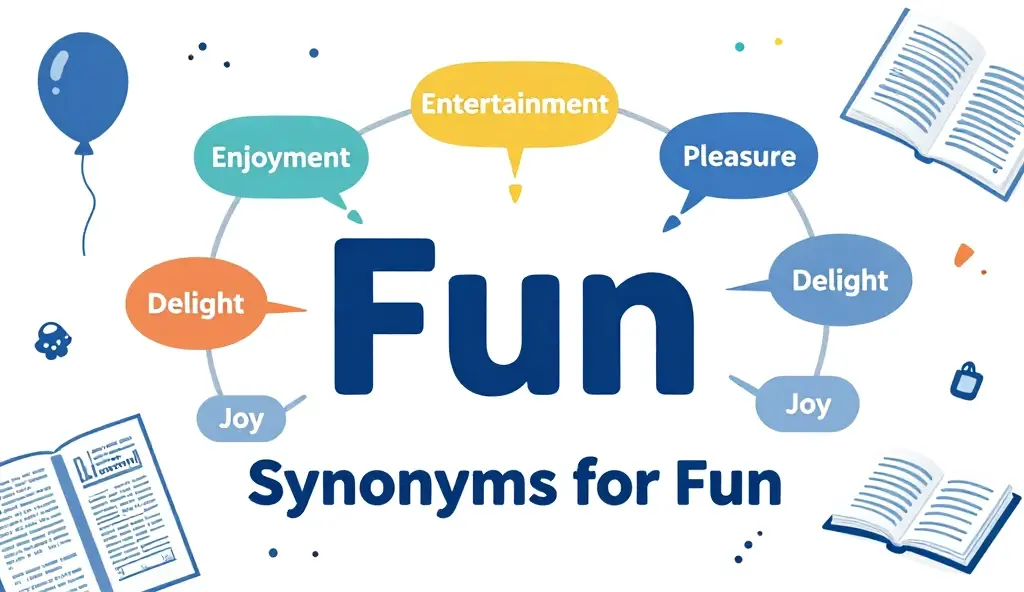
The best synonyms for fun include enjoyable, entertaining, amusing, exciting, delightful, playful, pleasurabls on what you mean. Use enjoyable for a pleasant activity, amusing for something that makes people laugh, exciting for a thrilling event, and playful for light and cheerful behavior.
Finding another word for fun may seem simple. Yet each synonym has its own tone. One word may describe a party. Another may fit a game, trip, person, lesson, or joke.
This guide explains the meaning of fun, its pronunciation, grammar, synonyms, antonyms, examples, collocations, phrases, and common mistakes. It will help you choose a word that sounds natural and fits your exact idea.
What Does Fun Mean?
Fun means pleasure, enjoyment, or an activity that makes someone feel happy and interested. It can describe a good experience, a playful moment, or something people enjoy doing.
For example:
- We had fun at the beach.
- The party was fun.
- Reading can be fun.
- She planned a fun game for the class.
The word often points to a light, happy, and pleasant experience. It does not always mean laughter. A quiet walk, a puzzle, a road trip, or a deep talk with a friend can also be fun.
Major English dictionaries describe fun as pleasure or enjoyment. They also recognize its common use as both a noun and an adjective. Merriam-Webster notes that it can even work as a less common verb. for synonyms for fun when they want to:
- Avoid using the same word many times
- Make a sentence more exact
- Improve an essay or story
- Write better social media captions
- Describe an event in a fresh way
- Choose a formal word for school or work
- Find a stronger word for an exciting experience
The best replacement depends on the context. A comedy show may be amusing, while a roller coaster may be thrilling. Both can be fun, but they create different feelings.
Pronunciation of Fun
The word fun is pronounced:
/fʌn/
It sounds like:
fuhn
The vowel sound is short. It is the same sound heard in:
- Sun
- Run
- Done
- One
- Come
To pronounce it naturally, begin with the f sound. Let air pass between your lower lip and upper teeth. Then make a short “uh” sound. End by touching your tongue near the top of your mouth for the n sound.
Say it as one quick sound:
fuhn
Do not stretch the vowel too much. Saying “foon” would sound incorrect in standard American English.
Try these short phrases:
- Have fun
- Sounds fun
- So much fun
- A fun day
- Just for fun
The pronunciation does not change when fun works as a noun or an adjective.
What Part of Speech Is Fun?
The word fun is most often a noun or an adjective. It can also appear as a verb, but that use is far less common.
Fun as a Noun
As a noun, fun means pleasure or enjoyment.
Examples:
- We had a lot of fun.
- The children are having fun.
- There is no harm in having some fun.
- Cooking together was great fun.
In this use, fun is normally an uncountable noun. That means people usually do not say “a fun” or “three funs.”
Correct:
- We had some fun.
- It was great fun.
- They had a lot of fun.
Incorrect:
- We had a fun.
- They enjoyed many funs.
Cambridge identifies fun as an uncountable noun when it means pleasure and enjoyment. Adjective
As an adjective, fun describes something enjoyable.
Examples:
- That was a fun movie.
- We played a fun game.
- He is a fun teacher.
- It looks like a fun place.
This use is very common in modern English, especially in daily conversation.
Fun as a Verb
Fun can sometimes mean joking or teasing.
Example:
- I’m only funning with you.
This use is rare and very informal. Most speakers would say:
- I’m only joking with you.
- I’m just teasing you.
For clear writing, use joking or teasing instead.
Synonyms for Fun
Here is a useful fun synonym list. Some words describe pleasure. Others describe laughter, energy, play, or excitement.
| Word | Meaning | Best Usage | Formality | Example | Difficulty |
| Enjoyable | Pleasant and satisfying | Activities and events | Neutral | The trip was enjoyable. | Easy |
| Entertaining | Holding attention in a pleasant way | Shows, books, speakers | Neutral | The movie was entertaining. | Easy |
| Amusing | Making someone smile or laugh | Jokes and stories | Neutral | His story was amusing. | Easy |
| Exciting | Creating strong interest or energy | Trips, games, news | Neutral | It was an exciting match. | Easy |
| Delightful | Very pleasant and charming | People, places, events | Polite | We had a delightful evening. | Medium |
| Pleasurable | Giving pleasure | Experiences and feelings | Formal | The walk was pleasurable. | Medium |
| Playful | Full of light, happy play | People, pets, designs | Neutral | The puppy was playful. | Easy |
| Lively | Full of life and energy | Parties and places | Neutral | It was a lively celebration. | Easy |
| Engaging | Holding interest | Lessons, books, speakers | Formal-neutral | The lesson was engaging. | Medium |
| Recreational | Done for enjoyment in free time | Sports and activities | Formal | The park offers recreational activities. | Medium |
| Thrilling | Very exciting | Adventures and events | Neutral | The ride was thrilling. | Easy |
| Cheerful | Happy and positive | Mood, person, setting | Neutral | The room had a cheerful feel. | Easy |
| Lighthearted | Happy and not serious | Movies and talks | Neutral | We watched a lighthearted film. | Medium |
| Enjoyment | The feeling of having a good time | General pleasure | Neutral | Music brings her enjoyment. | Easy |
| Amusement | Pleasure from something funny or interesting | Entertainment | Neutral-formal | The game gave us great amusement. | Medium |
| Pleasure | A happy or satisfying feeling | Formal and general use | Neutral-formal | It was a pleasure to join them. | Easy |
| Merriment | Cheerful laughter and celebration | Festive writing | Formal-literary | The room was full of merriment. | Hard |
| Festive | Cheerful and linked to celebration | Holidays and events | Neutral | The market felt festive. | Easy |
| Diverting | Pleasantly interesting | Books or activities | Formal | The puzzle was diverting. | Hard |
| Enjoyable experience | An event that gives pleasure | General descriptions | Neutral | The tour was an enjoyable experience. | Easy |
Best Synonyms for Fun and How to Use Them
A good synonym should match the kind of fun you mean. It should also fit the tone of the sentence. Here are the most useful choices.
Enjoyable
Enjoyable means pleasant or satisfying.
It is one of the closest synonyms for fun. It works well for trips, meals, books, meetings, classes, and events.
Difference: Fun often sounds casual. Enjoyable sounds a little calmer and more polished.
Example: The family picnic was enjoyable.
Best situation: Use it when an experience was pleasant but not wild or thrilling.
Common mistake: Do not use enjoyable to describe a person in the same way you use fun.
Natural:
- She is fun to be around.
- Her company is enjoyable.
Less natural:
- She is an enjoyable person.
Entertaining
Entertaining means interesting and pleasant to watch, hear, or experience.
It is a strong synonym for fun when talking about movies, shows, books, videos, performances, or speakers.
Difference: Fun describes the whole experience. Entertaining focuses on how well something holds attention.
Example: The play was funny and entertaining.
Best situation: Use it for content or performances.
Common mistake: Entertaining does not always mean funny. A mystery film can be entertaining without making anyone laugh.
Amusing
Amusing means causing mild laughter or a smile.
It works well for jokes, stories, comments, mistakes, and unusual situations.
Difference: Fun means enjoyable. Amusing means something creates humor.
Example: His story about the lost suitcase was amusing.
Best situation: Use it when something is funny in a gentle way.
Common mistake: Do not use amusing for a thrilling adventure unless it also made people laugh.
Exciting
Exciting means causing strong interest, energy, or eagerness.
It is a better word than fun when an event feels active, new, or full of suspense.
Difference: Fun is pleasant. Exciting is more intense.
Example: Moving to a new city was exciting.
Best situation: Use it for sports, travel, news, adventures, contests, or new plans.
Common mistake: Exciting does not always mean safe or relaxing. A storm can be exciting to watch, but it may not be fun.
Delightful
Delightful means very pleasant, lovely, or charming.
It sounds warm and polite. It often appears in reviews, letters, travel writing, and formal conversation.
Difference: Fun is casual. Delightful feels more refined and affectionate.
Example: We spent a delightful afternoon in the garden.
Best situation: Use it for pleasant people, meals, visits, places, or small experiences.
Common mistake: It may sound too gentle for a loud concert or extreme sport.
Pleasurable
Pleasurable means giving pleasure or satisfaction.
It is a formal synonym for fun. It often describes calm experiences, comfort, beauty, and personal enjoyment.
Difference: Pleasurable is more formal and often more personal. Fun is broader and more casual.
Example: Listening to the rain was a pleasurable experience.
Best situation: Use it in essays, reviews, reports, and polished descriptions.
Common mistake: It can sound stiff in casual speech.
Formal:
- The visit was pleasurable.
More natural in conversation:
- The visit was fun.
- We enjoyed the visit.
Playful
Playful means light, cheerful, and ready for play.
It may describe a child, pet, joke, design, voice, or mood.
Difference: Fun describes enjoyment. Playful describes behavior or style.
Example: The kitten became playful after its nap.
Best situation: Use it for cheerful actions, creative designs, gentle teasing, or childlike energy.
Common mistake: A person can be playful without being funny.
Lively
Lively means full of life, movement, talk, or energy.
It often describes parties, streets, music, discussions, and crowds.
Difference: Lively focuses on energy. Fun focuses on enjoyment.
Example: The café had a lively mood on Friday night.
Best situation: Use it when a place or event feels active and social.
Common mistake: A lively debate may be interesting but not pleasant for everyone.
Engaging
Engaging means interesting enough to hold attention.
It is useful in education, business, publishing, and professional writing.
Difference: Engaging focuses on interest. Fun focuses on pleasure.
Example: The teacher used an engaging activity to explain math.
Best situation: Use it for lessons, articles, talks, books, videos, and presentations.
Common mistake: Engaging does not always mean easy. A hard puzzle can still be engaging.
Recreational
Recreational means done for pleasure during free time rather than for work.
It is often used for sports, parks, games, swimming, and outdoor activities.
Difference: Fun describes a feeling. Recreational describes the purpose of an activity.
Example: The city built a new recreational center.
Best situation: Use it in formal writing about hobbies, sports, health, parks, and community programs.
Common mistake: Do not use recreational as a direct replacement in every sentence.
Incorrect:
- The party was recreational.
Better:
- The center offers recreational events.
- The party was fun.
Thrilling
Thrilling means extremely exciting.
It is stronger than fun and exciting.
Difference: Fun may be calm. Thrilling includes a rush of emotion.
Example: The final race was thrilling.
Best situation: Use it for adventure sports, close games, action movies, rides, and major events.
Common mistake: Avoid using it for a quiet activity unless that activity truly creates strong excitement.
Lighthearted
Lighthearted means cheerful and free from serious worry.
It often describes a movie, story, mood, joke, or talk.
Difference: Fun focuses on enjoyment. Lighthearted tells readers that something is not serious or heavy.
Example: We had a lighthearted talk over lunch.
Best situation: Use it for cheerful content and relaxed social moments.
Common mistake: A lighthearted story may be sweet and pleasant without being very funny.
Synonyms for Fun by Context
The same word will not fit every situation. These groups make it easier to find the right alternative.
Synonyms for a Fun Activity
- Enjoyable
- Entertaining
- Engaging
- Recreational
- Pleasant
- Rewarding
- Exciting
- Relaxing
- Lively
- Playful
Example:
- The museum tour was an engaging activity.
- The beach game was playful and exciting.
Synonyms for a Fun Person
- Entertaining
- Lively
- Cheerful
- Playful
- Good-humored
- Amusing
- Energetic
- Sociable
- Easygoing
- Witty
Example:
- Mia is lively and easygoing.
- He is an entertaining person to travel with.
Synonyms for a Fun Party
- Lively
- Festive
- Joyful
- Energetic
- Entertaining
- Cheerful
- Exciting
- Memorable
- Vibrant
- Spirited
Example:
- The wedding had a festive mood.
- It was a lively party with music and games.
Synonyms for a Fun Trip
- Enjoyable
- Exciting
- Memorable
- Adventurous
- Delightful
- Pleasant
- Thrilling
- Refreshing
- Rewarding
- Unforgettable
Example:
- We had an adventurous weekend in the mountains.
- The train ride was a delightful part of the trip.
Synonyms for Fun in Writing
- Enjoyment
- Amusement
- Pleasure
- Merriment
- Entertainment
- Delight
- Recreation
- Cheer
- Excitement
- Playfulness
Example:
- The festival brought cheer to the town.
- The children shouted with excitement.
Informal Synonyms for Fun
- A blast
- A good time
- Cool
- Awesome
- Great
- A treat
- A laugh
- A riot
- A thrill
- Good times
Example:
- The concert was a blast.
- That game was a lot of laughs.
Some informal words can change meaning by region, age, and tone. “A riot,” for example, can mean very funny in casual speech, but its main meaning also refers to violent public disorder. Use it only when the context is clear.
Antonyms for Fun
Antonyms for fun describe boredom, sadness, difficulty, seriousness, discomfort, or a lack of interest.
| Antonym | Meaning | Best Usage | Example |
| Boring | Not interesting or enjoyable | Events and activities | The lecture felt boring. |
| Dull | Lacking interest, energy, or excitement | Events, writing, places | The show was dull. |
| Tedious | Long, slow, and tiring | Tasks and processes | Filling out the forms was tedious. |
| Unpleasant | Causing discomfort or dislike | Experiences | The trip home was unpleasant. |
| Miserable | Very unhappy or uncomfortable | Feelings and conditions | The cold weather made us miserable. |
| Serious | Not playful or humorous | Talks and situations | It was a serious meeting. |
| Depressing | Causing sadness or loss of hope | News, stories, places | The ending was depressing. |
| Painful | Causing physical or emotional pain | Experiences | The loss was painful. |
| Tiresome | Causing boredom or annoyance | Repeated actions | The long delay became tiresome. |
| Dreary | Dull, sad, and without life | Weather, places, routines | It was a dreary afternoon. |
| Stressful | Causing worry or pressure | Work and events | The move was stressful. |
| Uninteresting | Not holding attention | Topics and content | The article was uninteresting. |
| Gloomy | Dark, sad, or without hope | Moods and places | The room felt gloomy. |
| Humorless | Lacking humor | People and writing | His speech sounded humorless. |
Boring
Boring is the most direct opposite when fun means interesting or enjoyable.
- The game was fun.
- The game was boring.
Use it for an activity, class, movie, book, talk, or person’s behavior.
Dull
Dull means low in interest, energy, or color.
- The party was lively.
- The party was dull.
It is often softer than boring.
Tedious
Tedious describes something that takes a long time and feels tiring because it repeats.
- The game was fun.
- The paperwork was tedious.
It is useful for work, forms, long tasks, and slow processes.
Unpleasant
Unpleasant is a broad opposite of enjoyable.
- We had an enjoyable visit.
- We had an unpleasant visit.
It may describe bad weather, rude behavior, pain, noise, smells, or difficult events.
Miserable
Miserable is much stronger than not fun. It means very unhappy, uncomfortable, or upset.
- The camping trip was miserable because of the rain.
Use it only when the negative feeling is strong.
Serious
Serious is not always a true opposite of fun. Something can be serious and still be interesting. Yet it is an opposite when fun means playful or lighthearted.
- We began with a fun game, then had a serious talk.
Depressing
Depressing means causing deep sadness or low hope.
- The comedy was fun.
- The final scene was depressing.
Use it for news, stories, situations, or places that create sadness.
Tiresome
Tiresome means annoying or tiring, often because something lasts too long.
- His first joke was amusing, but the repeated jokes became tiresome.
Dreary
Dreary describes something dull, sad, and lacking energy.
- The bright café felt fun.
- The empty waiting room felt dreary.
Stressful
Stressful means causing worry, pressure, or tension.
An activity may still have fun moments, but a stressful event does not feel calm or easy.
- Planning the wedding was exciting but stressful.
How to Choose the Right Synonym for Fun
Start by asking what kind of feeling you want to show.
Is It Pleasant?
Use:
- Enjoyable
- Pleasant
- Delightful
- Pleasurable
Example:
- We had a pleasant lunch by the river.
Does It Make People Laugh?
Use:
- Amusing
- Funny
- Comical
- Hilarious
- Witty
Example:
- Her reply was amusing.
Is It Full of Energy?
Use:
- Lively
- Energetic
- Spirited
- Vibrant
Example:
- The town has a lively night market.
Is It Very Exciting?
Use:
- Thrilling
- Exciting
- Exhilarating
- Adventurous
Example:
- The mountain ride was thrilling.
Does It Hold Attention?
Use:
- Engaging
- Entertaining
- Interesting
- Absorbing
- Captivating
Example:
- The guide gave an engaging talk.
Is It Light and Playful?
Use:
- Playful
- Lighthearted
- Cheerful
- Good-humored
Example:
- The ad uses a playful style.
Is It Linked to Free Time?
Use:
- Recreational
- Leisure
- Relaxing
- Social
Example:
- The park has several recreational areas.
30 Real-World Examples of Fun Synonyms
The following examples show how different words for fun work in daily life.
- The school fair was enjoyable for children and parents.
- We watched an entertaining movie after dinner.
- His story about missing the bus was amusing.
- The final minutes of the game were exciting.
- Our host planned a delightful evening.
- Sitting near the fire was a pleasurable way to end the day.
- The dog became playful when the children arrived.
- The market was lively on Saturday morning.
- The science teacher made the lesson engaging.
- Swimming is a popular recreational activity.
- The roller coaster was thrilling.
- We enjoyed a cheerful family breakfast.
- The show offered a lighthearted look at office life.
- The festival brought merriment to the village.
- The hotel had a festive mood during the holidays.
- The puzzle was difficult but diverting.
- The class trip became a memorable experience.
- Our hike through the forest was adventurous.
- The birthday dinner was pleasant and relaxed.
- The magician gave an absorbing performance.
- Her speech was short, warm, and witty.
- The children played an energetic game in the yard.
- The city center felt vibrant after sunset.
- It was a rewarding day for the whole team.
- The boat ride was both refreshing and peaceful.
- We had a great time at the community picnic.
- The concert was a blast from start to finish.
- The comedy show was a lot of laughs.
- Our weekend at the lake was a real treat.
- The surprise visit added joy to her day.
25 Sentences Using Fun Naturally
These sentences show fun as a noun and an adjective in different writing styles.
- We had fun making dinner together.
- The new board game looks fun.
- Learning a language can be fun.
- They planned a fun day at the zoo.
- I joined the race just for fun.
- The children had so much fun in the snow.
- That sounds like fun.
- She makes every meeting more fun.
- It was fun to see my old friends again.
- Our teacher gave us a fun writing task.
- There is more to life than work; people need fun too.
- We had fun even though it rained.
- The app turns math practice into a fun challenge.
- Camping is fun when the weather is good.
- He is fun to work with because he stays positive.
- The party was small but fun.
- Let’s do something fun this weekend.
- Cooking with children can be messy and fun.
- She wore a fun jacket with bright shapes on it.
- The trip was more fun than we expected.
- Are you having fun?
- They added music to make the event more fun.
- It is no fun waiting in a long line.
- We made fun memories during the summer.
- The team used a fun activity to welcome new workers.
Formal and Informal Ways to Say Fun
Fun is common in conversation, social posts, personal writing, and friendly business messages. In formal writing, a more exact word may sound better.
| Informal Expression | Formal or Neutral Alternative | Example |
| Fun | Enjoyable | The visit was enjoyable. |
| A blast | Highly enjoyable | The event was highly enjoyable. |
| Cool | Appealing | The design is visually appealing. |
| Awesome | Impressive | The result was impressive. |
| A good time | A pleasant experience | Guests had a pleasant experience. |
| A laugh | Amusing | The story was amusing. |
| Wild | Lively | The celebration was lively. |
| Super fun | Very entertaining | The program was very entertaining. |
| Good times | Enjoyable moments | The event created enjoyable moments. |
| Fun stuff | Recreational activities | The center offers recreational activities. |
Informal Usage
Informal language works well with friends, family, captions, texts, and casual speech.
Examples:
- The beach trip was a blast.
- That game looks cool.
- We had a great time.
- The party was super fun.
- The show was a lot of laughs.
These phrases sound natural, warm, and relaxed.
Formal Usage
Formal writing often needs a clear word that explains why something was fun.
Examples:
- Participants found the workshop engaging.
- The event provided an enjoyable social experience.
- Students took part in recreational activities.
- The speaker gave an entertaining presentation.
- The program created a lively learning environment.
Words such as engaging, recreational, enjoyable, and beneficial work better in reports, school papers, business writing, and official descriptions.
Academic Usage of Fun and Its Synonyms
The word fun is not wrong in academic writing. Still, it may be too broad for a serious paper. A more exact term can explain the result or purpose of an activity.
Instead of writing:
- The lesson was fun.
Write:
- The lesson was engaging.
- The lesson increased student interest.
- The activity created an enjoyable learning experience.
- The task encouraged playful learning.
- The exercise supported active participation.
Instead of writing:
- Sports are fun for children.
Write:
- Recreational sports can support social interaction.
- Children often find team sports enjoyable.
- Playful physical activities may increase participation.
- Sports can create rewarding social experiences.
Academic Alternatives to Fun
| Word | Academic Use | Example |
| Engaging | Holds attention | The text offers an engaging introduction to science. |
| Enjoyable | Creates pleasure | Students described the activity as enjoyable. |
| Recreational | Done in free time | Recreational programs were offered after school. |
| Interactive | Includes active involvement | The class used an interactive learning task. |
| Stimulating | Encourages thought or interest | The debate was mentally stimulating. |
| Rewarding | Gives value or satisfaction | Volunteers found the work rewarding. |
| Motivating | Encourages action | Games can create a motivating learning setting. |
| Playful | Uses play or light creativity | The study explored playful learning methods. |
| Entertaining | Holds interest pleasantly | The video was both clear and entertaining. |
| Pleasurable | Gives personal satisfaction | Music can provide a pleasurable experience. |
Be specific. “Fun” gives a general feeling. “Engaging” explains that something held attention. “Interactive” explains that people took part. “Rewarding” shows that the activity gave value or satisfaction.
Using Fun Synonyms in Daily Conversation
Daily conversation does not need to sound formal. Short and familiar words often work best.
Talking About an Event
- The party was fun.
- The party was lively.
- The party was a blast.
- The party was more enjoyable than I expected.
Talking About a Person
- She is fun to be around.
- She is lively and cheerful.
- She always has an amusing story.
- She has a playful sense of humor.
Talking About a Movie
- The movie was fun.
- The movie was entertaining.
- The movie was lighthearted.
- The movie was exciting from the start.
Talking About a Trip
- We had a fun trip.
- The trip was adventurous.
- We had a great time.
- It was a memorable experience.
Talking About a Class
- The class was fun.
- The lesson was engaging.
- The activity was interactive.
- The teacher made the topic enjoyable.
Talking About a Game
- The game was fun.
- The game was exciting.
- The game kept us entertained.
- It was a playful way to learn.
A simple rule helps: use common words in speech and more exact words when the listener needs detail.
Grammar Tips for Using Fun
Fun is easy to use, but a few grammar points cause common mistakes.
Fun Is Usually Uncountable
Fun usually does not take a, an, or a plural ending when it means enjoyment.
Correct:
- We had fun.
- We had some fun.
- We had a lot of fun.
- It was great fun.
Incorrect:
- We had a fun.
- We had many funs.
You may see “a fun time,” but the noun is time, not fun.
- We had a fun time.
Use Fun Before a Noun
Fun can work as an adjective before a noun.
- A fun game
- A fun trip
- A fun activity
- A fun teacher
- A fun idea
It can also come after a linking verb.
- The game was fun.
- That sounds fun.
- The trip looks fun.
Fun and Funny Are Different
Fun means enjoyable.
- The game was fun.
Funny usually means humorous or strange.
- The joke was funny.
- The milk smells funny.
Cambridge’s grammar guidance separates fun, which means pleasure or enjoyment, from funny, which commonly describes humor or something odd. he clown was funny.
The clown made people laugh.
- The circus was fun.
People enjoyed the circus.
More Fun or Funner?
Both forms can appear in modern English, and dictionaries record funner. However, more fun remains the safer choice in formal and general writing. s game is more fun than the other one.
- The second trip was more fun.
Very informal:
- This game is funner.
Most Fun or Funnest?
Use most fun in careful writing.
- That was the most fun part of the trip.
- She is the most fun person in our group.
“Funnest” is informal and may sound childlike.
Have Fun, Not Do Fun
Correct:
- We had fun at the park.
- I hope you have fun.
Incorrect:
- We did fun at the park.
You may say:
- We did something fun.
- We did a fun activity.
Common Collocations with Fun
A collocation is a group of words that commonly appear together. Learning collocations helps your English sound natural.
Have Fun
This is the most common phrase.
- We had fun at the fair.
- Have fun on your trip.
Great Fun
This means very enjoyable.
- The game was great fun.
- Cooking together can be great fun.
Good Fun
This describes harmless enjoyment.
- The event was good fun.
- The friendly contest was all in good fun.
A Lot of Fun
This means a high level of enjoyment.
- The class was a lot of fun.
- We had a lot of fun together.
So Much Fun
This adds strong feeling.
- The concert was so much fun.
- The children had so much fun painting.
Just for Fun
This means without a serious goal.
- I draw just for fun.
- We entered the contest just for fun.
Make Something Fun
This means to add enjoyment.
- Music can make exercise fun.
- The teacher made the lesson fun.
Sounds Fun
This is a common reply to a plan.
- “We’re going bowling.”
- “Sounds fun!”
Fun Activity
An activity people enjoy.
- The teacher planned a fun activity.
- Baking is a fun activity for families.
Fun Fact
A short and interesting piece of information.
- Here is a fun fact about dolphins.
- She shares a fun fact each morning.
Fun Day
A day filled with pleasant activities.
- We had a fun day at the beach.
- The school held a family fun day.
Fun Way
An enjoyable method.
- Songs are a fun way to learn words.
- Walking tours are a fun way to see the city.
Full of Fun
Cheerful and playful.
- The puppy is full of fun.
- The story is full of fun and adventure.
No Fun
Not pleasant or enjoyable.
- Being sick is no fun.
- Waiting alone was no fun.
Spoil the Fun
To stop or harm an enjoyable moment.
- The rain did not spoil the fun.
- Do not spoil the fun by telling us the ending.
Common Phrases and Idioms with Fun
Fun appears in many useful English expressions.
Have Fun
Meaning: Enjoy yourself.
- Have fun at the wedding.
For Fun
Meaning: For enjoyment rather than work, money, or a serious purpose.
- She paints for fun.
Just for the Fun of It
Meaning: Simply because an activity feels enjoyable.
- We drove to the beach just for the fun of it.
Make Fun of Someone
Meaning: Laugh at or tease someone, often in an unkind way.
- It is wrong to make fun of someone’s accent.
This phrase is very different from “have fun.”
Poke Fun at Something
Meaning: Make gentle jokes about someone or something.
- The show pokes fun at office rules.
Oxford lists “poke fun at” as an expression linked to ridicule or making jokes about someone or something. od Fun
Meaning: Intended as harmless play or humor.
- Do not be upset. It was all in good fun.
Fun and Games
Meaning: Enjoyable activity, or a situation that may look easy at first.
- The trip was not all fun and games.
- Running a business is not always fun and games.
A Fun-Loving Person
Meaning: Someone who enjoys cheerful social activities.
- He is a fun-loving person who enjoys meeting new people.
What Fun!
Meaning: A cheerful response to an enjoyable idea or event.
- A picnic by the lake? What fun!
This expression may sound more common in British English or in playful writing than in everyday American speech.
No Fun at All
Meaning: Completely unpleasant.
- Missing the train was no fun at all.
Fun vs. Funny
Fun and funny are related in sound, but their meanings are different.
| Word | Meaning | Example |
| Fun | Enjoyable or pleasant | The party was fun. |
| Funny | Making people laugh | The joke was funny. |
| Funny | Strange or unusual | The car is making a funny sound. |
A movie can be both fun and funny.
- It is fun because you enjoy watching it.
- It is funny because it makes you laugh.
A roller coaster may be fun but not funny.
A joke may be funny but not fun if it hurts someone.
Incorrect:
- We had a funny time at the beach.
This sentence may suggest that something strange happened.
Better:
- We had a fun time at the beach.
- We had an enjoyable time at the beach.
Fun vs. Enjoyable
Fun and enjoyable are close in meaning.
| Fun | Enjoyable |
| Casual | Neutral or slightly formal |
| Often lively or playful | Often calm and pleasant |
| Common in speech | Common in speech and writing |
| Broad meaning | Polished description |
Examples:
- The party was fun.
- The museum visit was enjoyable.
- We had a fun afternoon playing games.
- We had an enjoyable afternoon walking through the gardens.
Use fun when you want a casual, friendly tone. Use enjoyable when you want a calm or polished tone.
Fun vs. Entertaining
Entertaining often describes something that holds attention.
| Fun | Entertaining |
| Focuses on enjoyment | Focuses on interest and pleasure |
| Used for activities and people | Often used for content or performances |
| Very casual | Neutral |
Examples:
- The game was fun.
- The speaker was entertaining.
- The book was entertaining from the first page.
- We had fun discussing the book.
A person can be entertaining because they tell stories or make people laugh. A person is fun when others enjoy spending time with them.
Fun vs. Amusing
Amusing relates more closely to humor.
| Fun | Amusing |
| Enjoyable | Mildly funny |
| May include action or play | Often creates a smile or laugh |
| Common in casual speech | Slightly more descriptive |
Examples:
- The game was fun.
- His comment was amusing.
- The trip was fun but tiring.
- The story was amusing but not true.
Use amusing when humor is the main point.
Fun vs. Exciting
Exciting is stronger and more active.
| Fun | Exciting |
| Pleasant and enjoyable | Full of interest, energy, or suspense |
| Can be calm | Usually feels active |
| Broad | More intense |
Examples:
- Playing cards was fun.
- The close final was exciting.
- The boat trip was fun.
- Seeing dolphins near the boat was exciting.
An activity can be exciting without being pleasant. For example, hearing sudden news may be exciting but also stressful.
Fun vs. Playful
Playful describes behavior, style, or mood.
| Fun | Playful |
| Describes enjoyment | Describes light and cheerful behavior |
| Can describe an event | Often describes people, pets, jokes, or designs |
| Broad | More specific |
Examples:
- The party was fun.
- The puppy was playful.
- The lesson was fun.
- The teacher used a playful tone.
A playful person may joke, tease gently, or enjoy games.
Similar Words to Fun
Many related words share part of the meaning of fun, but they are not always direct synonyms.
| Word | Main Meaning | Difference from Fun | Example |
| Happy | Feeling pleasure | Describes emotion | She felt happy. |
| Funny | Making people laugh | Focuses on humor | The joke was funny. |
| Joyful | Full of great happiness | Stronger emotional feeling | It was a joyful reunion. |
| Pleasant | Nice and comfortable | Calmer than fun | We had a pleasant talk. |
| Interesting | Holding attention | May not be enjoyable | The report was interesting. |
| Exciting | Creating strong energy | More intense than fun | The race was exciting. |
| Relaxing | Reducing stress | Calm rather than active | The bath was relaxing. |
| Rewarding | Giving value or satisfaction | May involve hard work | Teaching can be rewarding. |
| Entertaining | Pleasantly holding attention | Often describes media | The show was entertaining. |
| Charming | Pleasant and attractive | Focuses on appeal | The village was charming. |
| Humorous | Full of humor | Focuses on comedy | He wrote a humorous essay. |
| Cheerful | Happy and positive | Describes mood | She gave a cheerful greeting. |
| Festive | Linked to celebration | Used for special events | The room looked festive. |
| Adventurous | Willing or likely to involve adventure | Suggests risk or discovery | We planned an adventurous trip. |
| Memorable | Easy to remember | May be good or bad | It was a memorable day. |
Common Mistakes When Replacing Fun
A synonym may be close in meaning but still sound wrong in a sentence.
Using Funny Instead of Fun
Incorrect:
- The party was funny.
This means the party caused laughter or felt strange.
Better:
- The party was fun.
- The party was enjoyable.
Calling Every Fun Experience Exciting
A quiet cup of coffee may be enjoyable, but it is rarely exciting.
Weak:
- Reading by the fire was exciting.
Better:
- Reading by the fire was relaxing and enjoyable.
Using Recreational as a Direct Replacement
Incorrect:
- The movie was recreational.
Better:
- The movie was entertaining.
- The center offers recreational programs.
Using Amusing for an Adventure
Incorrect:
- The mountain climb was amusing.
Better:
- The mountain climb was exciting.
- The mountain climb was adventurous.
“Amusing” works only when something about the climb caused laughter.
Using Pleasurable in Very Casual Speech
Grammatically correct:
- The pizza was pleasurable.
More natural:
- The pizza was great.
- I really enjoyed the pizza.
Using Hilarious When Something Is Only Pleasant
Hilarious means extremely funny.
Incorrect:
- The relaxing walk was hilarious.
Better:
- The walk was pleasant.
- The walk was enjoyable.
Overusing Awesome
Awesome is common in casual American English, but it can lose force when used in every sentence.
Instead of:
- The meal was awesome.
- The trip was awesome.
- The show was awesome.
Try:
- The meal was delicious.
- The trip was memorable.
- The show was entertaining.
Specific language paints a clearer picture.
Expert Tips for Choosing Better Words for Fun
Match the Word to the Feeling
Ask what made the experience enjoyable.
Was it funny, active, peaceful, social, or surprising?
- Funny experience: amusing
- Active experience: exciting
- Peaceful experience: pleasant
- Social experience: lively
- Deeply satisfying experience: rewarding
Describe the Source of the Fun
Instead of writing “The event was fun,” explain why.
- The live music created a lively mood.
- The games kept the children engaged.
- The speaker told amusing stories.
- The final contest was exciting.
- The shared meal made the evening enjoyable.
Use Simple Words When They Work
A longer word is not always better.
“Fun” is often the most natural choice:
- We had fun.
- It was a fun day.
- That sounds fun.
Do not replace a clear word only to make a sentence look formal.
Avoid Repeating One Synonym
Using enjoyable five times is not much better than using fun five times.
Change the focus:
- The trip was enjoyable.
- The guide was entertaining.
- The hike was exciting.
- The village was charming.
- The evening felt relaxing.
Think About Your Reader
Children and general readers may prefer:
- Fun
- Happy
- Playful
- Exciting
- Funny
Professional readers may expect:
- Engaging
- Enjoyable
- Interactive
- Recreational
- Rewarding
Check the Part of Speech
Do not replace a noun with an adjective without changing the sentence.
Original noun:
- Music brings me fun and joy.
Better noun replacement:
- Music brings me enjoyment and joy.
Original adjective:
- It was a fun event.
Better adjective replacement:
- It was an enjoyable event.
Choose Natural Phrases
English speakers often use groups of words rather than rare synonyms.
Natural:
- We had a great time.
- It was a lot of fun.
- The concert was a blast.
- The day was full of excitement.
Less natural in casual speech:
- We experienced abundant merriment.
“Merriment” is correct, but it fits festive or literary writing better.
Frequently Asked Questions About Synonyms for Fun
What Is the Best Synonym for Fun?
The best general synonym for fun is enjoyable. It works for activities, trips, events, books, classes, and many other experiences. Still, the right choice depends on context. Use amusing for something funny, exciting for something thrilling, engaging for something interesting, and playful for light or cheerful behavior.
What Is Another Word for Fun?
Another word for fun can be enjoyable, entertaining, amusing, delightful, exciting, pleasurable, playful, lively, engaging, or recreational. Each word has a slightly different meaning. “Enjoyable” is the closest general choice, while “entertaining” is better for shows and “lively” is better for active social events.
What Is a Stronger Word Than Fun?
A stronger word than fun is thrilling when the experience creates intense excitement. Other strong choices include exhilarating, unforgettable, spectacular, and adventurous. These words should not replace fun in every sentence. Use them only when the experience truly felt powerful, active, or memorable.
What Is a Formal Synonym for Fun?
Formal synonyms for fun include enjoyable, pleasurable, engaging, recreational, entertaining, and rewarding. The best word depends on the sentence. A workshop may be engaging, a free-time activity may be recreational, and a calm experience may be pleasurable. “Enjoyable” is usually the safest formal or neutral alternative.
What Is an Informal Synonym for Fun?
Informal synonyms and phrases include a blast, a good time, cool, awesome, a treat, a laugh, and a lot of laughs. For example, “The concert was a blast” means the concert was very enjoyable. These expressions work best in conversation, texts, captions, and friendly writing.
Are Fun and Funny Synonyms?
Fun and funny are not exact synonyms. Fun means enjoyable, while funny usually means humorous or strange. A party may be fun because people enjoy it. A joke may be funny because it makes people laugh. Something can be both fun and funny, but the words do not always replace each other.
Is Enjoyable a Synonym for Fun?
Yes, enjoyable is one of the closest synonyms for fun. It means pleasant or satisfying. “The trip was fun” and “The trip was enjoyable” share a similar meaning. However, enjoyable often sounds calmer and more polished, while fun sounds more casual, lively, and friendly.
Is Exciting the Same as Fun?
Exciting and fun overlap, but they are not identical. Fun means enjoyable. Exciting means creating strong interest, energy, or suspense. A quiet picnic can be fun without being exciting. A close sports match can be exciting even when it makes viewers nervous.
Can Fun Be an Adjective?
Yes. Fun commonly works as an adjective in modern English. It can appear before a noun, as in “a fun game,” or after a linking verb, as in “the game was fun.” Dictionaries also list fun as a noun meaning pleasure or enjoyment. Countable or Uncountable Noun?
Fun is normally an uncountable noun when it means pleasure or enjoyment. Say “We had fun,” “We had some fun,” or “We had a lot of fun.” Do not normally say “a fun” or “several funs.” In “a fun day,” fun is an adjective describing the noun day.
Should I Say More Fun or Funner?
“More fun” is the safest choice in standard and formal English. For example, “This game is more fun than the first one.” “Funner” is also used, especially in casual speech, and modern dictionaries record it. Still, many readers consider “more fun” more natural and polished.
What Is the Opposite of Fun?
Common opposites of fun include boring, dull, tedious, unpleasant, miserable, tiresome, dreary, stressful, and uninteresting. The best antonym depends on the meaning. Use boring when something does not hold attention, unpleasant when an experience feels bad, and stressful when it creates worry or pressure.
What Word Describes a Fun Person?
A fun person may be described as entertaining, lively, cheerful, playful, witty, sociable, easygoing, energetic, or good-humored. Choose the word based on the person’s main quality. A witty person uses clever humor, while a lively person brings energy to a group.
What Is Another Word for a Fun Activity?
An enjoyable activity can also be called entertaining, engaging, recreational, exciting, playful, relaxing, rewarding, or interactive. A game may be playful, a lesson may be engaging, a hobby may be recreational, and an outdoor adventure may be exciting. The activity’s purpose and mood guide the best choice.
What Is a Professional Way to Say Fun at Work?
At work, use words such as engaging, enjoyable, interactive, rewarding, lively, collaborative, or motivating. Instead of writing “We held a fun meeting,” write “We held an engaging team session” or “The workshop offered an enjoyable and interactive experience.” These choices sound clear without becoming too stiff.
What Is Another Word for Having Fun?
Phrases for having fun include enjoying yourself, having a good time, taking pleasure in something, being entertained, relaxing, celebrating, playing, and making the most of the moment. In informal speech, people also say “having a blast” or “having the time of my life.”
conclusion:
The most useful synonyms for fun are enjoyable, entertaining, amusing, exciting, delightful, playful, lively, engaging, pleasurable, and recreational.
Use enjoyable when you need a close general replacement. Choose amusing when something makes people smile. Use exciting for energy or suspense, playful for cheerful behavior, and engaging for content that holds attention.
You do not need to replace fun in every sentence. It is a clear, natural, and useful word. A synonym helps most when it adds detail.
Before choosing another word for fun, ask one question: What made the experience enjoyable? The answer will lead you to the right word.

Emily Sanders is an English language content creator from Columbus, Ohio. She develops informative vocabulary guides for students and professionals.