
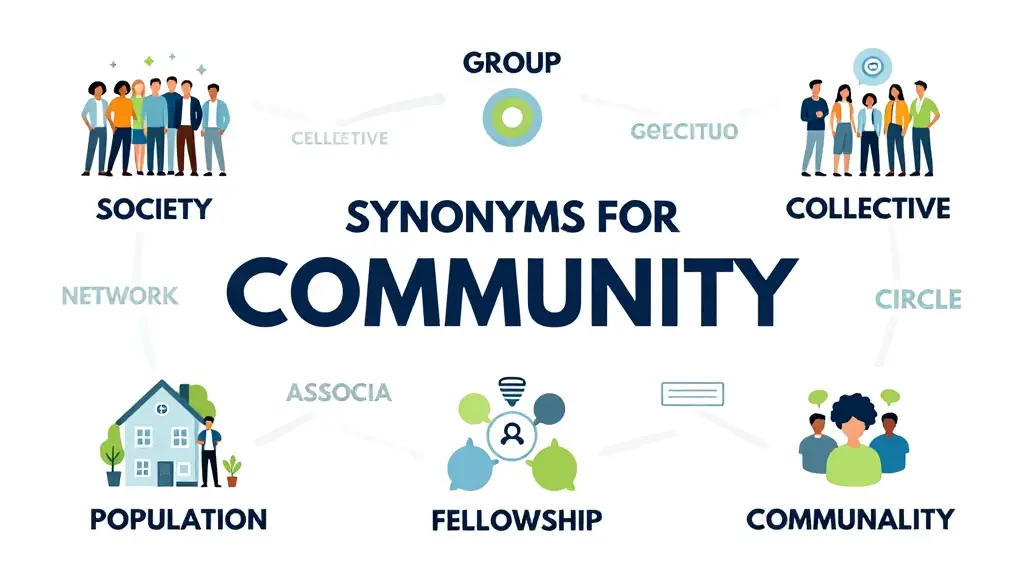
The word community is used in many areas of English.
It can describe people who live in the same place, share an interest, belong to the same group, or work toward a common goal.
For example:
Our community supports local businesses.
You could also say:
Our neighborhood supports local businesses.
Or:
Our local population supports local businesses.
The best replacement depends on the meaning.
People search for synonyms for community to avoid repetition, improve academic writing, describe social groups more precisely, or find a better word for a group of people connected by location, identity, interests, work, or shared goals.
Meaning of Community
Community means a group of people who live in the same area or share something such as interests, values, experiences, work, or goals.
Definition
Community: a group of people connected by location, interests, relationships, identity, work, or a shared purpose.
Examples
The local community organized a clean-up.
She is active in the school community.
The online community welcomed new members.
The scientific community discussed the findings.
The word can refer to both physical and online groups.
Pronunciation of Community
Community is pronounced:
/kəˈmjuː.nə.ti/
It sounds like:
kuh-MYOO-nuh-tee
Example:
The local community came together to help.
The stress falls mainly on the second syllable: MYOO.
Part of Speech
Community is primarily a noun.
Community as a Noun
It describes a group of connected people.
The community worked together.
Plural Form
The plural is:
communities
Different communities have different traditions.
Related Words
- Community — noun
- Communities — plural noun
- Communal — adjective
- Communally — adverb
- Community-based — adjective
- Community-oriented — adjective
Example
The organization provides community-based services.
Synonyms for Community
| Word | Meaning | Usage | Formality | Example | Difficulty |
| Society | Organized group of people | Large social groups | Formal | Society changes over time. | Easy |
| Neighborhood | People living in the same area | Local areas | Neutral | Our neighborhood is friendly. | Easy |
| Group | People connected in some way | General | Neutral | The group met today. | Easy |
| Population | People living in a place | Statistics, geography | Formal | The population is growing. | Easy |
| Collective | People considered as one group | Shared goals | Formal | The collective supported the project. | Medium |
| Network | Connected people or organizations | Professional, social, online | Neutral | She built a strong network. | Easy |
| Association | Organized group with a shared purpose | Clubs, professions | Formal | The association held a meeting. | Medium |
| Organization | Structured group | Business, nonprofit, institutions | Formal | The organization helps families. | Easy |
| Circle | Small group with shared interests | Friends, social groups | Neutral | She has a close circle of friends. | Easy |
| Fellowship | Group connected by shared interests or beliefs | Formal/literary | Formal | The fellowship welcomed new members. | Medium |
| Clan | Group connected by family or tradition | Family, culture | Neutral/formal | The clan gathered for the ceremony. | Medium |
| Tribe | Social group with shared identity | Culture, informal groups | Neutral | The tribe has a strong tradition. | Easy |
| Constituency | Group represented by a person or organization | Politics, organizations | Formal | The representative met with constituents. | Advanced |
| Public | People as a whole or a particular audience | Media, government | Neutral/formal | The public was informed. | Easy |
| Audience | People watching, reading, or listening | Media, events | Neutral | The audience responded positively. | Easy |
| Population | All people in a particular area | Demographics | Formal | The rural population grew. | Easy |
| Residents | People living in a place | Local areas | Neutral | Local residents attended. | Easy |
| Inhabitants | People or animals living in a place | Geography | Formal | The island’s inhabitants welcomed visitors. | Medium |
| Locals | People who live in an area | Travel, casual speech | Informal | The locals recommended a restaurant. | Easy |
| Neighbors | People living nearby | Residential areas | Neutral | The neighbors helped each other. | Easy |
| Peers | People of similar status or interests | Education, work | Formal/neutral | Students learned from their peers. | Easy |
| Network | Connected people | Professional/social | Neutral | The professional network expanded. | Easy |
| Circle | People with a shared relationship | Social groups | Neutral | His social circle is small. | Easy |
| Cohort | People sharing a stage or experience | Education, research | Formal | The student cohort graduated. | Advanced |
| Alliance | Groups united for a purpose | Politics, organizations | Formal | The groups formed an alliance. | Medium |
| Coalition | Groups working together | Politics, causes | Formal | A coalition supported the plan. | Medium |
| Union | People or groups joined together | Labor, political, social | Formal | The union represented workers. | Easy |
| Federation | Organizations united under one system | Institutions, sports | Formal | The federation oversees the clubs. | Advanced |
| Consortium | Organizations working together | Business, research | Formal | The universities formed a consortium. | Advanced |
| Movement | People united around a cause | Social causes | Neutral/formal | The movement gained support. | Easy |
| Fellowship | People sharing interests or beliefs | Religious, academic, social | Formal | The group offered fellowship. | Medium |
| Brotherhood | Group united by strong bonds | Social, professional | Formal/literary | The organization promoted brotherhood. | Medium |
| Sisterhood | Group united by shared experiences | Social | Neutral | The group emphasized sisterhood. | Easy |
| Circle | Close social group | Friends, interests | Neutral | Her creative circle encouraged her. | Easy |
| Club | Group with shared interests | Social, sports | Neutral | He joined a book club. | Easy |
| Society | Organized group around a subject | Academic, cultural | Formal | She joined a historical society. | Easy |
| Association | Group with a shared purpose | Professional/social | Formal | The teachers’ association met. | Medium |
| Parish | Local church community | Religious/local | Formal | The parish organized a fundraiser. | Advanced |
| Congregation | People attending a religious organization | Religious | Formal | The congregation gathered. | Medium |
| Diaspora | People dispersed from their homeland | Cultural/geographic | Formal | The diaspora maintains traditions. | Advanced |
| Settlement | People living in a newly established area | Historical/geographic | Formal | The settlement grew quickly. | Medium |
| Municipality | Local government area and its residents | Government | Formal | The municipality approved the project. | Advanced |
| District | Defined geographic area | Government, education | Neutral/formal | The district has many schools. | Easy |
| Region | Broad geographic area | Geography | Neutral | The region has diverse communities. | Easy |
| Locality | A particular area or place | Geography | Formal | The locality has changed rapidly. | Advanced |
| Ecosystem | Interconnected group or system | Business, technology, society | Formal | The startup ecosystem is growing. | Medium |
| Hub | Center of activity or connection | Business, technology, culture | Neutral | The city is a creative hub. | Easy |
| Circle | Connected social group | Friends/interests | Neutral | She joined a new social circle. | Easy |
| Community of practice | People sharing a profession or skill | Education, work | Formal | Teachers formed a community of practice. | Advanced |
Best Synonyms for Community
1. Society
Society refers to a large group of people who live together within a social system and share institutions, customs, or rules.
Technology has changed society.
Best Situation
Use society for:
- countries
- cultures
- social systems
- large populations
- social issues
- academic writing
Community is often smaller or more specific than society.
2. Neighborhood
A neighborhood is an area where people live, along with the people who live there.
Our neighborhood is very friendly.
Use it when talking about a local residential area.
3. Group
Group is the simplest and broadest alternative.
A group of volunteers cleaned the park.
However, group does not always imply the strong connection or shared identity that community can suggest.
4. Population
Population refers to all the people living in a specific place or belonging to a particular category.
The city’s population has grown.
It is especially common in:
- statistics
- research
- demographics
- geography
- public policy
5. Collective
A collective is a group considered as a single unit, often because members share interests, goals, or work.
The artists formed a creative collective.
It is useful in professional, artistic, and social contexts.
6. Network
A network emphasizes connections between people or organizations.
She has a large professional network.
It works particularly well for:
- business
- social media
- professional relationships
- technology
- online groups
7. Association
An association is an organized group formed around a shared purpose or interest.
He joined a professional association.
It sounds more formal than group.
8. Organization
An organization is a structured group created to achieve specific goals.
The organization supports local families.
It is especially useful for:
- nonprofits
- businesses
- charities
- institutions
- professional groups
9. Circle
A circle usually describes a smaller group of friends, colleagues, or people with shared interests.
She has a close circle of friends.
It feels personal and informal.
10. Fellowship
Fellowship describes a friendly relationship or group connected by shared interests, beliefs, work, or experiences.
The students developed a strong sense of fellowship.
It often sounds formal or literary.
Synonyms for Local Community
Use:
- neighborhood
- residents
- locals
- locality
- district
- municipality
- population
- inhabitants
- neighborhood group
- local population
Examples
The local community supported the project.
Local residents supported the project.
The neighborhood supported the project.
Locals welcomed the new service.
Synonyms for Online Community
Useful alternatives include:
- online group
- digital community
- virtual community
- network
- forum
- audience
- social network
- user group
- online network
- digital collective
Examples
The online community shared useful advice.
The online group shared useful advice.
The digital network connected users worldwide.
Synonyms for Community in Business
Use:
- network
- professional network
- industry
- association
- organization
- ecosystem
- stakeholder group
- business network
- professional circle
- business community
Example
The business community supported the new policy.
You could write:
The business network supported the new policy.
Or:
The local business association supported the new policy.
Synonyms for Community in Academic Writing
Useful alternatives include:
- society
- population
- cohort
- group
- collective
- network
- association
- constituency
- community of practice
- research community
Example
The scientific community accepted the findings.
More specific:
The research community accepted the findings.
Or:
The scientific community responded positively to the findings.
Synonyms for Community in Sociology
Depending on context, use:
- society
- social group
- population
- collective
- social network
- social structure
- neighborhood
- association
- social unit
- cultural group
Society is usually broader than community.
Synonyms for Community Support
Instead of repeating community support, consider:
- public support
- local support
- neighborhood support
- social support
- collective support
- community backing
- local backing
- public backing
- group support
- grassroots support
Example
The project received strong community support.
The project received strong local support.
Synonyms for Community Members
Use:
- residents
- locals
- neighbors
- citizens
- members
- participants
- constituents
- inhabitants
- volunteers
- community participants
The best word depends on the group.
Community members attended the meeting.
can become:
Local residents attended the meeting.
Synonyms for Community Leader
Depending on context:
- local leader
- community representative
- neighborhood leader
- organizer
- advocate
- spokesperson
- representative
- coordinator
- activist
- civic leader
Example
The community leader spoke at the event.
The local representative spoke at the event.
Synonyms for Community Development
Useful alternatives include:
- local development
- neighborhood development
- social development
- civic development
- community growth
- local improvement
- neighborhood improvement
- social progress
- regional development
- grassroots development
Synonyms for Community Service
Depending on meaning:
- volunteer work
- public service
- social service
- civic service
- volunteer service
- charitable work
- community work
- public assistance
- local service
Example
Students completed community service.
Students completed volunteer work.
Synonyms for Strong Community
Use:
- close-knit community
- connected group
- united community
- supportive network
- cohesive group
- strong social network
- tight-knit neighborhood
- united society
- supportive community
- connected population
Example
They have a strong community.
They have a close-knit community.
Antonyms of Community
There is no single perfect opposite of community, because the meaning changes by context. However, these words can express separation, isolation, or lack of social connection.
| Antonym | Meaning | Example |
| Isolation | Separation from others | He lived in isolation. |
| Individualism | Focus on the individual | Individualism shapes some cultures. |
| Separation | State of being apart | The separation weakened cooperation. |
| Solitude | Being alone | She enjoyed solitude. |
| Alienation | Feeling disconnected | He experienced social alienation. |
| Disconnection | Lack of connection | Social disconnection can be difficult. |
| Division | Separation into groups | Political division increased. |
| Fragmentation | Breaking into smaller parts | Social fragmentation became noticeable. |
| Exclusion | Keeping people out | The policy caused exclusion. |
| Loneliness | Sadness from lack of connection | Loneliness affected many residents. |
| Seclusion | Being away from others | The cabin offered complete seclusion. |
| Conflict | Serious disagreement | Conflict divided the group. |
| Hostility | Unfriendly behavior | Hostility damaged relationships. |
| Disunity | Lack of agreement or unity | Disunity weakened the organization. |
| Individual | A single person | The decision affected each individual. |
30 Real-World Examples
- The local community supported the new school.
- Our neighborhood organized a clean-up.
- The online community shared helpful advice.
- The scientific community reviewed the study.
- The business community welcomed the change.
- The community came together after the storm.
- Local residents attended the meeting.
- The association organized a charity event.
- The professional network helped her find a job.
- The group worked toward a common goal.
- The population has grown rapidly.
- The neighborhood is known for its friendly residents.
- The organization provides services to families.
- The community raised money for the hospital.
- The student community welcomed new members.
- The gaming community discussed the latest update.
- The research community debated the findings.
- The artistic collective held an exhibition.
- The local population depends on farming.
- The community center offers free classes.
- The residents created a neighborhood watch.
- The organization works closely with local communities.
- The online network connects thousands of users.
- The community celebrated the festival together.
- The professional association published new guidelines.
- The school built a strong sense of community.
- The community responded quickly to the emergency.
- The group created a supportive network.
- The city has a diverse cultural community.
- Strong communities often depend on trust and cooperation.
25 Naturally Written Sentences
- Our community came together to help families affected by the storm.
- The neighborhood held a small festival last weekend.
- The online community gave me several useful suggestions.
- Local residents worked together to improve the park.
- The scientific community continues to study the issue.
- She has built a strong professional network.
- The organization provides free meals to local families.
- The student community welcomed the new members.
- The group shares a strong interest in environmental protection.
- The town has a close-knit community.
- The association organizes events throughout the year.
- The population has changed significantly over the past decade.
- The community center offers activities for children and adults.
- His social circle includes artists, writers, and musicians.
- The research community has shown growing interest in the topic.
- Local businesses received strong support from residents.
- The group formed a collective to promote local artists.
- The neighborhood became quieter after the new park opened.
- Volunteers created a network to support elderly residents.
- The community worked together to raise money for the school.
- The organization encourages people to become active citizens.
- A strong sense of belonging can bring people closer.
- The digital community connects people from many countries.
- The local association helped organize the event.
- Communities become stronger when people trust and support one another.
Formal vs. Informal Usage
| Informal | Neutral | Formal |
| Group | Community | Collective |
| Neighbors | Local residents | Local population |
| Friends | Social circle | Social network |
| Online group | Online community | Digital network |
| Work group | Professional community | Professional association |
| Locals | Residents | Inhabitants |
| People | Community members | Constituents |
| Club | Group | Association |
| Team | Group | Organization |
| Support group | Community group | Social support network |
Informal
A lot of people in the neighborhood helped.
Neutral
The local community helped.
Formal
Local residents participated in the initiative.
Academic Usage
The word community is extremely common in academic writing, but it should be used precisely.
For example:
The scientific community has shown interest in the discovery.
Here, community means researchers and experts working in the same field.
Other academic alternatives include:
- research population
- cohort
- social group
- society
- professional network
- academic community
- research community
- population
Example
Instead of:
The community was studied.
Write:
The study population was analyzed.
This is more precise when referring to research participants.
Daily Conversation
Community, neighborhood, group, friends, circle, and locals are common in everyday speech.
I love my community.
Our neighborhood is friendly.
I joined an online group.
My social circle is pretty small.
The locals were very helpful.
The best word depends on the relationship between the people.
Grammar Tips
Community + Singular Verb
When community refers to one collective group, it usually takes a singular verb in American English.
The community is growing.
The community has responded.
Communities + Plural Verb
When talking about multiple communities:
Different communities have different traditions.
Several communities are working together
Community of + Nou
This is a very useful structure.
a community of teachers
a community of writers
a community of researchers
a community of artists
a community of gamer
Community-Based
Community-based is a common adjective.
community-based programs
community-based healthcare
community-based research
community-based services
Community-Led
This means something is led by members of a community
a community-led project
a community-led initiativ
Community-Oriented
This describes something designed around the needs of a community.
a community-oriented organization
a community-oriented approac
Sense of Community
This means a feeling of belonging and connection with others.
The school has a strong sense of community.
Common Collocations With Community
Local Community
The local community supported the project.
Online Community
The online community discussed the topic.
Global Community
The global community responded to the crisis.
Business Community
The business community welcomed the announcement.
Scientific Community
The scientific community reviewed the research.
Academic Community
The academic community discussed the findings.
Student Community
The student community organized the event.
Religious Community
The religious community gathered for the celebration.
Cultural Community
The cultural community preserved its traditions.
Professional Community
The professional community shared useful resources.
Community Support
The project received community support.
Community Service
Students completed community service.
Community Center
The community center offers free classes.
Community Development
The program focuses on community development.
Community Engagement
The organization encourages community engagement.
Community Outreach
The charity expanded its community outreach.
Community Resources
Residents can access community resources.
Community Health
The program focuses on community health.
Community Leadership
Strong community leadership helped the project succeed.
Community Involvement
The project depends on community involvement.
Common Phrases With Community
Sense of Community
The school creates a strong sense of community.
Close-Knit Community
A close-knit community is one where people know and support each other.
They live in a close-knit community.
Community Spirit
This means a shared feeling of pride, cooperation, and support.
The event helped build community spirit.
Community Engagement
This means active participation in community activities.
Community engagement is important to the project.
Community Outreach
This means efforts to connect an organization with people in the wider community.
The charity expanded its community outreach.
Community Support
The project received strong community support.
Community Leader
Local community leaders attended the meeting.
Community Member
Every community member was invited.
Community-Based
The organization provides community-based services.
Community-Led
It was a successful community-led project.
Similar Words
| Word | Meaning | Difference | Example |
| Community | Connected people | Broad but emphasizes connection | The community helped. |
| Society | Large organized population | Broader than community | Society is changing. |
| Group | People together | Less emphasis on connection | The group met. |
| Neighborhood | Local area and residents | Geographic focus | The neighborhood is safe. |
| Population | People in an area/category | Statistical focus | The population grew. |
| Network | Connected people | Focuses on relationships | She built a network. |
| Association | Organized group | Shared formal purpose | The association met. |
| Organization | Structured group | Focuses on structure | The organization helped. |
| Collective | People viewed as one unit | Shared purpose or identity | The collective protested. |
| Circle | Small social group | Personal relationships | Her circle is small. |
| Society | Social system | Larger scale | Modern society uses technology. |
| Cohort | People sharing a stage or experience | Often research or education | The cohort graduated. |
| Alliance | Groups united for a goal | Emphasizes cooperation | They formed an alliance. |
| Coalition | Groups temporarily working together | Often political or social | The coalition supported reform. |
| Ecosystem | Interconnected people or groups | Emphasizes relationships and systems | The startup ecosystem grew. |
| Hub | Center connecting activity | Emphasizes centrality | The city is a tech hub. |
| Fellowship | Group connected by shared interests | Emphasizes companionship | The fellowship met weekly. |
| Constituency | People represented by someone | Political/organizational | The constituency voted. |
| Club | Organized interest group | Usually recreational or social | She joined a book club. |
Community vs. Society
Community usually refers to a smaller or more specific group of connected people.
The local community supported the project.
Society is broader and can refer to an entire country, culture, or social system.
Technology affects modern society.
A community can exist within a society.
Community vs. Group
Group is a broad term for people gathered together.
A group of students met outside.
Community usually suggests a stronger connection, shared identity, location, interest, or purpose.
The student community organized a fundraiser.
Community vs. Neighborhood
A neighborhood is primarily geographic.
I live in a quiet neighborhood.
A community can be geographic, but it can also be based on interests or shared identities.
I belong to an online writing community.
Community vs. Network
A network emphasizes connections between people.
She has a strong professional network.
A community emphasizes belonging and shared connection.
She is part of a supportive professional community.
Community vs. Population
A population usually refers to people counted or studied in a particular area or category.
The population of the city is growing.
A community suggests social relationships and shared connections.
The community organized a celebration.
Community vs. Association
An association is usually an organized group with a specific purpose.
The teachers’ association published new guidelines.
A community can be much less formal.
The teachers formed a supportive community.
Community vs. Collective
A collective often describes people who work or act together as one unit.
The artists formed a collective.
Community is broader and emphasizes belonging or connection.
Community vs. Circle
A circle usually describes a smaller social group.
She has a close circle of friends.
A community can contain thousands or even millions of people.
The online community has millions of members.
Common Mistakes
Mistake 1: Using Community and Neighborhood as Exact Synonyms
A neighborhood is geographic.
A community can be geographic or based on shared interests.
an online community
You cannot naturally replace this with:
an online neighborhood
Mistake 2: Using Population When You Mean Social Connectio
Population is useful for statistics.
The population increased by 10%.
But:
The community came together.
shows social connection rather than numbers
Mistake 3: Using Society for a Small Local Grou
You usually wouldn’t say:
My society helped clean the park.
Better:
My community helped clean the park
Mistake 4: Confusing Community With Organizatio
An organization normally has a formal structure.
A community can be informal.
The online community discussed the issue.
The people don’t necessarily belong to a formal organization
Mistake 5: Overusing Community
If you use community repeatedly, choose a more precise word.
Instead of:
The community attended. The community helped. The community supported the event.
Try:
Local residents attended. Volunteers helped. Neighbors supported the event.
This makes your writing more natural.
Expert Tips
1. Use Neighborhood for a Physical Area
The neighborhood organized a cleanup.
2. Use Residents for People Living There
Local residents attended the meeting.
3. Use Society for Large Social Systems
Technology has transformed society.
4. Use Population for Statistics
The population has increased.
5. Use Network for Professional Connections
She expanded her professional network.
6. Use Association for Formal Groups
He joined a professional association.
7. Use Collective for Shared Work
The artists created a collective.
8. Use Circle for Close Social Relationships
She has a small circle of friends.
9. Use Cohort for Research or Education
The study followed a cohort of students.
10. Use Constituency for Representation
The representative met with constituents.
11. Use Ecosystem for Interconnected Systems
The local technology ecosystem is growing.
12. Use Community of Practice for Shared Skills
Teachers created a community of practice.
13. Use Locals in Casual Travel Writing
The locals recommended a quiet café.
14. Use Inhabitants in Formal Geographic Writing
The island’s inhabitants depend on fishing.
15. Be Specific
Don’t always replace community with another broad word. Ask what connects the people: location, profession, interest, culture, family, education, or a shared goal. Then choose the most accurate synonym.
FAQs
Q.1. What is the best synonym for community?
A: The best synonym for community depends on context. Neighborhood works for people living in the same area, society for a large social group, network for connected people, group for a general collection of people, and association for a formal organization. If you want a broad everyday alternative, group is usually the simplest.
Q.2. What is a simple synonym for community?
A: Simple alternatives include group, neighborhood, society, network, and circle. “Group” is the easiest general substitute, while “neighborhood” works when you mean people living near one another. For friends or people with shared interests, “circle” can sound more natural.
Q.3. What is a formal synonym for community?
A: Formal alternatives include society, population, collective, association, constituency, cohort, and organization. The correct choice depends on the context. In academic writing, “population” may be appropriate for research participants, while “society” works for broader social systems.
Q.4. What is the opposite of community?
A: There is no single exact antonym for community. Depending on the meaning, possible opposites include isolation, separation, individualism, alienation, disconnection, division, fragmentation, and solitude. These words describe situations where people lack the connection, cooperation, or shared identity associated with a community.
Q.5. Is society a synonym for community?
A: Yes, society can sometimes replace community, but it usually describes a much larger social system. A community may consist of residents in one neighborhood or people who share an interest, while society can refer to an entire country, culture, or civilization.
Q.6. Is neighborhood a synonym for community?
A: Yes, when community refers to people living in a particular area. However, a neighborhood has a clear geographic meaning, while a community can also be online, professional, cultural, academic, religious, or based on a shared interest.
Q.7. What is a synonym for online community?
A: Useful alternatives include online group, digital community, virtual community, online network, social network, user group, forum, and digital collective. “Online group” is the simplest option, while “digital network” emphasizes connections among users.
Q.8. What is a synonym for local community?
A: Common alternatives include neighborhood, local population, local residents, locals, neighborhood group, locality, and district. “Residents” refers specifically to people living in an area, while “neighborhood” can refer to both the geographic area and the people connected to it.
Q.9. What is a synonym for community members?
A: Depending on the situation, you can use residents, locals, neighbors, citizens, participants, members, constituents, inhabitants, or volunteers. “Residents” works for a geographic community, while “constituents” is appropriate when discussing people represented by an elected official.
Q.10. What is a synonym for community support?
A: Useful alternatives include local support, public support, collective support, neighborhood support, social support, community backing, local backing, and grassroots support. The best choice depends on who is providing the support and what kind of project or cause they support.
Q.11. What is a synonym for community in academic writing?
A: Academic alternatives include society, population, cohort, social group, collective, research network, professional network, and community of practice. Choose carefully. “Population” often refers to research participants, while “society” refers to a broader social system.
Q.12. What is the difference between community and society?
A: A community is usually a more specific group connected by place, interests, experiences, or goals. Society is broader and usually refers to a large population or social system. For example, a city neighborhood can be a community within the larger society of a country.
Q.13. What is the difference between community and group?
A: A group simply means people gathered or connected in some way. Community usually suggests a deeper sense of belonging, shared identity, location, interests, or purpose. A group can be temporary, while a community often has an ongoing relationship among its members.
Q.14. What is the difference between community and network?
A: A community emphasizes belonging, shared interests, and relationships. A network emphasizes connections between people or organizations. A professional community may feel like a group that shares a field, while a professional network focuses more on the relationships and contacts among individuals.
Q.15. What is the difference between community and population?
A: A population refers to people in a particular geographic area or category, often for statistical or research purposes. A community emphasizes social connection and shared experience. For example, “the population increased” focuses on numbers, while “the community organized an event” focuses on cooperation.
Conclusion:
The best synonyms for community depend on the connection between the people you are describing.
Use neighborhood for a local area, society for a broad social system, group for a general collection of people, population for demographic or research contexts, network for connected people, and association for a formal organization.
For more specific writing, words such as collective, cohort, constituency, fellowship, residents, locals, and social circle can make your meaning clearer.
The strongest synonym isn’t always the most complicated one.
It is the word that tells readers exactly who the people are and what connects them.

Chloe Ward is a vocabulary content specialist from Tampa, Florida. She enjoys helping readers build stronger communication skills through better word choices.