
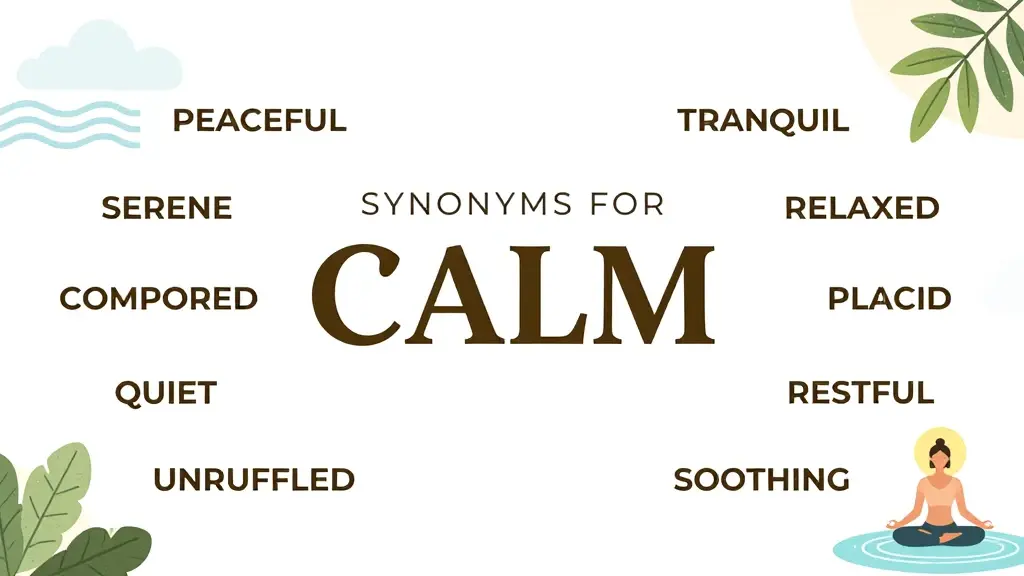
The word calm describes a peaceful state with little stress, excitement, anger, or disturbance.
It can describe a person, place, situation, voice, sea, or emotional state.
For example:
She remained calm during the interview.
You could also say:
She remained composed during the interview.
She stayed collected under pressure.
She remained relaxed during the interview.
These words are close, but they do not always mean exactly the same thing.
People search for synonyms for calm when they want to improve their vocabulary, make writing more descriptive, avoid repetition, or find a word that fits a specific emotional or physical situation.
Meaning of Calm
Calm means peaceful, quiet, relaxed, or free from strong emotion and disturbance.
Definition
Calm: peaceful and without worry, anger, excitement, or sudden movement.
Examples
The lake was calm.
She stayed calm during the emergency.
Take a deep breath and remain calm.
The room was quiet and calm.
The meaning changes slightly depending on what calm describes.
Pronunciation of Calm
Calm is pronounced:
/kɑːm/
It sounds like:
KAHM
The l is silent in standard English pronunciation.
Example:
Please stay calm.
Part of Speech
Calm can be a noun, verb, adjective, or adverb in some expressions.
Calm as an Adjective
It describes someone or something peaceful or relaxed.
She is calm.
The sea is calm.
Calm as a Verb
It means to make someone or something less upset or excited.
The mother calmed the child.
Music helped calm him.
Calm as a Noun
It means a peaceful state.
After the storm came a period of calm.
Calmly as an Adverb
She spoke calmly.
Related Words
- Calm — noun, verb, adjective
- Calmly — adverb
- Calmness — noun
- Calming — adjective/verb form
- Calmed — verb/adjective form
Synonyms for Calm
| Word | Meaning | Usage | Formality | Example | Difficulty |
| Peaceful | Free from disturbance | People, places, situations | Neutral | The village was peaceful. | Easy |
| Tranquil | Very peaceful and quiet | Places, moods | Formal | The garden was tranquil. | Medium |
| Serene | Calm, peaceful, and untroubled | People, places | Formal | She had a serene expression. | Medium |
| Relaxed | Free from tension or stress | People, situations | Neutral | He felt relaxed. | Easy |
| Composed | Calm and in control | People, emotions | Formal | She remained composed. | Medium |
| Collected | Calm and controlled | People under pressure | Formal | He stayed collected. | Medium |
| Placid | Calm and undisturbed | People, water, places | Formal | The lake was placid. | Advanced |
| Still | Without movement | Water, air, places | Neutral | The water was still. | Easy |
| Quiet | Without much noise or activity | Places, people | Neutral | The room was quiet. | Easy |
| Restful | Helping someone relax | Places, experiences | Neutral | It was a restful weekend. | Easy |
| Soothing | Having a calming effect | Sounds, words, actions | Neutral | Her voice was soothing. | Easy |
| Untroubled | Free from worry or problems | People, lives | Formal | He seemed untroubled. | Medium |
| Unruffled | Not upset or disturbed | People | Formal | She remained unruffled. | Advanced |
| Equable | Calm and even-tempered | People, moods | Formal | He had an equable nature. | Advanced |
| Level-headed | Sensible and calm | People | Neutral | She is very level-headed. | Medium |
| Cool | Calm under pressure | People | Informal | He kept his cool. | Easy |
| Laid-back | Relaxed and easygoing | People, lifestyles | Informal | He has a laid-back personality. | Easy |
| Easygoing | Relaxed and tolerant | People | Neutral | She is easygoing. | Easy |
| Mellow | Relaxed and gentle | People, moods | Informal | He was in a mellow mood. | Easy |
| Unperturbed | Not worried or disturbed | People | Formal | She remained unperturbed. | Advanced |
| Sedate | Quiet, calm, and dignified | People, settings | Formal | The atmosphere was sedate. | Advanced |
| Reposeful | Peaceful and restful | Literary | Formal/literary | The scene was reposeful. | Advanced |
| Restful | Providing peace or relaxation | Places, activities | Neutral | The room was restful. | Easy |
| Stable | Emotionally steady | People, situations | Neutral/formal | He remained emotionally stable. | Easy |
| Balanced | Emotionally steady and reasonable | People, decisions | Neutral | She has a balanced approach. | Easy |
| Patient | Able to remain calm while waiting | People | Neutral | He was patient with the child. | Easy |
| Gentle | Soft and not harsh | People, actions, sounds | Neutral | She used a gentle voice. | Easy |
| Mild | Not strong or intense | Weather, behavior, moods | Neutral | He has a mild temperament. | Easy |
| Subdued | Quiet and restrained | People, moods, settings | Formal | The mood was subdued. | Medium |
| Muted | Soft, restrained, or not intense | Sounds, emotions | Neutral | The room had a muted atmosphere. | Medium |
| Unexcited | Not excited or agitated | People, reactions | Neutral | He remained unexcited. | Easy |
| Cool-headed | Calm and sensible under pressure | People | Neutral | She is cool-headed in emergencies. | Medium |
| Self-possessed | Calm and confident | People | Formal | He remained self-possessed. | Advanced |
| Stoic | Showing little emotion or complaint | People | Formal | He remained stoic. | Medium |
| Nonchalant | Calm and unconcerned | People, behavior | Formal | She seemed nonchalant. | Advanced |
| Unconcerned | Not worried | People | Neutral | He appeared unconcerned. | Easy |
| Composed | Emotionally controlled | People | Formal | She looked composed. | Medium |
| Unflappable | Not easily upset | People | Neutral | He is completely unflappable. | Advanced |
| Sedate | Quiet and dignified | People, places | Formal | The gathering was sedate. | Advanced |
| Peaceable | Avoiding conflict | People, groups | Formal | They reached a peaceable agreement. | Medium |
| Harmonious | Marked by agreement and peace | Relationships, groups | Formal | They have a harmonious relationship. | Medium |
| Quieted | Made calmer or quieter | Situations | Neutral | The crowd finally quieted. | Easy |
| Pacified | Made peaceful or less angry | People, groups | Formal | The leader pacified the crowd. | Advanced |
| Reassured | Made less worried | People | Neutral | Her words reassured him. | Easy |
| Comforted | Made less upset or worried | People | Neutral | She comforted the child. | Easy |
| Relaxing | Causing a peaceful feeling | Activities, places | Neutral | The music was relaxing. | Easy |
| Calming | Having a peaceful effect | Sounds, activities | Neutral | The rain was calming. | Easy |
| Meditative | Quiet and deeply reflective | Activities, moods | Formal | The music was meditative. | Medium |
| Contemplative | Quietly thoughtful | People, moods | Formal | He was in a contemplative mood. | Advanced |
Best Synonyms for Calm
1. Peaceful
Peaceful means free from noise, conflict, stress, or disturbance.
The countryside was peaceful.
It is one of the easiest and most useful alternatives to calm.
Best Situation
Use peaceful for:
- places
- relationships
- communities
- situations
- moods
2. Relaxed
Relaxed means free from physical or emotional tension.
I feel relaxed after a long walk.
It is especially useful when describing a person’s state of mind or body.
Best Situation
Use it for:
- people
- conversations
- vacations
- environments
- lifestyles
3. Tranquil
Tranquil means extremely peaceful and quiet.
We spent the afternoon beside a tranquil lake.
It is more descriptive and formal than calm.
4. Serene
Serene describes deep peace and quietness.
She had a serene smile.
The garden was serene.
It is an excellent choice for descriptive and creative writing.
5. Composed
Composed means calm and emotionally controlled, especially during a difficult situation.
She remained composed during the interview.
This word is especially useful for professional situations.
6. Collected
Collected means calm, controlled, and able to think clearly.
He remained collected during the crisis.
It is a good alternative when someone is under pressure.
7. Placid
Placid means calm and peaceful, especially when describing water, places, or a person’s temperament.
The lake was placid.
He had a placid personality.
It is more formal than calm.
8. Unruffled
Unruffled means not upset, worried, or disturbed by something.
She remained unruffled despite the criticism.
It is useful when someone stays calm despite pressure.
9. Unperturbed
Unperturbed means not worried or affected by a difficult situation.
He seemed completely unperturbed by the delay.
This word works well in formal writing.
10. Level-Headed
Level-headed describes someone who stays sensible and calm, especially during problems.
She is very level-headed in emergencies.
It is especially useful for describing people.
Synonyms for Calm Person
Use:
- composed
- collected
- relaxed
- peaceful
- serene
- level-headed
- cool-headed
- unruffled
- unperturbed
- unflappable
- self-possessed
- patient
- easygoing
- laid-back
- stoic
Examples
She is a calm person.
She is level-headed.
She is composed under pressure.
She is easygoing and relaxed.
Synonyms for Calm Down
When calm is used as a verb, useful alternatives include:
- relax
- settle down
- compose yourself
- cool down
- quiet down
- soothe
- reassure
- pacify
- comfort
- ease
- settle
- tranquilize
- de-escalate
Examples
Calm down.
Take a breath and relax.
Please settle down.
Try to compose yourself.
The teacher helped soothe the child.
Synonyms for Calm Mind
Use:
- peaceful
- relaxed
- tranquil
- serene
- quiet
- balanced
- clear
- focused
- composed
- undisturbed
- centered
- meditative
Examples
Meditation helps create a calm mind.
Meditation helps create a peaceful mind.
She maintained a clear and balanced mind.
Synonyms for Calm Person Under Pressure
The best choices are:
- composed
- collected
- level-headed
- cool-headed
- unflappable
- unruffled
- self-possessed
- stoic
- steady
- controlled
Example
He stayed calm during the emergency.
Better alternatives:
He remained composed during the emergency.
He stayed cool-headed under pressure.
He remained unflappable during the crisis.
Synonyms for Calm Place
Use:
- peaceful
- tranquil
- serene
- quiet
- restful
- secluded
- still
- soothing
- relaxing
- idyllic
Examples
The beach was calm.
The beach was peaceful.
The beach was tranquil.
The beach had a serene atmosphere.
Synonyms for Calm Voice
Use:
- soothing
- gentle
- quiet
- soft
- reassuring
- composed
- steady
- measured
- controlled
Examples
She spoke in a calm voice.
She spoke in a soothing voice.
He answered in a steady, measured voice.
Her reassuring voice helped everyone relax.
Synonyms for Calm Water
Use:
- still
- placid
- tranquil
- smooth
- peaceful
- glassy
- motionless
- undisturbed
Examples
The water was calm.
The water was still.
The lake was placid.
The sea looked glassy and peaceful.
Synonyms for Calm Weather
Use:
- peaceful
- still
- quiet
- mild
- settled
- clear
- tranquil
- gentle
Examples
The weather was calm.
The weather was settled.
The sea was still.
It was a quiet and peaceful morning.
Synonyms for Calm Before a Storm
The phrase calm before the storm describes a quiet period before a difficult or exciting event.
Related expressions include:
- temporary peace
- brief quiet
- peaceful pause
- moment of stillness
- lull
- period of calm
- quiet before trouble
Example
The quiet morning felt like the calm before the storm.
Antonyms of Calm
| Antonym | Meaning | Example |
| Agitated | Emotionally disturbed | He became agitated. |
| Anxious | Worried or nervous | She felt anxious. |
| Nervous | Worried or uneasy | He was nervous before the exam. |
| Excited | Highly stimulated | The crowd was excited. |
| Angry | Feeling strong displeasure | He was angry. |
| Upset | Emotionally disturbed | She was upset. |
| Restless | Unable to relax | The child was restless. |
| Disturbed | Emotionally unsettled | He seemed disturbed. |
| Frantic | Extremely anxious or panicked | They became frantic. |
| Panicked | Overcome by sudden fear | She panicked. |
| Chaotic | Completely disorganized | The situation became chaotic. |
| Turbulent | Characterized by disorder or disturbance | The period was turbulent. |
| Hectic | Extremely busy and active | It was a hectic day. |
| Unstable | Not emotionally or physically steady | The situation was unstable. |
| Tense | Full of stress or nervousness | The room felt tense. |
| Irritated | Slightly angry or annoyed | He became irritated. |
| Furious | Extremely angry | She was furious. |
| Alarmed | Frightened or worried | He was alarmed by the news. |
| Agitated | Unable to remain calm | The patient became agitated. |
| Wild | Uncontrolled or disorderly | The crowd became wild. |
30 Real-World Examples
- She remained calm during the emergency.
- The lake was perfectly still.
- The village was peaceful and quiet.
- He stayed composed during the interview.
- She felt relaxed after the vacation.
- The garden was tranquil.
- His face had a serene expression.
- The manager remained collected under pressure.
- The child slowly calmed down.
- Her soothing voice helped everyone relax.
- The situation became calm after the discussion.
- He is a very level-headed person.
- She remained unruffled despite the criticism.
- The ocean looked placid in the morning.
- The music created a peaceful atmosphere.
- He kept his cool during the argument.
- The room felt restful and quiet.
- She answered in a calm voice.
- The teacher helped soothe the frightened child.
- The weather was unusually settled.
- He appeared completely unperturbed.
- The peaceful setting helped me relax.
- She has a calm and balanced personality.
- The crowd eventually quieted down.
- His gentle words reassured her.
- The lake had a glassy surface.
- The evening was quiet and serene.
- She stayed cool-headed during the crisis.
- Meditation helped him develop a calmer mind.
- The peaceful environment reduced everyone’s stress.
25 Naturally Written Sentences
- She stayed calm even when the situation became difficult.
- The lake was so still that it looked like glass.
- We found a peaceful place to sit and talk.
- He remained composed throughout the interview.
- I felt relaxed after spending the afternoon outside.
- The garden had a tranquil atmosphere.
- Her serene expression made everyone feel comfortable.
- He stayed collected when the computer suddenly stopped working.
- Please take a breath and calm down.
- Her soothing voice helped the child fall asleep.
- The manager is known for being level-headed.
- She remained unruffled when the plan changed.
- The beach was quiet, peaceful, and almost empty.
- The water looked completely placid at sunrise.
- He managed to keep his cool during the argument.
- The music created a calm and restful mood.
- She answered every question in a steady voice.
- The peaceful surroundings helped me clear my mind.
- He remained unperturbed by the unexpected criticism.
- The evening was quiet and serene.
- She has an easygoing personality.
- The teacher used gentle words to soothe the upset student.
- The weather finally became settled after the storm.
- He stayed cool-headed when everyone else started to panic.
- A few minutes of silence helped restore a sense of calm.
Formal vs. Informal Usage
| Informal | Neutral | Formal |
| Chill | Relaxed | Composed |
| Chill out | Calm down | Compose yourself |
| Keep your cool | Stay calm | Remain composed |
| Laid-back | Easygoing | Equable |
| Cool-headed | Level-headed | Self-possessed |
| Quiet | Peaceful | Tranquil |
| Relaxed | Calm | Serene |
| Not bothered | Unconcerned | Unperturbed |
| Settled down | Calmed down | Became pacified |
| Nice and quiet | Peaceful | Tranquil |
Informal
Just chill out.
Neutral
Try to relax.
Formal
Please remain composed.
Academic Usage
In academic writing, calm is useful, but more precise alternatives can make your writing stronger.
Instead of:
The participants remained calm.
You might write:
The participants remained composed.
Instead of:
The environment was calm.
You could write:
The environment was tranquil.
Instead of:
The intervention had a calming effect.
You could write:
The intervention had a soothing effect.
The right choice depends on whether you are describing emotions, behavior, an environment, or an effect.
Daily Conversation
Calm, relaxed, quiet, peaceful, easygoing, and chill are common in everyday English.
Stay calm.
Just relax.
Calm down.
He’s very easygoing.
Let’s keep things calm.
I just want a quiet evening.
For casual conversation, calm is usually the safest and most natural choice.
Grammar Tips
Calm + Noun
a calm person
a calm voice
a calm environment
calm water
a calm evenin
Remain Calm
This is a very common expression.
Please remain calm.
She remained calm during the emergency
Stay Calm
Stay calm and think carefully.
Try to stay calm
Calm Down
Calm down means become less upset or make someone less upset.
He eventually calmed down.
The teacher calmed the students down
Calm + Someone
She calmed the child.
His words calmed me
Calm vs. Calml
Calm is an adjective.
She is calm.
Calmly is an adverb.
She spoke calmly
Calm vs. Calming
Calm describes a peaceful state.
The room is calm.
Calming describes something that causes calmness.
The music is calming
Calm vs. Calmed
Calmed describes something that has become less upset.
The child is calmed by music.
More naturally:
The child calmed down after hearing the music.
Common Collocations With Calm
Stay Calm
Stay calm during the test.
Remain Calm
Remain calm and follow the instructions.
Calm Down
Take a moment to calm down.
Calm Voice
She spoke in a calm voice.
Calm Mind
Meditation can help create a calm mind.
Calm Environment
A calm environment helps students learn.
Calm Person
He is naturally a calm person.
Calm Water
The boat moved across calm water.
Calm Sea
The sea was calm in the morning.
Calm Atmosphere
The room had a calm atmosphere.
Calm Response
She gave a calm response.
Calm Approach
He took a calm approach to the problem.
Calm Manner
She handled the issue in a calm manner.
Calm Behavior
The child’s calm behavior impressed everyone.
Calm Temperament
Dogs with a calm temperament are often easy to train.
Common Phrases With Calm
Keep Calm
Keep calm and think clearly.
Stay Calm
Stay calm during the emergency.
Calm Down
Everyone needs a minute to calm down.
Keep Your Cool
This means remain calm when under pressure.
He kept his cool during the argument.
Calm Before the Storm
This describes a quiet period before trouble or excitement.
The silence felt like the calm before the storm.
A Sense of Calm
This means a feeling of peace.
The music gave me a sense of calm.
Calm and Collected
This means calm and in control.
She remained calm and collected.
Calm, Cool, and Collected
This phrase emphasizes strong emotional control.
He stayed calm, cool, and collected.
Similar Words
| Word | Meaning | Difference | Example |
| Calm | Peaceful and not upset | Broadest choice | She stayed calm. |
| Peaceful | Free from conflict or disturbance | Often describes places or situations | The town was peaceful. |
| Relaxed | Free from tension or stress | Usually describes people | He felt relaxed. |
| Tranquil | Very peaceful and quiet | Often describes places | The garden was tranquil. |
| Serene | Deeply peaceful | Often describes mood or appearance | She looked serene. |
| Composed | Calm and emotionally controlled | Usually describes people | He remained composed. |
| Collected | Calm and able to think clearly | Often used under pressure | She stayed collected. |
| Placid | Calm and undisturbed | Often water or temperament | The lake was placid. |
| Quiet | Little noise or activity | Focuses on sound/activity | The room was quiet. |
| Soothing | Produces calm | Describes something that calms | Her voice was soothing. |
| Unruffled | Not upset by problems | Strong emotional control | She remained unruffled. |
| Unperturbed | Not worried or affected | Formal | He seemed unperturbed. |
| Easygoing | Relaxed and tolerant | Describes personality | He is easygoing. |
| Level-headed | Sensible and calm | Describes judgment | She is level-headed. |
| Cool-headed | Calm under pressure | Often used in emergencies | He is cool-headed. |
| Nonchalant | Calm and seemingly unconcerned | Can imply lack of concern | He looked nonchalant. |
| Stoic | Shows little emotion or complaint | Often about hardship | He remained stoic. |
| Mellow | Relaxed and gentle | Casual | He was in a mellow mood. |
| Still | Without movement | Physical calm | The water was still. |
| Subdued | Quiet and restrained | Often moods or reactions | The mood was subdued. |
Calm vs. Peaceful
These words overlap, but peaceful often describes a place or situation without conflict.
The village was peaceful.
Calm can describe both people and environments.
She was calm.
The lake was calm.
Calm vs. Relaxed
Relaxed usually means free from stress or physical tension.
I feel relaxed after a massage.
Calm can also describe someone who is emotionally controlled during pressure.
She stayed calm during the emergency.
You can be calm without feeling relaxed.
Calm vs. Tranquil
Tranquil is stronger and more descriptive.
The lake was calm.
The lake was tranquil.
Tranquil often creates an image of deep, beautiful peace.
Calm vs. Serene
Serene suggests deep, graceful, or undisturbed peace.
She had a calm expression.
She had a serene expression.
The second sounds more descriptive and literary.
Calm vs. Composed
Composed is mainly used for people who control their emotions.
She remained composed during the crisis.
You would not normally say:
The lake was composed.
For water or places, calm, still, or tranquil is better.
Calm vs. Quiet
Quiet mainly refers to a lack of noise or activity.
The room was quiet.
Calm refers to a lack of emotional disturbance, excitement, or movement.
The room was calm.
A room can be quiet but tense. So quiet and calm are not always interchangeable.
Calm vs. Placid
Placid means very calm and undisturbed.
The lake was placid.
It can also describe a person with a gentle, peaceful temperament.
He had a placid personality.
It is more formal than everyday calm.
Calm vs. Cool-Headed
Cool-headed specifically describes someone who can think clearly during stressful situations.
She stayed cool-headed during the crisis.
It is especially useful for leadership, emergencies, and decision-making.
Common Mistakes
Mistake 1: Confusing Calm and Quiet
Quiet means little noise.
Calm means little disturbance or emotional stress.
The room was quiet but tense.
This shows why quiet and calm aren’t always the same.
Mistake 2: Using Calm and Calming the Same Way
Calm:
She is calm.
Calming:
Her voice is calming.
One describes the state; the other describes the effect.
Mistake 3: Confusing Calm and Calmed
The child is calm.
means the child is peaceful now.
The music calmed the child.
means the music caused the child to become peaceful
Mistake 4: Using Relaxed for Every Situation
A person can be composed during a crisis without being relaxed.
She remained composed during the emergency.
This is more accurate than:
She remained relaxed during the emergency.
Mistake 5: Overusing “Very Calm”
Instead of:
The lake was very calm.
try:
The lake was placid.
Instead of:
She was very calm.
try:
She was composed.
Expert Tips
1. Use Peaceful for Places
It was a peaceful village.
2. Use Relaxed for People
I feel relaxed today.
3. Use Tranquil for Beautiful, Quiet Settings
The garden was tranquil.
4. Use Serene for Deep Peace
She had a serene expression.
5. Use Composed for Emotional Control
She remained composed under pressure.
6. Use Collected for Clear Thinking
He stayed collected during the crisis.
7. Use Level-Headed for Good Judgment
She is very level-headed.
8. Use Placid for Still Water
The lake was placid.
9. Use Soothing for a Calming Effect
Her voice was soothing.
10. Use Unruffled for Someone Who Isn’t Easily Upset
He remained unruffled by the criticism.
11. Use Unperturbed for Formal Writing
She remained unperturbed by the delay.
12. Use Easygoing for a Relaxed Personality
He has an easygoing nature.
13. Use Cool-Headed for Pressure
She is cool-headed during emergencies.
14. Use Mellow for Casual Conversation
I’m feeling mellow today.
15. Use Still for Water or Movement
The water was completely still.
FAQs
Q.1. What is the best synonym for calm?
A: The best synonym for calm depends on the context. Peaceful works well for places and situations, relaxed for people, composed for emotional control, tranquil for peaceful environments, and serene for a deeply peaceful mood. For someone under pressure, level-headed or cool-headed may be more precise.
Q.2. What is a simple synonym for calm?
A: Simple synonyms include peaceful, quiet, relaxed, still, gentle, and composed. The easiest everyday alternatives are usually peaceful and relaxed. For example, “She felt calm” can become “She felt relaxed,” while “The room was calm” can become “The room was peaceful.”
Q.3. What is a formal synonym for calm?
A: Formal synonyms include tranquil, serene, composed, collected, unruffled, unperturbed, placid, self-possessed, and equable. “Composed” is especially useful for describing a person who remains emotionally controlled, while “tranquil” works well for peaceful settings.
Q.4. What is the opposite of calm?
A: Common opposites include agitated, anxious, nervous, upset, restless, tense, frantic, panicked, chaotic, turbulent, and angry. The best choice depends on the situation. “Agitated” describes emotional disturbance, “restless” describes an inability to relax, and “chaotic” describes disorder in a situation or environment.
Q.5. Is peaceful a synonym for calm?
A: Yes, peaceful can be a synonym for calm, especially when describing places, situations, relationships, or environments. However, peaceful often emphasizes the absence of conflict or disturbance, while calm can also describe a person’s emotional control or the lack of movement in water.
Q.6. Is relaxed a synonym for calm?
A: Yes. Relaxed is a close synonym when calm means free from stress or tension. However, relaxed usually describes a comfortable state, while calm can describe someone who remains controlled during a stressful event. A person can be calm during an emergency without actually feeling relaxed.
Q.7. What is a synonym for calm down?
A: Common alternatives to calm down include relax, settle down, cool down, compose yourself, soothe, reassure, quiet down, and de-escalate. “Relax” is common in everyday speech, while “compose yourself” is more formal. “De-escalate” is useful when describing a conflict.
Q.8. What is a synonym for calm person?
A: A calm person can be described as composed, collected, level-headed, cool-headed, unruffled, unflappable, self-possessed, serene, or easygoing. The best word depends on the reason for the person’s calmness. “Composed” suggests emotional control, while “easygoing” suggests a naturally relaxed personality.
Q.9. What is a synonym for calm mind?
A: Useful alternatives include peaceful mind, relaxed mind, tranquil mind, serene mind, balanced mind, clear mind, and quiet mind. In personal development and meditation contexts, phrases such as “peace of mind,” “inner calm,” and “mental tranquility” are also natural choices.
Q.10. What is a synonym for calm in academic writing?
A: Academic alternatives include composed, tranquil, stable, peaceful, controlled, unperturbed, and emotionally regulated. The best word depends on the research context. Instead of saying participants were “calm,” a researcher might describe them as showing “reduced emotional arousal” when that is what the evidence actually measures.
Q.11. What is a synonym for calm in business?
A: Useful business alternatives include composed, collected, level-headed, controlled, steady, balanced, and cool-headed. For example, “a calm leader” could become “a composed leader” or “a level-headed leader,” particularly when discussing decision-making during stressful situations.
Q.12. What is the difference between calm and serene?
A: Both words describe peace, but serene usually suggests a deeper, more graceful, or undisturbed form of calm. “Calm” is common and flexible, while “serene” sounds more descriptive and formal. You might describe a lake as calm or serene, but you would normally describe a person’s behavior as calm rather than serene.
Q.13. What is the difference between calm and composed?
A: Calm has many uses and can describe people, places, water, weather, and situations. Composed usually describes a person who controls their emotions, especially during pressure or difficulty. “The sea was calm” is natural, but “the sea was composed” is not.
Q.14. What is the difference between calm and quiet?
A: Quiet mainly means having little or no noise or activity. Calm means peaceful, relaxed, or free from emotional disturbance. A room can be quiet but tense, while a person can be calm even in a noisy environment. The two words overlap but are not exact synonyms.
Q.15. What is a strong word for calm?
A: Strong or more expressive alternatives include serene, tranquil, placid, unruffled, unperturbed, composed, self-possessed, and unflappable. For a peaceful place, “tranquil” or “serene” works well. For a person who stays calm under pressure, “unflappable” or “composed” is stronger and more precise.
Conclusion:
The best synonyms for calm depend on what you are describing.
Use peaceful for places and situations, relaxed for people who are free from tension, tranquil for deeply peaceful settings, serene for a graceful sense of peace, and composed for someone who stays in control under pressure.
For everyday conversation, calm, relaxed, peaceful, and quiet are natural choices.
In formal or academic writing, words such as composed, unperturbed, tranquil, and unruffled can add more precision.
The key is to choose a synonym based on the exact kind of calm you mean.
That makes your writing clearer, more natural, and more descriptive.

Charlotte Evans is a language researcher and vocabulary writer from New York, USA. She specializes in English synonyms, word usage, and educational content that helps readers improve their communication skills.