
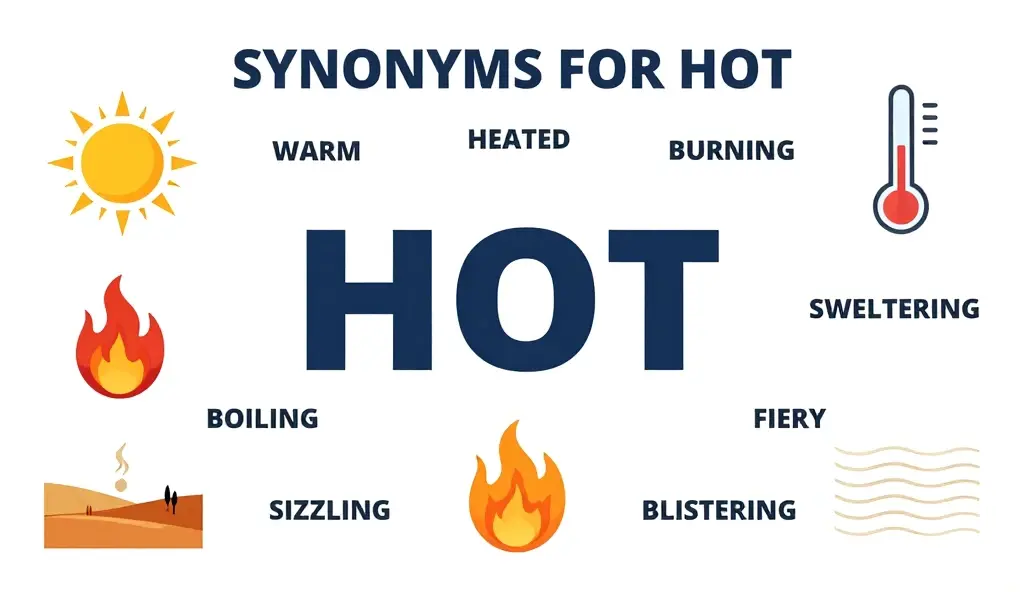
The word hot has many meanings in English.
It can describe temperature, weather, food, drinks, colors, popularity, attractiveness, anger, or passion.
For example:
The weather is hot today.
You could say:
The weather is sweltering today.
When describing food:
The soup is hot.
You could say:
The soup is steaming.
When describing popularity:
That new song is hot.
You could say:
That new song is trending.
This makes hot a flexible word, but it can also be vague.
Choosing a more specific synonym helps your writing sound clearer and more natural.
People search for synonyms for hot when they want better vocabulary for essays, articles, descriptions, creative writing, conversations, product descriptions, and SEO content.
Meaning of Hot
Hot generally means having a high temperature.
Definition
Hot: having a relatively high temperature or producing a strong sensation of heat.
However, hot has several other meanings.
Temperature
The coffee is hot.
Weather
It is hot outside.
Food
Be careful. The pan is hot.
Spicy
This curry is very hot.
Attractive
He is considered hot.
Popular
That is a hot new product.
Angry
She was hot with anger.
Intense
The competition is getting hot.
Because the word has so many meanings, the best synonym depends heavily on context.
Pronunciation of Hot
Hot is pronounced:
/hɑːt/ in American English.
It sounds like:
HAHT
Example:
It’s hot outside.
The pronunciation is short and direct, with a clear h sound.
Part of Speech
Hot is mainly an adjective.
Adjective
The water is hot.
It was a hot afternoon.
It can also appear in common expressions and compounds.
Related Forms
- Hotter — comparative adjective
- Hottest — superlative adjective
- Hotly — adverb
- Heat — noun
- Heat up — verb phrase
Examples
Today is hotter than yesterday.
This is the hottest day of the month.
The issue was hotly debated.
The heat was difficult to tolerate.
Synonyms for Hot
| Word | Meaning | Usage | Formality | Example | Difficulty |
| Warm | Moderately high temperature | General | Neutral | The water is warm. | Easy |
| Heated | Made hot or emotionally intense | General | Neutral | The room became heated. | Easy |
| Scorching | Extremely hot | Weather | Neutral | It was a scorching afternoon. | Medium |
| Sweltering | Extremely hot and uncomfortable | Weather | Formal/neutral | The room was sweltering. | Medium |
| Boiling | Extremely hot | Water/weather/general | Neutral | The water is boiling. | Easy |
| Burning | Very hot | Objects/feelings | Neutral | The sand was burning hot. | Easy |
| Blazing | Extremely hot or bright | Weather/fire | Descriptive | The blazing sun hurt my eyes. | Medium |
| Sizzling | Very hot, often with sound | Food/heat | Neutral | The steak was sizzling. | Easy |
| Fiery | Very hot or passionate | Food/emotions | Descriptive | The sauce has a fiery flavor. | Medium |
| Torrid | Extremely hot | Weather/literary | Formal | They experienced torrid weather. | Advanced |
| Steamy | Hot and humid | Weather/rooms | Neutral | The bathroom was steamy. | Easy |
| Sultry | Hot and humid | Weather/atmosphere | Literary | It was a sultry evening. | Medium |
| Roasting | Very hot | Weather/casual | Informal | We’re roasting in here. | Easy |
| Baking | Very hot | Weather/casual | Informal | I’m baking in this room. | Easy |
| Sweltering | Uncomfortably hot | Weather/rooms | Neutral | The city was sweltering. | Medium |
| Stifling | Uncomfortably hot or lacking air | Rooms/weather | Neutral | The office was stifling. | Medium |
| Muggy | Warm and humid | Weather | Neutral | It was hot and muggy. | Easy |
| Tropical | Warm/hot climate | Weather/climate | Neutral | The region has a tropical climate. | Easy |
| Arid | Very dry and hot | Climate | Formal | The region has an arid climate. | Medium |
| Sultry | Warm, humid, and atmospheric | Weather | Literary | A sultry summer night followed. | Medium |
| Scalding | Extremely hot liquid | Drinks/water | Formal | The water was scalding. | Medium |
| Blistering | Extremely hot | Weather/speed | Strong | It was a blistering day. | Medium |
| Seething | Very angry | Emotion | Formal | He was seething with anger. | Medium |
| Passionate | Emotionally intense | People/emotions | Neutral | She gave a passionate speech. | Easy |
| Intense | Very strong | General | Neutral | The heat was intense. | Easy |
| Popular | Widely liked | Trends | Neutral | The product is popular. | Easy |
| Trending | Becoming widely discussed | Social media | Modern | The topic is trending. | Easy |
| Fashionable | Currently stylish | Fashion | Neutral | That style is fashionable. | Medium |
| In-demand | Highly wanted | Business | Neutral | The product is in demand. | Medium |
| Attractive | Good-looking | People | Neutral | She is very attractive. | Easy |
| Alluring | Highly attractive | People/things | Formal | The design is alluring. | Medium |
| Seductive | Sexually or romantically attractive | People/style | Formal | The advertisement used a seductive style. | Medium |
| Sexy | Sexually attractive | Informal | Informal | The outfit looks sexy. | Easy |
| Spicy | Containing strong spices | Food | Neutral | The curry is spicy. | Easy |
| Piquant | Pleasantly sharp or spicy | Food | Formal | The sauce has a piquant flavor. | Advanced |
| Peppery | Tasting like pepper | Food | Neutral | The soup has a peppery taste. | Medium |
| Fiery | Very spicy | Food | Descriptive | The salsa is fiery. | Easy |
| Scintillating | Exciting or lively | Conversation/writing | Formal | They had a scintillating discussion. | Advanced |
| Explosive | Extremely intense | Events/emotions | Neutral | The debate became explosive. | Medium |
| Fervent | Strongly passionate | Beliefs/emotions | Formal | He is a fervent supporter. | Advanced |
| Burning | Strongly felt | Desire/emotion | Neutral | She had a burning desire to succeed. | Easy |
| Urgent | Requiring immediate attention | Situations | Neutral | It became an urgent issue. | Easy |
Best Synonyms for Hot
1. Warm
Warm means having a comfortably or moderately high temperature.
The water is warm.
It is not usually as strong as hot.
Best Situation
Use warm for:
- weather
- drinks
- food
- rooms
- objects
- feelings
We had a warm afternoon.
The tea is warm.
2. Heated
Heated means made hot, but it can also describe an argument or emotional situation.
The heated water was ready for the experiment.
The meeting became heated.
Best Situation
Use it for physical temperature or strong disagreement.
3. Scorching
Scorching means extremely hot.
It was a scorching summer afternoon.
It creates a stronger image than simply saying hot.
Best Situation
Use scorching for:
- weather
- sunlight
- deserts
- outdoor conditions
4. Sweltering
Sweltering means extremely hot and uncomfortable.
The classroom was sweltering.
It emphasizes discomfort, not just temperature.
Best Situation
Use it when heat makes a place difficult to tolerate.
5. Boiling
Boiling can describe water that has reached its boiling point, but it is also used informally for extremely hot conditions.
The water is boiling.
It’s boiling outside today.
In British English, boiling is especially common for very hot weather.
6. Burning
Burning means extremely hot or capable of causing a burn.
The sand was burning hot.
It can also describe strong emotions:
He had a burning desire to succeed.
7. Blazing
Blazing describes something extremely hot, bright, or intense.
The blazing sun made the road uncomfortable.
It is especially useful in vivid descriptions.
8. Sizzling
Sizzling means extremely hot, especially when food is cooking and making a sizzling sound.
The steak arrived sizzling on a hot plate.
It can also describe something exciting or lively.
The event had a sizzling atmosphere.
9. Fiery
Fiery can describe heat, spicy food, strong emotions, or passionate behavior.
She made a fiery speech.
The sauce has a fiery taste.
It is a highly flexible descriptive synonym.
10. Torrid
Torrid means extremely hot and is especially common in formal or literary writing.
The region experienced torrid temperatures.
It can also describe passionate relationships or emotions.
They had a torrid romance.
11. Steamy
Steamy describes an environment filled with hot water vapor.
The bathroom became steamy.
It can also describe romantic or sensual content.
12. Sultry
Sultry describes hot, humid weather, especially in an atmospheric or literary way.
It was a sultry summer evening.
It can also describe an attractive or sensual person or atmosphere.
13. Stifling
Stifling means uncomfortably hot or lacking fresh air.
The room was stifling.
It is especially useful when heat makes breathing or staying inside uncomfortable.
14. Muggy
Muggy means warm and humid in an uncomfortable way.
It was hot and muggy outside.
Unlike scorching, muggy focuses on humidity as well as heat.
15. Blistering
Blistering means extremely hot or intense.
We experienced blistering heat.
It can also describe speed:
He delivered a blistering attack.
Hot Synonyms for Weather
When hot describes weather, use:
- warm
- scorching
- sweltering
- boiling
- blazing
- stifling
- muggy
- humid
- sultry
- torrid
- blistering
- roasting
- baking
Examples
It was a scorching afternoon.
The city was sweltering.
The air felt muggy.
We were roasting in the sun.
The room was stifling.
Hot Synonyms for Food
When hot describes food temperature:
- warm
- steaming
- piping hot
- heated
- scalding
- sizzling
- burning
Examples
The soup is steaming.
Be careful. The coffee is scalding.
The steak arrived sizzling.
When hot means spicy:
- spicy
- fiery
- peppery
- piquant
- pungent
- zesty
This curry is fiery.
The sauce has a peppery flavor.
Hot Synonyms for Attractive
When hot means physically attractive, alternatives include:
- attractive
- good-looking
- beautiful
- handsome
- gorgeous
- stunning
- striking
- alluring
- appealing
- sexy
- glamorous
- captivating
Examples
She is very attractive.
He is exceptionally handsome.
The actress looked stunning.
Hot is informal and can sound more direct than attractive.
Hot Synonyms for Popular
When hot means popular or currently successful, use:
- popular
- trending
- fashionable
- trendy
- sought-after
- in-demand
- successful
- current
- prominent
- widely discussed
Examples
That restaurant is very popular.
The topic is trending online.
This is one of the most sought-after products.
Hot Synonyms for Angry
When hot describes anger, use:
- angry
- furious
- enraged
- heated
- irritated
- outraged
- livid
- seething
- incensed
- upset
Examples
He was furious about the decision.
The discussion became heated.
She was seething with anger.
Hot Synonyms for Intense
When hot means intense or emotionally strong:
- intense
- passionate
- fierce
- fiery
- powerful
- explosive
- fervent
- heated
- strong
- extreme
Example
The debate became heated.
She gave a passionate speech.
The competition was fierce.
Antonyms of Hot
| Antonym | Meaning | Example |
| Cold | Having a low temperature | The water is cold. |
| Cool | Slightly cold | The room is cool. |
| Chilly | Uncomfortably cool | It feels chilly outside. |
| Freezing | Extremely cold | The weather is freezing. |
| Icy | Extremely cold or covered with ice | The road was icy. |
| Frigid | Extremely cold | The air was frigid. |
| Frozen | Turned into ice | The lake is frozen. |
| Tepid | Slightly warm, often less warm than expected | The coffee was tepid. |
| Lukewarm | Only slightly warm | The soup is lukewarm. |
| Mild | Not extreme in temperature | We had mild weather. |
| Unpopular | Not widely liked | The idea became unpopular. |
| Unattractive | Not physically appealing | The design looks unattractive. |
| Calm | Not emotionally intense | The discussion remained calm. |
30 Real-World Examples
- The weather was scorching yesterday.
- The room became unbearably hot.
- The water is too hot to touch.
- The coffee was steaming.
- The soup was piping hot.
- The pan was burning hot.
- The steak arrived sizzling.
- The curry has a fiery flavor.
- The sauce is extremely spicy.
- The afternoon was sweltering.
- The air felt hot and muggy.
- The desert has a torrid climate.
- The sun was blazing overhead.
- The office became stifling.
- We were roasting in the afternoon sun.
- The beach was baking under the sun.
- The weather was blistering.
- The bathroom was warm and steamy.
- It was a sultry summer evening.
- The argument became heated.
- She gave a fiery speech.
- The competition became intense.
- That restaurant is incredibly popular.
- The new phone is trending online.
- She looked stunning at the event.
- He is considered very attractive.
- The company launched a sought-after product.
- He was furious about the decision.
- She was seething with anger.
- The debate became explosive.
25 Naturally Written Sentences
- The weather is extremely hot today.
- The afternoon sun was scorching.
- We spent the day in sweltering heat.
- The room became stifling after the windows were closed.
- The air felt warm and humid.
- The coffee is still too hot to drink.
- Be careful with that scalding water.
- The soup arrived steaming.
- The steak was sizzling on the plate.
- The curry has a fiery kick.
- This sauce is much spicier than I expected.
- The desert can become blisteringly hot during the day.
- The sun was blazing over the mountains.
- It was a sultry evening by the coast.
- The bathroom became warm and steamy.
- The argument quickly became heated.
- She gave a passionate speech.
- The competition has become fierce.
- That new restaurant is incredibly popular.
- The product is currently trending online.
- She looked stunning in the new dress.
- He was furious about the unfair decision.
- The discussion became intense.
- The summer heat was exhausting.
- The afternoon was so hot that everyone stayed indoors.
Formal vs. Informal Usage
| Formal | Neutral | Informal |
| Scorching | Hot | Roasting |
| Sweltering | Warm | Baking |
| Torrid | Heated | Boiling |
| Blistering | Intense | Burning up |
| Scalding | Very hot | Super hot |
| Sultry | Humid | Muggy |
| Fervent | Passionate | Fiery |
Formal
The region experienced torrid temperatures.
Neutral
The region experienced extremely hot temperatures.
Informal
It was absolutely roasting outside.
Academic Usage
In academic writing, avoid using hot when a more precise scientific term is available.
Instead of:
The region has hot weather.
Write:
The region experiences high temperatures.
Instead of:
The material becomes hot.
Write:
The material reaches elevated temperatures.
For climate discussions:
The region experiences extreme heat during the summer months.
For food science:
The sample was heated to a specific temperature.
Academic writing usually favors precision over dramatic words such as blazing or scorching.
Daily Conversation
Hot is extremely common in everyday English.
It’s hot today.
You can make the statement more expressive:
It’s really hot today.
It’s boiling outside.
It’s roasting outside.
I’m burning up.
It’s scorching today.
It’s so hot in here.
For casual conversation, simple expressions usually sound more natural than highly formal words such as torrid.
Grammar Tips
Hot as an Adjective
The coffee is hot.
It was a hot day.
Comparative Form
The comparative is:
hotter
Today is hotter than yesterday.
Notice that the final consonant is doubled before -er.
Superlative Form
The superlative is:
hottest
This was the hottest day of the year
Hot Enough
The water is hot enough to make tea
Too Hot
The coffee is too hot to drink
Get Hot
The weather is getting hot
Become Hot
The engine became hot after several hours
Feel Hot
I feel hot after exercising.
Hotter Than
This summer is hotter than last summer.
Common Collocations With Hot
Hot Weather
We weren’t prepared for the hot weather.
Hot Day
It was a very hot day.
Hot Summer
We had a hot summer.
Hot Sun
The hot sun made the walk difficult.
Hot Water
Turn on the hot water.
Hot Coffee
I ordered a cup of hot coffee.
Hot Food
Be careful—the food is hot.
Hot Sauce
I love hot sauce.
Hot Curry
This restaurant serves hot curry.
Hot Tea
She made a cup of hot tea.
Hot Temperature
The machine operates at a high temperature.
Hot Topic
Climate change is a hot topic.
Hot Trend
That style is a hot trend this year.
Hot Product
The phone became a hot product.
Hot Debate
The issue sparked a hot debate.
Hot Competition
The two companies are in hot competition.
Hot Seat
The manager was put in the hot seat.
Hot Market
Housing is a hot market in the area.
Common Phrases With Hot
Hot Topic
A subject receiving a lot of attention.
Climate change is a hot topic.
Hot Seat
A difficult or uncomfortable position.
The manager was in the hot seat during the interview.
Hot Water
This can mean physically hot water or trouble.
He found himself in hot water after breaking the rules.
Hot Head
A person who becomes angry quickly.
He’s a bit of a hothead.
Hot Potato
A difficult or controversial issue.
The proposal became a political hot potato.
Strike While the Iron Is Hot
To act while an opportunity is available.
We should strike while the iron is hot.
Hot Under the Collar
To become angry or upset.
He was hot under the collar after the argument.
In Hot Pursuit
To chase someone closely.
The police were in hot pursuit.
Similar Words
| Word | Meaning | Difference | Example |
| Hot | High temperature | Broad everyday term | The water is hot. |
| Warm | Moderately high temperature | Less intense than hot | The water is warm. |
| Scorching | Extremely hot | Stronger than hot | It was scorching outside. |
| Sweltering | Very hot and uncomfortable | Emphasizes discomfort | The room was sweltering. |
| Boiling | Extremely hot | Often used for water or weather | It’s boiling today. |
| Burning | Extremely hot | Can imply danger or pain | The sand was burning hot. |
| Blazing | Very hot and bright | Often describes sun/fire | The blazing sun was intense. |
| Sizzling | Very hot with a sound | Common for food | The steak was sizzling. |
| Sultry | Hot and humid | Often literary | It was a sultry evening. |
| Muggy | Warm and humid | Focuses on humidity | The weather was muggy. |
| Stifling | Hot and lacking air | Emphasizes discomfort | The room was stifling. |
| Torrid | Extremely hot | Formal/literary | The region had torrid weather. |
| Steamy | Hot with moisture | Often describes rooms | The bathroom was steamy. |
| Fiery | Hot or passionate | Figurative as well as literal | She gave a fiery speech. |
Hot vs. Warm
Warm is milder than hot.
The tea is warm.
This means it has some heat but isn’t very hot.
The tea is hot.
This suggests a higher temperature.
Use warm when the temperature feels comfortable or moderate.
Hot vs. Scorching
Scorching is much stronger than hot.
It was hot outside.
It was scorching outside.
The second sentence suggests extreme heat.
Hot vs. Sweltering
Both describe high temperatures, but sweltering emphasizes discomfort.
The afternoon was hot.
The afternoon was sweltering.
The second sentence suggests that the heat was difficult to tolerate.
Hot vs. Boiling
Boiling literally describes liquid at its boiling point, but it can also be used informally to describe very hot weather.
The water is boiling.
It’s boiling outside.
In casual speech, the second sentence means “It’s extremely hot.”
Hot vs. Spicy
These words are often confused when describing food.
Hot can refer to temperature:
The soup is hot.
It can also mean spicy:
The curry is hot.
Spicy specifically refers to a strong flavor caused by spices or chili peppers.
The curry is spicy.
So spicy is usually more precise when talking about chili heat.
Hot vs. Attractive
When hot describes a person, it usually means sexually or physically attractive.
He is hot.
A more neutral alternative is:
He is attractive.
Other choices include:
handsome
beautiful
good-looking
stunning
gorgeous
Hot vs. Popular
When hot means popular:
That restaurant is hot right now.
It means the restaurant is receiving a lot of attention.
More precise alternatives include:
popular
trending
fashionable
in-demand
sought-after
Common Mistakes
Mistake 1: Using Hot When You Mean Spicy
The curry is hot.
This can mean either temperature or spice.
If you mean chili flavor, say:
The curry is spicy.
Mistake 2: Using Scorching for Mild Weather
Scorching suggests extreme heat.
Don’t use it for slightly warm weather.
It was a warm spring morning.
is better than:
It was a scorching spring morning.
unless the temperature was genuinely extreme.
Mistake 3: Confusing Muggy With Hot
Muggy specifically describes warm, humid air.
A day can be hot but dry.
The desert was scorching but dry.
A day can also be warm and muggy.
The air was warm, humid, and muggy.
Mistake 4: Using “Hot” in Formal Writing Too Often
In academic or professional writing, consider more precise terms:
high temperatures
extreme heat
elevated temperatures
intense heat
high thermal energy
Expert Tips
1. Use “Warm” for Mild Heat
The water feels warm.
2. Use “Scorching” for Extreme Weather
It was a scorching afternoon.
3. Use “Sweltering” When Heat Is Uncomfortable
The room was sweltering.
4. Use “Sizzling” for Food
The steak was sizzling.
5. Use “Scalding” for Very Hot Liquids
The water was scalding.
6. Use “Fiery” for Spicy Food
The sauce has a fiery flavor.
7. Use “Muggy” for Heat Plus Humidity
It was hot and muggy.
8. Use “Stifling” for Poorly Ventilated Heat
The office was stifling.
9. Use “Trending” for Popular Things
The product is trending online.
10. Use “Attractive” for Neutral Descriptions of People
She is very attractive.
11. Use “Heated” for Strong Arguments
The discussion became heated.
12. Use “Passionate” for Strong Positive Emotion
He gave a passionate speech.
FAQs
Q.1. What is the best synonym for hot?
A: The best synonym depends on the meaning. Warm works for moderate heat, scorching and sweltering describe extreme weather, sizzling works well for food, and heated can describe both temperature and emotional arguments. If you mean spicy food, spicy is usually more precise than hot.
Q.2. What is a simple synonym for hot?
A: Warm is the simplest alternative when you mean temperature, although it is weaker than hot. Heated is another easy choice. For extremely hot weather, everyday speakers may use boiling, roasting, or burning up, depending on the situation.
Q.3. What is a formal synonym for hot?
A: Formal alternatives include scorching, sweltering, torrid, blistering, scalding, and elevated when discussing temperatures. In academic writing, phrases such as high temperatures, extreme heat, and elevated temperatures are often more precise.
Q.4. What is a synonym for hot weather?
A: Good alternatives include scorching, sweltering, blazing, boiling, roasting, baking, blistering, torrid, sultry, and muggy. Choose based on the exact conditions.
Q.5. What is the opposite of hot?
A: The most common opposite of hot is cold. Depending on the situation, other opposites include cool, chilly, freezing, frigid, icy, and frozen.
Q.6. What is a synonym for hot when describing food?
A: If you mean temperature, use steaming, piping hot, heated, scalding, or sizzling. If you mean strong spices, use spicy, fiery, peppery, piquant, or pungent.
Q.7. What is a synonym for hot when describing a person?
A: When hot means physically attractive, alternatives include attractive, handsome, beautiful, good-looking, gorgeous, stunning, striking, alluring, and sexy. Attractive is neutral, while sexy and hot are more direct and informal.
Q.8. What is a synonym for hot in slang?
A: Depending on the meaning, slang alternatives include lit, fire, sick, awesome, popping, or trending when something is exciting or popular. When describing an attractive person, informal alternatives can include sexy, fine, gorgeous, or good-looking.
Q.9. What is the difference between hot and warm?
A: Hot describes a higher temperature, while warm describes a moderate or comfortable level of heat. For example, “hot water” may be uncomfortable to touch, while “warm water” is usually pleasant.
Q.10. What is the difference between hot and scorching?
A: Scorching is much stronger than hot. It describes extremely high temperatures, especially outdoors. “It is scorching today” suggests that the temperature is unusually high and uncomfortable.
Q.11. What is the difference between hot and spicy?
A: Hot can refer to temperature or spice, but spicy specifically refers to flavor and the sensation caused by spices such as chili peppers. “The soup is hot” may refer to temperature, while “The soup is spicy” refers to its flavor.
Q.12. What is a synonym for hot in academic writing?
A: In academic writing, use precise phrases such as high temperature, elevated temperature, extreme heat, thermal intensity, or high thermal energy, depending on the subject.
Q.13. What is a synonym for hot when something is popular?
A: Use popular, trending, fashionable, trendy, sought-after, in-demand, successful, or widely discussed. For example, “This is a hot product” can become “This is a highly sought-after product.”
Q.14. What is a synonym for hot when someone is angry?
A: Useful alternatives include angry, furious, enraged, heated, livid, seething, incensed, and outraged. Heated is especially useful for arguments or discussions.
Q.15. How can I avoid repeating the word hot?
A: First determine what “hot” means in your sentence. Use warm, scorching, or sweltering for weather; steaming or scalding for liquids; spicy or fiery for food; attractive for people; trending for popularity; and heated or intense for arguments.
Conclusion:
The best synonyms for hot depend on the exact meaning you want to express.
For temperature, warm, scorching, sweltering, boiling, blazing, and stifling are useful alternatives.
For food, choose steaming, sizzling, scalding, spicy, or fiery based on whether you’re describing temperature or flavor.
When hot means attractive, words such as attractive, handsome, beautiful, stunning, and alluring can be more precise.
When it means popular, use trending, fashionable, sought-after, or in-demand.
For anger or emotional intensity, heated, furious, fiery, and passionate may work better.
The strongest synonym isn’t always the most dramatic one.
Choose the word that tells your reader exactly what kind of “hot” you mean.

Charlotte Evans is a language researcher and vocabulary writer from New York, USA. She specializes in English synonyms, word usage, and educational content that helps readers improve their communication skills.