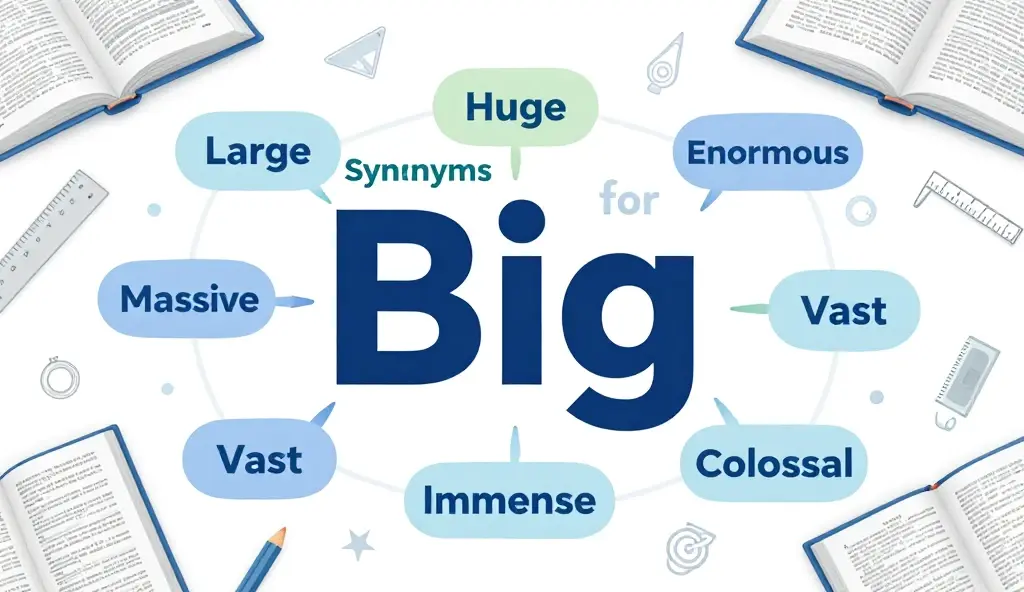
The best synonyms for big include large, huge, enormous, massive, giant, vast, major, important, great, substantial, serious, and significant.
The right choice depends on what you mean. Use large for physical size, huge for something far above normal size, major for importance, vast for a wide area, and substantial for a large amount.
The word big is simple, useful, and common. Still, it does not fit every sentence. A big house may be large. A big problem may be serious. A big change may be major. A big crowd may be huge.
This article will help you choose the exact word you need.
Introduction to Synonyms for Big
People search for synonyms for big because the word has many meanings. It may describe size, amount, age, power, importance, success, or emotion.
For example:
- A big truck is large in size.
- A big bill is high in amount.
- A big decision is important.
- A big brother is older.
- A big star is famous.
- A big mistake has serious results.
Using the same word too often can make writing sound flat. A more exact word adds detail and makes your meaning clear.
Think about this sentence:
We had a big problem during the event.
What kind of problem was it?
It may have been serious, major, costly, complex, or urgent. Each word tells the reader something new.
That is why choosing the correct alternative to big matters.
What Does Big Mean?
Big usually means large in size, amount, number, power, importance, or effect. It can also describe an older child, a strong feeling, or a successful person or event.
Merriam-Webster defines big through several related senses, including being large in size, extent, amount, or number. Cambridge also notes that it may refer to size, amount, age, importance, or emphasis.
Simple definition
Big means larger, greater, or more important than what is normal or expected.
Common meanings of big
| Meaning | Example | Better alternative |
| Large in size | They bought a big house. | Large, huge, spacious |
| High in amount | We received a big order. | Large, substantial |
| Great in number | A big crowd arrived. | Huge, massive |
| Important | This is a big decision. | Major, important |
| Serious | We have a big problem. | Serious, major |
| Successful | The film was a big hit. | Major, huge |
| Famous | She is a big star. | Famous, leading |
| Older | His big sister helped him. | Older |
| Strong in feeling | He is a big fan. | Loyal, devoted |
| Ambitious | She has big plans. | Bold, ambitious |
The meaning changes with the noun that follows it. You cannot replace big with the same synonym in every sentence.
Pronunciation of Big
The word big is pronounced:
/bɪɡ/
It sounds like:
big
The vowel is short. It is the same vowel sound heard in sit, fish, and win.
Break the word into three sounds:
- /b/ as in book
- /ɪ/ as in ship
- /ɡ/ as in give
Cambridge lists the same pronunciation for both American and British English: /bɪɡ/.
How to pronounce it naturally
Keep the word short. Do not stretch the vowel.
Correct:
That is a big dog.
Avoid saying it like beeg. The middle sound should be quick and relaxed.
Comparative and superlative forms
- Big
- Bigger
- Biggest
When adding -er or -est, double the final g.
Correct:
- This box is bigger.
- That is the biggest room.
Incorrect:
- Biger
- Bigest
Part of Speech and Word Forms
The word big is mainly an adjective. An adjective describes a noun.
Big as an adjective
They live in a big house.
Here, big describes the noun house.
We made a big mistake.
Here, big describes the noun mistake.
Big before a noun
The most common pattern is:
big + noun
Examples:
- Big city
- Big company
- Big family
- Big question
- Big change
- Big risk
- Big opportunity
Big after a linking verb
The word can also come after verbs such as be, look, seem, feel, or become.
Examples:
- The room is big.
- The problem seems big.
- The puppy has become big.
- The coat looks too big.
Big as an informal adverb
In some informal phrases, big acts like an adverb.
The company is thinking big.
This means the company is planning bold or ambitious actions.
She won big at the contest.
This means she won a large prize or had great success.
In formal writing, a more exact phrase may be better:
- Think ambitiously
- Win by a wide margin
- Achieve major success
Related word forms
| Form | Part of speech | Example |
| Big | Adjective | It is a big room. |
| Bigger | Comparative adjective | This room is bigger. |
| Biggest | Superlative adjective | It is the biggest room. |
| Bigness | Noun | The bigness of the task surprised us. |
| Big-time | Adjective or adverb | She became a big-time producer. |
| Bighearted | Adjective | He is kind and bighearted. |
The noun bigness is correct, but it is not common in polished writing. Words such as size, scale, importance, or scope often sound more natural.
Quick List of Synonyms for Big
The following table gives useful synonyms for big based on meaning and tone.
| Word | Meaning | Best usage | Formality | Example | Difficulty |
| Large | Above normal size | Objects, groups, amounts | Neutral | They own a large home. | Easy |
| Huge | Very big | Size, number, effect | Neutral | A huge crowd arrived. | Easy |
| Enormous | Extremely big | Size, cost, effect | Neutral | The project had an enormous cost. | Easy |
| Massive | Very large and heavy | Objects, crowds, change | Neutral | A massive truck blocked the road. | Easy |
| Giant | Much larger than normal | Objects, firms, animals | Neutral | A giant tree stood nearby. | Easy |
| Vast | Very wide or extensive | Land, knowledge, distance | Formal | The country has vast deserts. | Medium |
| Immense | Extremely large | Space, effort, value | Formal | The job took immense effort. | Medium |
| Colossal | Extremely large | Scale, failure, structure | Strong | It was a colossal building. | Medium |
| Gigantic | Extremely large | Physical objects | Neutral | A gigantic wave hit the shore. | Easy |
| Mammoth | Unusually large | Tasks, projects, size | Informal | Cleaning it was a mammoth task. | Medium |
| Major | Very important | Events, changes, problems | Formal | This is a major decision. | Easy |
| Important | Having great value | Decisions, people, facts | Neutral | We discussed an important issue. | Easy |
| Significant | Important or noticeable | Research, change, effect | Formal | Sales showed significant growth. | Medium |
| Substantial | Large in amount or value | Money, support, evidence | Formal | They made a substantial investment. | Medium |
| Considerable | Large enough to notice | Time, money, effort | Formal | It took considerable effort. | Medium |
| Great | Large in degree or importance | Success, interest, power | Neutral | The plan had great value. | Easy |
| Grand | Large and impressive | Buildings, plans, events | Neutral | They entered a grand hall. | Easy |
| Serious | Important and worrying | Problems, risks, illness | Neutral | We face a serious problem. | Easy |
| Powerful | Having strong force | Impact, person, machine | Neutral | The speech had a powerful effect. | Easy |
| Leading | Important or successful | People, firms, brands | Formal | It is a leading company. | Medium |
| Popular | Liked by many people | People, products, places | Neutral | The show became popular. | Easy |
| Older | Having more age | Brothers, sisters, children | Neutral | My older sister called me. | Easy |
| Spacious | Having plenty of room | Homes, rooms, cars | Neutral | The apartment feels spacious. | Medium |
| Broad | Wide or covering much | Areas, topics, support | Neutral | The plan has broad support. | Easy |
| Extensive | Covering a large area | Research, damage, work | Formal | The storm caused extensive damage. | Medium |
Best Synonyms for Big and How to Use Them
Not all synonyms for big have the same meaning. The following words are among the most useful alternatives.
Large
Meaning: Above average in size, amount, or number.
Difference: Large is the closest general synonym for big. It often sounds more formal and more exact.
Example:
The company received a large number of orders.
Best situation: Use it for objects, groups, amounts, homes, businesses, and formal reports.
Common mistake: Do not use large for every fixed phrase.
Natural:
- Big mistake
- Big brother
- Big fan
Less natural:
- Large mistake
- Large brother
- Large fan
Huge
Meaning: Very big or much greater than normal.
Difference: Huge is stronger than big and large.
Example:
The store offered a huge discount.
Best situation: Use it when the size, amount, result, or difference is far above normal.
Common mistake: Do not use it for a small increase that is only easy to notice.
Weak:
Sales rose from 100 to 102, which was a huge increase.
Better:
Sales rose slightly from 100 to 102.
Enormous
Meaning: Extremely large in size, amount, or degree.
Difference: Enormous often adds surprise. It is stronger than large and close to huge.
Example:
The bridge took an enormous amount of money to build.
Best situation: Use it for costs, buildings, pressure, effort, growth, or impact.
Common mistake: Avoid using it too often. Its strong meaning becomes weak when every object is called enormous.
Massive
Meaning: Very large, heavy, wide, or serious.
Difference: Massive can suggest weight, strength, scale, or broad effect.
Example:
The storm caused massive damage along the coast.
Best situation: Use it for structures, crowds, machines, damage, change, support, and business growth.
Common mistake: A massive object may be heavy, but a massive change is large in scale. The word does not always refer to weight.
Giant
Meaning: Much larger than other things of the same type.
Difference: Giant often shows a clear comparison.
Example:
A giant screen stood at the front of the stadium.
Best situation: Use it for animals, plants, screens, machines, firms, and products.
Common mistake: When used for a company, giant means a very large or powerful business. It does not refer to the height of its building.
The technology giant opened a new office.
Vast
Meaning: Extremely wide, broad, or great in range.
Difference: Vast focuses on area, distance, range, or scope rather than simple physical size.
Example:
The team studied a vast amount of data.
Best situation: Use it for land, oceans, space, knowledge, wealth, experience, or information.
Common mistake: It does not sound natural for many small objects.
Awkward:
She bought a vast cup.
Better:
She bought a large cup.
Immense
Meaning: Extremely large in size, value, power, or degree.
Difference: Immense often describes things that feel hard to measure.
Example:
The volunteers made an immense contribution.
Best situation: Use it for pressure, joy, value, effort, power, talent, or distance.
Common mistake: Do not confuse immense with intense.
- Immense means very large.
- Intense means very strong.
Major
Meaning: Very important, serious, or large in effect.
Difference: Major does not usually describe physical size. It describes importance.
Example:
The new law caused a major change in the industry.
Best situation: Use it for decisions, problems, events, causes, changes, projects, and achievements.
Common mistake: Do not use major when you only mean physically large.
Wrong:
They bought a major table.
Better:
They bought a large table.
Significant
Meaning: Important, meaningful, or large enough to notice.
Difference: Significant is more formal than big. It often appears in academic, business, and research writing.
Example:
The new method led to a significant improvement.
Best situation: Use it for changes, differences, results, effects, findings, and contributions.
Common mistake: In research, statistically significant has a technical meaning. It does not always mean that a result is large or important in daily life.
Substantial
Meaning: Large in amount, value, size, or importance.
Difference: Substantial often suggests that something is solid, meaningful, or valuable.
Example:
The school received substantial financial support.
Best situation: Use it for money, evidence, meals, support, progress, investment, or savings.
Common mistake: Do not treat it as a synonym for every large object.
Awkward:
A substantial elephant entered the field.
Better:
A huge elephant entered the field.
Considerable
Meaning: Fairly large or important.
Difference: Considerable is formal and often less dramatic than enormous.
Example:
The repair required considerable time and skill.
Best situation: Use it for amounts, effort, thought, experience, concern, and interest.
Common mistake: It usually comes before an uncountable noun or a singular idea.
Natural:
- Considerable effort
- Considerable interest
- A considerable amount
Less natural:
- Considerable chairs
Use many chairs or a large number of chairs instead.
Grand
Meaning: Large, impressive, important, or ambitious.
Difference: Grand adds a sense of beauty, style, status, or ambition.
Example:
The ceremony took place in a grand hall.
Best situation: Use it for buildings, plans, entrances, events, hotels, and designs.
Common mistake: A grand plan may sound ambitious but may not be practical.
Serious
Meaning: Important, harmful, or likely to cause trouble.
Difference: Serious is a better replacement when big describes a worrying problem.
Example:
A lack of clean water is a serious problem.
Best situation: Use it for risks, problems, injuries, illness, mistakes, and concerns.
Common mistake: Serious does not always mean physically large.
A small cut can become a serious health problem.
Synonyms for Big in Physical Size
Use these alternatives when describing an object, animal, person, room, or structure.
| Synonym | Strength | Best example |
| Large | Mild | A large box |
| Spacious | Mild | A spacious room |
| Oversized | Medium | An oversized shirt |
| Huge | Strong | A huge building |
| Enormous | Strong | An enormous ship |
| Massive | Strong | A massive wall |
| Giant | Strong | A giant screen |
| Gigantic | Very strong | A gigantic wave |
| Colossal | Very strong | A colossal statue |
| Towering | Very strong | A towering tree |
Large
Use large when something is above normal size.
We need a large table for the meeting.
Spacious
Use spacious when a place has a lot of open room.
The house has a spacious kitchen.
A big kitchen may be large. A spacious kitchen also feels open and comfortable.
Oversized
Use oversized when something is larger than its standard or expected size.
He wore an oversized jacket.
The word may be neutral, positive, or negative depending on the context.
Towering
Use towering for something very tall.
Towering trees covered the mountain path.
It does not mean wide or heavy.
Colossal
Use colossal when something is extremely large or impressive.
A colossal stone gate marked the entrance.
The word is strong, so use it with care.
Synonyms for Big Amounts and Numbers
A physical object may be large, but an amount may be substantial, considerable, or high.
| Situation | Natural word | Example |
| Money | Substantial | A substantial payment |
| Cost | High | A high cost |
| Number of people | Large | A large number of people |
| Increase | Significant | A significant increase |
| Quantity | Large | A large quantity of water |
| Effort | Considerable | Considerable effort |
| Profit | Large or substantial | A substantial profit |
| Demand | Strong or high | High demand |
| Debt | Heavy or large | A heavy debt |
| Data | Vast | A vast amount of data |
Large amount
We used a large amount of water.
Use amount with uncountable nouns such as water, time, money, and sugar.
Large number
A large number of guests arrived.
Use number with countable nouns such as guests, cars, books, and orders.
Substantial amount
The project saved a substantial amount of money.
This sounds formal and shows that the amount matters.
Significant increase
The business reported a significant increase in sales.
This works well in reports, news, and academic writing.
High cost
The high cost stopped many families from joining.
Use high, not big, before words such as cost, price, rate, temperature, and speed in careful writing.
Synonyms for Big Importance or Impact
When big means important, physical-size words may not work.
| Informal wording | Better alternative |
| A big decision | A major decision |
| A big issue | An important issue |
| A big problem | A serious problem |
| A big effect | A significant effect |
| A big role | A leading or central role |
| A big success | A major success |
| A big change | A major change |
| A big risk | A serious risk |
| A big achievement | A major achievement |
| A big influence | A powerful influence |
Major
Moving overseas was a major decision for the family.
Important
Sleep plays an important role in good health.
Significant
The policy had a significant effect on small businesses.
Powerful
Her story had a powerful impact on the audience.
Central
Trust has a central role in every strong team.
These words show why something matters. They give more information than big alone.
Informal Synonyms for Big
Some alternatives work best in speech, advertising, social posts, and friendly writing.
| Informal word or phrase | Meaning | Example |
| Huge | Very large | That store is huge. |
| Giant | Much larger than normal | We ordered a giant pizza. |
| Jumbo | Extra-large | He bought a jumbo drink. |
| Mega | Very large or powerful | It became a mega event. |
| Super-sized | Made extra-large | They sell super-sized meals. |
| Whopping | Surprisingly large | The repair cost a whopping $5,000. |
| Hefty | Large, heavy, or costly | The service came with a hefty fee. |
| Monster | Extremely large or powerful | A monster storm hit the coast. |
| Humongous | Extremely large | Their new TV is humongous. |
| Ginormous | Extremely large | The child drew a ginormous dragon. |
Whopping
Whopping shows surprise.
The video gained a whopping two million views.
It is common in news headlines and casual writing. Avoid it in formal academic work.
Hefty
Hefty may describe weight, size, cost, or an unpleasant amount.
The bank charged a hefty fee.
It can also describe a strong or solid object.
He carried a hefty bag of tools.
Monster
Monster can work as an informal adjective.
The team signed a monster contract.
It suggests something unusually large or powerful.
Humongous and ginormous
Both words are playful and informal.
That is a humongous sandwich.
They built a ginormous snowman.
They are not good choices for formal reports.
Antonyms for Big
The most common opposite of big is small, but other antonyms may fit better.
| Antonym | Meaning | Best use | Example |
| Small | Below normal size | General size | We rented a small car. |
| Little | Small in size or amount | Daily speech | She found a little box. |
| Tiny | Very small | Objects and amounts | A tiny insect landed nearby. |
| Miniature | A very small copy | Models and objects | He built a miniature house. |
| Narrow | Not wide | Roads, spaces, topics | We walked down a narrow path. |
| Short | Not tall or long | Height, time, distance | It was a short meeting. |
| Low | Small in level or amount | Prices, rates, sound | The store offered a low price. |
| Minor | Not very important | Issues, changes, injuries | It was a minor problem. |
| Trivial | Too small to matter | Problems and details | They argued over a trivial detail. |
| Slight | Small in degree | Changes and differences | There was a slight delay. |
| Limited | Small in range or supply | Time, space, resources | We have limited time. |
| Modest | Not large or grand | Homes, goals, amounts | They live in a modest home. |
| Insignificant | Not important or noticeable | Effects and amounts | The difference was insignificant. |
| Weak | Lacking strength | Effects, demand, power | Demand remained weak. |
| Unimportant | Having little importance | Facts and issues | That detail is unimportant. |
Small
Small is the general opposite of big.
They moved from a big house to a small apartment.
Little
Little often sounds warmer or more personal than small.
She carried a little red bag.
It can also mean a low amount.
We have little time left.
Tiny
Tiny means extremely small.
A tiny crack appeared in the glass.
Minor
Minor is the opposite of major.
The car had only minor damage.
It refers to importance or seriousness, not always physical size.
Slight
Slight means small in degree.
We noticed a slight change in color.
Modest
Modest may describe something simple, limited, or not showy.
They started with a modest budget.
Insignificant
Insignificant means too small or unimportant to have much effect.
The change in cost was insignificant.
Use it with care when discussing a person’s work or feelings. It can sound dismissive.
30 Real-World Examples of Synonyms for Big
These examples show how to replace big with a more exact word.
- Big house: They bought a large house near the lake.
- Big room: The hotel gave us a spacious room with two windows.
- Big truck: A massive truck stopped outside the warehouse.
- Big wave: A gigantic wave crashed against the rocks.
- Big tree: A towering tree shaded the entire yard.
- Big crowd: A huge crowd gathered outside the stadium.
- Big order: The bakery received a large order for the wedding.
- Big payment: The client made a substantial payment in advance.
- Big increase: The company saw a significant increase in online sales.
- Big cost: The high cost made the plan hard to approve.
- Big problem: The broken water pipe caused a serious problem.
- Big decision: Choosing a new school was a major decision.
- Big change: The company announced a major change in its policy.
- Big effect: Better lighting had a powerful effect on the room.
- Big difference: Regular practice made a noticeable difference.
- Big role: Her teacher played a central role in her success.
- Big success: The new product became a major success.
- Big company: He works for a leading company in the industry.
- Big star: She became a famous star after the show.
- Big plans: The team has ambitious plans for next year.
- Big goal: Buying a home is a major goal for the couple.
- Big mistake: Missing the deadline was a serious mistake.
- Big risk: Driving in the storm would be a serious risk.
- Big meal: The workers ate a hearty meal after the long shift.
- Big collection: The museum owns an extensive collection of local art.
- Big area: The fire spread across a vast area of dry land.
- Big effort: Finishing the work took immense effort.
- Big support: The plan gained broad support from local families.
- Big fee: The company charged a hefty fee for late payment.
- Big achievement: Graduating first in her class was a major achievement.
25 Natural Sentences Using Alternatives to Big
- The family needs a larger car before the baby arrives.
- We saw a huge line outside the new restaurant.
- The storm left a massive pile of branches in the road.
- She made a significant contribution to the school project.
- The team faces a major test this weekend.
- They crossed a vast stretch of open land.
- The company invested a substantial sum in staff training.
- It took considerable skill to repair the old clock.
- The child stared at the gigantic dinosaur model.
- A towering wall surrounded the ancient fort.
- The move had an enormous effect on their daily life.
- The room looked spacious after we removed the extra chairs.
- The hospital serves a large part of the county.
- That small error created a serious safety risk.
- She has ambitious goals for her new business.
- The program received broad support from parents.
- The book covers an extensive range of topics.
- We made great progress during the first week.
- The artist painted a colossal ship in the center of the wall.
- He carried a hefty box up three flights of stairs.
- The new bridge was a major achievement for the city.
- They offered a generous reward for the missing dog.
- The speech had a powerful effect on the crowd.
- A giant balloon floated above the parade.
- The repair created a noticeable improvement in performance.
Formal vs. Informal Synonyms for Big
Your word choice should match the setting.
Comparison table
| Meaning | Informal | Neutral | Formal |
| Physical size | Humongous | Huge | Extensive |
| Amount | A ton of | A large amount | A substantial amount |
| Importance | A big deal | Important | Significant |
| Problem | Huge problem | Serious problem | Major concern |
| Cost | Hefty price | High price | Substantial cost |
| Success | Big hit | Great success | Major achievement |
| Change | Huge shift | Major change | Significant development |
| Effort | Tons of work | Great effort | Considerable effort |
| Area | Huge space | Large area | Vast region |
| Support | Lots of support | Strong support | Broad support |
Informal usage
Informal words are suitable for friends, family, social posts, ads, and relaxed conversation.
We had a huge meal last night.
That new mall is humongous.
Winning the award was a big deal for her.
Formal usage
Formal words are better for business reports, essays, research, proposals, and professional emails.
The company reported a significant rise in demand.
The project requires substantial funding.
The delay presents a major operational risk.
Formal writing does not always require difficult words. It requires clear and exact words.
Academic Usage of Synonyms for Big
Academic writing often needs a more exact term than big.
Instead of writing:
The study found a big difference.
Write:
The study found a significant difference.
Instead of:
A big number of students joined the survey.
Write:
A large number of students joined the survey.
Instead of:
The change had a big effect on learning.
Write:
The change had a substantial effect on learning.
Useful academic alternatives
| Weak wording | Better academic wording |
| Big difference | Significant difference |
| Big effect | Substantial effect |
| Big amount | Large amount |
| Big number | Large number |
| Big issue | Important issue |
| Big problem | Major problem |
| Big change | Significant change |
| Big area | Broad area |
| Big range | Wide range |
| Big body of research | Extensive body of research |
A note about significant
In general writing, significant can mean important or easy to notice.
In statistical research, the word may have a special meaning. A statistically significant result meets a set test or measure. It does not always mean the result is large, useful, or important in real life.
Writers should explain which meaning they intend.
Using Big in Daily Conversation
The word big is natural in everyday speech. You do not need to replace it every time.
These phrases sound normal:
- Big day
- Big deal
- Big mistake
- Big surprise
- Big fan
- Big brother
- Big sister
- Big question
- Big dream
- Big smile
Tomorrow is a big day for our family.
I’m a big fan of her music.
That was a big surprise.
Replacing big may change the tone:
Tomorrow is a significant day for our family.
This sounds more formal.
I’m a devoted admirer of her music.
This sounds stronger and less natural in casual speech.
Good vocabulary is not about choosing the longest word. It is about choosing the word that fits.
Grammar Tips for Using Big
Use bigger when comparing two things
This room is bigger than the other one.
The normal pattern is:
A + is + bigger than + B
My new phone is bigger than my old phone.
Do not use more big.
Incorrect:
This house is more big than ours.
Correct:
This house is bigger than ours.
Use biggest for three or more things
This is the biggest store in town.
Use the before the superlative in most cases.
It was the biggest challenge of my career.
Double the final consonant
Because big ends with one vowel followed by one consonant, double the g before adding -er or -est.
- Big → bigger
- Big → biggest
Use large number with countable nouns
A large number of students attended.
Students can be counted.
Use large amount with uncountable nouns
A large amount of water was wasted.
Water is treated as an uncountable noun.
Use high with levels and rates
Some nouns normally take high, not big.
Natural:
- High price
- High cost
- High rate
- High speed
- High temperature
- High salary
- High level
Less natural in formal English:
- Big price
- Big rate
- Big temperature
Use great with feelings and qualities
Natural combinations include:
- Great interest
- Great care
- Great joy
- Great skill
- Great value
- Great importance
The nurse treated each patient with great care.
Do not use very enormous
Enormous already means extremely big.
Weak:
The building was very enormous.
Better:
The building was enormous.
You may use truly enormous or absolutely enormous for emphasis, but one strong word is often enough.
Common Collocations with Big
A collocation is a group of words that often appears together.
Big deal
Something important or impressive.
Getting her first job was a big deal.
It may also appear in the phrase no big deal.
Don’t worry about the cup. It’s no big deal.
Big decision
An important choice.
Moving to another city is a big decision.
A formal alternative is major decision.
Big difference
A clear or important difference.
Good lighting makes a big difference.
Formal alternatives include significant difference and noticeable difference.
Big problem
A serious difficulty.
We have a big problem with the roof.
A more exact phrase may be serious problem, major issue, or urgent concern.
Big mistake
A serious error.
Ignoring the warning was a big mistake.
Big opportunity
A valuable chance.
This job is a big opportunity for her.
More formal alternatives include major opportunity and valuable opportunity.
Big success
A strong or important success.
The school event was a big success.
You may also say major success or great success.
Big change
An important or wide change.
Starting college brought a big change to his routine.
Alternatives include major change, significant change, and dramatic change.
Big risk
A serious chance of harm, loss, or failure.
Investing all your money in one plan is a big risk.
A stronger formal choice is serious risk or substantial risk.
Big question
The main or most important question.
The big question is how we will pay for the work.
You may also say main question, key question, or central question.
Big fan
A person who likes someone or something very much.
I’m a big fan of mystery books.
Natural alternatives include loyal fan, keen supporter, and devoted admirer.
Big family
A family with many members.
She grew up in a big family.
Large family is also natural and slightly more formal.
Big business
A large and powerful company or business sector.
Online shopping has become big business.
The phrase may also refer to large companies as a group.
Big picture
The full situation rather than one small detail.
Step back and look at the big picture.
This phrase is common in business and planning.
Big step
An important action or stage.
Opening a second store was a big step for the owner.
Formal alternatives include major step and important milestone.
Common Phrases and Idioms with Big
Think big
To make bold or ambitious plans.
If you want the company to grow, you need to think big.
Make it big
To become successful or famous.
She moved to the city and hoped to make it big as a singer.
Big deal
An important matter.
Winning that client was a big deal for our small team.
It can also be used in a dismissive way:
So he bought a new phone. Big deal.
The tone changes the meaning.
No big deal
Not important or not difficult.
I can fix the chair. It’s no big deal.
The big picture
The whole situation.
Do not let one bad day make you forget the big picture.
A big ask
A request that is hard to meet.
Finishing the project by Friday is a big ask.
This phrase is common in business and daily speech.
Big time
To a great degree or at a high level.
The plan failed big time.
She wants to enter big-time sports.
The phrase is informal.
Too big for your boots
To act as if you are more important than you are.
He became too big for his boots after one small success.
This phrase is more common in British English.
Go big or go home
Make a strong effort or do not try at all.
We decided to go big or go home with the launch event.
It is informal and often playful.
Big fish in a small pond
An important person in a small group.
He was a big fish in a small pond at his old company.
The phrase may suggest that the person would seem less important in a larger group.
Similar Words and Word Comparisons
Big vs. Large
| Word | Meaning | Difference | Example |
| Big | General word for size or importance | Common and informal | It was a big decision. |
| Large | Above normal size or amount | More formal and measurable | We received a large order. |
Both words may describe physical size:
A big room
A large room
Only big sounds natural in many fixed phrases:
- Big mistake
- Big fan
- Big brother
- Big day
Big vs. Huge
| Word | Strength | Example |
| Big | Above normal | They own a big house. |
| Huge | Far above normal | They own a huge house. |
Use huge when you want stronger emphasis.
Huge vs. Enormous
Both mean extremely large.
Huge is more common in speech.
We saw a huge crowd.
Enormous may sound more descriptive or formal.
The project placed enormous pressure on the team.
The difference is small, so both may work in many sentences.
Big vs. Major
| Word | Main meaning | Example |
| Big | Large or important | We have a big problem. |
| Major | Very important or serious | We have a major problem. |
Use major when importance matters more than physical size.
Big vs. Great
Big often points to size or importance.
It was a big event.
Great may point to degree, quality, value, or success.
It was a great event.
The first sentence says the event was large or important. The second says it was very good.
Big vs. Tall
Use big for general size.
He is a big man.
This may refer to height, weight, or build.
Use tall only for height.
He is a tall man.
A person may be tall but thin. A building may be tall but narrow.
Big vs. Wide
Use wide for the distance from side to side.
The river is wide.
Use big for general size.
The lake is big.
For exact writing, name the dimension:
- Tall building
- Wide road
- Long bridge
- Deep pool
- Thick wall
Big vs. Fat
Big is a general size word. Fat refers to body fat or thickness.
When describing people, fat can sound rude or hurtful. Better choices may include:
- Larger
- Heavyset
- Broad
- Plus-size
Use body descriptions only when they are needed and relevant.
Vast vs. Massive
Vast often describes a wide area, range, or amount.
The country has vast forests.
Massive often describes weight, structure, or large-scale impact.
A massive wall protected the city.
Both may describe something very large, but they create different pictures.
Substantial vs. Significant
Substantial often focuses on amount or value.
The company made a substantial investment.
Significant often focuses on importance, meaning, or noticeable change.
The company reported significant growth.
A change may be significant without involving a huge amount of money.
Common Mistakes When Choosing Synonyms for Big
Using one synonym for every meaning
A huge table sounds natural. A huge decision may work in casual speech, but major decision is more exact.
Always check what big means in the sentence.
Making every sentence too dramatic
Words such as colossal, gigantic, and enormous are strong.
If a normal chair is called colossal, readers may stop trusting the description.
Choosing a formal word that sounds unnatural
I am a substantial fan of your work.
This is incorrect.
Better:
I am a big fan of your work.
I am a devoted admirer of your work.
Confusing amount and number
Correct:
A large number of books
A large amount of water
Books are countable. Water is uncountable.
Using big with the wrong measurement word
Instead of big price, use high price.
Instead of big speed, use high speed.
Instead of big distance, use long distance or great distance.
Repeating big too often
Weak:
We entered a big house with a big room and a big table beside a big window.
Better:
We entered a large house with a spacious room and a long table beside a wide window.
The second version creates a clearer picture.
Suggested Image ALT Text
Publishers can use clear ALT text when adding charts or graphics to this article.
- Synonyms for big grouped by size, amount, and importance
- Comparison table showing big, large, huge, and enormous
- Formal and informal alternatives to the word big
- Common synonyms and antonyms for big with examples
- Best words to replace big in English sentences
ALT text should explain the image. It should not be filled with repeated keywords.
Frequently Asked Questions About Synonyms for Big
What is the best synonym for big?
Large is the closest general synonym for big. It works for physical size, amounts, numbers, homes, groups, and businesses. Still, it is not right in every phrase. Use major for an important decision, serious for a problem, huge for extreme size, and substantial for a large amount of money or support.
What is a stronger word than big?
Strong words for big include huge, enormous, massive, gigantic, colossal, and immense. The best word depends on the noun. A building may be enormous, a machine may be massive, an area may be vast, and an effort may be immense. Strong words should be saved for things that are truly far above normal.
What is a formal synonym for big?
Formal synonyms include large, substantial, significant, considerable, extensive, major, and immense. Use large for size or number, substantial for amount or value, significant for an important effect, and major for an important issue. Exact wording is more useful than simply choosing the most difficult word.
What is another word for a big problem?
Good alternatives include serious problem, major problem, urgent issue, critical concern, complex challenge, and severe difficulty. Choose the word based on the problem. A serious problem may cause harm. An urgent issue needs fast action. A complex challenge has many parts and may take time to solve.
What is another word for a big amount?
Use large amount, substantial amount, considerable amount, great deal, vast quantity, or high volume. The noun matters. Say a large amount of water, a substantial sum of money, a high volume of traffic, or a great deal of work. These phrases sound more natural than using one replacement everywhere.
Is large the same as big?
Big and large often have the same basic meaning, but they are not always interchangeable. Large sounds more formal and often refers to measurable size or amount. Big is more common in daily speech and fixed phrases. People say big mistake, big brother, and big fan, not usually large mistake, large brother, or large fan.
What is the difference between huge and big?
Big means above normal size or importance. Huge means far above normal. A big house may have more space than most homes. A huge house may look unusually large. Because huge adds strong emphasis, it should not describe a small or ordinary difference unless the speaker is joking or exaggerating.
Can big describe importance?
Yes. Big often means important, serious, or influential. Examples include big decision, big change, big opportunity, and big problem. In formal writing, more exact choices may be better. Use major decision, significant change, valuable opportunity, or serious problem to show the exact type of importance.
What is an academic synonym for big?
Useful academic choices include significant, substantial, considerable, extensive, major, broad, and large. A researcher may write about a significant difference, substantial effect, considerable variation, extensive damage, or large sample. Academic writers should choose a word that names the type of size, scope, amount, or importance being discussed.
What is an informal word for very big?
Informal alternatives include humongous, ginormous, monster, mega, jumbo, whopping, and super-sized. You might say, “That sandwich is humongous,” or “The repair came with a whopping fee.” These words work well in speech, ads, headlines, and playful writing, but they may sound too casual in academic or business documents.
What is the opposite of big?
The general opposite is small. Other antonyms include little, tiny, miniature, minor, slight, limited, modest, and insignificant. The right choice depends on meaning. Use tiny for physical size, minor for importance, slight for degree, limited for supply or range, and modest for an amount that is not large.
Should I use big or large?
Use big in casual speech and common phrases such as big day, big fan, big mistake, and big deal. Use large when discussing measurable size, amount, or number. For example, write a large building, a large payment, or a large number of visitors. Both words are correct when the sentence sounds natural.
What word can replace big in a business report?
The best replacement depends on the fact being reported. Use significant growth, substantial investment, major risk, large customer base, high demand, considerable expense, or extensive change. Business reports become clearer when writers name the exact type of size or importance instead of using a broad word in every sentence.
What word can replace big in a story?
Story writers can use towering, giant, enormous, broad, heavy, sprawling, immense, or colossal when those words fit the scene. Instead of writing “a big castle,” you might write “a towering stone castle” or “a sprawling castle with six wings.” The best description shows height, width, weight, shape, or emotional impact.
Is enormous stronger than huge?
Both words mean extremely large, and the difference is often small. Huge is common in casual English. Enormous may sound slightly more descriptive or formal. A person may say a huge crowd in conversation and write an enormous financial burden in a report. Context and tone matter more than a fixed strength ranking.
Can big mean older?
Yes. In informal English, big brother and big sister can mean an older brother or sister. However, older brother and older sister are clearer when age is the main point. The phrase big brother may also suggest a protective role, authority, or a person who watches over someone younger.
Expert Tips for Choosing the Right Big Synonym
Identify the exact meaning first
Ask one simple question:
What is big about it?
Is it tall, wide, costly, important, serious, popular, or large in number?
The answer will lead you to a more exact word.
Name the measurement when possible
Instead of:
The box was big.
Write:
The box was wide and deep.
Instead of:
It was a big trip.
Write:
It was a long and costly trip.
Exact details help readers form a picture.
Match the word to the noun
Some words form natural pairs:
- High price
- Heavy rain
- Strong demand
- Wide range
- Long distance
- Deep concern
- Major change
- Serious risk
- Large number
- Substantial payment
Learning these pairs is more useful than memorizing a long synonym list.
Match the strength to the facts
Use large for something above normal.
Use huge or enormous for something far above normal.
Use colossal only when the size or effect is truly extreme.
Keep common phrases natural
Do not replace big when the new phrase sounds forced.
Natural:
- Big fan
- Big day
- Big deal
- Big brother
- Big smile
A common word is often the best word.
Read the sentence aloud
A synonym may be correct in meaning but wrong in tone. Reading aloud helps you hear stiff, dramatic, or unnatural wording.
She is a substantial fan of the team.
The sentence sounds wrong.
She is a big fan of the team.
The second version sounds natural.
Remove weak intensifiers
Instead of:
The building was very, very big.
Write:
The building was enormous.
One exact word is stronger than several weak words.
Conclusion:
The best synonyms for big depend on what you are describing. Use large for general size, huge or enormous for extreme size, vast for wide areas, substantial for meaningful amounts, major for important events, and serious for risks or problems.
Do not replace big only to sound clever. First decide what the word means in your sentence. Then choose an alternative that shows size, number, value, scope, strength, or importance.
Clear writing often comes from one small change:
A big problem became a serious problem.
A big payment became a substantial payment.
A big area became a vast region.
The new word gives the reader more information. That is the real value of using the right synonym.

Chloe Ward is a vocabulary content specialist from Tampa, Florida. She enjoys helping readers build stronger communication skills through better word choices.