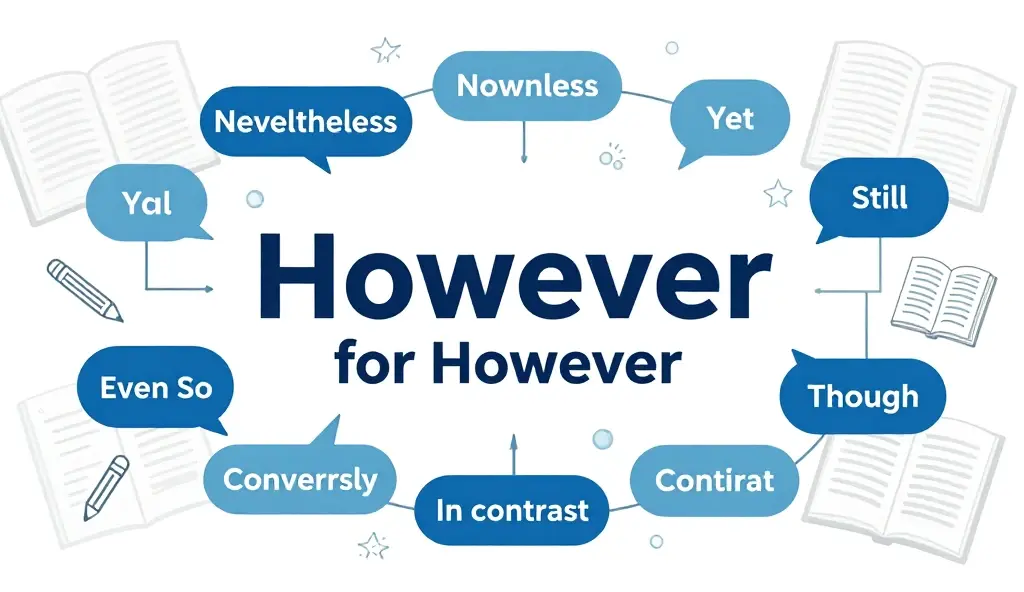
The best synonyms for however include but, yet, still, nevertheless, nonetheless, even so, though, on the other hand, that said, and all the same. Each word shows contrast, but they do not always fit the same sentence. “But” sounds natural in daily speech, while “nevertheless” and “nonetheless” sound more formal. The right choice depends on tone, sentence structure, and the kind of contrast you want to show.
What Does “However” Mean?
“However” is a common English word used to show that one idea is different from, limited by, or surprising compared with another idea.
It often means:
- Despite what was just said
- On the other hand
- But
- In whatever way
- To whatever degree
Here is a simple example:
The hotel was expensive. However, the service was excellent.
The first sentence gives a negative point. The second gives a positive point that contrasts with it.
People search for synonyms for however because repeating the same transition word can make writing sound dull. They may also need a simpler, more formal, or more conversational alternative.
You can use “however” in essays, emails, reports, stories, conversations, and business writing. The best replacement depends on where the word appears and what it means in that sentence.
Exact Meaning and Definition of “However”
“However” has more than one meaning. Its most common use is to introduce a contrast.
Definition 1: In spite of that
“However” can mean that something is true even though another fact may lead us to expect a different result.
The road was long. However, we reached the town before dark.
The long road could have caused a delay. The result was different from what we might expect.
Definition 2: No matter how
“However” can also mean “to whatever degree.”
However tired you feel, you must finish the task.
This means no matter how tired you feel.
Definition 3: In whatever way
It may also mean “in any way that someone chooses.”
Arrange the chairs however you like.
This means you may arrange them in any way you want.
Most synonyms for however only replace the first meaning. Words such as “but,” “nevertheless,” and “even so” show contrast. They cannot always replace “however” when it means “in whatever way.”
Why People Look for Synonyms for However
Writers often use “however” when they need to connect two different ideas. Yet using it too many times can make an article feel stiff or repetitive.
Someone may search for another word for however because they want to:
- Improve sentence flow
- Avoid repeating one transition
- Make a sentence easier to read
- Use a more formal word
- Sound more natural in conversation
- Strengthen a point of contrast
- Improve an essay or report
- Find a word that fits the sentence structure
- Write for a young or general audience
- Choose between “but,” “yet,” and “however”
For example, this paragraph sounds repetitive:
The product is affordable. However, it has limited features. However, it may still work for beginners. However, advanced users may need another option.
A smoother version would be:
The product is affordable, but it has limited features. Even so, it may work for beginners. Advanced users, however, may need another option.
The meaning stays clear, but the writing feels more natural.
How to Pronounce “However”
“However” is pronounced:
how-EV-er
Phonetic spelling:
/haʊˈev.ɚ/ in American English
/haʊˈev.ə/ in British English
The stress falls on the second part:
how-EV-er
Say it in three clear parts:
how + ev + er
A natural pronunciation sounds like:
how-EV-er
Do not put strong stress on the first part. Saying HOW-ever may sound unnatural unless you are giving special emotional emphasis.
Practice with these sentences:
However, I understand your concern.
The task was hard. However, we completed it.
You may decorate the room however you wish.
In fast speech, the final sound may become softer, but all three parts should still be clear.
What Part of Speech Is “However”?
“However” is usually an adverb.
More specifically, it can work as a conjunctive adverb when it connects contrasting ideas.
However as a conjunctive adverb
The car is old. However, it still runs well.
Here, “however” connects two complete thoughts and shows contrast.
However as an adverb meaning “no matter how”
However slowly you walk, you will reach the gate.
Here, it changes the meaning of “slowly.”
However meaning “in whatever way”
You can solve the problem however you choose.
Here, it describes the way the problem may be solved.
“However” is not normally a noun, verb, or adjective. It works mainly as an adverb or linking expression.
Complete Synonyms for However
The following table shows common synonyms for however, their meanings, tone, and best use.
| Word or Phrase | Meaning | Typical Usage | Formality | Example | Difficulty |
| But | Shows a direct contrast | Speech and general writing | Informal to neutral | I called, but no one answered. | Easy |
| Yet | Shows an unexpected contrast | Speech and writing | Neutral | The task was hard, yet she finished it. | Easy |
| Still | Despite that fact | Speech and writing | Neutral | It was late. Still, we kept working. | Easy |
| Though | But or despite that | Informal speech and writing | Informal to neutral | It was costly. I bought it, though. | Easy |
| Although | In spite of the fact that | Complete dependent clauses | Neutral to formal | Although it rained, we went out. | Easy |
| Nevertheless | Despite what was said | Essays and formal writing | Formal | The risk was high. Nevertheless, they continued. | Medium |
| Nonetheless | In spite of that | Reports and formal writing | Formal | The plan had flaws. Nonetheless, it worked. | Medium |
| Even so | Despite that | Speech and general writing | Neutral | He was tired. Even so, he helped us. | Easy |
| On the other hand | Shows another side | Comparison and discussion | Neutral | It costs more. On the other hand, it lasts longer. | Easy |
| That said | Adds a limit or different view | Speech, blogs, business writing | Neutral | The phone is good. That said, it is expensive. | Easy |
| All the same | Despite the previous fact | Speech and literary writing | Neutral | It was risky. All the same, we agreed. | Medium |
| Despite that | In spite of that fact | General and formal writing | Neutral | The road was closed. Despite that, we arrived. | Easy |
| In contrast | Shows a clear difference | Essays and reports | Formal | Sales rose in May. In contrast, June was weak. | Medium |
| Conversely | Introduces an opposite relation | Academic and technical writing | Formal | Heat speeds the process. Conversely, cold slows it. | Hard |
| Instead | Presents another action or choice | General writing | Neutral | She did not complain. Instead, she found a solution. | Easy |
| By contrast | Shows a strong difference | Academic and business writing | Formal | The first plan is cheap. By contrast, the second is costly. | Medium |
| Be that as it may | Accepts a fact before disagreeing | Formal or old-fashioned writing | Very formal | The plan is popular. Be that as it may, it remains risky. | Hard |
| Notwithstanding | In spite of something | Legal and formal writing | Very formal | Notwithstanding the delay, the work was completed. | Hard |
Best Synonyms for However and How to Use Them
Not every alternative carries the same tone. Some words create a quick contrast. Others sound more careful, formal, or forceful.
But
Meaning: “But” joins two ideas that are different or opposed.
Difference from however: “But” is a coordinating conjunction. It usually joins clauses within one sentence. “However” often begins a new sentence or follows a semicolon.
I wanted to leave, but the rain became heavier.
I wanted to leave. However, the rain became heavier.
Best situation: Use “but” in conversation, simple writing, emails, stories, and short sentences.
Common mistake: Do not normally use “but” and “however” together to perform the same job.
Incorrect:
But, however, the plan failed.
Better:
However, the plan failed.
Or:
But the plan failed.
“But” is often the best choice for readers who want clear and easy language.
Yet
Meaning: “Yet” introduces a fact that seems surprising after the first fact.
Difference from however: “Yet” often makes the contrast feel more unexpected.
The box looked small, yet it held all our books.
The result is surprising because a small box would not seem able to hold many books.
Best situation: Use “yet” in essays, stories, speeches, and polished everyday writing.
Common mistake: Do not confuse this use with “yet” meaning “until now.”
She has not arrived yet.
In that sentence, “yet” does not mean “however.”
“Yet” works well when the second point goes against what the reader might expect.
Still
Meaning: “Still” means that something remains true despite another fact.
Difference from however: “Still” often feels softer and more natural in conversation.
The weather was cold. Still, we enjoyed the trip.
This means the cold weather did not stop the group from having a good time.
Best situation: Use “still” when you accept the first point but want to show that another fact also matters.
Common mistake: “Still” has several meanings. It can also mean “not moving” or “continuing until now.”
Please stand still.
She still lives in Boston.
Only the contrast use is a synonym for “however.”
Nevertheless
Meaning: “Nevertheless” means “despite that fact.”
Difference from however: It sounds more formal and may add stronger emphasis.
The evidence was limited. Nevertheless, the court reviewed the claim.
Best situation: Use it in academic papers, formal reports, legal discussion, serious articles, and professional arguments.
Common mistake: Do not use it too often in simple or casual writing. It can make a friendly message sound stiff.
Less natural in a text message:
I am tired. Nevertheless, I will meet you at the café.
More natural:
I’m tired, but I’ll meet you at the café.
“Nevertheless” is useful when you want a strong, formal contrast.
Nonetheless
Meaning: “Nonetheless” means “in spite of what was just stated.”
Difference from however: It is close to “nevertheless.” In most sentences, the two words can replace each other.
The company faced several delays. Nonetheless, it launched the product on time.
Best situation: Use it in professional, academic, and formal writing.
Common mistake: Some writers think “nonetheless” must be written as three words. The standard modern spelling is one word.
Correct:
nonetheless
Less common:
none the less
“Nonetheless” often sounds a little shorter and smoother than “nevertheless,” but the meaning is almost the same.
Even So
Meaning: “Even so” means that the second statement remains true despite the first.
The instructions were unclear. Even so, Maria completed the form correctly.
Difference from however: “Even so” places strong focus on the fact that the first problem did not change the result.
Best situation: Use it in speech, articles, stories, and clear business writing.
Common mistake: Do not use “even so” when the second idea is merely different. The second idea should remain true despite a problem, limit, or opposing fact.
Weak use:
The chair is blue. Even so, the table is brown.
Better:
The chair was uncomfortable. Even so, he sat there for hours.
Though
Meaning: “Though” can mean “but” or “despite that.”
The meal was simple. It tasted good, though.
Difference from however: “Though” is more conversational and can appear at the end of a sentence.
The work was tiring. I enjoyed it, though.
“However” would sound less natural in that exact position:
The work was tiring. I enjoyed it, however.
The second sentence is correct, but more formal.
Best situation: Use “though” in conversation, personal writing, blog posts, messages, and relaxed workplace communication.
Common mistake: When “though” introduces a dependent clause, it cannot stand alone.
Incorrect:
Though the weather was bad.
Correct:
Though the weather was bad, we continued.
Although
Meaning: “Although” means “in spite of the fact that.”
Although the store was busy, we received quick service.
Difference from however: “Although” introduces a dependent clause. “However” usually connects separate complete ideas.
Compare:
Although the store was busy, we received quick service.
The store was busy. However, we received quick service.
Best situation: Use “although” when you want the contrast to appear within one sentence.
Common mistake: Avoid using “although” and “but” together in standard English.
Incorrect:
Although it was late, but we stayed.
Correct:
Although it was late, we stayed.
Or:
It was late, but we stayed.
On the Other Hand
Meaning: This phrase introduces another side of an issue.
Renting costs less at first. On the other hand, buying can build long-term value.
Difference from however: It often presents a balanced comparison rather than a simple disagreement.
Best situation: Use it when discussing choices, benefits, risks, views, or two sides of a topic.
Common mistake: Do not write “on the other hand” unless there is a clear first side to compare with.
Unclear:
On the other hand, the office closes at five.
Clear:
Working from home saves travel time. On the other hand, the office may offer better teamwork.
That Said
Meaning: “That said” accepts the previous point before adding a limit, warning, or different view.
The course is useful. That said, it may be too basic for experts.
Difference from however: It sounds thoughtful and natural. It tells the reader, “I accept that point, but another point also matters.”
Best situation: Use it in business writing, reviews, blogs, discussions, and professional conversation.
Common mistake: Avoid it in very formal academic work when a more exact connector would be better.
For a research paper, “nevertheless” or “by contrast” may fit better.
For a product review, “that said” often sounds warm and natural.
All the Same
Meaning: “All the same” means that a fact remains true despite what has been said.
The walk was longer than expected. All the same, we enjoyed the view.
Difference from however: It often sounds more personal or literary.
Best situation: Use it in stories, opinion writing, thoughtful speech, or informal discussion.
Common mistake: “All the same” can also mean “there is no difference.”
Red or blue—it is all the same to me.
That meaning is different from the contrast meaning.
Despite That
Meaning: “Despite that” means “in spite of that fact.”
The team had little time to practice. Despite that, it won the match.
Difference from however: It clearly points back to a difficulty, problem, or limit.
Best situation: Use it when the second event happens even though the first fact could have stopped it.
Common mistake: “Despite” is normally followed by a noun, pronoun, or gerund, not a full clause.
Correct:
Despite the rain, we left.
Despite feeling tired, she worked.
Incorrect:
Despite it was raining, we left.
Better:
Although it was raining, we left.
In Contrast
Meaning: “In contrast” highlights a clear difference between two things.
The city center is crowded. In contrast, the village is calm.
Difference from however: “In contrast” is best for direct comparisons. “However” can introduce many kinds of limits or opposing points.
Best situation: Use it in comparison essays, reports, research, product reviews, and data analysis.
Common mistake: Make sure the two ideas can be compared in a clear way.
Weak comparison:
The car is fast. In contrast, my phone is new.
Clear comparison:
The first car is fast. In contrast, the second is built for comfort.
Conversely
Meaning: “Conversely” introduces an opposite relationship.
Regular exercise can improve sleep. Conversely, poor sleep can make exercise harder.
Difference from however: “Conversely” does not simply mean “but.” It points to a reversed or opposite connection.
Best situation: Use it in academic, scientific, logical, and technical writing.
Common mistake: Do not use “conversely” when the second idea is only slightly different.
Incorrect or weak:
The room was small. Conversely, it was clean.
Better:
Higher demand may raise prices. Conversely, lower demand may cause prices to fall.
Instead
Meaning: “Instead” introduces another action, choice, or result.
We did not take the highway. Instead, we used a quiet country road.
Difference from however: “Instead” shows replacement. One thing happens in place of another.
Best situation: Use it when someone rejects, avoids, or does not choose the first option.
Common mistake: Do not use “instead” for every contrast.
Weak use:
The room was small. Instead, it was comfortable.
Better:
We did not book the small room. Instead, we chose the larger one.
Antonyms and Opposite Connectors for However
“However” does not have one perfect antonym because it is a connecting word rather than a descriptive word. Still, several transitions express continuation, agreement, cause, or a similar idea instead of contrast.
| Opposite Connector | Meaning | How It Differs from However | Example |
| Therefore | Shows a result | Gives a consequence, not a contrast | It rained; therefore, the game was canceled. |
| Thus | Shows a conclusion or result | Moves an idea forward logically | The road was closed; thus, we turned back. |
| Accordingly | Shows a suitable result | Explains what happened because of a fact | Demand rose. Accordingly, production increased. |
| As a result | Introduces an outcome | Shows cause and effect | She practiced daily. As a result, she improved. |
| Consequently | Shows a consequence | Links an action to its result | Costs rose. Consequently, prices increased. |
| Similarly | Shows likeness | Connects ideas that are alike | Ben enjoys hiking. Similarly, his sister loves outdoor trips. |
| Likewise | Shows agreement or similarity | Adds a matching point | The manager was helpful. Likewise, the staff was polite. |
| Also | Adds information | Continues rather than contrasts | The room is large. It is also bright. |
| Furthermore | Adds support | Builds on the first idea | The plan is affordable. Furthermore, it is easy to follow. |
| Therefore | Shows a logical outcome | Explains what follows from the first fact | The store was closed. Therefore, we went home. |
Therefore
“Therefore” shows that the second idea results from the first.
The battery was empty. Therefore, the phone turned off.
It is not a synonym for however because it shows cause and effect rather than contrast.
Similarly
“Similarly” links two ideas that are alike.
The older model is easy to use. Similarly, the new model has simple controls.
“However” would show a difference, while “similarly” shows a shared quality.
Furthermore
“Furthermore” adds another supporting point.
The hotel is close to the beach. Furthermore, it offers free breakfast.
It strengthens the first idea instead of limiting or opposing it.
As a Result
“As a result” introduces an outcome.
The driver missed the turn. As a result, we arrived late.
Use it when one event causes another event. Use “however” when the second idea contrasts with the first.
30 Real-World Examples of However and Its Synonyms
These examples show how synonyms for however work in normal situations.
- The café was crowded. However, we found a table near the window.
- I wanted to buy the jacket, but it was too expensive.
- The test was difficult, yet most students passed.
- It started raining. Still, the children kept playing.
- The room was small. Even so, it felt warm and comfortable.
- The job pays well. On the other hand, the hours are long.
- The phone has a good camera. That said, its battery life is weak.
- She had little experience. Nevertheless, she handled the problem well.
- The project faced delays. Nonetheless, it finished within the approved budget.
- The restaurant looked plain. The food was excellent, though.
- Although the bus was late, we reached the airport on time.
- The trail was steep. All the same, we climbed to the top.
- The team lost its best player. Despite that, it won the next game.
- The first apartment was dark. In contrast, the second had large windows.
- High temperatures speed up the reaction. Conversely, cold temperatures slow it down.
- We did not order takeout. Instead, we cooked dinner at home.
- The laptop is light, but it feels strong.
- He was nervous, yet his voice remained calm.
- The instructions were confusing. Even so, I completed the setup.
- The hotel was far from downtown. Still, the quiet area made the trip relaxing.
- The plan may save money. However, it could take more time.
- The shoes looked stylish. That said, they were not comfortable enough for walking.
- Although the movie was long, it never felt boring.
- The company had a small team. Nevertheless, it served customers across the country.
- The route was longer. On the other hand, it had less traffic.
- She did not get the first job. Instead, she found a better one a week later.
- The book starts slowly. It becomes exciting, though.
- The weather report predicted storms. Despite that, the sky stayed clear.
- One method is fast but costly. By contrast, the other is slow but affordable.
- The offer sounded attractive. Be that as it may, we needed to read the contract carefully.
25 Natural Sentences Using Words Like However
The following sentences use a mix of formal, informal, academic, and conversational styles.
- I understand your point; however, I do not fully agree.
- The shop was about to close, but the owner let us enter.
- The task looked simple, yet it took three hours.
- We were tired. Still, no one wanted to leave early.
- The price is higher than expected. Even so, the quality may make it worthwhile.
- The first plan offers speed. On the other hand, the second offers better control.
- The course is well designed. That said, some lessons feel too short.
- The evidence is limited. Nevertheless, it deserves careful review.
- The road conditions were poor. Nonetheless, the delivery arrived safely.
- I did not enjoy the ending. The rest of the film was good, though.
- Although the kitchen is small, it has plenty of storage.
- The climb was difficult. All the same, the view made every step worthwhile.
- There was no clear sign. Despite that, we found the building.
- The northern area receives heavy rain. In contrast, the south stays dry.
- More sunlight may help the plant grow. Conversely, too much heat may damage it.
- We chose not to complain. Instead, we asked for a simple solution.
- The software is useful; however, new users may need time to learn it.
- The hotel had mixed reviews, yet our stay was pleasant.
- I know the meeting starts early. Still, I plan to attend.
- The car is old. Even so, it remains safe and reliable.
- The service was friendly. That said, our order took too long.
- The study involved only 40 people. Nevertheless, its results may guide future research.
- Although his answer was brief, it covered the main point.
- The package arrived late. It was in perfect condition, though.
- The cheaper model lacks several tools. On the other hand, it may be ideal for beginners.
Formal vs. Informal Synonyms for However
The word you choose should match your reader and purpose. A legal report needs a different tone from a text message.
| Situation | Formal Choice | Neutral Choice | Informal Choice |
| Academic essay | Nevertheless | However | But |
| Business report | Nonetheless | That said | Still |
| Legal writing | Notwithstanding | However | But |
| Friendly email | However | Still | But |
| Text message | Yet | Though | But |
| Product review | Nevertheless | That said | Still |
| Debate | Conversely | On the other hand | But |
| Story | Nevertheless | Yet | Though |
| Research paper | In contrast | However | But |
| Spoken conversation | However | Even so | Though |
Formal usage
Formal alternatives include:
- Nevertheless
- Nonetheless
- Notwithstanding
- Conversely
- By contrast
- In contrast
- Be that as it may
Example:
The sample size was limited. Nevertheless, the findings provide a useful starting point.
This sentence fits a report or academic paper.
Neutral usage
Neutral alternatives include:
- However
- Yet
- Still
- Even so
- On the other hand
- Despite that
Example:
The room was basic. Even so, it had everything we needed.
This works in speech, reviews, blogs, and normal business writing.
Informal usage
Informal alternatives include:
- But
- Though
- Still
- Then again
Example:
It’s a little expensive, but I really like it.
This sounds natural in conversation.
Do not choose a formal word only because it looks more advanced. Clear writing is usually stronger than complicated writing.
How to Use However in Academic Writing
“However” is common in academic work because it helps writers present limits, exceptions, and opposing evidence.
Showing a limit
The study found a clear pattern. However, the sample was too small to support a broad claim.
The second sentence limits the strength of the first.
Presenting conflicting evidence
Several reports support the policy. However, newer data suggests that its effects may vary by region.
This use shows that the evidence does not point in only one direction.
Comparing two findings
Group A improved after four weeks. In contrast, Group B showed little change.
“In contrast” may be better than “however” when comparing two clear sets of results.
Reversing a relationship
Increased support may improve attendance. Conversely, low attendance may reduce future funding.
“Conversely” is useful when the second statement describes an opposite relationship.
Accepting a point before challenging it
The method is affordable. Nevertheless, its accuracy remains uncertain.
This structure shows fair judgment. The writer accepts one benefit but explains an important weakness.
Academic punctuation
When “however” joins two complete clauses, use a semicolon before it and a comma after it.
Correct:
The first test was successful; however, the second produced different results.
You may also divide the ideas into two sentences.
The first test was successful. However, the second produced different results.
Avoid joining two complete clauses with only commas.
Incorrect:
The first test was successful, however, the second produced different results.
How to Use However in Daily Conversation
“However” is correct in speech, but it may sound formal when used too often. In relaxed conversation, people often choose “but,” “still,” “though,” or “even so.”
Formal-sounding speech:
I enjoyed the party. However, the music was too loud.
More natural casual speech:
I enjoyed the party, but the music was too loud.
Another natural option:
The music was too loud. I enjoyed the party, though.
Common conversational alternatives
But
I called him, but he didn’t answer.
Still
It’s getting late. Still, we have enough time.
Though
The place was busy. The food was good, though.
Even so
I had a headache. Even so, I went to the meeting.
Then again
The apartment is small. Then again, it is close to work.
“Then again” asks the listener to consider another side. It is casual and often used when someone changes or softens an opinion.
Grammar and Punctuation Tips for However
Good punctuation makes the meaning of “however” clear.
Use a period before however
The train was delayed. However, we arrived before noon.
This is one of the easiest and safest structures.
Use a semicolon between complete clauses
The train was delayed; however, we arrived before noon.
Both sides can stand as complete sentences, so a semicolon is correct.
Use commas when however interrupts a sentence
The train, however, arrived before noon.
Here, “however” is placed inside the sentence. Commas separate it from the main clause.
Do not create a comma splice
Incorrect:
The train was delayed, however, we arrived before noon.
Correct:
The train was delayed; however, we arrived before noon.
Correct:
The train was delayed. However, we arrived before noon.
Use however without commas when it means “no matter how”
However hard she tried, the lid would not open.
The phrase “however hard” forms part of the clause, so do not place a comma between the two words.
Use however without commas when it means “in any way”
You may arrange the files however you prefer.
In this example, “however” does not act as a sentence transition.
Avoid using although with but
Incorrect:
Although the price was high, but I bought it.
Correct:
Although the price was high, I bought it.
Correct:
The price was high, but I bought it.
Avoid using but and however together
Weak:
But, however, the result was different.
Better:
However, the result was different.
Or:
But the result was different.
Common Collocations and Patterns With However
A collocation is a group of words that often appears together. “However” does not form many fixed collocations, but it appears in several common sentence patterns.
However, it is important to note
This phrase introduces a limit or warning.
However, it is important to note that the results may change.
It is common in reports, but it can sound wordy. A shorter form may be better:
However, the results may change.
However, this does not mean
This pattern corrects a possible misunderstanding.
The test was difficult. However, this does not mean it was unfair.
However, there are
This phrase introduces exceptions, problems, or other choices.
The plan has several benefits. However, there are also some risks.
However, some people
This structure introduces a different opinion.
Many people enjoy remote work. However, some people prefer an office.
However, the results
This pattern often appears in research writing.
The first trial showed promise. However, the results were not repeated in the second trial.
However small
This means “no matter how small.”
Every step matters, however small it may seem.
However difficult
This means “no matter how difficult.”
However difficult the task becomes, we should remain patient.
However much
This means “no matter how much.”
However much he practiced, he still felt nervous.
However long
This means “no matter how long.”
However long the journey takes, we will stay together.
However possible
This means “in any possible way,” though it is often clearer to say “in whatever way is possible.”
We will help however possible.
A clearer version is:
We will help in whatever way we can.
Common Phrases Using However
“However” appears in several useful phrases and sentence forms.
However, that may be
This accepts uncertainty before adding another point.
However that may be, we still need a decision.
It sounds formal and somewhat old-fashioned.
However you look at it
This means that the same result is clear from every viewpoint.
However you look at it, the project was a success.
However it happens
This means the exact method does not matter.
However it happens, we need the documents by Friday.
However you choose
This gives someone freedom to decide.
You may present the idea however you choose.
However much you try
This means “no matter how much you try.”
However much you try, you cannot please everyone.
However difficult it may be
This accepts that something may be hard.
However difficult it may be, honest feedback is useful.
However unlikely
This means “even if it seems very unlikely.”
We must consider every risk, however unlikely.
However slight
This means “even if it is very small.”
Report every change, however slight.
These phrases cannot always be replaced with “but” or “nevertheless.” The meaning of “however” changes according to the structure.
Idioms and Expressions Related to Contrast
“However” itself is not usually part of a true idiom. Still, English has several expressions that introduce contrast or show that another side matters.
On the flip side
This is an informal way to present another side.
The job requires travel. On the flip side, you get to visit new places.
Then again
This phrase introduces a thought that may change the speaker’s first view.
The rent is high. Then again, the location is perfect.
Be that as it may
This means “even if that is true.”
The idea is popular. Be that as it may, we must review the cost.
When all is said and done
This means after every point has been considered.
When all is said and done, customer safety must come first.
On second thought
This shows that the speaker has reconsidered.
I planned to drive. On second thought, I’ll take the train.
For all that
This means “despite that.”
The house is old, but it is comfortable for all that.
This expression is less common in modern American conversation.
At the same time
This phrase adds another point that may seem to conflict with the first.
We need to work quickly. At the same time, we cannot ignore safety.
It is useful when both points are true and deserve attention.
Similar Words and Their Differences
Several words look like direct synonyms for however, but each has its own grammar and purpose.
| Word | Basic Meaning | Main Difference | Example |
| However | Introduces contrast | Flexible and neutral | The room was small. However, it was clean. |
| But | Joins opposing ideas | Usually connects clauses in one sentence | The room was small, but it was clean. |
| Yet | Shows surprising contrast | Stronger sense of surprise | The room was small, yet it felt open. |
| Although | Introduces a contrast clause | Cannot normally stand alone | Although the room was small, it felt open. |
| Nevertheless | Means despite that | More formal and forceful | The room was small. Nevertheless, we booked it. |
| Nonetheless | Means despite that | Formal and close to nevertheless | The room was small. Nonetheless, it met our needs. |
| Still | Means the point remains true | More conversational | The room was small. Still, we liked it. |
| Though | Means but or despite that | Can appear at the sentence end | The room was small. It was comfortable, though. |
| Even so | Despite that problem | Emphasizes an unchanged result | The room was small. Even so, four people fit inside. |
| Instead | In place of something | Shows replacement, not simple contrast | We skipped the small room. Instead, we chose a suite. |
| Conversely | Shows an opposite relation | Used for logical reversal | Heat expands the material. Conversely, cold contracts it. |
| On the other hand | Presents another side | Best for balanced comparison | The room is small. On the other hand, it is affordable. |
However vs. But
“But” joins ideas directly:
I was tired, but I kept working.
“However” often starts a new sentence:
I was tired. However, I kept working.
Both are correct. “But” sounds simpler and more conversational.
However vs. Although
“Although” begins a dependent clause:
Although I was tired, I kept working.
“However” connects complete ideas:
I was tired. However, I kept working.
Do not replace one with the other without changing the sentence structure.
However vs. Nevertheless
The two words often share the same meaning.
The task was difficult. However, we completed it.
The task was difficult. Nevertheless, we completed it.
“Nevertheless” sounds more formal and may place stronger focus on overcoming the difficulty.
However vs. Yet
“Yet” often highlights surprise.
He had never trained, yet he finished the race.
“However” gives a more neutral contrast.
He had never trained. However, he finished the race.
However vs. Still
“Still” sounds softer and more natural in speech.
The bus was late. Still, we reached work on time.
“However” sounds slightly more formal.
The bus was late. However, we reached work on time.
However vs. Conversely
“Conversely” requires an opposite or reversed relationship.
Higher prices may lower demand. Conversely, lower prices may increase demand.
“However” can introduce a broader kind of contrast:
Prices fell. However, demand did not rise.
Common Mistakes When Replacing However
Choosing another word for however involves more than swapping one word for another. The grammar may also need to change.
Using but after a period without a clear link
Starting a sentence with “but” is acceptable in modern English, especially in informal and general writing. Still, the sentence must connect clearly to the one before it.
The plan sounded easy. But several problems appeared during testing.
This is correct, though some formal styles may prefer “however.”
Using although as a complete sentence
Incorrect:
Although the price was high.
Correct:
Although the price was high, we bought the item.
The clause beginning with “although” needs a main clause.
Using conversely for a weak difference
Incorrect:
The car is fast. Conversely, it is blue.
Speed and color are not opposite relationships.
Better:
A lighter car may use less fuel. Conversely, a heavier car may require more energy.
Overusing formal alternatives
A paragraph filled with “nevertheless,” “nonetheless,” and “notwithstanding” may sound unnatural.
Use the simplest word that fits. In many cases, “but” is the strongest choice because readers understand it at once.
Using instead without replacement
Incorrect:
The room was cold. Instead, it was clean.
Cleanliness does not replace coldness.
Correct:
We did not stay in the cold room. Instead, we asked for another one.
Repeating however in every paragraph
Even a correct transition becomes distracting when repeated too often. Mix sentence structures and use alternatives only when they improve clarity.
Choosing a synonym only for variety
Do not replace “however” with a word that changes the meaning. Variety matters, but accuracy matters more.
Expert Tips for Choosing the Right Synonym
Decide what kind of contrast you need
Ask what the second idea is doing.
Is it simply different? Use “but” or “however.”
Is it surprising? Use “yet.”
Does the result remain true despite a problem? Use “still,” “even so,” or “nevertheless.”
Are you comparing two sides? Use “on the other hand” or “in contrast.”
Is one choice replacing another? Use “instead.”
Match the reader’s reading level
For young readers or a broad audience, use simple words:
- But
- Yet
- Still
- Though
- Even so
For formal readers, you may use:
- Nevertheless
- Nonetheless
- Conversely
- Notwithstanding
Simple wording is not weak. It often makes an argument easier to trust.
Read the sentence aloud
A word may be correct but still sound awkward. Reading aloud helps you hear whether the transition fits the tone.
Compare:
I’m sorry you’re upset. Nevertheless, I cannot attend.
I’m sorry you’re upset, but I can’t attend.
The second sounds more natural in a personal message.
Check the punctuation
If both sides are complete sentences, use a period or semicolon with “however.”
The plan was approved. However, work did not begin.
The plan was approved; however, work did not begin.
Do not force a transition
Sometimes the best edit is to remove the connector.
Wordy:
The room was small. However, it had large windows.
Direct:
The small room had large windows.
The direct sentence is shorter and keeps the contrast.
Use stronger wording only when the idea needs it
“Nevertheless” draws more attention than “but.” Save it for a point that truly deserves emphasis.
Keep nearby transitions varied
Avoid using the same contrast word in back-to-back sentences. You can change the sentence structure instead of searching for a rare synonym.
Frequently Asked Questions About Synonyms for However
What is the best synonym for however?
The best general synonym for “however” is often but. It is short, clear, and natural in both speech and writing. “Nevertheless” works better in formal writing, while “still” and “though” sound more conversational. The right choice depends on the sentence structure and the type of contrast being expressed.
What is a formal synonym for however?
Good formal synonyms include nevertheless, nonetheless, notwithstanding, conversely, in contrast, and by contrast. “Nevertheless” and “nonetheless” mean “despite that.” “Conversely” introduces an opposite relationship. “Notwithstanding” is highly formal and is most common in legal, policy, or official writing.
What is an informal synonym for however?
Common informal choices include but, though, still, then again, and even so. “But” is the most common in everyday speech. “Though” often appears at the end of a sentence, as in, “The room was small. It was comfortable, though.” These choices usually sound warmer than “however.”
Can I replace however with but?
You can often replace “however” with “but,” but you may need to change the punctuation. Write, “The trip was long, but it was enjoyable.” With “however,” write, “The trip was long. However, it was enjoyable.” The meaning is similar, but “but” joins clauses directly.
Is nevertheless the same as however?
“Nevertheless” and “however” often have the same basic meaning. Both can introduce a point that contrasts with the previous statement. “Nevertheless” usually sounds more formal and may stress that the second fact remains true despite a serious difficulty. “However” is more neutral and works in a wider range of writing.
What can I say instead of however in an essay?
Useful choices include nevertheless, nonetheless, in contrast, by contrast, conversely, although, yet, and on the other hand. Choose based on meaning. Use “in contrast” for a direct comparison, “conversely” for an opposite relationship, and “nevertheless” when a result remains true despite a problem.
Can a sentence start with however?
Yes, a sentence can start with “however.” Place a comma after it when it introduces a contrast: “However, the final result was different.” This structure is common in essays, reports, articles, and business writing. Make sure the sentence connects clearly with the idea that comes before it.
Do I use a comma after however?
Use a comma after “however” when it acts as a transition at the start of a sentence: “However, we decided to continue.” Use two commas when it interrupts a sentence: “The team, however, did not agree.” Do not add a comma when it means “no matter how,” as in “However hard you try.”
What is the difference between however and although?
“However” usually connects two complete ideas. “Although” introduces a dependent clause. Write, “The room was small. However, it was comfortable.” With “although,” write, “Although the room was small, it was comfortable.” The meaning is close, but the sentence structure is different.
Is still a synonym for however?
“Still” can be a synonym for “however” when it means “despite that.” For example, “The job was difficult. Still, she completed it.” However, “still” also has other meanings. It may mean “not moving” or “continuing until now,” so the meaning depends on the sentence.
What is another word for however in academic writing?
“Nevertheless” is one of the strongest alternatives in academic writing. Other useful choices include “nonetheless,” “in contrast,” “conversely,” and “by contrast.” Each has a different role. “Conversely” shows an opposite relationship, while “in contrast” compares clear differences between two subjects or findings.
Is yet stronger than however?
“Yet” can feel stronger when the second fact is surprising. For example, “He had little training, yet he won the race.” The word highlights the unexpected result. “However” gives a more neutral contrast: “He had little training. However, he won the race.” Both are correct.
Can I use however and but together?
You normally should not use “however” and “but” together to show the same contrast. “But, however, the plan failed” sounds repetitive. Choose one: “However, the plan failed,” or “But the plan failed.” Both words serve a similar linking purpose in this context.
What is the difference between however and on the other hand?
“However” introduces a contrast, limit, or exception. “On the other hand” presents another side of a comparison. For example, “The house is expensive. However, we may still buy it.” Compare that with, “The house is expensive. On the other hand, it is close to work.”
What are simple synonyms for however?
The simplest synonyms for however are “but,” “yet,” “still,” “though,” and “even so.” These words are easy to read and work well in normal conversation, school writing, emails, and blog posts. “But” is the most direct choice, while “yet” often adds a sense of surprise.
What can replace however at the beginning of a sentence?
Depending on the meaning, you may start the sentence with “Nevertheless,” “Nonetheless,” “Still,” “Even so,” “That said,” “On the other hand,” “In contrast,” or “Despite that.” Check the relationship between the ideas before choosing. Some options show resistance, while others introduce comparison or balance.
Conclusion:
The most useful synonyms for however are but, yet, still, though, nevertheless, nonetheless, even so, that said, and on the other hand.
Use “but” for simple, direct contrast. Choose “yet” when the result is surprising. Use “still” or “even so” when something remains true despite a problem. “Nevertheless” and “nonetheless” fit formal writing, while “though” sounds natural in conversation.
The strongest replacement is not always the longest word. It is the word that shows the exact relationship between your ideas.
Before replacing “however,” check three things: meaning, grammar, and tone. A clear choice will make your sentence easier to read and your message easier to understand.

Grace Anderson is an English language editor based in Chicago, Illinois. She creates easy-to-understand vocabulary resources and enjoys making complex language concepts simple for everyday learners.