
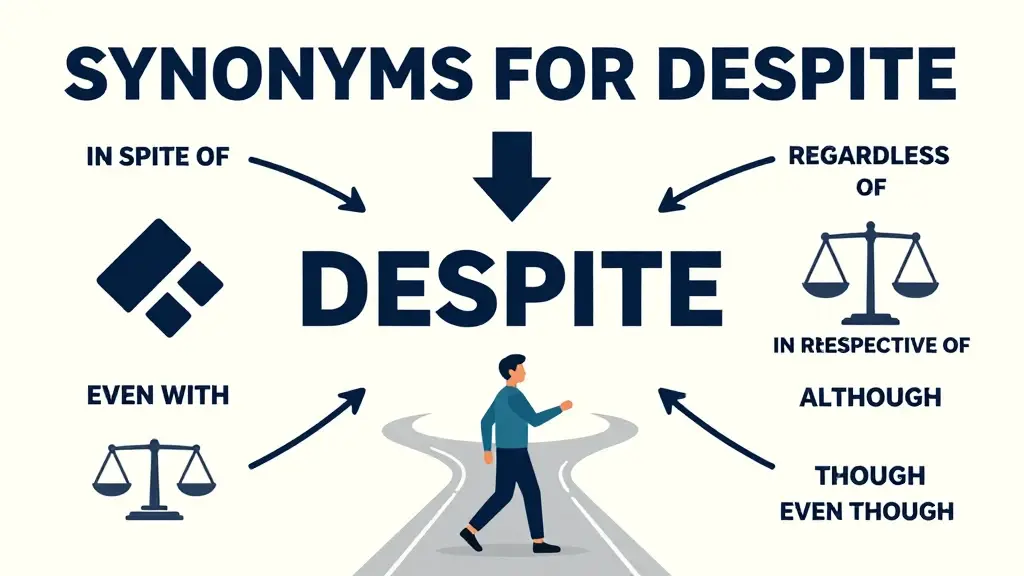
The word despite is used to show a contrast between two things.
It often means “even though,” “in spite of,” or “regardless of.” For example, “Despite the rain, we went outside” means that the rain did not stop us from going outside.
People search for synonyms for despite when they want to avoid repeating the same phrase, improve their writing, or understand which alternative fits a sentence correctly.
Common alternatives include in spite of, regardless of, even though, although, and notwithstanding.
However, these expressions are not always grammatically interchangeable.
One important difference is grammar. Despite and in spite of are normally followed by a noun, pronoun, or -ing form.
Although and even though are normally followed by a complete clause containing a subject and verb.
Choosing the wrong structure can make a sentence grammatically incorrect.
This guide explains the most useful synonyms for despite, their meanings, grammar rules, examples, common mistakes, British and American usage, and the best alternatives for formal, academic, professional, and everyday writing.
Despite Synonyms – Quick Answer
The most common synonyms and alternatives for despite include:
- In spite of – almost the same meaning as despite
- Regardless of – without being affected by something
- Notwithstanding – despite or in spite of; more formal
- Even though – introduces a complete clause
- Although – introduces a complete clause
- Though – a more flexible and often less formal alternative to although
- Even with – shows that something happens despite a condition
- In the face of – despite a difficult situation
- Against – can show opposition or contrary conditions in some contexts
- For all – despite everything, usually in a fixed expression
Simple Examples
Despite the rain, we went hiking.
In spite of the rain, we went hiking.
Regardless of the rain, we went hiking.
Although it was raining, we went hiking.
Even though it was raining, we went hiking.
These sentences express a similar overall contrast, but their grammar is different.
The closest direct synonym for despite is usually in spite of.
The Origin of “Despite”
The word despite has a long history in English. It comes from Old French and Anglo-French forms related to the idea of contempt, scorn, or opposition. The word is connected to Latin despectus, meaning “looking down upon” or “contempt.”
Over time, despite developed into its modern grammatical use as a preposition meaning in spite of or regardless of.
Today, its negative historical sense is less important in the common expression:
Despite the difficulties, they continued.
Here, despite simply introduces a condition that contrasts with the result.
The word can also appear in the phrase “despite the fact that,” which allows it to introduce a complete clause:
Despite the fact that it was late, they continued working.
This construction is grammatical, but although or even though is often more concise:
Although it was late, they continued working.
British English vs American English Spelling
Despite is spelled the same way in both British and American English.
There is no standard American or British spelling variation.
| Word or Phrase | American English | British English | Meaning |
| Despite | Despite | Despite | In spite of |
| In spite of | In spite of | In spite of | Despite |
| Regardless of | Regardless of | Regardless of | Without being affected by |
| Although | Althoug | Although | In spite of the fact that |
| Even though | Even though | Even though | Despite the fact that |
| Notwithstanding | Notwithstanding | Notwithstanding | Despite or in spite of |
Correct
Despite the traffic, we arrived on time.
Also Correct
In spite of the traffic, we arrived on time.
The spelling remains the same in American and British English. The main differences concern style, frequency, and sentence structure rather than spelling.
Which Spelling Should You Use?
You can use despite for both American and British English audiences.
It is a standard word in both forms of English and is widely used in:
- School essays
- Academic writing
- Business communication
- News articles
- Reports
- Emails
- Everyday conversation
- Social media
There is no need to change its spelling for a US or UK audience.
If you are writing for a general audience, despite is usually a clear and natural choice.
For formal writing, notwithstanding can sometimes work, but it may sound more legal or formal than necessary.
For everyday writing, in spite of, although, and even though are also common choices.
Common Synonyms for Despite
1. In Spite Of
In spite of is the closest direct synonym for despite.
Despite the cold weather, we went outside.
In spite of the cold weather, we went outside.
The meaning is essentially the same.
Both despite and in spite of can be followed by:
- A noun
- A pronoun
- An -ing form
Examples:
Despite the rain, we played.
In spite of the rain, we played.
Despite feeling tired, she continued.
In spite of feeling tired, she continued
2. Regardless Of
Regardless of means without allowing something to change a decision, action, or result.
Regardless of the weather, the event will continue.
It is similar to despite, but the emphasis can be slightly different.
Despite focuses on contrast.
Regardless of often emphasizes that something does not affect the decision or outcome.
3. Notwithstanding
Notwithstanding means despite or in spite of.
Notwithstanding the difficulties, the project continued.
It is more formal and is common in legal, official, and formal writing.
For everyday writing, despite is usually more natural
4. Although
Although means “in spite of the fact that.”
It must normally be followed by a clause.
Although it was raining, we went outside.
Compare:
Despite the rain, we went outside.
Although it was raining, we went outside.
Do not write:
Despite it was raining, we went outside.
Instead, write:
Despite the rain, we went outside.
or:
Although it was raining, we went outside.
5. Even Though
Even though has a similar meaning to although, but it often gives stronger emphasis to the contrast.
Even though it was raining, they continued playing.
Compare:
Although it was raining, they continued playing.
Even though it was raining, they continued playing.
Both are correct.
6. Though
Though can work as an alternative to although in many sentences.
Though it was difficult, she continued.
It can also appear at the end of a sentence in informal English:
It was difficult. She continued, though.
This makes though more flexible than despite.
7. Even With
Even with can sometimes express a similar contrast.
Even with the heavy traffic, we arrived on time.
It suggests that something happened despite the presence of a particular condition.
However, even with is not a replacement for despite in every sentence.
8. In the Face Of
In the face of means despite or while dealing with a difficult condition.
They continued working in the face of serious challenges.
It often emphasizes difficulty, pressure, or opposition.
Despite vs In Spite Of
These two expressions have almost exactly the same meaning.
| Despite | In Spite Of |
| Despite the rain, we went out. | In spite of the rain, we went out. |
| Despite being tired, she worked. | In spite of being tired, she worked. |
| Despite the problem, they continued. | In spite of the problem, they continued. |
The biggest difference is style and length.
Despite is shorter.
In spite of is a three-word expression.
Both are standard in American and British English.
Important Grammar Rule
Use:
Despite + noun
Despite + pronoun
Despite + -ing verb
Examples:
Despite the noise, I slept.
Despite being tired, she finished the work.
Despite vs Although
This is one of the most important differences.
Despite
Use despite + noun or -ing form.
Despite the rain, we walked home.
Despite being tired, he kept working.
Although
Use although + subject + verb.
Although it was raining, we walked home.
Although he was tired, he kept working.
Incorrect
Despite it was raining, we walked home.
Correct
Despite the rain, we walked home.
or:
Although it was raining, we walked home.
Despite vs Even Though
Even though is followed by a complete clause.
Even though she was tired, she studied.
Despite usually takes a noun or -ing form.
Despite being tired, she studied.
Both sentences express contrast.
Even though can sound more conversational and emphatic.
Despite is concise and works well in formal writing.
Despite vs Regardless Of
These words are similar but not identical.
Despite the cost, she bought the car.
This focuses on the surprising contrast between the cost and the decision.
Regardless of the cost, she will buy the car.
This emphasizes that the cost will not affect her decision.
In some situations, both work. In others, one gives a more precise meaning.
Despite Synonyms for Formal Writing
For formal or academic writing, useful alternatives include:
- Despite
- In spite of
- Notwithstanding
- Regardless of
- Although
- Even though
- In the face of
Examples
Despite the limitations, the study produced useful results.
Notwithstanding the limitations, the study produced useful results.
Although the study had limitations, it produced useful results.
The first option is often the simplest and clearest.
Notwithstanding is more formal and should not be used merely to make writing sound sophisticated.
Despite Synonyms for Academic Writing
Academic writing often uses:
- Despite
- Although
- Even though
- In spite of
- Regardless of
- Notwithstanding
Examples:
Despite the small sample size, the findings were useful.
Although the sample size was small, the findings were useful.
In spite of the small sample size, the findings were useful.
Each version is grammatically correct, but the sentence structure changes.
For academic writing, clarity is usually more important than using the longest or most formal synonym.
Despite Synonyms for Everyday English
In everyday conversation, common alternatives include:
- In spite of
- Although
- Even though
- Though
- Regardless of
- Even with
Examples:
Despite being tired, I went to the gym.
Even though I was tired, I went to the gym.
Though I was tired, I went to the gym.
In spite of being tired, I went to the gym.
All can express a similar contrast.
Common Mistakes with Despite
Mistake 1: Using “Despite Of”
A very common error is:
Despite of the rain, we went outside.
This is incorrect.
Use:
Despite the rain, we went outside.
Or:
In spite of the rain, we went outside.
Despite does not need of.
Mistake 2: Using a Complete Clause Directly After Despite
Incorrect:
Despite it was raining, we went outside.
Correct:
Despite the rain, we went outside.
Or:
Although it was raining, we went outside.
Mistake 3: Confusing Despite and In Spite Of
Remember:
Despite the problem
In spite of the problem
Not:
Despite of the proble
Mistake 4: Thinking Despite Means “Because”
Despite shows contrast, not cause.
Despite the rain, we went outside.
The rain did not stop us.
It does not mean:
Because of the rain, we went outside.
That sentence has a completely different meaning.
Mistake 5: Using “Despite” When There Is No Contrast
Despite normally introduces something that could have prevented or changed the result.
Despite being tired, she continued working.
There is a clear contrast between being tired and continuing to work.
Despite in Everyday Examples
At Work
Despite the deadline, the team remained calm.
At School
Despite the difficult exam, she stayed positive.
In an Email
Despite the delay, we completed the project on time.
In News Writing
Despite heavy rainfall, the event continued.
In Social Media
Despite the bad weather, we had an amazing day.
In Conversation
Despite being tired, I went out with my friends.
These examples show how naturally despite can fit into many kinds of writing.
Despite Synonyms by Context
| Context | Good Alternatives |
| General writing | In spite of, although |
| Formal writing | Notwithstanding, regardless of |
| Academic writing | Although, despite, in spite of |
| Conversation | Even though, though |
| Strong contrast | Even though |
| No effect on decision | Regardless of |
| Difficult situation | In the face of |
| Noun after the expression | Despite, in spite of |
| Complete clause after the expression | Although, even though, though |
Despite Synonyms – Comparison Table
| Word/Phrase | Meaning | Grammar | Tone |
| Despite | In spite of | Noun/-ing | Neutral |
| In spite of | In spite of | Noun/-ing | Neutral |
| Regardless of | Without being affected by | Noun/-ing | Neutral |
| Notwithstanding | Despite | Noun/phrase | Formal |
| Although | In spite of the fact that | Complete clause | Neutral/formal |
| Even though | Despite the fact that | Complete clause | Neutral/emphatic |
| Though | Although | Complete clause | Casual/neutral |
| Even with | Despite having | Noun | Neutral |
| In the face of | Despite a difficult situation | Noun | Formal |
| For all | Despite everything | Noun/phrase | Less common |
How to Choose the Right Synonym for Despite
Choosing the correct alternative is mainly a grammar and meaning decision.
Use despite when you want a short, clear contrast:
Despite the rain, we went out.
Use in spite of when you want the same meaning in a slightly longer form:
In spite of the rain, we went out.
Use although when a complete clause follows:
Although it was raining, we went out.
Use even though when you want a stronger or more noticeable contrast:
Even though it was raining, we went out.
Use regardless of when you want to emphasize that something does not affect a decision:
Regardless of the weather, the event will continue.
Use notwithstanding for formal or legal-style writing:
Notwithstanding the difficulties, the agreement remained valid.
The best synonym is the one that fits both the meaning and grammar of your sentence.
Google Trends & Usage Data for “Despite”
Despite is a common English word used in everyday speech, education, business, journalism, and academic writing.
People searching for this topic may use queries such as:
- synonyms for despite
- despite synonyms
- another word for despite
- synonyms of despite
- despite meaning
- despite vs although
- despite vs in spite of
- despite synonym in a sentence
- formal synonym for despite
- despite synonyms for essays
- despite synonym for academic writing
These searches show that users often need more than a simple list. They want to know which alternative is grammatically correct in a specific sentence.
Exact search-volume and Google Trends figures can change by country and time. For current numerical data, use Google Trends or a live keyword research platform instead of relying on fixed numbers.
FAQs
Q.1. What is the best synonym for despite?
A: In spite of is usually the closest direct synonym. Although and even though can also express a similar idea but require a different sentence structure.
Q.2. What is another word for despite?
A: Common alternatives include in spite of, regardless of, notwithstanding, although, even though, and though.
Q.3. Is “in spite of” the same as “despite”?
A: Yes. They usually have the same meaning and can often replace one another.
Q.4. Can I use “although” instead of “despite”?
A: Yes, but the grammar changes. Use despite + noun/-ing and although + subject + verb.
Q.5. Is “despite of” correct?
A: No. Despite of is incorrect in standard English. Say despite the problem or in spite of the problem.
Q.6. What is the difference between despite and in spite of?
A: There is almost no difference in meaning. Despite is shorter, while in spite of contains three words.
Q.7. What is the difference between despite and although?
A: Despite is normally followed by a noun, pronoun, or -ing form. Although is followed by a complete clause.
Q.8. Is regardless of a synonym for despite?
A: It can be a synonym in some contexts. Regardless of emphasizes that something does not affect a decision or result.
Q.9. What is a formal synonym for despite?
A: Notwithstanding is a formal alternative. It is especially common in legal and official writing.
Q.10. What is a simple synonym for despite?
A: In spite of is the simplest direct alternative. Although is also common when followed by a complete clause.
Q.11. What is a synonym for despite in academic writing?
A: Although, in spite of, regardless of, and notwithstanding can work, depending on sentence structure and tone.
Q.12. What is the opposite of despite?
A: There is no single perfect opposite in every context. Depending on the sentence, because of, due to, thanks to, or as a result of may express a contrasting relationship.
Q.13. Can “even though” replace despite?
A: Yes, when you change the grammar.
Despite the rain, we went out.
Even though it was raining, we went out.
Q.14. Is “though” a synonym for despite?
A: It can express a similar contrast, but though normally introduces a clause.
Though it was raining, we went out.
Q.15. What is the best synonym for despite in a resume?
A: For resumes, despite, regardless of, or in spite of can work depending on the sentence. The best choice should be based on the exact meaning rather than formality alone.
Conclusion:
The best synonym for despite depends on both meaning and grammar.
The closest direct alternative is in spite of, and the two expressions can usually be used in the same way.
Regardless of is useful when you want to show that something does not affect a decision or result.
Although and even though express a similar contrast but must normally be followed by a complete clause.
One of the most important grammar rules is simple: use despite + noun, pronoun, or -ing form. For example, “Despite the rain, we continued.” Do not write “despite of the rain.” If you want to use although, change the structure: “Although it was raining, we continued.”
For formal writing, notwithstanding can be useful, especially in legal or official contexts, but it can sound unnecessarily formal in everyday English.
In most situations, despite remains short, clear, and natural.
Remember that synonyms are not always perfect replacements.
A good synonym keeps the original meaning while also fitting the grammar, tone, and context of the sentence.
Choosing the right alternative makes your writing more natural, precise, and easy to understand.

Alexander Price is a language researcher based in Salt Lake City, Utah. He focuses on English word relationships and practical vocabulary development.