
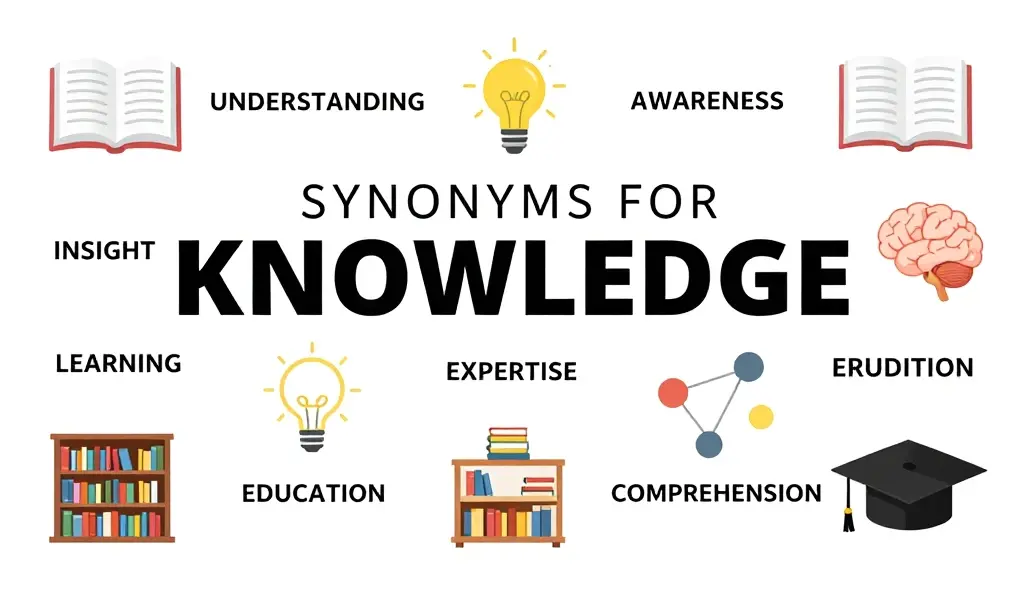
Knowledge is a broad word that can describe facts, information, skills, understanding, or experience gained over time.
For example:
She has extensive knowledge of marketing.
You could also say:
She has extensive expertise in marketing.
Or:
She has a deep understanding of marketing.
Or:
She has strong familiarity with marketing tools.
These words are related, but they are not always interchangeable.
People search for synonyms for knowledge when they want to improve an essay, resume, academic paper, professional profile, website, or everyday writing.
Choosing a more precise word can make your sentence clearer and more natural.
Meaning of Knowledge
Knowledge means information, facts, understanding, or skills that a person gains through learning, education, study, experience, or observation.
Definition
Knowledge: information, understanding, or skills gained through learning or experience.
Common Usage
She has extensive knowledge of science.
Reading helps us gain knowledge.
His knowledge of computers is impressive.
Practical knowledge comes from experience.
Knowledge can be theoretical, practical, technical, general, or specialized.
Pronunciation of Knowledge
Knowledge is pronounced:
/ˈnɑːlɪdʒ/
It sounds approximately like:
NOL-ij
The k at the beginning is silent.
knowledge
general knowledge
practical knowledge
expert knowledge
Part of Speech
Knowledge is a noun.
Noun
Her knowledge is impressive.
Related Words
- Know — verb
- Knowledgeable — adjective
- Knowing — adjective/participle
- Know-how — noun
Examples
I know the answer.
She is knowledgeable about finance.
His knowledge helped the team.
He has excellent technical know-how.
Synonyms for Knowledge
| Word | Meaning | Usage | Formality | Example | Difficulty |
| Understanding | Clear grasp of something | General/academic | Neutral | She has a good understanding. | Easy |
| Awareness | Knowing that something exists or happens | General | Neutral | Public awareness increased. | Easy |
| Wisdom | Knowledge combined with good judgment | Life/experience | Neutral | Her wisdom helped us. | Easy |
| Expertise | Advanced knowledge or skill | Professional | Formal | He has technical expertise. | Medium |
| Information | Facts or details | General | Neutral | We need more information. | Easy |
| Learning | Knowledge gained through study | Academic/general | Neutral | Learning takes time. | Easy |
| Insight | Deep understanding | Academic/business | Formal | She offered valuable insight. | Medium |
| Familiarity | Knowledge from experience | General/professional | Neutral | He has familiarity with the system. | Medium |
| Comprehension | Ability to understand something | Academic | Formal | Reading comprehension improved. | Medium |
| Education | Knowledge gained through schooling | Academic | Neutral | Education expands knowledge. | Easy |
| Proficiency | Skilled knowledge or ability | Professional | Formal | She has proficiency in English. | Medium |
| Mastery | Very advanced knowledge or skill | Academic/professional | Formal | He achieved mastery of the subject. | Medium |
| Know-how | Practical knowledge of how to do something | Work/everyday | Informal | She has the know-how. | Easy |
| Acquaintance | Basic knowledge or familiarity | General | Neutral | He has some acquaintance with the topic. | Medium |
| Perception | Way of understanding or viewing something | Academic/general | Formal | Public perception changed. | Medium |
| Cognizance | Awareness or knowledge | Formal/legal | Advanced | He had cognizance of the issue. | Advanced |
| Erudition | Deep scholarly knowledge | Academic | Advanced | His erudition was impressive. | Advanced |
| Scholarship | Advanced academic knowledge | Academic | Formal | Her scholarship is respected. | Advanced |
| Literacy | Knowledge or ability in a field | Academic/general | Neutral | Financial literacy is important. | Medium |
| Intelligence | Ability to learn and understand | General | Neutral | Intelligence supports learning. | Easy |
| Acumen | Ability to understand and judge well | Business | Formal | She has strong business acumen. | Advanced |
| Competence | Sufficient knowledge and ability | Professional | Formal | He demonstrated competence. | Medium |
| Skill | Ability gained through learning | Practical | Neutral | She has strong technical skills. | Easy |
| Capacity | Ability to understand or learn | Academic/general | Formal | He has the capacity to learn. | Medium |
| Awareness | Conscious knowledge | General | Neutral | Awareness of the problem grew. | Easy |
| Consciousness | Awareness of something | Academic/general | Formal | Consciousness of risk is important. | Medium |
| Grasp | Understanding of something | General | Neutral | He has a good grasp of the topic. | Easy |
| Command | Strong knowledge or control | Formal/professional | Formal | She has a strong command of English. | Medium |
| Familiarity | Basic or practical knowledge | General | Neutral | His familiarity with the software helped. | Medium |
| Background | Previous education or experience | Professional | Neutral | She has a strong background in science. | Easy |
| Experience | Knowledge gained through doing | Work/general | Neutral | He has years of experience. | Easy |
| Training | Knowledge and skills gained through instruction | Professional | Neutral | The job requires training. | Easy |
| Study | Knowledge gained through focused learning | Academic | Neutral | Her study of history is extensive. | Easy |
| Research | Knowledge gained through investigation | Academic | Formal | The research produced new findings. | Easy |
| Facts | Pieces of true information | General | Neutral | He knows the facts. | Easy |
| Data | Collected information | Technical/business | Formal | The data supports the conclusion. | Easy |
| Findings | Information discovered through research | Academic | Formal | The findings were significant. | Medium |
| Intelligence | Useful gathered information | Military/business | Formal | The team gathered intelligence. | Medium |
| Wisdom | Deep understanding from experience | General | Neutral | His wisdom guided the decision. | Easy |
| Discernment | Ability to recognize differences or truth | Formal | Advanced | Her discernment was valuable. | Advanced |
| Judgment | Ability to make sensible decisions | General/professional | Neutral | His judgment was sound. | Easy |
| Familiarization | Process of becoming familiar | Professional | Formal | Training supports familiarization. | Medium |
| Orientation | Basic introduction to a subject | Education/work | Neutral | The course provides orientation. | Medium |
| Insightfulness | Quality of showing deep understanding | Formal | Advanced | Her insightfulness impressed the team. | Advanced |
| Savvy | Practical understanding | Business/casual | Casual | She has excellent marketing savvy. | Medium |
Best Synonyms for Knowledge
1. Understanding
Understanding means having a clear grasp of an idea, subject, or situation.
She has a strong understanding of economics.
Best Situation
Use understanding when you want to emphasize comprehension rather than simply knowing facts.
2. Awareness
Awareness means knowing that something exists, happens, or matters.
Public awareness of climate issues has increased.
Difference
Knowledge can involve detailed information, while awareness may be much more basic.
3. Wisdom
Wisdom means knowledge combined with experience, judgment, and good sense.
Her wisdom helped the team make a better decision.
Someone can have lots of knowledge without necessarily having wisdom.
4. Expertise
Expertise means advanced knowledge and skill in a particular subject.
He has expertise in cybersecurity.
It is one of the best synonyms for knowledge in professional writing.
5. Information
Information refers to facts, details, or data about something.
We need more information before making a decision.
Knowledge is often built from information, but the two aren’t exactly the same.
6. Learning
Learning refers to knowledge gained through study, teaching, or experience.
Learning is a lifelong process.
It can describe both the process and the knowledge gained from that process.
7. Insight
Insight means a deep or useful understanding of something.
Her insight helped us understand the problem.
It often suggests seeing something in a way that isn’t immediately obvious.
8. Familiarity
Familiarity means having knowledge of something because you have encountered or experienced it.
He has some familiarity with the software.
It usually suggests basic or moderate knowledge rather than expertise.
9. Comprehension
Comprehension means the ability to understand something.
The test measures reading comprehension.
It is especially common in academic and educational contexts.
10. Education
Education refers to knowledge and skills gained through teaching and learning.
Education can expand a person’s opportunities.
It can also refer to the process or institution of learning.
11. Proficiency
Proficiency means a good level of skill or competence in a particular area.
She has proficiency in Spanish.
It is especially useful when knowledge can be demonstrated through performance.
12. Mastery
Mastery means a very high level of knowledge or skill.
He achieved mastery of the subject.
It suggests considerably more than basic knowledge.
13. Know-How
Know-how means practical knowledge of how to do something.
She has the technical know-how to solve the problem.
It is useful in everyday and business language.
14. Acumen
Acumen means the ability to make good judgments and understand situations quickly.
She has excellent business acumen.
It is especially common in professional and business writing.
15. Erudition
Erudition means extensive and deep scholarly knowledge.
His erudition was evident during the lecture.
It is a formal and advanced word, so it is best used when the context calls for it.
Knowledge Synonyms by Context
Academic Knowledge
Best choices:
- understanding
- learning
- comprehension
- scholarship
- expertise
- mastery
- education
- erudition
- research
Her understanding of biology is impressive.
Professional Knowledge
Use:
- expertise
- proficiency
- competence
- know-how
- experience
- background
- mastery
- acumen
He has extensive expertise in project management.
Practical Knowledge
Use:
- know-how
- experience
- skill
- proficiency
- competence
- familiarity
Practical experience helped her solve the problem.
General Knowledge
Use:
- information
- awareness
- understanding
- familiarity
- facts
- learning
The quiz tests general knowledge.
Deep Knowledge
Use:
- expertise
- mastery
- erudition
- insight
- wisdom
- scholarship
- command
She has a deep understanding of the subject.
Antonyms of Knowledge
| Antonym | Meaning | Example |
| Ignorance | Lack of knowledge | Ignorance can cause mistakes. |
| Unawareness | Lack of awareness | His unawareness caused confusion. |
| Unfamiliarity | Lack of familiarity | Her unfamiliarity with the system was obvious. |
| Confusion | Lack of clear understanding | The instructions caused confusion. |
| Misunderstanding | Incorrect understanding | The problem resulted from a misunderstanding. |
| Uncertainty | Lack of confidence or knowledge | There was uncertainty about the result. |
| Inexperience | Lack of practical experience | His inexperience was clear. |
| Illiteracy | Lack of basic reading/writing knowledge | Education can reduce illiteracy. |
| Doubt | Lack of certainty | She had doubts about the claim. |
| Blindness | Lack of awareness, often figurative | His blindness to the risks was surprising. |
| Naivety | Lack of experience or knowledge | His naivety caused problems. |
| Uncertainty | State of not knowing | Uncertainty remained about the plan. |
30 Real-World Examples
- She has extensive knowledge of marketing.
- His understanding of physics is impressive.
- Public awareness of the issue has increased.
- Her wisdom helped the team make a decision.
- He has expertise in software development.
- We need more information before deciding.
- Learning can continue throughout life.
- Her insight helped explain the problem.
- He has familiarity with the software.
- The course improved students’ comprehension.
- Education provides valuable knowledge and skills.
- She has proficiency in several languages.
- He achieved mastery of the subject.
- Her technical know-how solved the problem.
- His business acumen helped the company grow.
- The professor’s erudition was clear.
- She demonstrated strong competence in the field.
- His experience gave him practical knowledge.
- The research produced useful findings.
- The data provided important information.
- She has a strong background in science.
- He has a good grasp of mathematics.
- She has a strong command of English.
- Financial literacy helps people make better decisions.
- His judgment improved with experience.
- The training provided essential knowledge.
- Her scholarship has received recognition.
- The researcher gained valuable insight.
- His familiarity with the industry was useful.
- The team developed greater awareness of the risks.
25 Natural Sentences
- Knowledge grows through learning and experience.
- She has a deep understanding of history.
- Public awareness has increased over the past decade.
- His wisdom helped guide the team.
- She has extensive expertise in digital marketing.
- We need accurate information before making a decision.
- Learning new skills can improve your career.
- His insight changed the way we viewed the problem.
- I have some familiarity with the software.
- The lesson improved my comprehension of the topic.
- Education can open many opportunities.
- She developed proficiency through regular practice.
- He achieved mastery after years of study.
- Her technical know-how was extremely useful.
- His business acumen impressed the investors.
- The professor’s erudition was clear from the lecture.
- She demonstrated strong competence in her role.
- Experience gave him valuable practical knowledge.
- The research provided new findings.
- The data gave us useful information.
- She has a strong background in engineering.
- He has a good grasp of the subject.
- She has an excellent command of English.
- Financial literacy is an important life skill.
- His judgment improved as he gained experience.
Formal vs. Informal Usage
| Informal | Neutral | Formal |
| Know-how | Knowledge | Expertise |
| Know a lot about | Understand | Possess extensive knowledge |
| Good grasp | Understanding | Comprehension |
| Know the basics | Familiarity | Foundational knowledge |
| Skill | Proficiency | Mastery |
| Know your stuff | Expertise | Specialized competence |
| Experience | Practical knowledge | Professional expertise |
Informal
She really knows her stuff.
Neutral
She has a lot of knowledge about marketing.
Formal
She possesses extensive expertise in marketing.
Academic Usage
Knowledge is very common in academic writing, but precise alternatives can make an argument stronger.
Instead of:
Students need knowledge of research methods.
You could write:
Students need a strong understanding of research methods.
If the students can perform the tasks:
Students need proficiency in research methods.
If they have advanced command:
Students should develop mastery of research methods.
If you’re discussing new discoveries:
The study contributes new knowledge to the field.
Daily Conversation
In everyday English, simple alternatives are usually more natural.
I know a little about cars.
I have some experience with computers.
She knows a lot about cooking.
He really understands the subject.
I have some familiarity with the software.
She knows her stuff.
More formal words such as erudition, cognizance, and scholarship are less common in casual conversation.
Grammar Tips
Knowledge of
She has knowledge of accounting.
Knowledge about
He knows computers.
Knowledge of is often more natural in formal English.
extensive knowledge of science
working knowledge of Excel
Knowledgeable About
Use knowledgeable as an adjective.
She is knowledgeable about marketing.
Gain Knowledge
Students gain knowledge through study.
Acquire Knowledge
Researchers acquire knowledge through investigation.
Share Knowledge
Good teachers share knowledge with their students.
Apply Knowledge
Students should learn to apply their knowledge.
Expand Knowledge
Reading can expand your knowledge.
Deepen Knowledge
The course helped deepen my knowledge.
Practical Knowledge
Experience provides practical knowledge.
Common Collocations With Knowledge
Extensive Knowledge
She has extensive knowledge of finance.
This means a large amount of knowledge.
In-Depth Knowledge
He has in-depth knowledge of the subject.
This suggests detailed understanding.
Working Knowledge
She has a working knowledge of Excel.
This means enough knowledge to use something effectively.
Practical Knowledge
The job requires practical knowledge.
This refers to knowledge gained through real-world use.
Technical Knowledge
The position requires technical knowledge.
This refers to specialized knowledge.
General Knowledge
The quiz tests general knowledge.
This refers to broad information about many subjects.
Expert Knowledge
The project requires expert knowledge.
This means advanced specialized knowledge.
Specialized Knowledge
The position requires specialized knowledge.
This refers to knowledge in a specific field.
Gain Knowledge
Students gain knowledge through experience.
Share Knowledge
Teams should share knowledge.
Apply Knowledge
Workers must apply their knowledge.
Expand Knowledge
Reading helps expand knowledge.
Acquire Knowledge
Research helps us acquire knowledge.
Common Phrases With Knowledge
Knowledge Is Power
Knowledge is power.
This famous saying expresses the idea that knowledge gives people greater ability to make decisions and take action.
A Wealth of Knowledge
She has a wealth of knowledge about business.
This means someone has a large amount of knowledge.
A Source of Knowledge
Books are an important source of knowledge.
Firsthand Knowledge
He has firsthand knowledge of the situation.
This means knowledge gained directly through experience.
Working Knowledge
I have a working knowledge of the software.
This means enough practical knowledge to use something.
Common Knowledge
It is common knowledge that exercise benefits health.
This refers to information widely known by people.
Knowledge Gap
The training addressed an important knowledge gap.
This means an area where needed knowledge is missing.
Idioms Related to Knowledge
Know Like the Back of Your Hand
She knows the city like the back of her hand.
Meaning: to know something extremely well.
Learn the Ropes
It took me a few weeks to learn the ropes.
Meaning: to learn how something works.
Get the Hang of It
You’ll get the hang of it soon.
Meaning: to begin understanding how to do something.
Know Your Stuff
She really knows her stuff.
Meaning: to have strong knowledge or skill.
In the Know
Keep me in the know.
Meaning: keep someone informed.
Knowledge Is Power
Knowledge is power.
Meaning: knowledge can give people greater control and ability.
Similar Words
| Word | Meaning | Difference | Example |
| Knowledge | Information or understanding | Broadest term | He has knowledge of history. |
| Information | Facts and details | Raw facts, not necessarily deep understanding | I need more information. |
| Understanding | Clear grasp of something | Focuses on comprehension | She has a good understanding. |
| Awareness | Conscious knowledge | Often basic recognition | Awareness is increasing. |
| Expertise | Advanced knowledge and skill | Specialized and professional | He has medical expertise. |
| Wisdom | Knowledge with good judgment | Usually gained through experience | Her wisdom helped us. |
| Insight | Deep understanding | Reveals something less obvious | His insight was valuable. |
| Familiarity | Basic knowledge from exposure | Usually less advanced | I have some familiarity with it. |
| Education | Knowledge gained through learning | Often connected to formal learning | Education matters. |
| Mastery | Very high level of knowledge | Suggests advanced control | She achieved mastery. |
| Proficiency | Ability to perform well | Focuses on practical competence | He has proficiency in English. |
| Experience | Knowledge gained by doing | Practical rather than theoretical | Experience taught him a lot. |
| Know-how | Practical knowledge | Informal | She has the know-how. |
Knowledge vs. Information
Information consists of facts or details.
The report contains useful information.
Knowledge is what a person understands or knows after processing and learning from information.
She has extensive knowledge of the subject.
In simple terms:
Information → Understanding → Knowledge
Knowledge vs. Understanding
Knowledge can mean knowing facts.
I know the formula.
Understanding means knowing how or why something works.
I understand how the formula works.
Someone may memorize information without truly understanding it.
Knowledge vs. Wisdom
Knowledge is what you know.
Wisdom involves using knowledge and experience to make sound decisions.
Knowledge tells you what happened.
Wisdom helps you decide what to do next.
Knowledge vs. Expertise
Knowledge can be basic or advanced.
Expertise usually means advanced knowledge and skill in a particular field.
He has knowledge of computers.
He has expertise in cybersecurity.
The second statement suggests a much higher level.
Knowledge vs. Experience
Knowledge can come from books, education, research, or observation.
Experience comes from actually doing something.
She has theoretical knowledge of marketing.
She has practical experience in marketing.
The two often work together.
Common Mistakes
Mistake 1: Treating Knowledge and Information as Identical
They are closely related but not exact synonyms.
Information consists of facts and details. Knowledge involves understanding and knowing.
Mistake 2: Using Expertise for Basic Knowledge
Expertise suggests advanced knowledge.
He has expertise in medicine.
This is much stronger than:
He knows a little about medicine.
Mistake 3: Using Wisdom When You Mean Facts
Wisdom suggests experience and good judgment.
For simple facts, use information or knowledge.
Mistake 4: Confusing Knowledge With Skill
Knowledge means knowing something.
Skill means being able to do something well.
She has knowledge of photography.
She has photography skills.
A person may have knowledge without being highly skilled.
Expert Tips
1. Use “Information” for Facts
The website provides useful information.
2. Use “Understanding” for Comprehension
She has a strong understanding of the topic.
3. Use “Expertise” for Professional Knowledge
He has expertise in finance.
4. Use “Wisdom” for Experience-Based Judgment
Her wisdom helped guide the team.
5. Use “Insight” for Deep Understanding
His insight revealed the real problem.
6. Use “Familiarity” for Basic Knowledge
I have some familiarity with the software.
7. Use “Proficiency” for Demonstrated Ability
She has proficiency in Spanish.
8. Use “Mastery” for Advanced Ability
He achieved mastery of the subject.
9. Use “Know-How” for Practical Knowledge
She has the know-how to fix the problem.
10. Use “Acumen” for Business Judgment
His financial acumen helped the company grow.
Q.1 What is the best synonym for knowledge?
A: The best synonym depends on the context. Understanding works for a clear grasp of a subject, information refers to facts and details, expertise suggests advanced professional knowledge, and wisdom combines knowledge with experience and judgment.
Q.2 What is another word for knowledge?
A: Common alternatives include understanding, awareness, information, wisdom, expertise, learning, insight, familiarity, education, proficiency, mastery, comprehension, know-how, experience, and competence.
Q.3 What is a simple synonym for knowledge?
A: Understanding is a simple and natural synonym when you mean knowing or grasping something. Information is another easy option when referring to facts or details.
Q.4 What is a formal synonym for knowledge?
A: Formal alternatives include expertise, proficiency, mastery, scholarship, erudition, cognizance, comprehension, and acumen. Expertise is particularly useful in professional writing, while erudition suggests deep scholarly knowledge.
Q.5 What is the opposite of knowledge?
A: The most direct opposite of knowledge is ignorance, meaning a lack of knowledge or information. Other alternatives include unawareness, unfamiliarity, confusion, uncertainty, inexperience, and misunderstanding.
Q.6 What is a synonym for knowledge on a resume?
A: Strong resume alternatives include expertise, proficiency, competence, experience, technical skills, specialized knowledge, know-how, and professional background.
Q.7 What is a synonym for knowledge in academic writing?
A: Useful academic alternatives include understanding, comprehension, scholarship, expertise, learning, insight, and mastery. Understanding is useful for discussing how well students grasp a subject.
Q.8 What is the difference between knowledge and understanding?
A: Knowledge can refer to facts, information, or awareness, while understanding shows that you grasp the meaning, relationships, or reasons behind something. Understanding therefore goes beyond simply knowing facts.
Q.9 What is the difference between knowledge and wisdom?
A: Knowledge is information and understanding gained through learning or experience. Wisdom involves applying that knowledge, along with experience and judgment, to make sensible decisions.
Q.10 What is the difference between knowledge and expertise?
A: Knowledge can range from basic information to advanced understanding, while expertise suggests a high level of knowledge and skill in a particular area. Expertise usually develops through study, practice, and experience.
Q.11 What is a synonym for practical knowledge?
A: Good alternatives include know-how, experience, practical experience, proficiency, competence, skill, and hands-on knowledge. Hands-on experience is especially useful on resumes.
Q.12 What is a synonym for deep knowledge?
A: Strong choices include expertise, mastery, erudition, profound understanding, in-depth knowledge, scholarship, and specialized knowledge. Expertise is ideal for professional contexts.
Q.13 What is a synonym for general knowledge?
A: Depending on the context, you can use general understanding, common knowledge, basic information, broad awareness, or general awareness. “General knowledge” is often the clearest phrase.
Q.14 How can I avoid repeating the word knowledge?
A: Use information for facts, understanding for comprehension, expertise for advanced professional ability, wisdom for experience-based judgment, insight for deep understanding, and familiarity for basic exposure.
Q.15 What is the strongest word for knowledge?
A: There is no single strongest synonym. Mastery suggests an exceptionally high level of knowledge and skill, expertise suggests advanced specialized knowledge, and erudition describes extensive scholarly learning.
Conclusion:
The best synonyms for knowledge depend on what you actually mean.
Use information for facts, understanding for comprehension, awareness for recognition, expertise for advanced professional knowledge, and wisdom for knowledge combined with experience and judgment.
For practical situations, know-how, experience, proficiency, and competence work well.
For advanced academic contexts, mastery, scholarship, erudition, and insight can be more precise.
The key is not to choose the most complicated word.
Choose the word that clearly tells your reader what kind of knowledge you mean and how deep it is.

Charlotte Evans is a language researcher and vocabulary writer from New York, USA. She specializes in English synonyms, word usage, and educational content that helps readers improve their communication skills.