The word and is one of the most frequently used words in English.
It connects words, phrases, and ideas to show that they belong together.
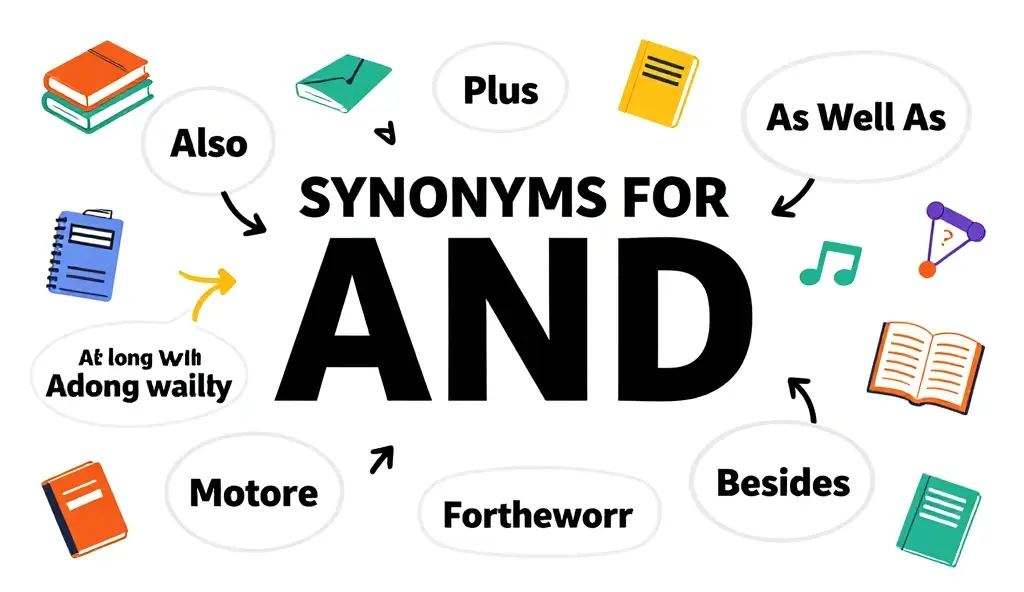
People search for synonyms for and because they want to improve their writing, avoid repeating the same word, or make sentences sound smoother.
Although and is simple, many alternatives depend on the situation.
Some work best in formal writing, while others fit everyday conversation.
Choosing the right replacement can make your message clearer and more engaging.
In this guide, you’ll learn the meaning of and, its pronunciation, grammar role, the best synonyms, examples, common mistakes, and practical tips for using each alternative correctly.
Meaning of “And”
The word and is a coordinating conjunction used to connect two or more words, phrases, clauses, or ideas. It tells readers that the connected parts belong together or happen together.
Definition
And joins similar words or ideas without showing contrast or choice.
Common Usage
You can use and to connect:
- Two nouns
- Two verbs
- Two adjectives
- Two phrases
- Two independent clauses
- Items in a list
Examples
- Emma bought apples and oranges.
- Jack laughed and smiled.
- The room was clean and quiet.
- We studied hard and passed the test.
Pronunciation
Phonetic Pronunciation (IPA):
/ænd/
Natural pronunciation:
and → sounds like and
In fast, natural speech, native speakers often pronounce it as:
- ənd
- n
- an
Examples:
“I went and bought coffee.”
Natural speech often sounds like:
“I went n bought coffee.”
This shortened pronunciation is common in everyday American English.
Part of Speech
And is a Coordinating Conjunction.
Its main job is to connect words or groups of words that have equal importance.
Examples:
Connecting nouns
Sarah and John arrived early.
Connecting verbs
He washed and dried the dishes.
Connecting adjectives
The movie was funny and exciting.
Connecting clauses
I called my friend, and she answered immediately.
Unlike words such as because or although, and does not explain a reason or contrast. It simply joins information together.
Synonyms for And
| Word | Meaning | Best Usage | Formality | Example | Difficulty |
| Plus | Adds another idea | Conversation | Informal | Tea plus cookies | Easy |
| As well as | Adds extra information | Writing | Formal | Alice as well as Tom attended. | Medium |
| Along with | Together with | Everyday English | Neutral | Pizza along with salad | Easy |
| Together with | Accompanied by | Formal writing | Formal | The CEO together with staff | Medium |
| In addition to | Adds something extra | Academic writing | Formal | In addition to homework | Medium |
| Also | Additional information | Any writing | Neutral | She also agreed. | Easy |
| Besides | Extra information | Conversation | Neutral | Besides coffee, we bought tea. | Easy |
| Including | Contains as part of | Lists | Neutral | Fruits including apples | Easy |
| Coupled with | Combined with | Professional writing | Formal | Talent coupled with effort | Hard |
| Not to mention | Adds emphasis | Conversation | Informal | He’s smart, not to mention kind. | Medium |
| Furthermore | Adds another point | Essays | Formal | Furthermore, the data improved. | Hard |
| Moreover | Adds stronger support | Academic | Formal | Moreover, results increased. | Hard |
| Additionally | Adds information | Reports | Formal | Additionally, costs fell. | Hard |
| As well | Also | Conversation | Neutral | I want one as well. | Easy |
| Likewise | Similar addition | Formal | Formal | Likewise, the manager agreed. | Medium |
Best Synonyms for And
1. Plus
Meaning
Plus means and also or added to something.
Difference
Unlike and, plus often gives extra emphasis to the second item.
Example
- Coffee plus cake makes a great breakfast.
- We earned extra points plus a bonus prize.
Best Situation
Use plus in:
- Casual writing
- Friendly conversations
- Marketing
- Headlines
Common Mistakes
Incorrect:
The report plus was submitted yesterday.
Correct:
The report and the presentation were submitted yesterday.
2. As Well As
Meaning
As well as means in addition to.
Difference
It often highlights the first subject more than the second.
Examples
- Emma as well as Liam attended the meeting.
- She enjoys reading as well as writing.
Best Situation
Perfect for:
- Business writing
- Academic papers
- Formal emails
- Professional reports
Common Mistakes
Incorrect:
Emma as well as her friends are coming.
Correct:
Emma as well as her friends is coming.
The verb usually agrees with the first subject.
3. Along With
Meaning
Along with means together with.
Difference
It suggests that one thing accompanies another.
Examples
- I brought sandwiches along with drinks.
- He submitted the application along with the required documents.
Best Situation
Useful in:
- Everyday conversation
- Emails
- School writing
- Instructions
Common Mistake
Incorrect:
The teacher along with the students were excited.
Correct:
The teacher along with the students was excited.
4. Together With
Meaning
Together with shows that two people or things are connected or included.
Difference
It sounds more formal than along with.
Examples
- The president, together with the board, approved the proposal.
- The package arrived together with the receipt.
Best Situation
Ideal for:
- Official documents
- Legal writing
- Business communication
- Reports
Common Mistake
Remember that the main subject controls the verb.
Correct:
The manager, together with her assistants, has arrived.
5. In Addition To
Meaning
In addition to means besides or also including.
Difference
This phrase emphasizes adding something extra.
Examples
- In addition to English, she speaks French.
- We planted flowers in addition to vegetables.
Best Situation
Excellent for:
- Research papers
- Academic essays
- Professional presentations
- Formal letters
Common Mistake
Incorrect:
In addition to finish the project…
Correct:
In addition to finishing the project…
Use a noun or -ing verb after this phrase.
Best Synonyms for And (Continued)
6. Also
Meaning
Also means in addition, too, or as well. It introduces another related idea without changing the meaning of the sentence.
Difference
Unlike and, also usually adds information to a complete sentence instead of directly joining two words.
Examples
- She speaks Spanish. She also speaks Italian.
- The hotel offers free breakfast. It also has a swimming pool.
- I also enjoy hiking on weekends.
Best Situation
Use also in:
- Daily conversations
- Emails
- Articles
- School assignments
- Professional writing
Common Mistakes
Incorrect:
She also and her sister came.
Correct:
She and her sister came.
Or:
She also came.
7. Besides
Meaning
Besides means in addition to or apart from.
Difference
It often introduces extra information that supports or strengthens the first idea.
Examples
- Besides math, I enjoy science.
- Besides saving money, walking is good exercise.
- Besides coffee, they served tea and juice.
Best Situation
Best for:
- Casual conversations
- Informal writing
- Friendly emails
- Blog posts
Common Mistakes
Don’t confuse besides with beside.
- Beside = next to
- Besides = in addition to
Correct:
Besides reading, she enjoys painting.
8. Including
Meaning
Including means containing as part of a group.
Difference
Unlike and, it introduces examples rather than simply joining ideas.
Examples
- The package includes everything, including batteries.
- Many countries, including Canada, support the program.
- Everyone, including the manager, attended.
Best Situation
Use it for:
- Lists
- Reports
- Business writing
- Academic papers
Common Mistakes
Incorrect:
Including and pencils.
Correct:
Including pencils.
9. Coupled With
Meaning
Coupled with means combined with.
Difference
It emphasizes that two factors work together to produce a result.
Examples
- Hard work coupled with patience leads to success.
- Experience coupled with education creates confidence.
- Good planning coupled with teamwork improves results.
Best Situation
Ideal for:
- Business reports
- Academic writing
- Professional articles
- Research papers
Common Mistakes
Avoid using it in simple everyday conversations where and sounds more natural.
10. Not to Mention
Meaning
Not to mention adds another important point for emphasis.
Difference
It often introduces something even more impressive than the first idea.
Examples
- The house is spacious, not to mention affordable.
- She’s talented, not to mention hardworking.
- The trip was exciting, not to mention unforgettable.
Best Situation
Best for:
- Storytelling
- Conversations
- Reviews
- Opinion writing
Common Mistakes
Incorrect:
Not to mention and beautiful.
Correct:
Beautiful, not to mention affordable.
11. Furthermore
Meaning
Furthermore introduces another supporting point.
Difference
It sounds much more formal than and.
Examples
- The results improved. Furthermore, customer satisfaction increased.
- Furthermore, the new policy reduced costs.
- Furthermore, the study supports previous findings.
Best Situation
Perfect for:
- Essays
- Academic writing
- Business reports
- Research papers
Common Mistakes
Avoid using furthermore in very casual conversations.
12. Moreover
Meaning
Moreover means what is more or besides that.
Difference
It adds stronger supporting evidence.
Examples
- The software is affordable. Moreover, it’s easy to use.
- Moreover, the team finished ahead of schedule.
- The restaurant serves fresh food. Moreover, the prices are reasonable.
Best Situation
Use in:
- Formal essays
- Research
- Professional documents
- Reports
Common Mistakes
Don’t overuse moreover in everyday speech.
13. Additionally
Meaning
Additionally introduces extra information.
Difference
It sounds professional and organized.
Examples
- Additionally, free shipping is available.
- Additionally, students receive online support.
- The company expanded internationally. Additionally, profits increased.
Best Situation
Best for:
- Reports
- Business writing
- Technical documents
- Academic papers
Common Mistakes
Use a comma after additionally when it begins a sentence.
Correct:
Additionally, the project finished early.
14. As Well
Meaning
As well means also or too.
Difference
It normally appears at the end of a sentence.
Examples
- I’d like some dessert as well.
- She plays soccer as well.
- Can I come as well?
Best Situation
Excellent for:
- Everyday conversation
- Friendly emails
- Text messages
- Informal writing
Common Mistakes
Incorrect:
As well I want pizza.
Correct:
I want pizza as well.
15. Likewise
Meaning
Likewise means in the same way or also.
Difference
It connects similar ideas or actions instead of simply joining words.
Examples
- Liam enjoys reading. Likewise, Emma loves books.
- The manager approved the plan. Likewise, the director agreed.
- Thank you. Likewise!
Best Situation
Use it in:
- Professional communication
- Formal writing
- Comparisons
- Discussions
Common Mistakes
Don’t use likewise when simply listing items.
Incorrect:
Apples likewise oranges.
Correct:
Apples and oranges.
Antonyms for And
Although and is a conjunction rather than a descriptive word, several words express the opposite relationship by showing contrast, choice, exclusion, or alternatives.
| Word | Meaning | Common Usage | Formality | Example |
| Or | Gives a choice | Everyday English | Neutral | Tea or coffee |
| But | Shows contrast | All writing | Neutral | Small but powerful |
| Yet | Shows unexpected contrast | Formal & Informal | Neutral | He tried, yet failed |
| However | Introduces contrast | Formal writing | Formal | However, we continued |
| Instead | Replaces one option with another | Everyday English | Neutral | Walk instead |
| Rather Than | Expresses preference | Formal | Formal | Read rather than watch |
| Except | Excludes something | Everyday English | Neutral | Everyone except Tom |
| Neither…Nor | Connects two negative ideas | Formal | Formal | Neither rain nor snow |
| Otherwise | Means “if not” | Formal | Neutral | Hurry; otherwise you’ll be late |
| Conversely | Shows opposite ideas | Academic writing | Formal | Conversely, sales declined |
Understanding Each Antonym
Or
Meaning: Offers a choice between two or more options.
Example
- Would you like tea or coffee?
- You can drive or take the train.
When to Use
Use or whenever only one option is expected.
But
Meaning: Connects two ideas that contrast with each other.
Example
- She is young but experienced.
- The task was difficult but rewarding.
Difference from “And”
- And adds information.
- But changes direction by introducing contrast.
Yet
Meaning: Shows an unexpected contrast or surprising result.
Example
- He studied hard, yet he was nervous.
- The weather was cold, yet we enjoyed the trip.
However
Meaning: Introduces a contrasting statement formally.
Example
- The product is expensive. However, it’s worth the price.
- We planned carefully. However, unexpected delays occurred.
Instead
Meaning: Replaces one thing with another.
Example
- Walk instead of driving.
- We stayed home instead.
Rather Than
Meaning: Shows preference between two choices.
Example
- I’d rather read than watch TV.
- She chose coffee rather than tea.
Except
Meaning: Excludes one person or thing from a group.
Example
- Everyone came except Ben.
- The store is open every day except Sunday.
Neither…Nor
Meaning: Connects two negative choices.
Example
- Neither Alex nor Emma attended.
- Neither option works for me.
Otherwise
Meaning: Means if not.
Example
- Leave now; otherwise, you’ll miss the bus.
- Save your work; otherwise, you may lose it.
Conversely
Meaning: Introduces the opposite point or viewpoint.
Example
- Sales increased in Europe. Conversely, they declined in Asia.
- Some students preferred online classes. Conversely, others liked in-person learning.
Real-World Examples of And
Below are 30 natural examples that show how and connects words, phrases, and ideas in everyday English.
- Emma bought bread and milk from the grocery store.
- Jack enjoys reading books and listening to music.
- We cleaned the house and washed the car.
- My brother and I play basketball every weekend.
- She smiled and waved before leaving.
- The teacher explained the lesson and answered every question.
- I woke up early and went for a walk.
- They ordered pizza and soda for dinner.
- Sarah studied hard and passed her final exam.
- The baby laughed and clapped happily.
- Tom packed his clothes and his laptop for the trip.
- The company hired new employees and expanded its office.
- We visited New York and Boston during our vacation.
- The dog barked and chased the ball.
- He finished his homework and watched television.
- Olivia speaks English and French fluently.
- My parents enjoy gardening and cooking together.
- The meeting started on time and ended early.
- The children played outside and built a snowman.
- We planted flowers and watered the garden.
- Lisa baked cookies and shared them with her neighbors.
- The store sells clothing and accessories.
- David opened the window and let in fresh air.
- The doctor checked my temperature and blood pressure.
- They watched the sunset and took beautiful photos.
- We saved money and planned our dream vacation.
- Ethan washed the dishes and cleaned the kitchen.
- The concert was exciting and unforgettable.
- The restaurant serves breakfast and lunch every day.
- She finished the report and emailed it to her manager.
25 Sentences Using And
These sentences demonstrate different writing styles and sentence structures.
- I like coffee and tea.
- She sings and dances beautifully.
- The sun was shining, and the birds were singing.
- Liam bought a new phone and a smartwatch.
- Emma is kind and honest.
- We laughed and talked until midnight.
- The train arrived on time and left without delay.
- My parents traveled to Canada and the United States.
- Jack studies engineering and works part-time.
- The movie was funny and heartwarming.
- I cleaned my room and organized my desk.
- Sophia cooked dinner and baked a cake.
- They visited museums and historical landmarks.
- The weather was warm and pleasant.
- He opened the door and welcomed everyone inside.
- We exercised every morning and felt healthier.
- The project required creativity and teamwork.
- Olivia smiled and thanked the waiter.
- My sister enjoys painting and photography.
- The team practiced hard and won the championship.
- The child picked flowers and gave them to his mother.
- We bought tickets and reserved our hotel.
- The students listened carefully and took notes.
- The book was educational and entertaining.
- I finished my work and finally relaxed.
Formal vs. Informal Usage
The word and works well in both formal and informal English. However, some of its alternatives fit better depending on the context.
| Feature | Formal Usage | Informal Usage |
| Common Connector | and | and |
| Better Alternative | in addition to | plus |
| Academic Writing | furthermore | also |
| Business Writing | moreover | as well |
| Conversation | and | plus |
| Friendly Messages | and | besides |
Formal Examples
- The report includes sales data and financial forecasts.
- The proposal was approved and implemented immediately.
- The committee reviewed the application and recommended approval.
- The research examined climate change and renewable energy.
Informal Examples
- Let’s grab pizza and a drink.
- I bought a new phone and headphones.
- Jake came over and we watched a movie.
- She likes coffee and chocolate.
When to Use Formal Alternatives
Instead of repeating and, professional writers often choose:
- Furthermore
- Moreover
- Additionally
- In addition to
- As well as
These alternatives improve sentence variety without changing the meaning.
Academic Usage of And
Academic writing often requires clear connections between ideas. While and is perfectly acceptable, it should not appear repeatedly in long paragraphs. Mixing it with appropriate transition words creates smoother and more professional writing.
Examples
- The study analyzed income and education levels.
- Researchers collected survey responses and interview data.
- The experiment measured temperature and humidity over six months.
- Students learned grammar and vocabulary during the course.
- The report examines climate change and public health.
Academic Alternatives
| Instead of Repeating “And” | Use |
| and | furthermore |
| and | moreover |
| and | additionally |
| and | in addition to |
| and | as well as |
Academic Example
Less Effective:
The study collected surveys and interviews and observations.
Better:
The study collected surveys, interviews, as well as observations.
Or:
The study collected surveys. Furthermore, researchers conducted interviews.
Daily Conversation Usage
In everyday English, and is one of the easiest and most natural connecting words. Native speakers use it constantly because it sounds simple and friendly.
Examples
Friend:
“I bought bread and milk.”
Family:
“Mom cooked pasta and salad.”
School:
“We studied math and science today.”
Travel:
“We visited Paris and London.”
Shopping:
“I need eggs and butter.”
Work:
“I finished the report and sent it to my boss.”
Sports:
“The team practiced hard and won the game.”
Restaurant:
“I ordered soup and a sandwich.”
Weekend:
“We watched movies and played games.”
Vacation:
“We relaxed on the beach and watched the sunset.”
Conversation Tips
- Use and to connect similar ideas naturally.
- Avoid repeating and too many times in one sentence.
- Split long sentences into shorter ones when possible.
- Replace repeated and with words like also, plus, or in addition when appropriate.
- Read your sentence aloud. If it sounds repetitive, revise it.
Grammar Tips for And
The word and is simple, but using it correctly can make your writing clearer and more natural. Here are some important grammar tips.
1. Connect Similar Parts of Speech
Use and to join words or phrases that have the same grammatical function.
Correct
- Emma and Liam are friends.
- She likes reading and writing.
- The movie was funny and exciting.
Incorrect
- She enjoys reading and happy.
2. Join Independent Clauses
When and joins two complete sentences, use a comma before and.
Correct
- I finished my homework, and I watched a movie.
- She studied hard, and she passed the exam.
Incorrect
- I finished my homework and I watched a movie.
3. Don’t Overuse “And”
Too many ands can make writing sound repetitive.
Less Effective
- We bought apples and oranges and bananas and grapes and pears.
Better
- We bought apples, oranges, bananas, grapes, and pears.
4. Keep Parallel Structure
Words connected by and should follow the same pattern.
Correct
- She likes singing, dancing, and painting.
Incorrect
- She likes singing, to dance, and painting.
5. Use the Oxford Comma (Optional)
The Oxford comma comes before the final and in a list.
Without Oxford comma:
- We invited Jack, Emma and Liam.
With Oxford comma:
- We invited Jack, Emma, and Liam.
Both are correct, but be consistent throughout your writing.
6. Avoid Run-On Sentences
Don’t use and to join many ideas into one very long sentence.
Poor
- I woke up and ate breakfast and drove to work and attended meetings and came home and watched TV.
Better
- I woke up and ate breakfast. Then I drove to work, attended meetings, and came home to relax.
Common Collocations with And
Collocations are words that naturally appear together in English.
| Collocation | Meaning | Example |
| Safe and sound | Unharmed | We arrived safe and sound. |
| Black and white | Clearly defined | The issue isn’t black and white. |
| Give and take | Mutual compromise | Good relationships need give and take. |
| Trial and error | Learning by mistakes | We solved it through trial and error. |
| Pros and cons | Advantages and disadvantages | Let’s discuss the pros and cons. |
| Bread and butter | Main source of income | Writing is her bread and butter. |
| Now and then | Occasionally | We meet now and then. |
| Back and forth | Repeated movement | They walked back and forth. |
| More and more | Increasing | More and more people work remotely. |
| Day and night | Continuously | He worked day and night. |
| Heart and soul | Complete dedication | She gave her heart and soul. |
| Law and order | Public safety | Law and order are important. |
| Peace and quiet | Calm surroundings | I need some peace and quiet. |
| Wear and tear | Damage from use | The chair shows wear and tear. |
| Cause and effect | Relationship between events | Science studies cause and effect. |
Common English Phrases Using And
These phrases are frequently used by native English speakers.
- By and large
- First and foremost
- Here and there
- Again and again
- Time and time again
- Sooner or later
- Nice and easy
- Loud and clear
- Sick and tired
- High and dry
- Far and wide
- Slow and steady
- Live and learn
- Wait and see
- Try and help
- Win and lose
- Rich and famous
- Bits and pieces
- Give and receive
- Come and go
Example Sentences
- I heard the announcement loud and clear.
- We searched far and wide.
- Live and learn—that’s life.
- Let’s wait and see what happens.
- She became rich and famous.
Idioms Related to And
Although and itself isn’t an idiom, it appears in many popular English idioms.
| Idiom | Meaning | Example |
| Give and take | Compromise | Every friendship needs give and take. |
| Wear and tear | Normal damage | The sofa has wear and tear. |
| Trial and error | Learning by trying | We learned through trial and error. |
| Peace and quiet | Calm environment | I need peace and quiet. |
| Heart and soul | Complete effort | She worked with heart and soul. |
| Black and blue | Covered with bruises | He fell and was black and blue. |
| Alive and kicking | Healthy and active | My grandfather is alive and kicking. |
| Cut and dried | Already decided | The result isn’t cut and dried. |
| Short and sweet | Brief but pleasant | Keep your speech short and sweet. |
| Sink or swim | Succeed or fail | It’s time to sink or swim. |
Similar Words to And
Although no word replaces and in every sentence, these alternatives often serve a similar purpose.
| Word | Meaning | Best Used For | Formality |
| Plus | Adds another item | Conversation | Informal |
| Also | Adds information | Everyday writing | Neutral |
| As well | Also | Conversation | Neutral |
| As well as | Adds information | Formal writing | Formal |
| Along with | Together with | Everyday English | Neutral |
| In addition to | Extra information | Academic writing | Formal |
| Besides | Apart from | Informal writing | Neutral |
| Including | Contains as part | Lists | Neutral |
| Furthermore | Adds support | Essays | Formal |
| Moreover | Strong addition | Research | Formal |
Word Comparison
| Word | Meaning | Difference from And | Example |
| And | Connects equal ideas | Basic conjunction | Bread and butter |
| Plus | Adds emphasis | More casual | Tea plus cookies |
| Also | Adds another point | Doesn’t directly join words | She also came. |
| As well | Means “too” | Usually at sentence end | I’d like one as well. |
| As well as | Formal addition | Highlights first subject | Emma as well as Jack attended. |
| Besides | Adds extra information | Often conversational | Besides coffee, we bought tea. |
| In addition to | Formal addition | Used before nouns or gerunds | In addition to reading, she writes. |
| Furthermore | Adds supporting point | Academic transition | Furthermore, the data improved. |
| Moreover | Adds stronger support | More formal than “and” | Moreover, profits increased. |
| Including | Introduces examples | Doesn’t simply join ideas | Including apples and oranges. |
Q1. What are the best synonyms for and?
A: Common alternatives include plus, also, as well as, along with, besides, including, furthermore, and moreover.
Q2. Is there a perfect replacement for and?
A: No. No single word can replace and in every sentence.
Q3. Can I use plus instead of and?
A: Yes, but plus is better for casual writing than formal writing.
Q4. Is also a synonym for and?
A: Sometimes. Also adds information but doesn’t always replace and.
Q5. What’s the difference between and and as well as?
A: And joins equal ideas, while as well as is more formal and adds emphasis.
Q6. Is and a conjunction?
A: Yes. It is a coordinating conjunction.
Q7. Can I start a sentence with and?
A: Yes. Modern English allows it when used naturally.
Q8. Is repeating and bad writing?
A: Not always, but too much repetition can reduce variety.
Q9. What is the opposite of and?
A: Common opposites include or, but, and yet.
Q10. Which alternative is best for academic writing?
A: Furthermore, moreover, additionally, and as well as are strong formal choices.
Q11. Can including replace and?
A: Sometimes. Including introduces examples, while and simply connects ideas.
Q12. How can I avoid using and too often?
A: Use transition words and vary your sentence structure.
Q13. Why is and so common?
A: Because it connects words, phrases, and clauses in English.
Q14. Is and used in British and American English?
A: Yes. It is standard in all major English dialects.
Expert Tips
- Use and to connect equally important ideas.
- Avoid writing long chains of words joined only by and.
- Choose formal alternatives like furthermore or moreover in essays and reports.
- Read your sentences aloud to spot unnecessary repetition.
- Keep parallel grammar when joining words with and.
- Learn common collocations and idioms to sound more natural.
- Use commas correctly when and joins two independent clauses.
- Match your connector to your audience—simple for conversations, formal for academic writing.
Conclusion:
The word and may seem simple, but it’s one of the most important building blocks in English.
It connects ideas, creates smooth sentences, and helps readers follow your thoughts with ease.
While there isn’t a perfect substitute for every situation, alternatives like plus, also, as well as, along with, in addition to, furthermore, and can improve variety and make your writing more engaging.
By understanding when and how to use these synonyms, you’ll write with greater confidence, whether you’re working on an email, essay, report, or everyday conversation.

Alexander Price is a language researcher based in Salt Lake City, Utah. He focuses on English word relationships and practical vocabulary development.