
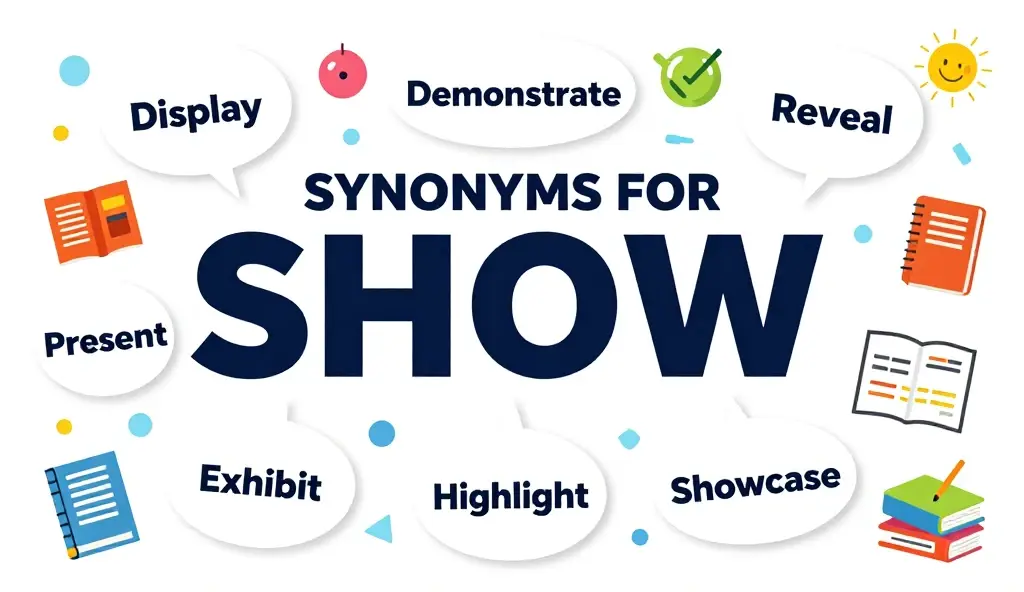
“Show” is one of the most flexible words in English.
We use it constantly.
“Show me your work.” “The results show a clear trend.” “We went to see a show.” “Her face showed relief.”
Because it does so much work, it also gets repeated a lot. A
nd when a word shows up too often in the same paragraph, writing starts to feel flat and repetitive.
That’s why writers, students, and professionals look for synonyms.
A synonym is a word that carries a similar meaning but adds precision, tone, or variety.
People search for “synonyms for show” for a few common reasons.
Students want to avoid repeating “show” in essays when describing evidence or data.
Writers want a livelier word for storytelling.
Business professionals want a more formal term for reports and presentations.
And everyday speakers just want variety in conversation.
You should reach for a synonym when “show” feels too generic.
If data clearly proves a point, use “demonstrate” instead of just “show.”
If someone’s face revealed an emotion, use “reveal” or “betray” instead of “show.”
If you’re describing a museum display, “exhibit” fits better than “show.”
Meaning
Definition: “Show” means to display, present, or make something visible or known. It can refer to physically presenting an object, proving a fact, revealing an emotion, or performing for an audience.
Context: The meaning shifts depending on what’s being shown. “Show me the report” means to display or present something. “The data shows a trend” means to indicate or prove. “She showed her excitement” means to reveal or express.
Common usage: People use “show” as both a verb (to display or reveal) and a noun (a performance or event), making it one of the most versatile words in English.
Pronunciation
“Show” is pronounced /ʃoʊ/ — rhymes with “go” and “know.” It’s a single syllable, with a long “o” sound.
Part of Speech
“Show” is most commonly used as a verb, meaning to display or reveal something.
- Example: Please show me your ID.
It is also frequently used as a noun, meaning a performance, exhibition, or display.
- Example: We watched a great show last night.
Synonyms for Show
| Word | Meaning | Usage | Formality | Example | Difficulty Level |
| Display | To put something visible on view | General | Neutral | “The store displays its new products in the window.” | Easy |
| Demonstrate | To prove or explain through action | Formal/academic | Formal | “She demonstrated how the machine works.” | Medium |
| Reveal | To make known something hidden | Emotional/informational | Neutral | “The report revealed a major flaw.” | Easy |
| Exhibit | To display, often formally or artistically | Art/formal settings | Formal | “The gallery will exhibit new paintings.” | Medium |
| Present | To formally show or introduce | Business/formal | Formal | “He presented the quarterly results.” | Easy |
| Illustrate | To explain or show clearly, often with examples | Academic/explanatory | Formal | “The chart illustrates the growth trend.” | Medium |
| Indicate | To point out or suggest | Formal/data-related | Formal | “The results indicate a strong correlation.” | Medium |
| Expose | To uncover something hidden, often negative | Investigative | Neutral | “The article exposed corporate fraud.” | Medium |
| Unveil | To reveal something new, often dramatically | Formal/marketing | Formal | “The company will unveil its new product.” | Medium |
| Prove | To show something is true with evidence | Formal/logical | Formal | “The test results prove the theory.” | Easy |
| Manifest | To show clearly, often abstract qualities | Formal/literary | Formal | “Her talent manifested early in life.” | Hard |
| Depict | To represent visually or in words | Art/literature | Formal | “The mural depicts the town’s history.” | Medium |
| Convey | To communicate or express | Formal/emotional | Formal | “His tone conveyed frustration.” | Medium |
| Portray | To represent in a particular way | Art/media | Formal | “The film portrays her as a hero.” | Medium |
| Disclose | To reveal formal or private information | Legal/formal | Formal | “The company disclosed its earnings.” | Medium |
| Broadcast | To show/transmit widely, especially media | Media | Neutral | “The event was broadcast live.” | Easy |
| Flaunt | To show off, often boastfully | Informal, negative connotation | Casual | “He loves to flaunt his new car.” | Medium |
| Showcase | To display prominently, highlighting strengths | Marketing/events | Neutral | “The expo showcases new technology.” | Easy |
| Point out | To draw attention to something | Casual/conversational | Casual | “She pointed out a mistake in the report.” | Easy |
| Bring to light | To reveal something previously unknown | Formal/idiomatic | Formal | “The investigation brought new facts to light.” | Hard |
| Betray | To unintentionally reveal an emotion | Emotional/literary | Formal | “Her eyes betrayed her nervousness.” | Hard |
| Signal | To indicate something through a sign | Formal/business | Formal | “The data signals a slowdown in sales.” | Medium |
| Uncover | To find and reveal something hidden | Investigative | Neutral | “Reporters uncovered the scandal.” | Medium |
| Prove out | To demonstrate over time (informal) | Casual/business | Casual | “The plan proved out in the end.” | Medium |
| Flash | To show briefly | Casual | Casual | “He flashed his badge at the door.” | Easy |
| Air | To broadcast on TV or radio | Media | Neutral | “The show airs every Friday night.” | Easy |
| Perform | To show through action, especially entertainment | Entertainment | Neutral | “The band performed live for two hours.” | Easy |
| Parade | To display openly, often ostentatiously | Casual, negative connotation | Casual | “He paraded his achievements around the office.” | Medium |
| Reflect | To show as a result or sign of | Formal | Formal | “The report reflects strong quarterly growth.” | Medium |
| Confirm | To show something is true, verify | Formal | Formal | “The test confirms our hypothesis.” | Easy |
Best Synonyms Explained
Display
Meaning: To put something out where it can be seen. Difference from “show”: More physical and visual — often used for objects, not emotions or data. Example: “The museum displays ancient artifacts.” Best situation: Describing physical objects, products, or exhibitions. Common mistake: Using it for abstract things like feelings, where “reveal” or “convey” fit better.
Demonstrate
Meaning: To prove or explain something through evidence or action. Difference from “show”: More formal, and implies a clear, logical proof. Example: “The experiment demonstrates how gravity affects motion.” Best situation: Academic writing, science, tutorials, presentations. Common mistake: Using it for casual, everyday actions — it works best with evidence or instruction.
Reveal
Meaning: To make known something that was hidden or secret. Difference from “show”: Implies discovery — something wasn’t visible before. Example: “The survey revealed surprising results.” Best situation: Emotional writing, investigative journalism, plot twists. Common mistake: Using it for things that were already obvious — “reveal” implies genuine surprise or discovery.
Exhibit
Meaning: To display formally, often in an artistic or professional setting. Difference from “show”: More formal and often implies a curated presentation. Example: “The artist will exhibit her latest collection next month.” Best situation: Art, museums, formal exhibitions, or describing observable behavior (“exhibit signs of stress”). Common mistake: Using it in casual conversation, where it can sound overly formal.
Illustrate
Meaning: To make something clear through examples, images, or explanation. Difference from “show”: Focuses on clarifying or explaining, not just displaying. Example: “This graph illustrates the company’s growth over five years.” Best situation: Academic writing, presentations, tutorials. Common mistake: Using it for simple physical display — it works best when explaining or clarifying a concept.
Unveil
Meaning: To reveal something new, often for the first time and with fanfare. Difference from “show”: Implies drama, anticipation, or a formal introduction. Example: “The company unveiled its new logo at the conference.” Best situation: Product launches, announcements, marketing. Common mistake: Using it for routine or unremarkable reveals — it should signal something notable or new.
Antonyms for Show
| Word | Meaning | Example |
| Hide | To keep something out of sight | “She tried to hide her disappointment.” |
| Conceal | To deliberately keep something secret | “He concealed the evidence.” |
| Cover | To put something over another to hide it | “She covered the stain with a rug.” |
| Obscure | To make something unclear or hidden | “The fog obscured the view.” |
| Mask | To disguise or hide feelings/appearance | “He masked his anger with a smile.” |
| Suppress | To hold back or prevent from showing | “She suppressed a laugh.” |
| Disguise | To change appearance to hide identity | “He disguised his voice on the call.” |
| Withhold | To deliberately not give or reveal | “The company withheld key information.” |
| Bury | To hide something deeply or figuratively | “The story was buried on page ten.” |
| Camouflage | To blend in and avoid detection | “The animal’s fur camouflages it in the snow.” |
Examples of Synonyms in Real Sentences
- The gallery will display local artists’ work this weekend.
- The teacher demonstrated the experiment step by step.
- New evidence revealed the truth about the case.
- The museum will exhibit rare fossils next spring.
- She presented her findings to the board.
- The diagram illustrates how the engine works.
- The survey results indicate growing customer satisfaction.
- The documentary exposed unsafe factory conditions.
- The brand will unveil its newest collection in June.
- The study proves the treatment’s effectiveness.
- His calm confidence manifested during the interview.
- The painting depicts a quiet countryside scene.
- Her letter conveyed deep gratitude.
- The series portrays the family’s struggles honestly.
- The firm was required to disclose its financial records.
- The ceremony was broadcast to millions worldwide.
- He tends to flaunt his success on social media.
- The trade show will showcase the latest innovations.
- She pointed out a typo in the final draft.
- The audit brought to light several accounting errors.
- His trembling hands betrayed his nervousness.
- Falling sales signal a need for a new strategy.
- Investigators uncovered hidden financial ties.
- Their new approach eventually proved out in practice.
- She flashed a quick smile before leaving the room.
- The interview will air on national television tonight.
- The orchestra will perform at the city hall this weekend.
- He loves to parade his awards around the office.
- The quarterly earnings reflect steady growth.
- Lab results confirm the initial diagnosis.
25 Naturally Written Sentences
- Can you show me how to use this software?
- The store displays its best products near the entrance.
- Our teacher demonstrated the correct way to solve the equation.
- The documents revealed inconsistencies in the report.
- The museum plans to exhibit dinosaur bones next year.
- She presented her business plan to potential investors.
- This example illustrates exactly what I meant.
- The chart indicates a steady rise in temperatures.
- The scandal exposed years of mismanagement.
- The tech company will unveil its newest smartphone next week.
- His calm response proved he wasn’t worried at all.
- Her leadership skills manifested early in her career.
- The novel depicts life in a small coastal town.
- His speech conveyed a strong sense of hope.
- The show portrays a realistic version of college life.
- They chose not to disclose the merger details yet.
- The match will be broadcast live across the country.
- He always flaunts his new gadgets at work.
- The festival will showcase local musicians and artists.
- I just wanted to point out a small mistake.
- The report brought several safety issues to light.
- Her expression betrayed a hint of doubt.
- Rising costs signal trouble ahead for the company.
- Journalists uncovered new details about the case.
- The strategy eventually proved out over several quarters.
Formal vs. Informal Usage
| Situation | Formal Word | Informal Word |
| Presenting data/results | Demonstrate, Indicate | Show, Point out |
| Revealing something hidden | Disclose, Uncover | Show, Let on |
| Displaying objects | Exhibit, Present | Show, Put out |
| Describing entertainment | Perform, Broadcast | Show, Air |
| Describing emotion | Convey, Manifest | Show |
In formal writing — reports, academic papers, business communication — use words like “demonstrate,” “indicate,” or “disclose.” In casual conversation, simpler words like “show,” “point out,” or “let on” feel more natural.
Academic Usage
In academic writing, “show” is often replaced with more precise, analytical verbs.
- Weak: “The data shows a strong correlation.”
- Strong: “The data demonstrates a strong correlation between the two variables.”
Other academic-friendly synonyms include: indicate, illustrate, suggest, reveal, and confirm.
Daily Conversation
In everyday talk, people naturally stick with “show” but sometimes mix in casual alternatives.
- “Can you show me the photos?” — “Sure, let me pull them up.”
- “The test results are in.” — “What do they show?” / “What do they say?”
- “He never lets on how he really feels.” (an informal way of saying he doesn’t show it)
These casual alternatives keep conversation relaxed without sounding overly formal.
Grammar Tips
- “Show” is an irregular verb: show, showed, shown. Be careful with the past participle — “I have shown you” is correct, not “I have showed you,” though “showed” is acceptable as simple past tense (“I showed you yesterday”).
- As a noun, “show” can be countable (“a TV show,” “two shows”) when referring to a program or performance.
- When “show” means to reveal emotion, it’s often followed by a possessive noun: “She showed her disappointment,” not “she showed disappointment to her.”
Collocations
Common word pairings using “show” and its synonyms:
- Show interest / Demonstrate interest
- Show proof / Provide proof
- Show signs of / Exhibit signs of
- Show off / Flaunt
- Show up / Arrive
- Show respect / Convey respect
- Talk show / Game show / Reality show
These pairings sound natural and appear often in daily speech and writing.
Common Phrases
- “Show off” — to display something proudly, sometimes excessively.
- “Show up” — to arrive somewhere.
- “Show your true colors” — to reveal your real character.
- “For show” — done only to create an impression, not sincerely.
- “Show of hands” — a quick way of voting or gauging opinion.
Idioms
- “Steal the show” — to attract the most attention or praise. Example: “The opening act completely stole the show.”
- “Show your cards” — to reveal your plans or intentions. Example: “He finally showed his cards during the negotiation.”
- “The show must go on” — meaning an event or plan must continue despite problems. Example: “We lost our lead singer, but the show must go on.”
Similar Words Comparison
| Word | Meaning | Difference | Example |
| Show | To display or reveal something | Neutral, broad | “The chart shows the results.” |
| Demonstrate | To prove through clear evidence | More formal, logical | “The chart demonstrates the results.” |
| Reveal | To uncover something hidden | Implies surprise or discovery | “The chart reveals the results.” |
| Display | To physically put on view | Focused on visibility | “The screen displays the results.” |
| Indicate | To point toward or suggest something | Slightly more subtle | “The chart indicates the results.” |
FAQs
Q1. What is the best synonym for “show”?
A: “Demonstrate” and “reveal” are among the strongest general synonyms, depending on context. “Demonstrate” fits proof and evidence, while “reveal” fits discovering something previously hidden.
Q2. Is “demonstrate” stronger than “show”?
A: Yes, in formal contexts. “Demonstrate” implies clear, logical proof through evidence or action, while “show” is more general and can apply to almost anything visible or known.
Q3. What’s a formal synonym for “show”?
A: Formal alternatives include “demonstrate,” “exhibit,” “indicate,” “disclose,” and “present.” These fit reports, academic writing, and professional communication better than the casual word “show.”
Q4. What’s a casual synonym for “show”?
A: Casual options include “point out,” “let on,” and “flash.” These fit everyday conversation and informal writing but sound too relaxed for formal or academic contexts.
Q5. What is the opposite of “show”?
A: Common antonyms include “hide,” “conceal,” “cover,” and “mask.” Each expresses keeping something out of view, with “conceal” specifically implying deliberate secrecy.
Q6. How do you say “show” in a more descriptive way?
A: Instead of “show,” be specific: “unveil” for a dramatic reveal, “exhibit” for an art display, “demonstrate” for proof, or “betray” for an unintentional emotional reveal.
Q7. What word can replace “show” in an essay?
A: In essays, try “demonstrate,” “indicate,” “illustrate,” or “confirm,” depending on what you’re proving. These words sound more precise and analytical than the generic verb “show.”
Q8. What’s a synonym for “show” when talking about TV or movies?
A: Words like “program,” “series,” “broadcast,” and “performance” all relate to entertainment “shows.” Choose based on format—”series” for episodic content, “broadcast” for the act of airing it.
Q9. What’s a synonym for “show off”?
A: You might say “flaunt,” “parade,” or “boast about.” These words focus on drawing attention to something, often with a slightly negative or self-promoting tone.
Q10. What’s another way to say “show me”?
A: Try “demonstrate that for me,” “walk me through it,” or “let me see.” Each phrase asks for the same thing while sounding slightly different in formality.
Q11. Can “display” mean the same as “show”?
A: Yes, but “display” is more specifically visual and physical. “The store displays its products” fits well, while “the data displays a trend” sounds unnatural—”indicates” or “shows” fits better there.
Q12. What’s a synonym for “show” in business writing?
A: In business contexts, use words like “indicate,” “demonstrate,” “reflect,” or “confirm.” These terms sound professional and are common in reports, forecasts, and presentations.
Q13. Why should I avoid repeating “show” in writing?
A: Repeating “show” makes writing sound repetitive and generic. Using varied synonyms adds precision, helps readers understand exactly how something was revealed or displayed, and improves overall flow.
Q14. What’s a synonym for “show” that implies proof?
A: Words like “demonstrate,” “prove,” and “confirm” all imply that evidence or results back up a claim, which “show” alone doesn’t always communicate clearly.
Expert Tips
- Match the synonym to what’s actually happening: use “reveal” for hidden things coming to light, “demonstrate” for proof through action, and “exhibit” for formal displays.
- In academic and business writing, replace “show” with sharper verbs like “indicate” or “confirm” — it instantly makes your writing sound more precise and professional.
- Save dramatic words like “unveil” or “expose” for events that truly deserve that weight. Overusing them dilutes their impact.
- When describing emotions, look past “show” entirely — words like “betray,” “convey,” or “radiate” often capture nuance that “show” simply can’t.
Conclusion:
“Show” is a workhorse word, flexible, simple, and always understood.
But leaning on it too much makes your writing feel repetitive and vague.
Swapping it for the right synonym “demonstrate” for proof, “reveal” for a surprising discovery, or “exhibit” for a formal display makes your language sharper and more precise.
Keep this list nearby, and next time you reach for “show,” pick a word that says exactly what you mean.

Chloe Ward is a vocabulary content specialist from Tampa, Florida. She enjoys helping readers build stronger communication skills through better word choices.