“A lot” is one of the most common phrases in English.
We use it to describe quantity, amount, and even intensity.
“I have a lot of homework.” “She loves him a lot.” “There were a lot of people at the concert.”
It’s useful because it works almost everywhere.
But that’s also the problem.
“A lot” is casual, vague, and repetitive when used too often.
It doesn’t tell your reader exactly how much, or paint any real picture.
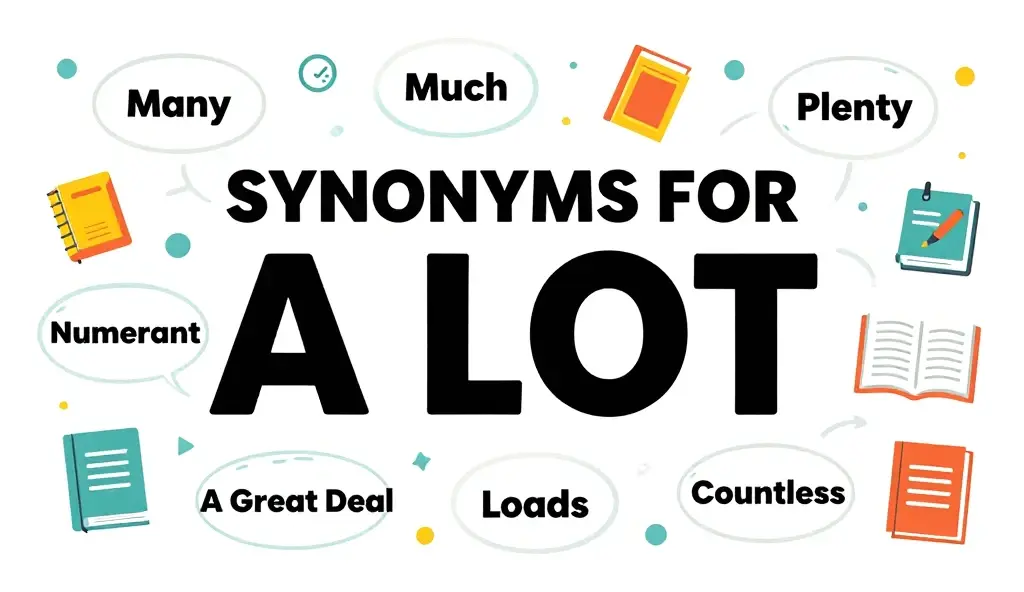
That’s why writers, students, and speakers reach for synonyms.
A synonym is a word or phrase that carries a similar meaning but with more precision or a different tone.
People search for “synonyms for a lot” for a few reasons.
Students want a more formal word for essays, since “a lot” is often flagged as too casual for academic writing.
Writers want variety, so their sentences don’t feel repetitive.
And everyday speakers just want a fresher way to express quantity.
You should reach for a synonym when “a lot” feels too plain or too informal.
If you’re writing a report, swap it for “numerous” or “a significant amount.” If you’re describing an emotional feeling, try “immensely” or “deeply.” If you’re just chatting with a friend, “tons” or “loads” might fit better.
Meaning
Definition: “A lot” means a large quantity, number, or amount of something. It can also mean “very much” or “to a great extent” when used to modify a verb.
Context: The meaning shifts slightly depending on what it’s describing. “A lot of books” refers to number (countable). “A lot of water” refers to amount (uncountable). “I miss you a lot” refers to intensity.
Common usage: People use “a lot” constantly in casual speech and informal writing to describe quantities of things, amounts of time, money, effort, or emotional intensity.
Pronunciation
“A lot” is pronounced /ə ˈlɑt/ — “uh-LOT,” with the stress on “lot.” Note: it is always written as two words. “Alot” is a common misspelling and is not considered correct English.
Part of Speech
“A lot” functions as a quantifier phrase, used like an adverb or a noun phrase depending on the sentence.
As a noun phrase describing quantity:
- Example: There are a lot of apples in the basket.
As an adverb phrase describing intensity:
- Example: He worries a lot about his exams.
It is informal in tone, which is why formal writing often replaces it with words like “numerous,” “considerably,” or “significantly.”
Synonyms for A Lot
| Word/Phrase | Meaning | Usage | Formality | Example | Difficulty Level |
| Many | A large number (countable) | General | Neutral | “Many students missed the bus.” | Easy |
| Much | A large amount (uncountable) | General | Neutral | “There isn’t much time left.” | Easy |
| Plenty | More than enough | General | Neutral | “We have plenty of food.” | Easy |
| Numerous | A large number, formal | Formal writing | Formal | “There were numerous complaints.” | Medium |
| Abundant | Existing in large quantity | Formal/descriptive | Formal | “The region has abundant wildlife.” | Medium |
| A great deal | A large amount | Formal | Formal | “She spent a great deal of time researching.” | Medium |
| A ton | A huge amount (informal) | Casual | Casual | “I have a ton of emails to answer.” | Easy |
| Countless | Too many to count | Descriptive | Neutral | “He’s given countless hours to charity.” | Medium |
| Ample | Sufficient, more than enough | Formal | Formal | “There’s ample parking near the venue.” | Medium |
| A wealth of | A large, valuable amount | Formal | Formal | “The book offers a wealth of information.” | Hard |
| Loads | A lot (informal) | Casual/British English | Casual | “There are loads of options here.” | Easy |
| Tons | A huge amount (informal) | Casual | Casual | “We got tons of feedback.” | Easy |
| Heaps | A large amount (informal) | Casual/British English | Casual | “She has heaps of experience.” | Medium |
| Considerable | Fairly large in amount | Formal | Formal | “It required considerable effort.” | Medium |
| Substantial | Large in size or amount | Formal | Formal | “They made a substantial donation.” | Medium |
| A multitude of | A large number | Formal/literary | Formal | “There are a multitude of reasons.” | Hard |
| Extensive | Large in scope or amount | Formal | Formal | “The report covers extensive research.” | Medium |
| Copious | Abundant, plentiful | Formal/literary | Formal | “She took copious notes.” | Hard |
| A large amount | A big quantity | Neutral | Neutral | “He spends a large amount of time reading.” | Easy |
| A significant number | A notable quantity | Formal | Formal | “A significant number of users complained.” | Medium |
| Sizable | Fairly large | Neutral | Neutral | “They have a sizable collection of books.” | Medium |
| Immensely | Extremely (intensity) | Formal/descriptive | Formal | “I enjoyed the trip immensely.” | Medium |
| Greatly | To a large degree | Formal | Formal | “The project greatly improved efficiency.” | Easy |
| Deeply | Intensely (emotional use) | Formal/emotional | Formal | “She cares deeply about the cause.” | Easy |
| Extremely | To a very high degree | General | Neutral | “It was extremely helpful.” | Easy |
| Quite a bit | A moderate to large amount | Casual | Casual | “We’ve made quite a bit of progress.” | Easy |
| A fair amount | A reasonably large amount | Neutral | Neutral | “There’s a fair amount of confusion.” | Easy |
| Bunches | A lot (informal, US regional) | Casual | Casual | “Thanks bunches for your help.” | Easy |
| Oodles | A great amount (informal) | Casual, playful | Casual | “They have oodles of charm.” | Medium |
| Scores of | A large number | Formal/literary | Formal | “Scores of fans lined up early.” | Hard |
Best Synonyms Explained
Many
Meaning: A large number of countable items. Difference from “a lot”: Only works with countable nouns (many books, not many water). Example: “Many employees requested remote work.” Best situation: Formal or neutral writing describing quantities of items or people. Common mistake: Using it with uncountable nouns — say “much water,” not “many water.”
Much
Meaning: A large amount of an uncountable thing. Difference from “a lot”: Only works with uncountable nouns and mostly in questions or negatives in casual speech. Example: “There isn’t much information available yet.” Best situation: Formal writing or negative/question sentences. Common mistake: Using “much” in positive statements sounds slightly formal or old-fashioned in casual speech — “I have much money” sounds stiff; “I have a lot of money” is more natural.
Numerous
Meaning: Existing in large numbers. Difference from “a lot”: More formal and precise, often used in reports or research. Example: “The study cites numerous sources.” Best situation: Academic writing, business reports, journalism. Common mistake: Using it for uncountable amounts — “numerous water” is incorrect; use “numerous” only with countable nouns.
A great deal
Meaning: A large quantity or amount, often used for effort, time, or money. Difference from “a lot”: Sounds more formal and deliberate. Example: “They invested a great deal of money into research.” Best situation: Formal writing, business or academic contexts. Common mistake: Overusing it in casual speech, where it can sound stiff.
Countless
Meaning: Too many to count. Difference from “a lot”: Emphasizes an extremely large, almost limitless quantity. Example: “She’s answered countless questions from students.” Best situation: Descriptive or emotional writing that wants to emphasize scale. Common mistake: Using it for small or modest quantities — it should signal a genuinely huge number.
Ample
Meaning: Enough or more than enough. Difference from “a lot”: Focuses on sufficiency, not just size. Example: “There was ample time to finish the exam.” Best situation: Formal writing describing resources, time, or space. Common mistake: Using it to mean “excessive” — “ample” implies just enough or comfortably enough, not overwhelming amounts.
Antonyms for A Lot
| Word/Phrase | Meaning | Example |
| A little | A small amount | “I only have a little time.” |
| Few | A small number | “Few people showed up.” |
| Scarce | Insufficient, rare | “Resources were scarce.” |
| Hardly any | Almost none | “There’s hardly any food left.” |
| Minimal | The smallest possible amount | “We made minimal progress.” |
| Sparse | Thinly spread, not abundant | “The forest had sparse vegetation.” |
| Not much | A small amount (informal) | “There’s not much left to do.” |
| Insufficient | Not enough | “The funding was insufficient.” |
| Limited | Restricted in amount | “We have limited resources.” |
| A handful | A small number | “Only a handful of guests arrived.” |
Examples of Synonyms in Real Sentences
- Many students struggled with the final exam.
- There isn’t much time before the deadline.
- We have plenty of supplies for the trip.
- The city received numerous complaints about traffic.
- The region is known for its abundant rainfall.
- She put a great deal of thought into her decision.
- I have a ton of laundry to do this weekend.
- He’s faced countless challenges in his career.
- There was ample space in the new office.
- The museum offers a wealth of historical artifacts.
- There are loads of great restaurants nearby.
- We got tons of positive reviews last month.
- She has heaps of patience with young children.
- It took considerable effort to finish the project.
- They made a substantial improvement to the app.
- There are a multitude of reasons for the delay.
- The article includes extensive research on the topic.
- He took copious notes during the lecture.
- She spends a large amount of time volunteering.
- A significant number of employees work remotely.
- They own a sizable property in the countryside.
- I immensely enjoyed the concert last night.
- The new policy greatly improved productivity.
- He cares deeply about environmental issues.
- The staff was extremely helpful during our stay.
- We’ve made quite a bit of progress this week.
- There’s a fair amount of confusion about the new rules.
- Thanks bunches for helping me move.
- The town has oodles of charm and history.
- Scores of volunteers showed up for the cleanup.
25 Naturally Written Sentences
- I’ve read many books on this subject over the years.
- There isn’t much left in the fridge, we should go shopping.
- Don’t worry, we have plenty of time before the flight.
- The company received numerous applications for the position.
- Their garden is full of abundant, colorful flowers.
- It took a great deal of patience to train the puppy.
- She has a ton of experience in customer service.
- I’ve made countless mistakes, but I’ve learned from every one.
- There’s ample opportunity for growth in this role.
- The seminar offered a wealth of practical advice.
- There are loads of things to do this weekend.
- We received tons of messages after the announcement.
- He has heaps of confidence going into the interview.
- Renovating the kitchen required considerable planning.
- The charity made a substantial impact this year.
- A multitude of factors influenced the final decision.
- Her thesis includes extensive interviews with local experts.
- The professor gave copious feedback on every essay.
- He spent a large amount of money on the renovation.
- A significant number of customers switched to the new app.
- Their new headquarters is a sizable, modern building.
- I immensely appreciate everything you’ve done for us.
- The update greatly improved the app’s speed.
- She deeply respects her mentor’s guidance.
- The trip was extremely rewarding for the whole family.
Formal vs. Informal Usage
| Situation | Formal Word/Phrase | Informal Word/Phrase |
| Describing quantity | Numerous, Considerable | A lot, Tons |
| Describing amount of time/money | A great deal, Substantial | A ton, Loads |
| Describing emotional intensity | Immensely, Deeply | A lot, So much |
| Academic or research writing | A significant number, Extensive | A bunch, Tons |
| Everyday conversation | Plenty, Ample | Loads, Heaps |
In formal writing — reports, essays, professional emails — use words like “numerous,” “considerable,” or “a significant number.” In casual conversation, phrases like “tons,” “loads,” or “heaps” feel more natural and relaxed.
Academic Usage
In academic writing, “a lot” is generally considered too casual and vague.
- Weak: “There were a lot of participants in the study.”
- Strong: “The study included a substantial number of participants.”
Other academic-friendly synonyms include: considerable, extensive, numerous, a significant proportion, and a substantial amount.
Daily Conversation
In everyday talk, people naturally reach for informal, expressive alternatives.
- “How much homework do you have?” — “Tons, honestly.”
- “Did many people show up to the party?” — “Yeah, loads!”
- “Do you like the new show?” — “I love it a lot — like, an unhealthy amount.”
These casual synonyms keep conversation lively without sounding stiff or overly formal.
Grammar Tips
- Use “many” with countable nouns (many friends, many cars) and “much” with uncountable nouns (much money, much water).
- “A lot of” works with both countable and uncountable nouns, which is part of why it’s so commonly used: “a lot of friends,” “a lot of water.”
- When “a lot” modifies a verb (intensity, not quantity), it comes at the end of the sentence: “I miss you a lot,” not “I a lot miss you.”
- Never write “alot” as one word — it is always two separate words: “a lot.”
Collocations
Common word pairings using “a lot” and its synonyms:
- A lot of time / Plenty of time / Ample time
- A lot of money / A great deal of money / Considerable money
- A lot of people / Numerous people / Countless people
- A lot of effort / Substantial effort / A great deal of effort
- A lot of information / A wealth of information / Extensive information
- A lot of fun / Tons of fun / Loads of fun
These pairings sound natural and are used often in both writing and everyday speech.
Common Phrases
- “Thanks a lot” — a casual way to say thank you (can also be sarcastic depending on tone).
- “A lot going on” — describing a busy or stressful period.
- “Not a lot to it” — meaning something is simple.
- “A lot to take in” — describing overwhelming information.
- “Quite a lot” — emphasizing a large amount.
Idioms
- “A dime a dozen” — something so common it has little value, the opposite of scarce. Example: “Coffee shops like this are a dime a dozen downtown.”
- “More than you can shake a stick at” — an old-fashioned way of saying “a lot.” Example: “There were more books than you could shake a stick at.”
- “Bags of” — informal British phrase meaning “a lot of.” Example: “She’s got bags of talent.”
Similar Words Comparison
| Word/Phrase | Meaning | Difference | Example |
| A lot | A large quantity or amount | Casual, general | “I have a lot of work.” |
| Many | A large number (countable) | More formal, countable only | “I have many tasks.” |
| Much | A large amount (uncountable) | More formal, uncountable only | “I have much work.” |
| Plenty | More than enough | Slightly positive connotation | “I have plenty of work.” |
| Numerous | A large number, formal | Used in writing, not speech | “I have numerous tasks.” |
FAQs
Q1. What is the best synonym for “a lot”?
A: “Numerous” and “considerable” are strong general synonyms for formal writing, while “plenty” and “tons” work well in everyday conversation. The best choice depends on whether you’re writing formally or speaking casually.
Q2. Is “many” the same as “a lot”?
A: Not exactly. “Many” only works with countable nouns, like “many books,” while “a lot of” works with both countable and uncountable nouns, like “a lot of water” or “a lot of books.”
Q3. What’s a formal synonym for “a lot”?
A: Formal alternatives include “numerous,” “considerable,” “a great deal,” “substantial,” and “a significant amount.” These fit essays, reports, and professional writing far better than casual phrases.
Q4. What’s a casual synonym for “a lot”?
A: Casual options include “tons,” “loads,” “heaps,” and “oodles.” These work well in conversation and texting but sound too informal for academic or business writing.
Q5. What is the opposite of “a lot”?
A: Common antonyms include “a little,” “few,” “scarce,” and “minimal.” Each expresses a small amount, with “scarce” specifically implying that something is hard to find or insufficient.
Q6. Is it “a lot” or “alot”?
A: It is always “a lot,” written as two separate words. “Alot” is a common misspelling and is not considered correct in standard English.
Q7. What word can replace “a lot” in an essay?
A: In essays, try “numerous,” “considerable,” “a substantial amount,” or “extensive,” depending on context. These words sound more precise and academic than the casual phrase “a lot.”
Q8. What’s a synonym for “a lot” that means an extremely large amount?
A: Words like “countless,” “a multitude of,” and “copious” all describe an especially large or seemingly limitless quantity. Choose based on tone—”copious” tends to sound more literary.
Q9. What’s a synonym for “a lot” when talking about time?
A: Try “a great deal of time,” “ample time,” or “considerable time.” These phrases specifically emphasize duration rather than a general quantity.
Q10. What’s another way to say “I like it a lot”?
A: Try “I like it immensely,” “I like it a great deal,” or “I really, really like it.” Each phrase intensifies the feeling while sounding slightly different in tone.
Q11. Can “plenty” mean the same as “a lot”?
A: Yes, but “plenty” often carries a positive connotation of having enough or more than enough. “We have plenty of food” suggests comfort, while “we have a lot of food” is more neutral.
Q12. What’s a synonym for “a lot” in business writing?
A: In business contexts, use words like “substantial,” “considerable,” “a significant number,” or “extensive.” These terms sound professional and are common in reports and proposals.
Q13. Why should I avoid repeating “a lot” in writing?
A: Repeating “a lot” makes writing sound casual and repetitive. Using varied synonyms adds precision, tells the reader more about scale, and shows stronger vocabulary control.
Q14. What’s a fun, casual way to say “a lot”?
A: Casual alternatives like “tons,” “loads,” “heaps,” and “bunches” keep everyday conversation lively and expressive, especially when reacting to something surprising or exciting.
Expert Tips
- Match the synonym to whether you’re describing something countable (“many,” “numerous”) or uncountable (“much,” “a great deal”). Mixing these up is one of the most common grammar mistakes.
- In formal writing, replace “a lot” almost every time — it’s one of the fastest ways to make an essay or report sound more polished.
- Save intense words like “countless” or “copious” for situations that truly justify them. Overusing dramatic synonyms weakens their impact.
- In casual writing or speech, don’t be afraid to keep “a lot” — it’s natural and widely accepted. Save the formal alternatives for professional contexts.
Conclusion:
“A lot” is easy and flexible, but it’s also vague and casual.
Swapping it for the right synonym “numerous” in a report, “a great deal” in a formal email, or “tons” in a text to a friend makes your language sound sharper and more intentional.
Keep this list handy, and next time you reach for “a lot,” pick a word that says exactly how much you mean.

Charlotte Evans is a language researcher and vocabulary writer from New York, USA. She specializes in English synonyms, word usage, and educational content that helps readers improve their communication skills.